 Verbamor
Portuguese phrases for travel
- 156 phrases
- 156 real examples
- 13 topics
- 1 free PDF
The Portuguese phrases a traveller uses most are oi (hi), por favor (please), obrigado or obrigada (thank you), com licença (excuse me), quanto custa? (how much is it?) and a conta, por favor (the bill, please). Below are 155 travel phrases in Brazilian Portuguese, with the Portugal version tagged Regional wherever it differs.
Your Portuguese for travel guide is ready
Save it to your phone so it's there when you need it.
Greetings and basics 16
Brazilians are warm and chatty. A smile and an oi, tudo bem? open most doors.
| # | Phrase | Meaning | Example | When to use |
|---|---|---|---|---|
| 1 | Oi! | Hi! | Oi! Tudo bem? Hi! How are you? | Everyday The hello you'll hear most in Brazil. Olá is a little more formal. |
| 2 | Olá! | Hello! | Olá, bom dia! Em que posso ajudar? Hello, good morning! How can I help? | Regional In Portugal olá is the everyday hello. Oi sounds Brazilian there. |
| 3 | Bom dia / Boa tarde / Boa noite | Good morning / afternoon / evening | Boa tarde, moço! Tudo bom? Good afternoon! All good? | Everyday Boa noite is both good evening and good night. Same in Brazil and Portugal. |
| 4 | Tudo bem? | How are you? / All good? | Oi, tudo bem? Tudo, e você? Hi, all good? All good, and you? | Everyday Answer tudo or tudo bem, e você? It's a hello, not a real question. |
| 5 | Obrigado / Obrigada | Thank you | Obrigada pela ajuda! Thanks for the help! | Everyday Men say obrigado, women obrigada, whoever they're thanking. |
| 6 | Valeu! | Thanks! | Valeu, cara! Thanks, man! | Casual The casual thanks in Brazil. Also means bye. Not used in Portugal. |
| 7 | De nada | You're welcome | Obrigado! De nada! Thanks! You're welcome! | Everyday Imagina is a warm Brazilian version. |
| 8 | Por favor | Please | Uma água, por favor. A water, please. | Everyday Por gentileza is more formal. |
| 9 | Com licença | Excuse me (to pass or get attention) | Com licença, posso passar? Excuse me, can I get by? | Everyday To get past someone or catch a waiter's eye. |
| 10 | Desculpa / Desculpe | Sorry | Desculpa, foi sem querer! Sorry, I didn't mean to! | Everyday Desculpe is more polite, for strangers. |
| 11 | Tchau! / Até logo! | Bye! / See you! | Tchau, até amanhã! Bye, see you tomorrow! | Everyday Tchau is the everyday bye. In Portugal adeus is common too. |
| 12 | Prazer! | Nice to meet you! | Prazer, eu sou o Tom. Nice to meet you, I'm Tom. | Everyday Short for muito prazer. Brazilians often kiss once or twice on the cheek. |
| 13 | Sim / Não | Yes / No | Sim, por favor. Não, obrigado. Yes, please. No, thanks. | Everyday Brazilians often answer by repeating the verb: Tem? Tem. |
| 14 | Tá bom / Beleza | OK / Cool | Às oito? Beleza! At eight? Cool! | Casual Tá bom is the plain OK. Beleza is very Brazilian. |
| 15 | Está bem / Pode ser | OK / Fine | Às oito? Está bem. At eight? Fine. | Regional Portugal says está bem or ok. Tá bom sounds Brazilian there. |
| 16 | Você / O senhor / A senhora | you (casual / to a man / to a woman) | O senhor sabe onde fica o metrô? Do you know where the metro is, sir? | Everyday Use o senhor or a senhora with older people. Você with everyone else in Brazil. |
Getting understood 7
| # | Phrase | Meaning | Example | When to use |
|---|---|---|---|---|
| 17 | Você fala inglês? | Do you speak English? | Desculpa, você fala inglês? Sorry, do you speak English? | Everyday Try Portuguese first. Spanish is not a safe swap; answer in Portuguese if you can. |
| 18 | Fala inglês? | Do you speak English? (Portugal) | Desculpe, fala inglês? Sorry, do you speak English? | Regional In Portugal people drop você and just use the verb. English is widely spoken in Lisbon and Porto. |
| 19 | Não falo português bem. | I don't speak Portuguese well. | Desculpa, não falo português bem. Sorry, I don't speak Portuguese well. | Everyday People slow down and help. |
| 20 | Não entendi. | I didn't understand. | Desculpa, não entendi. Sorry, I didn't understand. | Everyday Portugal says não percebi. |
| 21 | Pode repetir, por favor? | Can you repeat, please? | Pode repetir mais devagar, por favor? Can you repeat more slowly, please? | Everyday Mais devagar means more slowly. |
| 22 | Como se diz...? | How do you say...? | Como se diz receipt em português? How do you say receipt in Portuguese? | Everyday Works in both countries. |
| 23 | O que significa...? | What does...mean? | O que significa couvert? What does couvert mean? | Everyday Point at the word. |
What they'll ask you 14
The questions you'll hear at the counter, the till and the door. Most need one word back.
| # | Phrase | Meaning | Example | When to use |
|---|---|---|---|---|
| 24 | Posso ajudar? | Can I help? | Oi, posso ajudar? Hi, can I help? | Everyday Answer Só estou olhando, obrigado (just looking). |
| 25 | Pois não? | Yes? How can I help? | Pois não, senhor? Yes, sir, how can I help? | Everyday Confusing but common in Brazil: it means yes, go ahead. |
| 26 | Diga! | Tell me! / Go ahead! | Bom dia, diga! Good morning, what can I get you? | Regional How staff take your order in Portugal. |
| 27 | Crédito ou débito? | Credit or debit? | Crédito ou débito? Aproxima o cartão. Credit or debit? Tap your card. | Everyday Asked at every card payment in Brazil, even for foreign cards. |
| 28 | Vai parcelar? | Do you want to pay in instalments? | No crédito, vai parcelar? On credit, do you want to pay in instalments? | Everyday Brazilians split purchases into parcelas. Say à vista (all at once). |
| 29 | CPF na nota? | Your CPF on the receipt? | CPF na nota? Do you want your CPF on the receipt? | Everyday The CPF is a Brazilian tax number. Tourists just say não, obrigado. |
| 30 | Quer contribuinte? | Do you want your tax number on the receipt? | Quer fatura com contribuinte? Do you want an invoice with your tax number? | Regional The Portugal version of the same question. Say não, obrigado. |
| 31 | Quer sacola? | Do you want a bag? | Quer sacola? É paga. Do you want a bag? It costs extra. | Everyday Portugal says saco. |
| 32 | É pra viagem? | Is it to take away? | É pra comer aqui ou pra viagem? Is it to eat here or take away? | Everyday Portugal says para levar. |
| 33 | Mesa pra quantos? | Table for how many? | Boa noite, mesa pra quantos? Good evening, table for how many? | Everyday Answer pra dois (for two). |
| 34 | De onde você é? | Where are you from? | De onde você é? Dos Estados Unidos? Where are you from? The US? | Everyday Answer sou dos Estados Unidos, sou da Inglaterra. |
| 35 | Primeira vez no Brasil? | First time in Brazil? | Primeira vez no Brasil? Tá gostando? First time in Brazil? Enjoying it? | Everyday Answer Sim, tô amando! |
| 36 | Pra que time você torce? | Which football team do you support? | Pra que time você torce? Which team do you support? | Everyday Football is the first topic in any chat. Have an answer. |
| 37 | Passaporte, por favor. | Passport, please. | Passaporte, por favor. Quanto tempo vai ficar? Passport, please. How long are you staying? | Formal At the airport and the hotel. Answer with the number of days: dez dias. |
Key words on signs 10
| # | Phrase | Meaning | Example | When to use |
|---|---|---|---|---|
| 38 | Entrada / Saída | Entrance / Exit | A saída é por ali. The exit is that way. | Everyday Same in both countries. |
| 39 | Aberto / Fechado | Open / Closed | A loja tá fechada hoje. The shop is closed today. | Everyday Shops in small towns may close on Sunday. |
| 40 | Empurre / Puxe | Push / Pull | É pra empurrar, não puxar. It's push, not pull. | Everyday Portugal often writes empurrar and puxar. |
| 41 | Banheiro | Toilet | Onde fica o banheiro? Where's the toilet? | Everyday Brazil only. Masculino and feminino mark men and women. |
| 42 | Casa de banho | Toilet | Onde é a casa de banho? Where's the toilet? | Regional The Portugal word. In Portugal banheiro can mean a beach lifeguard. |
| 43 | Proibido... | ...is not allowed | Proibido fumar. No smoking. | Everyday Proibida a entrada: no entry. |
| 44 | Cuidado | Caution | Cuidado, piso molhado. Caution, wet floor. | Everyday Also on beaches for strong currents. |
| 45 | Caixa | Till / Checkout | Pague no caixa. Pay at the till. | Everyday In Portugal it's a caixa too. |
| 46 | Fila | Queue | A fila é aqui? Is this the queue? | Everyday Brazil has priority queues (preferencial) for older people and pregnant women. Don't stand in them. |
| 47 | Fora de serviço / Com defeito | Out of order | O elevador tá com defeito. The lift is out of order. | Everyday Avariado in Portugal. |
Airport, taxis and Uber 14
| # | Phrase | Meaning | Example | When to use |
|---|---|---|---|---|
| 48 | Onde pego um táxi? | Where do I get a taxi? | Com licença, onde pego um táxi? Excuse me, where do I get a taxi? | Everyday Airports have official taxi desks and app pickup points. |
| 49 | Vou chamar um Uber. | I'll call an Uber. | Vou chamar um Uber pro hotel. I'll get an Uber to the hotel. | Everyday Ride apps are widely used in Brazilian cities. 99 is the other big app. |
| 50 | a corrida | the ride | A corrida até o centro deu quanto? How much was the ride to the centre? | Everyday The word in ride apps for a trip. |
| 51 | Você é o motorista do Uber? | Are you the Uber driver? | Oi, você é o Carlos? Do Uber? Hi, are you Carlos? From Uber? | Everyday Check the plate (placa) and the name before you get in. |
| 52 | Qual é a placa? | What's the number plate? | Qual é a placa do carro? What's the car's number plate? | Everyday Match it with the app. Portugal says matrícula. |
| 53 | Pro aeroporto, por favor. | To the airport, please. | Pro aeroporto, por favor. To the airport, please. | Casual Pro is short for para o. Pra is para a. |
| 54 | Pode parar aqui? | Can you stop here? | Pode parar aqui, por favor? Can you stop here, please? | Everyday Aqui mesmo: right here. |
| 55 | Pode ligar o taxímetro? | Can you turn the meter on? | Moço, pode ligar o taxímetro? Could you turn the meter on, please? | Everyday Ask if a street taxi doesn't start the meter. |
| 56 | Quanto fica? | How much is it? | Até Copacabana, quanto fica? How much to Copacabana? | Everyday Ask before a taxi with no meter. |
| 57 | Pode abrir o porta-malas? | Can you open the boot? | Pode abrir o porta-malas pra mala? Can you open the boot for the suitcase? | Everyday Portugal says a mala do carro or o porta-bagagens. |
| 58 | a mala | the suitcase | Minha mala não chegou. My suitcase didn't arrive. | Everyday Bagagem is luggage. |
| 59 | o voo | the flight | Meu voo tá atrasado. My flight is late. | Everyday Atrasado is late, cancelado is cancelled. |
| 60 | o portão de embarque | boarding gate | Qual é o portão de embarque? What's the boarding gate? | Everyday Embarque is departures, desembarque is arrivals. |
| 61 | a esteira | baggage belt | As malas saem na esteira 3. The bags come out on belt 3. | Everyday The carousel at arrivals. |
Buses, metro and trains 10
| # | Phrase | Meaning | Example | When to use |
|---|---|---|---|---|
| 62 | o ônibus | the bus | Esse ônibus vai pra Ipanema? Does this bus go to Ipanema? | Everyday Brazil only. Signal with your arm to stop a bus. |
| 63 | o autocarro | the bus | Qual autocarro vai para Belém? Which bus goes to Belém? | Regional The Portugal word. Ônibus is Brazilian. |
| 64 | o ponto de ônibus | bus stop | Onde fica o ponto de ônibus? Where's the bus stop? | Everyday Portugal says a paragem. |
| 65 | o metrô | the metro | Vamos de metrô, é mais rápido. Let's take the metro, it's faster. | Everyday Portugal writes metro, no accent. |
| 66 | o trem | the train | O trem pra Campinas sai de onde? Where does the train to Campinas leave from? | Everyday Long-distance trains are rare in Brazil. Buses go almost everywhere. |
| 67 | o comboio | the train | O comboio para Sintra sai do Rossio. The Sintra train leaves from Rossio. | Regional The Portugal word. Trem sounds Brazilian there. |
| 68 | o elétrico | the tram | Apanhamos o elétrico 28. We'll catch tram 28. | Regional Lisbon's trams. Apanhar is to catch in Portugal; Brazil says pegar. |
| 69 | a rodoviária | bus station | A rodoviária fica longe do centro? Is the bus station far from the centre? | Everyday Long-distance buses leave from here. |
| 70 | Desce aqui? | Do I get off here? | Pra praia, desce aqui? For the beach, do I get off here? | Casual Descer is to get off. Subir is to get on. |
| 71 | a passagem | the ticket / fare | Quanto é a passagem? How much is the fare? | Everyday Portugal says o bilhete. |
Hotel and Airbnb 12
| # | Phrase | Meaning | Example | When to use |
|---|---|---|---|---|
| 72 | Tenho uma reserva. | I have a booking. | Boa noite, tenho uma reserva no nome de Smith. Good evening, I have a booking under Smith. | Everyday No nome de: under the name. |
| 73 | o café da manhã | breakfast | O café da manhã tá incluído? Is breakfast included? | Everyday Brazilian hotel breakfasts are big: fruit, cheese, cake, juice. |
| 74 | o pequeno-almoço | breakfast | O pequeno-almoço está incluído? Is breakfast included? | Regional The Portugal word. |
| 75 | A que horas é o check-out? | What time is check-out? | A que horas é o check-out? What time is check-out? | Everyday Both countries use the English words. |
| 76 | Qual é a senha do wifi? | What's the wifi password? | Qual é a senha do wifi? What's the wifi password? | Everyday Portugal says palavra-passe or just password. |
| 77 | Não tá funcionando... | ...isn't working | O ar-condicionado não tá funcionando. The air conditioning isn't working. | Everyday Portugal: não está a funcionar. |
| 78 | a toalha | towel | Pode trazer mais toalhas? Can you bring more towels? | Everyday Toalha de praia is a beach towel. |
| 79 | o chuveiro | the shower | O chuveiro não esquenta. The shower won't heat up. | Everyday Many Brazilian showers heat with an electric head. Portugal says o duche. |
| 80 | Posso deixar a mala? | Can I leave my bag? | Posso deixar a mala aqui até as três? Can I leave my bag here until three? | Everyday Most hotels will hold it. |
| 81 | o porteiro | doorman | Deixa a chave com o porteiro. Leave the key with the doorman. | Everyday Many Brazilian apartment buildings have one. Airbnb hosts often use them. |
| 82 | Qual é o código? | What's the code? | Qual é o código da portaria? What's the code for the front door? | Everyday Ask your host for door codes before you arrive. |
| 83 | Tem ventilador? | Is there a fan? | O quarto tem ventilador ou ar? Does the room have a fan or air con? | Everyday Ar is short for ar-condicionado. |
Food and drink 22
Lunch is the big meal in Brazil. Try a comida a quilo place: you pay for your plate by weight.
| # | Phrase | Meaning | Example | When to use |
|---|---|---|---|---|
| 84 | Uma mesa pra dois, por favor. | A table for two, please. | Boa noite, uma mesa pra dois, por favor. Good evening, a table for two, please. | Everyday Para dois in Portugal. |
| 85 | O cardápio, por favor. | The menu, please. | Moço, o cardápio, por favor. Excuse me, the menu, please. | Everyday Brazil says cardápio. Moço is a friendly way to call a young waiter. |
| 86 | A ementa, por favor. | The menu, please. | Pode trazer a ementa, por favor? Could you bring the menu, please? | Regional Portugal says ementa or carta. Cardápio is understood but Brazilian. |
| 87 | Eu quero... | I want... | Eu quero o frango grelhado. I want the grilled chicken. | Everyday Normal and polite in Brazil. Vou querer is softer. |
| 88 | Queria... | I'd like... | Queria uma bica e um pastel de nata. I'd like an espresso and a custard tart. | Regional The polite way to order in Portugal. |
| 89 | O que você recomenda? | What do you recommend? | O que você recomenda hoje? What do you recommend today? | Everyday Waiters like this question. |
| 90 | o prato feito (PF) | set plate | Um PF de frango, por favor. A chicken set plate, please. | Everyday Rice, beans, meat, salad and fries on one plate. Cheap and filling. |
| 91 | a comida a quilo | pay-by-weight buffet | Vamos num a quilo perto da praia? Shall we go to a by-weight buffet near the beach? | Everyday Fill your plate, weigh it at the till, pay for the weight. |
| 92 | o rodízio | all-you-can-eat service | Hoje é rodízio de pizza. Today it's all-you-can-eat pizza. | Everyday At a churrascaria, waiters bring meat to your table until you stop them. |
| 93 | o prato do dia | dish of the day | Qual é o prato do dia? What's the dish of the day? | Regional The best value lunch in Portugal. |
| 94 | o couvert | starter nibbles | O couvert é pago? Do we pay for the starter nibbles? | Everyday Bread, olives or butter brought to the table. In Portugal you pay for what you eat; send it back if you don't want it. |
| 95 | Sem carne, por favor. | No meat, please. | Sou vegetariano, tem algo sem carne? I'm vegetarian, is there something without meat? | Everyday Ask about beans: feijão often has pork. |
| 96 | Sou alérgico a... | I'm allergic to... | Sou alérgica a camarão. I'm allergic to shrimp. | Everyday Women say alérgica. |
| 97 | o suco | juice | Um suco de maracujá sem açúcar. A passion fruit juice with no sugar. | Everyday Fresh juices come sweetened unless you say sem açúcar. Portugal says sumo. |
| 98 | o cafezinho | small black coffee | Aceita um cafezinho? Would you like a coffee? | Everyday Small, strong and often sweet. Offered everywhere as a welcome. |
| 99 | a bica | an espresso | Uma bica, por favor. An espresso, please. | Regional Lisbon's word for an espresso. In Porto people say um cimbalino. |
| 100 | uma cerveja / um chope | a beer / a draught beer | Um chope bem gelado, por favor. A really cold draught beer, please. | Everyday Brazilians like beer very cold. Portugal says uma imperial (Lisbon) or um fino (Porto). |
| 101 | uma água com gás / sem gás | sparkling / still water | Uma água sem gás, por favor. A still water, please. | Everyday Same in both countries. |
| 102 | a padaria | bakery | Vou na padaria comprar pão de queijo. I'm going to the bakery for cheese bread. | Everyday Brazilian padarias serve coffee, snacks and lunch too. |
| 103 | a pastelaria | pastry shop and café | Vamos à pastelaria tomar o pequeno-almoço. Let's go to the café for breakfast. | Regional In Portugal, the place for coffee and pastries. In Brazil a pastelaria sells pastel (fried pastry). |
| 104 | A conta, por favor. | The bill, please. | Moço, a conta, por favor! Excuse me, the bill, please! | Everyday Or make a writing sign in the air. Same phrase in Portugal. |
| 105 | O serviço tá incluído? | Is service included? | O serviço tá incluído na conta? Is service included in the bill? | Everyday Many Brazilian restaurants add an optional service charge. Check the bill before tipping. |
At the beach 10
| # | Phrase | Meaning | Example | When to use |
|---|---|---|---|---|
| 106 | a praia | the beach | Vamos pra praia amanhã cedo? Shall we go to the beach early tomorrow? | Everyday Brazilian beaches are busy and social. Locals go early or late to avoid the strongest sun. |
| 107 | a barraca | beach stall | Vamos sentar na barraca do Seu Zé. Let's sit at Mr Zé's beach stall. | Everyday Stalls rent chairs and umbrellas and bring you drinks. |
| 108 | Quanto é a cadeira? | How much is the chair? | Quanto é a cadeira e o guarda-sol? How much are the chair and umbrella? | Everyday Ask before you sit. Often free if you buy drinks. |
| 109 | o guarda-sol | beach umbrella | Pode abrir o guarda-sol? Can you put up the umbrella? | Everyday Portugal says o chapéu de sol. |
| 110 | a canga | sarong | Vou estender a canga aqui. I'll lay my sarong out here. | Everyday Brazilians sit on a canga, not a towel. |
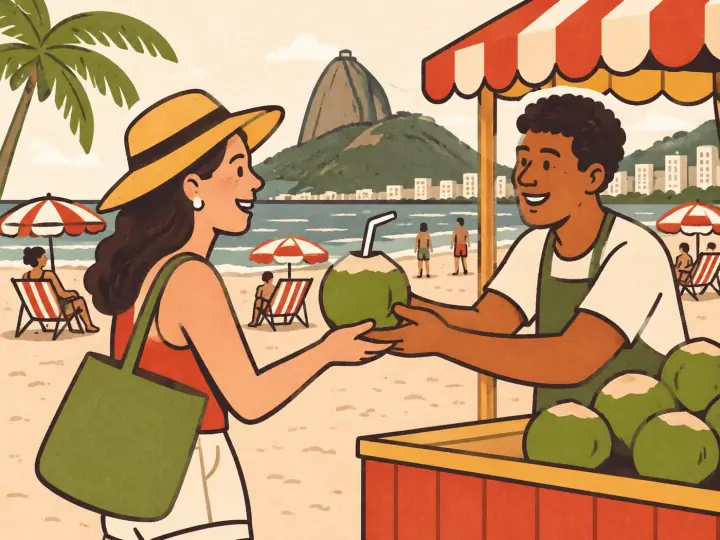
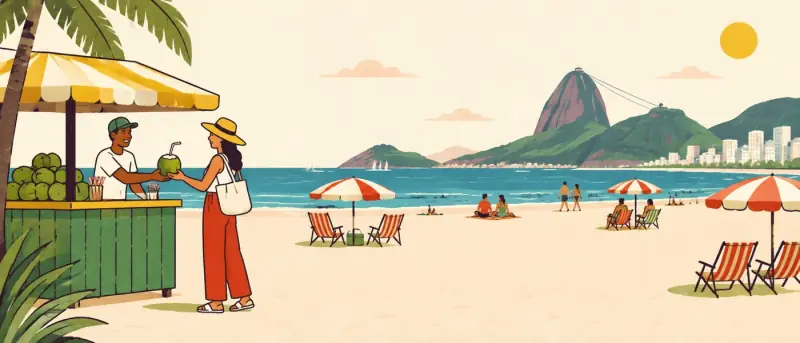
| 111 | a água de coco | coconut water | Uma água de coco bem gelada! A really cold coconut water! | Everyday Sold straight from the coconut with a straw. |
| 112 | o protetor solar | sunscreen | Esqueci o protetor solar. I forgot the sunscreen. | Everyday The sun is strong. Portugal says protetor solar too. |
| 113 | O mar tá forte? | Is the sea rough? | O mar tá forte hoje? Is the sea rough today? | Everyday Look for red flags (bandeira vermelha) and lifeguards (salva-vidas). |
| 114 | Cuida das minhas coisas? | Can you watch my things? | Cuida das minhas coisas enquanto eu nado? Can you watch my things while I swim? | Casual Ask the stall owner, not a stranger. Bring little to the beach. |
| 115 | o picolé | ice lolly | Um picolé de limão, por favor. A lime ice lolly, please. | Everyday Sold by walking vendors. Portugal says gelado. |
Money, cards and Pix 10
| # | Phrase | Meaning | Example | When to use |
|---|---|---|---|---|
| 116 | o Pix | instant payment | Aceita Pix? Te mando agora. Do you take Pix? I'll send it now. | Everyday Brazil's instant payment system, run by the central bank. Everyone uses it, from shops to street vendors. |
| 117 | a chave Pix | Pix key | Qual é a sua chave Pix? What's your Pix key? | Everyday A phone number, email or random code that receives a Pix. |
| 118 | o QR code | QR code | Pode pagar pelo QR code. You can pay with the QR code. | Everyday Shops show a QR code for Pix. |
| 119 | a maquininha | card machine | Traz a maquininha, por favor. Bring the card machine, please. | Everyday Waiters bring it to the table. |
| 120 | Aceita cartão? | Do you take cards? | Aceita cartão estrangeiro? Do you take foreign cards? | Everyday Most places do. Keep some cash for beach stalls and small towns. |
| 121 | à vista | paid in full / up front | Vou pagar à vista. I'll pay all at once. | Everyday The answer when asked about instalments. Shops sometimes give a discount à vista. |
| 122 | o troco | change | Tem troco pra cinquenta? Do you have change for a fifty? | Everyday Small sellers often lack change. Carry small notes. |
| 123 | o caixa eletrônico | cash machine | Tem caixa eletrônico aqui perto? Is there a cash machine near here? | Everyday Use machines inside banks or malls, by day. |
| 124 | o Multibanco | cash machine | Há um multibanco aqui perto? Is there a cash machine near here? | Regional The Portugal word for cash machine. Brazilians say caixa eletrônico. |
| 125 | Tá caro / Tá barato | It's expensive / It's cheap | Tá caro! Faz um desconto? That's expensive! Can you give me a discount? | Casual Bargaining works at markets and with street sellers, rarely in shops. |
Shops 8
| # | Phrase | Meaning | Example | When to use |
|---|---|---|---|---|
| 126 | Quanto custa? | How much is it? | Quanto custa essa camiseta? How much is this T-shirt? | Everyday Quanto é? is shorter. Same in Portugal. |
| 127 | Só estou olhando. | I'm just looking. | Obrigada, só estou olhando. Thanks, I'm just looking. | Everyday Portugal: só estou a ver. |
| 128 | Posso experimentar? | Can I try it on? | Posso experimentar esse vestido? Can I try on this dress? | Everyday O provador is the fitting room. |
| 129 | Tem um tamanho maior? | Do you have a bigger size? | Tem um tamanho menor? Do you have a smaller size? | Everyday Sizes run P, M, G (small, medium, large) in Brazil. |
| 130 | Vou levar. | I'll take it. | Gostei, vou levar. I like it, I'll take it. | Everyday Portugal: vou levar or fico com este. |
| 131 | a farmácia | pharmacy | Tem uma farmácia aberta agora? Is there a pharmacy open now? | Everyday Big chains in Brazil are often open late. |
| 132 | o mercado | supermarket / market | Vou no mercado comprar água. I'm going to the supermarket for water. | Everyday Brazilians call the supermarket o mercado. A feira is a street market. |
| 133 | a feira | street market | A feira é na quarta de manhã. The street market is Wednesday morning. | Everyday Fresh fruit, pastel and caldo de cana (sugarcane juice). |
Directions 10
| # | Phrase | Meaning | Example | When to use |
|---|---|---|---|---|
| 134 | Onde fica...? | Where is...? | Onde fica a estação de metrô? Where's the metro station? | Everyday Onde é...? also works. |
| 135 | É longe? | Is it far? | É longe pra ir a pé? Is it far to walk? | Everyday A pé: on foot. |
| 136 | É perto. | It's close. | É pertinho, dois quarteirões. It's really close, two blocks. | Everyday Pertinho means very close, but Brazilians stretch it. |
| 137 | à direita / à esquerda | on the right / on the left | Vira à direita na padaria. Turn right at the bakery. | Everyday Virar is to turn. |
| 138 | em frente / reto | straight on | Segue reto até a praia. Go straight on to the beach. | Everyday Portugal says sempre em frente. |
| 139 | o quarteirão | block | Fica a três quarteirões daqui. It's three blocks from here. | Everyday Brazilian cities give directions in blocks. |
| 140 | a esquina | the corner | O hotel fica na esquina. The hotel is on the corner. | Everyday Same in Portugal. |
| 141 | Estou perdido / perdida. | I'm lost. | Desculpa, estou perdida. Onde fica a Avenida Paulista? Sorry, I'm lost. Where's Avenida Paulista? | Everyday Women say perdida. |
| 142 | Pode me mostrar no mapa? | Can you show me on the map? | Pode me mostrar no mapa? Can you show me on the map? | Everyday Portugal puts the pronoun after: pode mostrar-me? |
| 143 | É seguro andar aqui à noite? | Is it safe to walk here at night? | É seguro andar aqui à noite? Is it safe to walk here at night? | Everyday Ask your host or hotel. Locals know which streets to avoid. |
Health and emergencies 13
In Brazil, 190 is the police, 192 is the ambulance (SAMU) and 193 is the fire brigade. In Portugal, call 112.
| # | Phrase | Meaning | Example | When to use |
|---|---|---|---|---|
| 144 | Socorro! | Help! | Socorro! Alguém me ajuda! Help! Someone help me! | Everyday Shout it. Same in Portugal. |
| 145 | Chama a polícia! | Call the police! | Chama a polícia, me roubaram! Call the police, I've been robbed! | Everyday Police in Brazil: 190. |
| 146 | Chama uma ambulância! | Call an ambulance! | Chama uma ambulância, ele desmaiou! Call an ambulance, he fainted! | Everyday SAMU in Brazil: 192. |
| 147 | Liga para o 112! | Call 112! | Liga para o 112, depressa! Call 112, quickly! | Regional The emergency number in Portugal, as across the EU. |
| 148 | Preciso de um médico. | I need a doctor. | Preciso de um médico, tô passando mal. I need a doctor, I feel sick. | Everyday Passar mal is to feel unwell. |
| 149 | o pronto-socorro | emergency room | Onde fica o pronto-socorro? Where's the emergency room? | Everyday Portugal says as urgências. |
| 150 | Dói aqui. | It hurts here. | Dói aqui, na barriga. It hurts here, in my stomach. | Everyday Estou com dor de cabeça: I have a headache. |
| 151 | Me roubaram... | My...was stolen | Me roubaram o celular na praia. My phone was stolen on the beach. | Everyday Portugal: roubaram-me o telemóvel. |
| 152 | o boletim de ocorrência (BO) | police report | Preciso fazer um BO pro seguro. I need a police report for the insurance. | Formal Many Brazilian states let you file one online for theft. |
| 153 | Perdi meu passaporte. | I lost my passport. | Perdi meu passaporte, o que eu faço? I lost my passport, what do I do? | Everyday File a report, then contact your consulate. |
| 154 | o celular | mobile phone | Meu celular tá sem bateria. My phone's out of battery. | Everyday Keep it out of sight on busy streets. |
| 155 | o telemóvel | mobile phone | O meu telemóvel ficou sem bateria. My phone ran out of battery. | Regional The Portugal word. |
| 156 | Estou bem. | I'm OK. | Obrigado, já estou bem. Thanks, I'm OK now. | Everyday Tô bem in casual Brazilian speech. |
Your Portuguese for travel guide is ready
Save it to your phone so it's there when you need it.
Good to know
Brazil and Portugal differ
Bus is ônibus in Brazil and autocarro in Portugal; breakfast is café da manhã or pequeno-almoço. Rows tagged Regional are the Portugal words.
Obrigado or obrigada
The word follows the speaker. A man says obrigado and a woman says obrigada, whoever they're thanking.
Pix runs Brazil
Pix is Brazil's instant payment system and shops, taxis and street sellers use it. Carry a card and some small notes as well.
Couvert costs extra
In Portugal, the bread, olives and butter put on the table are charged if you eat them. Say não, obrigado to send them back.
Emergency numbers
In Brazil call 190 for police, 192 for an ambulance and 193 for fire. In Portugal call 112.
Questions people ask
What are the most useful Portuguese phrases for travel?
Oi, por favor, obrigado or obrigada, com licença, quanto custa? and a conta, por favor. They cover most shops, taxis and restaurants.
Is Brazilian Portuguese different from Portugal Portuguese?
Yes, in sound and in many everyday words, like ônibus and autocarro for bus. People from each country understand each other, and this page tags the Portugal words.
Can I use Spanish in Brazil?
Many Brazilians understand some Spanish, but it isn't their language, and many prefer you try Portuguese. A few Portuguese phrases go a long way.
What is Pix?
Brazil's instant payment system, run by the central bank. You send money with a key or a QR code from a Brazilian bank app.
How do I say thank you in Portuguese?
Obrigado if you're a man, obrigada if you're a woman. In Brazil, valeu is the casual thanks.
What is the emergency number in Brazil?
190 for police, 192 for an ambulance and 193 for the fire brigade. In Portugal it's 112.
Keep going
- Brazilian slang: 300 phrases to sound like a local
- Brazilian vs European Portuguese
- Portuguese for renting an apartment in Lisbon
- What does kkkk mean
- Portuguese texting abbreviations, decoded
- Italian phrases for travel
- Russian phrases for travel
More travel phrase kits
- Pharmacy Spanish for Mexico
- Renting Spanish for Mexico City
- Lisbon rental Portuguese
- Restaurant Spanish
- French for restaurants and cafés
- Italian coffee bar phrases
- Italian for travel
- Russian for travel
- Spanish at the doctor
- French at the doctor
- Spanish for emergencies
- French for emergencies
- Portuguese bank account phrases
- French for the préfecture
- Spanish for the NIE and TIE
- Taxi and Uber Spanish
- Hotel and Airbnb Spanish
- Airport Spanish
- Border and immigration Spanish
Sources
- Wikipedia: Brazilian Portuguese
- Wikipedia: European Portuguese
- Wikipedia: Pix (payment system)
- Wikipedia: Multibanco
- Priberam Portuguese dictionary
Want these to stick? Verbamor turns any phrase on this page into a flashcard with a native voice, so it comes back right before you'd forget it.
More free tools
All 18-
Word patterns in 6 languages Understand and say whole groups of words from a few dozen simple rules. Spanish, French, Italian, Portuguese, Russian and German, each with a free PDF.
-
Slang for 20 Latin American countries 300 local phrases for each country, from Mexico to Brazil, with real examples, English translations and when to use each one.
-
How many Spanish words do you know? Tick the words you know from a frequency-banded sample. Fake words catch the guessing.
-
How much of a text do you already know? Paste any text and see what share of it sits inside the first 1,000 to 5,000 words.
-
The forgetting curve, drawn properly Put in the days since your last review and see how much of a word is left, on the real FSRS-6 curve.
-
What do 20 new cards a day cost you? Project your daily reviews for two years from a new-card rate and a retention target.
-
Cognate checker Type an English word, see its likely relatives in five languages, and get warned about false friends.
-
Der, die or das? Type a German noun and get its likely article, with the ending or compound rule behind it.
-
What a tutored word really costs Your lesson price divided by the words you still have next week, with the arithmetic in full.
-
Count the hours a term abroad buys The hours a semester abroad really adds, next to what the same money buys in tutoring.
-
Texting codes in 5 languages What mdr, tqm, kkkk, cmq and спс mean, with real chats, how to reply and a free decoder PDF for each language.
-
Terms of endearment in 5 languages What to call your partner, your kids and your friends in Spanish, French, Italian, Russian and Portuguese, with how each one sounds.
-
Same language, different country Spain vs Mexico, Brazil vs Portugal, Quebec vs France: the words that change and the ones that get you in trouble.
-
False friends in 5 languages Words that look like English and mean something else, from embarazada to préservatif, with the word you really want.
-
How people really talk The short forms, dropped sounds and accents that make fast speech hard to follow, written out so you can hear them.
-
Phrases for your partner's family What to say to your in-laws and your grandparents: first visits, meals, holidays and the questions they will ask.
-
Spanish slang translator Look up 6,000+ slang words and phrases from 20 countries, Spanish to English or English to Spanish.
- All 18 free tools Every tool on one page, plus the free debrief sheet.