 Verbamor
What does 20 new cards a day cost you in a year?
What 20 new cards a day costs you depends on two numbers you set: your retention target and the pass rate you expect. This planner projects the daily review load from them out to 2 years, before you have a collection. If you already have one, Anki's own simulator reads your real cards and beats this outright.
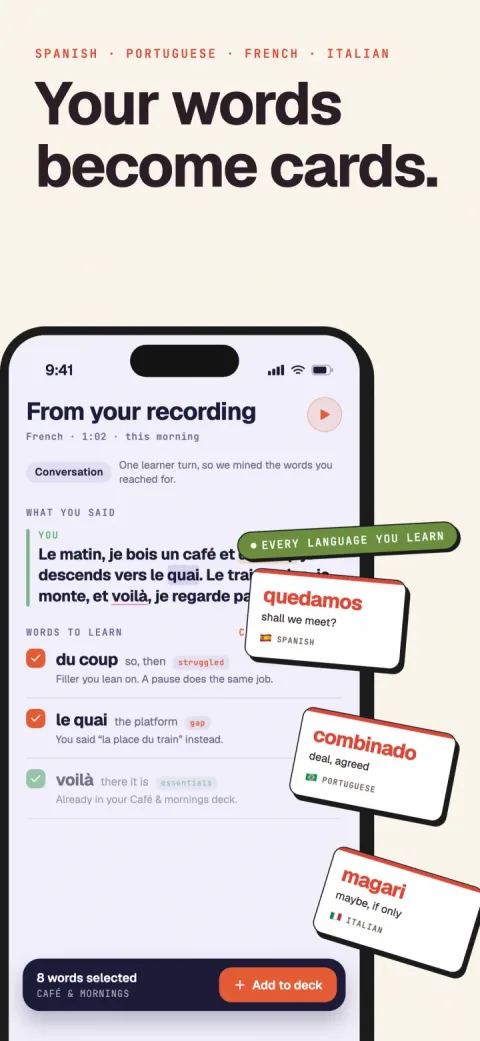
Verbamor turns the words from your own lessons and recordings into flashcards, and brings each one back before you’d forget it.

The planner
| Day | Reviews | Minutes | New cards added |
|---|
The projected load is the review half of the job. Building the cards is the other half, and the Anki comparison puts a number on those hours too, then says who should stay with Anki.
Use Anki's simulator instead, if you can
Anki ships an FSRS simulator inside its deck options. It reads the card states in your collection, the parameters fitted to your own review history, and your real grades. That is a far better instrument than anything a web page can build, and if you have a collection you should go open it and close this tab.
The planner on this page exists for the one case that simulator can't serve: you haven't started. There's no history to read, no parameters to fit, and the question is whether a habit of 20 new cards a day turns into 15 minutes an evening or 90 by next summer. That's a planning question, and a crude model answers it well enough to change a decision.
So the scope is narrow on purpose. Before you commit.
The model, written out
Every card walks a fixed interval ladder. Its stability starts at 3 days and multiplies by 2.5 on each success, and the interval you actually get is that stability scaled by the retention you asked for.
The scaling comes from the FSRS-6 forgetting curve, R(t) = (1 + 0.9803 × t/S)-0.1542, solved for the interval where recall probability equals your target. At 0.90 the interval equals the stability exactly, which is what that curve is built to do. At 0.95 it's 0.40 times the stability, and at 0.70 it's 9.29 times.
Then the day loop. Each day, new cards enter and get scheduled at the first rung. Every review due that day passes with your stated pass rate and lapses with the rest. A pass moves the card one rung up the ladder. A lapse sends it back to the first rung with a 1-day stability, which is roughly what Anki's relearning step does.
The model runs expected values, so a batch of 10 cards at a 90% pass rate becomes 9 passes and 1 lapse rather than a coin flip. That makes it reproducible and hand-checkable, and it means the curve is smoother than a real month of study will be.
The day loop is worth doing once by hand, because it's short. At 10 new cards a day, retention 0.90 and a 90% pass rate, the first rung is 3 days. So days 1 to 3 have no reviews, day 4 has the 10 cards from day 1, and 1 of them lapses to day 5. Day 5 gets its own 10 plus that 1, which is 11. Day 6 gets 10 plus 10% of 11, so 11.1. The series converges on 10 ÷ 0.9 = 11.11 until day 12, when the first batch's second rung lands and the number steps up by 9.
Is there a best desired retention for Anki?
There's no single best desired retention for Anki. The retention slider runs 0.70 to 0.95, and the tool prints no recommendation, because the recommended value is an artifact of the objective rather than a property of your deck.
Running FSRS's own optimiser on one deck, one parameter set, 3 different objective functions: minimising study time gives 0.70, minimising study time per unit of knowledge gives 0.70, and maximising knowledge gives 0.95. That's the whole legal range, decided by which question you asked. Anki's shipped default is 0.90, which sits between 2 defensible ends and is the setting you get by not touching anything.
The button that used to compute a number for your own deck, Compute Minimum Recommended Retention, has been documented as removed since Anki 25.07, though the code lives on inside the simulator.
So move the slider and read the cost. That's the useful thing here, and a recommendation would be a worse answer dressed as a better one.
The 4 things it gets wrong
One ladder for every card. Real FSRS gives each card its own difficulty and stability, and stability growth depends on how retrievable the card was when you saw it. Here every card grows at 2.5x. Your easy words will run ahead of this and your leeches will fall behind.
A flat pass rate. The model uses your one number on a card you've seen once and a card you've seen 8 times. In practice the mature cards pass more often, so a real collection carries a lighter late load than this shows.
No learning steps. Anki's default learning steps put a new card in front of you at 1 minute and 10 minutes on the day you first see it. Those same-day repetitions aren't counted here, so the first-week figures are low.
Expected values throughout. There's no randomness, so there's no bad week in it. A real Monday after a skipped weekend is much worse than any point on this curve.
Given all 4, read the output as an order of magnitude. It'll tell you whether 30 new cards a day is a 20-minute habit or an hour, and it will not tell you what next Tuesday looks like.
If you want to know how much the scheduler is buying you in the first place, the benchmark everyone cites for that doesn't contain an SM-2 row at all, and the numbers have to be aggregated out of unpublished files in the repository.
Questions people actually ask
Should I use this or Anki's own simulator?
Anki's, if you have a collection. Anki ships an FSRS simulator in its deck options that reads your actual card states, your fitted parameters and your real review history, and no web page can beat that. This planner is for the case where none of that exists yet: you are deciding whether to start, and you want to know what a habit of 20 new cards a day turns into by month 9. Once you have a few thousand reviews logged, open the simulator in Anki and stop using this.
What retention should I set?
There is no single right answer, and the honest reason is that the number moves with the question you ask. Running FSRS's own optimiser on one deck with one parameter set under 3 different objective functions gives 0.70 for minimising study time, 0.70 for minimising time per unit of knowledge, and 0.95 for maximising knowledge. That is the entire legal range 0.70 to 0.95, decided by the objective rather than by the deck. Anki's shipped default is 0.90, which sits between two defensible ends. Move the slider here and watch what each setting costs you rather than looking for the optimum.
Why does the load keep climbing instead of levelling off?
Because a card whose interval doubles every success generates fewer reviews per year but never zero, and you keep adding new ones. Load flattens only when you stop adding cards, or when intervals hit the maximum-interval cap. Set new cards per day to stop after some number of days and you can see the curve bend. That bend is the plateau, and it arrives after you stop, not while you are still adding.
How accurate is this projection?
Treat the projection as an order of magnitude, not a forecast. It runs expected values rather than a random draw, so there is no noise in it. It uses one interval ladder for every card, where real FSRS gives each card its own difficulty and stability. It assumes your pass rate is the same on a card you have seen once and one you have seen 8 times, which is false. And it ignores the learning steps that put a card in front of you twice in the first 10 minutes. All 4 of those simplifications are listed on the page.
Or skip the deck options page.
Verbamor runs FSRS on cards built from your own lessons, with the scheduling decisions already made.
Start 7 days freeThe 7-day free trial is on the yearly plan.
More free tools
All 8-
39 Spanish word patterns Learn one rule and get a whole group of words: -tion to -ción, el agua, me gusta. Thousands of words, with a free PDF.
-
How many Spanish words do you know? Tick the words you know from a frequency-banded sample. Fake words catch the guessing.
-
How much of a text do you already know? Paste any text and see what share of it sits inside the first 1,000 to 5,000 words.
-
The forgetting curve, drawn properly Put in the days since your last review and see how much of a word is left, on the real FSRS-6 curve.
-
Cognate checker Type an English word, see its likely relatives in four languages, and get warned about false friends.
-
What a tutored word really costs Your lesson price divided by the words you still have next week, with the arithmetic in full.
-
Count the hours a term abroad buys The hours a semester abroad really adds, next to what the same money buys in tutoring.
- All 8 free tools Every tool on one page, plus the free debrief sheet.