 Verbamor
39 Spanish word patterns that unlock thousands of words
Verbamor's free Spanish word patterns list puts 39 rules on one page. Each rule works on a whole group of words, so together they cover thousands. The page and the PDF give you 310 examples to start with. The first 4 are open below. Leave your email to open the other 35 and get the printable PDF.
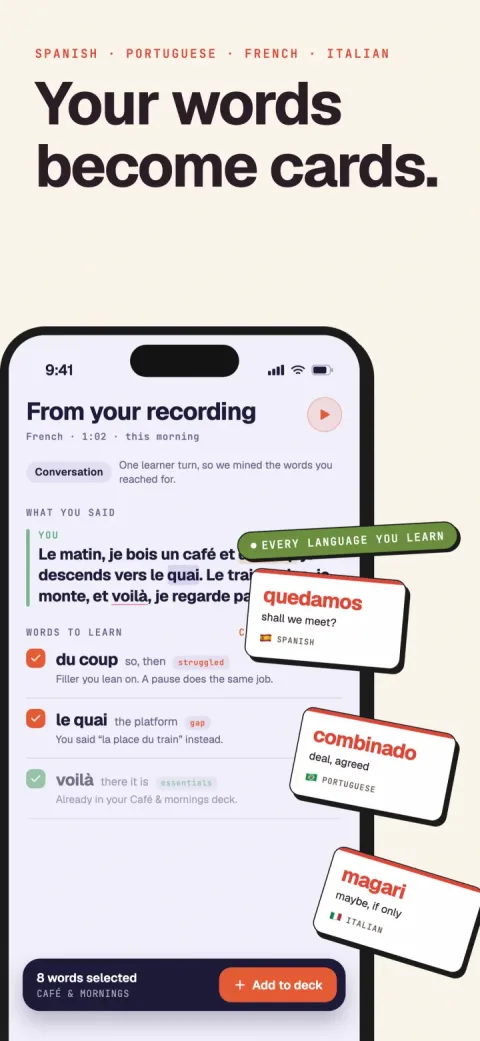
Verbamor turns the words from your own lessons and recordings into flashcards, and brings each one back before you’d forget it.

- 39 patterns
- 310 example words
- 7 groups
- Free PDF
Words you already know 22
English shares thousands of words with Spanish. Learn one ending and you get the whole group.
-tion becomes -ciónFeminine, la Nation, station, information -tion becomes -ción
English words that end in -tion end in -ción in Spanish. These words are feminine. Say la nación. The stress mark sits on the ó.
- la naciónnation
- la informacióninformation
- la educacióneducation
- la estaciónstation
- la conversaciónconversation
- la atenciónattention
- la celebracióncelebration
- la situaciónsituation
-sion becomes -siónFeminine, la Television, decision, version -sion becomes -sión
English words that end in -sion end in -sión. These words are feminine. Say la decisión.
- la televisióntelevision
- la decisióndecision
- la versiónversion
- la ocasiónoccasion
- la pasiónpassion
- la tensióntension
- la confusiónconfusion
- la explosiónexplosion
-ty becomes -dadFeminine, la University, city, identity -ty becomes -dad
English words that end in -ty end in -dad. These words are feminine. Say la ciudad.
- la universidaduniversity
- la ciudadcity
- la identidadidentity
- la sociedadsociety
- la realidadreality
- la calidadquality
- la actividadactivity
- la posibilidadpossibility
-ly becomes -mente Finally, normally, probably -ly becomes -mente
English adverbs that end in -ly end in -mente. Take the feminine adjective. Add -mente. Rápida becomes rápidamente.
- finalmentefinally
- normalmentenormally
- probablementeprobably
- generalmentegenerally
- exactamenteexactly
- rápidamenterapidly
- completamentecompletely
- especialmenteespecially
All 39 patterns are open. The PDF is in your inbox.
-ous becomes -oso Famous, delicious, curious -ous becomes -oso
English adjectives that end in -ous end in -oso. Use -osa with a feminine noun. Un hombre famoso. Una mujer famosa.
- famosofamous
- deliciosodelicious
- curiosocurious
- nerviosonervous
- generosogenerous
- peligrosodangerous
- preciosoprecious
- misteriosomysterious
-ic becomes -ico Fantastic, romantic, electric -ic becomes -ico
English adjectives that end in -ic or -ical end in -ico. Use -ica with a feminine noun. The stress mark goes on the vowel before -ico.
- fantásticofantastic
- románticoromantic
- eléctricoelectric
- públicopublic
- típicotypical
- políticopolitical
- clásicoclassic
- económicoeconomic
-al stays -al Animal, hospital, natural -al stays -al
Many English words that end in -al are the same in Spanish. The spelling does not change. The sound does. Say the a like the a in father.
- animalanimal
- hospitalhospital
- naturalnatural
- finalfinal
- normalnormal
- totaltotal
- personalpersonal
- capitalcapital
-ist becomes -ista Artist, tourist, dentist -ist becomes -ista
English words for people that end in -ist end in -ista. The word is the same for men and women. Only the article changes. El artista. La artista.
- artistaartist
- turistatourist
- dentistadentist
- pianistapianist
- optimistaoptimist
- especialistaspecialist
- novelistanovelist
- realistarealist
-ism becomes -ismoMasculine, el Tourism, optimism, realism -ism becomes -ismo
English words that end in -ism end in -ismo. These words are masculine. Say el turismo.
- el turismotourism
- el optimismooptimism
- el capitalismocapitalism
- el realismorealism
- el organismoorganism
- el mecanismomechanism
- el socialismosocialism
- el idealismoidealism
-ble stays -ble Possible, terrible, flexible -ble stays -ble
English adjectives that end in -ble end in -ble. Double letters become one letter. Possible is posible. The word is the same for masculine and feminine.
- posiblepossible
- terribleterrible
- responsableresponsible
- horriblehorrible
- probableprobable
- flexibleflexible
- visiblevisible
- increíbleincredible
-ent / -ant becomes -ente / -ante Important, different, student -ent / -ant becomes -ente / -ante
English words that end in -ent or -ant add an e. Important is importante. Different is diferente. The word is the same for masculine and feminine.
- importanteimportant
- diferentedifferent
- presidentepresident
- estudiantestudent
- elefanteelephant
- restauranterestaurant
- inteligenteintelligent
- excelenteexcellent
-ance / -ence becomes -ancia / -enciaFeminine, la Distance, experience, science -ance / -ence becomes -ancia / -encia
English words that end in -ance or -ence end in -ancia or -encia. These words are feminine. Say la experiencia.
- la distanciadistance
- la importanciaimportance
- la experienciaexperience
- la diferenciadifference
- la pacienciapatience
- la cienciascience
- la presenciapresence
- la eleganciaelegance
-age becomes -ajeMasculine, el Message, garage, percentage -age becomes -aje
English words that end in -age often end in -aje in Spanish. These words are masculine. Say el mensaje. The j sounds like a strong English h.
- el mensajemessage
- el garajegarage
- el porcentajepercentage
- el lenguajelanguage (speech, wording)
- el masajemassage
- el pasajepassage
- el corajecourage
- el sabotajesabotage
-or stays -orMasculine, el Color, error, motor -or stays -or
Many English words that end in -or are the same in Spanish. These words are masculine. Say el color. The stress is on the last part. Two common words are feminine. Say la flor and la labor.
- el colorcolor
- el errorerror
- el motormotor
- el favorfavor
- el humorhumor
- el honorhonor
- el horrorhorror
- el terrorterror
-ate becomes -ar Celebrate, create, participate -ate becomes -ar
English verbs that end in -ate often end in -ar in Spanish. Remove -ate. Add -ar. These verbs are regular. Say yo celebro.
- celebrarto celebrate
- crearto create
- participarto participate
- comunicarto communicate
- decorarto decorate
- separarto separate
- educarto educate
- calcularto calculate
-ize / -ify becomes -izar / -ificar Organize, authorize, identify -ize / -ify becomes -izar / -ificar
English verbs that end in -ize end in -izar. English verbs that end in -ify end in -ificar. Organize is organizar. Identify is identificar.
- organizarto organize
- utilizarto utilize
- autorizarto authorize
- modernizarto modernize
- identificarto identify
- modificarto modify
- simplificarto simplify
- verificarto verify
s- becomes es- School, special, space S- becomes es-
Spanish words do not start with s + consonant. They add an e first. School is escuela. Special is especial. Remove the e to find the English word.
- escuelaschool
- especialspecial
- espaciospace
- estilostyle
- estadostate
- estrésstress
- escenascene
- esqueletoskeleton
-ology becomes -ologíaFeminine, la Biology, technology, psychology -ology becomes -ología
English words that end in -ology end in -ología in Spanish. These words are feminine. Say la biología. The stress mark sits on the í.
- la biologíabiology
- la psicologíapsychology
- la tecnologíatechnology
- la ecologíaecology
- la sociologíasociology
- la arqueologíaarchaeology
- la mitologíamythology
- la ideologíaideology
-ary becomes -ario Necessary, vocabulary, salary -ary becomes -ario
English words that end in -ary often end in -ario. Most are masculine nouns. Say el diccionario. A few are adjectives. Necessary is necesario. Use -aria with a feminine noun. Say una cosa necesaria.
- necesarionecessary
- vocabulariovocabulary
- salariosalary
- aniversarioanniversary
- diccionariodictionary
- contrariocontrary
- itinerarioitinerary
- comentariocommentary
-ive becomes -ivo Active, positive, creative -ive becomes -ivo
English adjectives that end in -ive end in -ivo. Use -iva with a feminine noun. Un hombre activo. Una mujer activa.
- activoactive
- positivopositive
- negativonegative
- creativocreative
- efectivoeffective
- exclusivoexclusive
- agresivoaggressive
- nativonative
-ure becomes -uraFeminine, la Culture, temperature, adventure -ure becomes -ura
English words that end in -ure often end in -ura. These words are feminine. Say la cultura.
- la culturaculture
- la temperaturatemperature
- la estructurastructure
- la figurafigure
- la literaturaliterature
- la arquitecturaarchitecture
- la aventuraadventure
- la agriculturaagriculture
ph becomes f Telephone, pharmacy, philosophy Ph becomes f
Spanish has no ph. It writes f. Telephone is teléfono. Spanish also has no th. It writes t. Theater is teatro.
- filosofíaphilosophy
- teléfonotelephone
- farmaciapharmacy
- fotografíaphotography
- frasephrase
- físicaphysics
- alfabetoalphabet
- geografíageography
Gender and articles 6
The ending or the meaning of a word often gives its gender. Learn the group, not each word.
-maMasculine, el Problem, system, climate Greek words in -ma are masculine
Most words that end in -a are feminine. Words from Greek that end in -ma are masculine. Say el problema. Many are almost the same in English.
- el problemaproblem
- el sistemasystem
- el tematopic
- el climaclimate
- el idiomalanguage (Spanish, Japanese)
- el programaprogram
- el poemapoem
- el dramadrama
elFeminine, la Water, hunger, eagle Feminine words that take el
A feminine word that starts with a stressed a takes el. Say el agua. The word stays feminine. Say el agua fría. The plural takes las. Say las aguas.
- el aguawater
- el hambrehunger
- el águilaeagle
- el almasoul
- el áreaarea
- el aulaclassroom
- el armaweapon
- el hachaaxe
a → o Apple, orange, cherry The fruit is feminine, the tree is masculine
The fruit often ends in -a and is feminine. Change -a to -o for the tree. The tree is masculine. La manzana grows on el manzano.
- la manzana · el manzanoapple
- la naranja · el naranjoorange
- la cereza · el cerezocherry
- la ciruela · el cirueloplum
- la almendra · el almendroalmond
- la castaña · el castañochestnut
- la avellana · el avellanohazelnut
la Head, arm, leg Body parts take the article, not my
Spanish uses the article with parts of the body. It does not use my or your. Say me duele la cabeza. Say me lavo las manos.
- la cabezahead
- el brazoarm
- la piernaleg
- el piefoot
- el ojoeye
- la bocamouth
- la espaldaback
- el estómagostomach
elMasculine, el Monday, Friday, Sunday El lunes means on Monday
Use el with a day to say on. El lunes means on Monday. Los lunes means on Mondays. The days from lunes to viernes do not change in the plural. Write days with a small letter.
- el lunesMonday
- el martesTuesday
- el miércolesWednesday
- el juevesThursday
- el viernesFriday
- el sábadoSaturday
- el domingoSunday
en Mexico, Spain, Germany Countries take no article
Most countries take no article. Say vivo en México. Say soy de España. A few names keep the article. Say El Salvador, la India and el Reino Unido.
- MéxicoMexico
- EspañaSpain
- FranciaFrance
- AlemaniaGermany
- ItaliaItaly
- BrasilBrazil
- JapónJapan
- InglaterraEngland
Exceptions 2
These common words break the rules. Learn each set together.
≠ Hand, day, map Words that break the -o and -a rule
Words that end in -o are usually masculine. Words that end in -a are usually feminine. These common words break the rule. Foto and moto are short for fotografía and motocicleta.
- la manohand
- la fotophoto
- la motomotorcycle
- la radioradio
- el díaday
- el mapamap
- el planetaplanet
- el sofásofa
≈ Pregnant, current, success Words that look like English but are not
Most look-alike words mean the same in English. These do not. Embarazada means pregnant, not embarrassed. Learn the real meaning of each one.
- embarazadapregnantnot embarrassed
- actualcurrentnot actual
- éxitosuccessnot exit
- carpetafoldernot carpet
- sopasoupnot soap
- ropaclothesnot rope
- largolongnot large
- sensiblesensitivenot sensible
Plurals and other rules 2
One small rule changes many words.
z → ces Light, time, pencil The plural of -z is -ces
Words that end in -z change the z to c in the plural. Then add -es. Luz becomes luces. Spanish does not write z before e.
- luz becomes luceslight
- vez becomes vecestime (occasion)
- lápiz becomes lápicespencil
- pez becomes pecesfish
- voz becomes vocesvoice
- nariz becomes naricesnose
- actriz becomes actricesactress
- feliz becomes feliceshappy
¿? What, where, when Question words take a stress mark
Question words take a stress mark. Qué means what. Without the mark, que means that. The sound is the same. Write ¿ at the start of a question.
- quéwhatque = that
- cómohowcomo = like, as
- dóndewheredonde = the place where
- cuándowhencuando = at the time when
- quiénwhoquien = the person who
- cuálwhichel cual, la cual = which
- cuántohow muchcuanto = as much as
- por quéwhyporque = because
Word building 3
Add a small part to a word you know. You get a new word.
-eríaFeminine, la Bakery, bookshop, shoe shop Add -ería for the shop
Add -ería to a thing to name the shop that sells it. Zapato becomes zapatería. These words are feminine. Be careful with librería. It is a bookshop, not a library.
- el pan becomes la panaderíabakery
- el zapato becomes la zapateríashoe shop
- el libro becomes la libreríabookshop
- la carne becomes la carniceríabutcher shop
- el pescado becomes la pescaderíafish shop
- el helado becomes la heladeríaice cream shop
- la fruta becomes la fruteríafruit shop
- el pastel becomes la pasteleríapastry shop
-dorMasculine, el Worker, player, seller -dor names the person who does it
Take an -ar or -er verb. Remove the r. Add -dor for the person who does it. Trabajar becomes trabajador. Vender becomes vendedor. Add -a for a woman. Say la trabajadora.
- trabajar becomes el trabajadorworker
- jugar becomes el jugadorplayer
- vender becomes el vendedorseller
- entrenar becomes el entrenadorcoach
- ganar becomes el ganadorwinner
- nadar becomes el nadadorswimmer
- pescar becomes el pescadorfisherman
- diseñar becomes el diseñadordesigner
des- Undo, disappear, unknown Des- makes the opposite
Add des- to make the opposite. Hacer becomes deshacer. Aparecer becomes desaparecer. Desayuno is the meal that ends the ayuno, the fast.
- hacer becomes deshacerto undo
- aparecer becomes desaparecerto disappear
- conocido becomes desconocidounknown
- agradable becomes desagradableunpleasant
- empleo becomes desempleounemployment
- orden becomes desordendisorder
- conectar becomes desconectarto disconnect
- ayuno becomes desayunobreakfast
Verbs 3
Each set of verbs behaves in one way. Learn the set together.
me Like, love, hurt The thing you like is the subject
Gustar means to be pleasing. The thing you like is the subject. Say me gusta el café. Use gustan for many things. Say me gustan los libros. These verbs work the same way.
- gustar becomes me gustato like
- encantar becomes me encantato love (a thing)
- doler becomes me dueleto hurt
- faltar becomes me faltato lack
- importar becomes me importato matter
- interesar becomes me interesato interest
- molestar becomes me molestato bother
- parecer becomes me pareceto seem
yo -go Have, put, leave The yo form ends in -go
Some common verbs end in -go in the yo form. Tener becomes tengo. Only the yo form does this. Say yo salgo, but tú sales.
- tener becomes tengoto have
- venir becomes vengoto come
- poner becomes pongoto put
- salir becomes salgoto leave
- hacer becomes hagoto do
- decir becomes digoto say
- traer becomes traigoto bring
- oír becomes oigoto hear
he… Done, said, seen Past forms that break the rule
Most past forms end in -ado or -ido. Hablar becomes hablado. These common verbs break the rule. Hacer becomes hecho. Say he hecho for I have done.
- hacer becomes hechodone
- decir becomes dichosaid
- ver becomes vistoseen
- poner becomes puestoput
- escribir becomes escritowritten
- abrir becomes abiertoopened
- volver becomes vueltoreturned
- romper becomes rotobroken
Pronunciation 1
Some letters do not sound the way an English reader expects.
h Hello, hour, man The letter h is silent
The letter h is always silent in Spanish. Say OH-la for hola. The pair ch is different. It sounds like ch in cheese.
- holahelloOH-la
- horahourOH-ra
- hombremanOM-breh
- hijosonEE-kho
- hoytodayoy
- hotelhoteloh-TEL
- hermanobrotherer-MA-no
- huevoeggWEH-vo
How to use these patterns
Read one pattern a day. Say the example words out loud. Then look for that pattern in what you read and hear that week. A pattern you notice three times in real Spanish stays with you.
Start with the first group, words you already know. Those 22 patterns turn English words you use every day into Spanish ones. The gender group comes next. It tells you el or la before you look the word up.
A pattern is a guide, and every guide has exceptions. The exceptions group lists the common ones, like la mano. When a word you made from a pattern sounds wrong, check it.
Patterns cover the words you can work out. For the words you can't, the cognate checker marks the false friends that look like English and mean something else.
Questions people ask
What is a Spanish word pattern?
A rule that changes many words at once. English words that end in -tion end in -ción in Spanish, and they are all feminine. When you know that rule, you know la nación, la estación and la información before anyone teaches them to you.
Do the patterns always work?
Most of the time, and each pattern says where it stops. The -or pattern gives masculine words, and it names the two common feminine ones, la flor and la labor. The false friends pattern lists words that look like English and mean something else, like embarazada, which means pregnant.
Is this the same as the Word patterns screen in Verbamor?
Yes. These are the same 39 Spanish patterns. In the app you can pick any example word and save it as a flashcard with a picture, an example sentence and audio.
What do I get by email?
A printable PDF with all 39 patterns and 310 example words, and my post-lesson debrief handbook. Then a few short emails. You can unsubscribe at any time.
Save a whole pattern as flashcards.
Open Word patterns in Verbamor, pick the words you want, and save them. Each card gets a picture, an example sentence and audio, and comes back just before you forget it.
Start 7 days freeThe 7-day free trial is on the yearly plan.
More free tools
All 8-
How many Spanish words do you know? Tick the words you know from a frequency-banded sample. Fake words catch the guessing.
-
How much of a text do you already know? Paste any text and see what share of it sits inside the first 1,000 to 5,000 words.
-
The forgetting curve, drawn properly Put in the days since your last review and see how much of a word is left, on the real FSRS-6 curve.
-
What do 20 new cards a day cost you? Project your daily reviews for two years from a new-card rate and a retention target.
-
Cognate checker Type an English word, see its likely relatives in four languages, and get warned about false friends.
-
What a tutored word really costs Your lesson price divided by the words you still have next week, with the arithmetic in full.
-
Count the hours a term abroad buys The hours a semester abroad really adds, next to what the same money buys in tutoring.
- All 8 free tools Every tool on one page, plus the free debrief sheet.