 Verbamor
How much of this text is already inside your first 5,000 words?
Paste a Spanish, French, Italian or Portuguese text and this checker tells you what share of its running words sit inside the first 1,000, 2,000, 3,000 and 5,000 frequency ranks. The checker lists every word outside them, and counts proper nouns separately, kept out of the headline figure on purpose. Nothing leaves your browser.
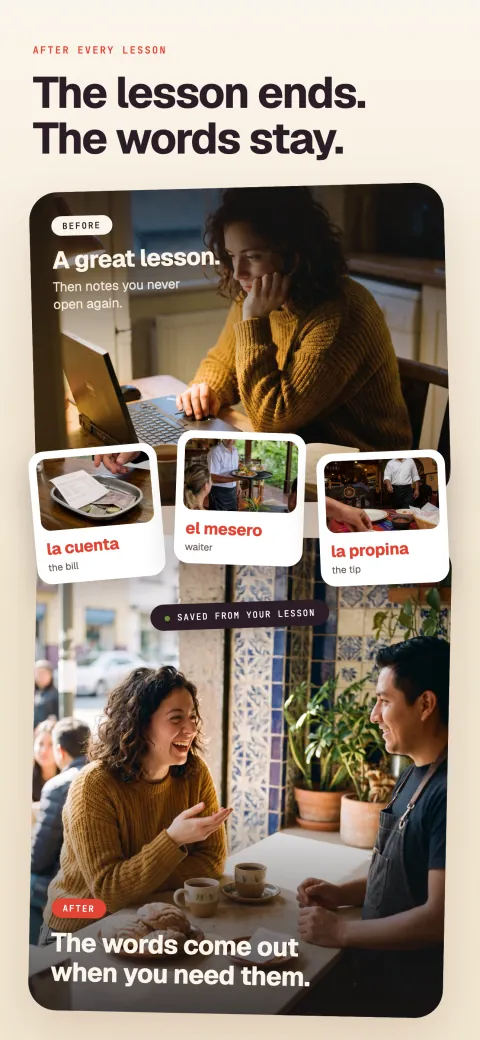
Verbamor records your lesson and turns what your tutor taught into cards that come back on schedule.

The checker
Words outside the first 5,000
The words the checker flags are the ones worth a card. How to make flashcards from a lesson shows how to cut them down and phrase each one, and what you lose if Verbamor makes them for you.
Coverage is the share of running words in a text that you already know. It's the number behind every "learn 1,000 words and you can read a newspaper" claim, and it's worth measuring on a text you actually want to read rather than on somebody's corpus.
So paste one in. Everything runs in your browser and nothing is sent anywhere.
It counts forms, and that matters
The checker on this page counts written forms. Hablo and hablas are 2 separate items in the list and 2 separate lookups here.
The famous coverage targets are not counted by written form. Paul Nation's 2006 paper, the source of "8,000 words to read a novel," counts word families: a headword plus every inflection and derivation you could decode from it. His own lists average 4.33 forms per family, so 8,000 families works out at 34,660 distinct written forms.
The unit difference means a percentage from this page and a percentage from Nation's paper are different measurements wearing the same sign. If you hit 90% here at 3,000 forms, you have not hit Nation's 3,000-family mark. Romance verbs make the gap worse: an English verb has 4 inflected forms, and hablar has around 44 before a derivation like hablador joins it.
Lemmatising would fix the unit, and I didn't do it. A tagger that guesses wrong on porto, which is a Portuguese city and a form of portare, corrupts 2 ranks at once, and I'd rather show you a number whose flaw is printed than a number whose flaw is hidden inside a model. So: forms.
Do proper nouns count toward coverage?
Yes, as coverage you get for free, because Madrid is Madrid in every language you'll read it in. They are also additive to the published figures rather than part of them. Nation's conclusion says the first 1,000 words plus proper nouns cover 78% to 81% of written text, and the clause falls off almost every time somebody quotes the number.
The proper-noun block is not small and it is not stable. Across the 14 texts Nation profiled it runs from 0.50% of The Turn of the Screw, a ghost story with 4 characters in it, to 6.12% of the Brown newspaper corpus. His 5 novels average 1.45% and his 5 newspaper corpora 5.41%, and the 2 groups don't overlap at all.
So a checker that quietly folded names into one percentage would move your score by up to 5 points depending on whether you pasted a novel or a news story. This one counts them, prints them, and leaves them out of the band figures.
The list, and its licence
The ranks come from hermitdave/FrequencyWords, built from the OpenSubtitles 2018 corpus through OPUS. The top 5,000 forms per language, lowercased, with duplicates removed after lowercasing. Downloaded 4 September 2026.
The FrequencyWords licence is CC BY-SA 4.0 for the data. The repository's README splits that from the MIT licence covering its code, and the LICENSE file holds only the MIT text, which is how "hermitdave is MIT" got started. Share-alike is a real obligation and this page honours it by attribution.
FrequencyWords is the list I could ship. Of the free options covering all 4 of these languages, it's the only one whose licence permits commercial use. SUBTLEX-ESP and SUBTLEX-IT are CC BY-NC-SA, SUBTLEX-PT-BR adds NoDerivatives on top, SUBTLEX-PT carries no licence file at all, and KELLY Italian is CC BY-NC-SA 2.0. I went through every list and read each licence at its own source, and several of the most-recommended ones would have been the wrong answer here.
Being subtitles, the OpenSubtitles corpus is dialogue. These ranks describe how people speak on screen, so a legal contract or a chemistry paper will score badly and that is the corpus talking, not you.
What this will get wrong
The proper-noun test is a capital letter that isn't at the start of a sentence. It's a heuristic, and it has 5 failures worth knowing.
- A name in the first position of a sentence gets counted as vocabulary.
- A text pasted in all lower case gets no names at all.
- A text pasted in ALL CAPS gets almost every word binned as a name.
- A capitalised common noun mid-sentence gets wrongly binned.
- An abbreviation ends a sentence as far as the checker is concerned, so in Sr. Garcia fue a casa the period after Sr makes Garcia look sentence-initial and it slips through as vocabulary.
The count of names is printed so you can eyeball whether it looks right for what you pasted.
Anything past rank 5,000 shows as outside. The list itself runs to 50,000, and I cut it at 5,000 because that's the range a learner works in and 4 full lists would be a 12 MB page.
Numbers, and tokens with no letters in them, are skipped entirely rather than counted as unknown. Apostrophes and hyphens follow the list rather than a general rule, because the list treats them differently. An elided clitic keeps its mark and stands alone, so l'homme is l' plus homme, and l' is rank 16 in French. A hyphenated compound stays whole, so est-ce is one word at rank 70 and peut-être one at 130. Portuguese carries 206 hyphenated forms like diz-me on the same rule. Splitting both marks, which is what this did first, put 202 French and 215 Portuguese entries permanently out of reach and sent aujourd'hui to the unknown pile from rank 271.
And the whole checker measures recognition of shapes on a page, which is the easiest thing vocabulary does. Reading desarrollo and knowing it means development is not the same skill as producing it in a sentence while somebody waits. The frequency curve explains why the first thousand ranks buy so much and the tenth buys so little.
Questions people actually ask
Does this count words or word families?
Written forms. Every inflection is its own entry, so hablo and hablas are 2 items here. The famous coverage targets, including Nation's 8,000 for reading a novel, are counted in word families, where a headword and all its inflections and derivations count as 1. Nation's own lists average 4.33 forms per family, so 8,000 families is 34,660 written forms. A number from this tool and a number from those studies are not the same unit and should not be compared directly.
Why are proper nouns reported separately?
Proper nouns are reported separately because they are additive to the published coverage figures rather than part of them. Nation's conclusion reads 'the first 1,000 plus proper nouns cover 78% to 81% of written text', and the 'plus proper nouns' clause usually falls off when the figure gets quoted. The size of that block swings from 0.50% of The Turn of the Screw to 6.12% of the Brown newspaper corpus. Novels in Nation's set average 1.45% and newspapers 5.41%, with no overlap between the two groups. Folding names into the headline number would overstate what your studied vocabulary is doing, by an amount that depends on what you happened to paste.
Which frequency list does this use?
hermitdave/FrequencyWords, built from the OpenSubtitles 2018 corpus via OPUS. The data is licensed CC BY-SA 4.0, which the repository README states separately from the MIT licence covering its code. It is the only free list covering all 4 of these languages whose licence permits commercial use. The SUBTLEX family and CEFRLex are noncommercial, SUBTLEX-PT-BR adds NoDerivatives on top, and SUBTLEX-PT states no licence at all.
How does the tool decide what is a proper noun?
A token counts as a proper noun if it starts with a capital letter and is not the first word of its sentence. That is a heuristic, not a tagger. It misses names in a text you pasted in all lower case, it misses sentence-initial names, and it will wrongly flag a capitalised common noun mid-sentence. The count is printed so you can judge whether it looks right for your text.
Knowing a word is the easy half.
Verbamor takes the words you got stuck on in your own lessons and schedules them back with native audio, so recognition turns into recall.
Start 7 days freeThe 7-day free trial is on the yearly plan.
More free tools
All 8-
39 Spanish word patterns Learn one rule and get a whole group of words: -tion to -ción, el agua, me gusta. Thousands of words, with a free PDF.
-
How many Spanish words do you know? Tick the words you know from a frequency-banded sample. Fake words catch the guessing.
-
The forgetting curve, drawn properly Put in the days since your last review and see how much of a word is left, on the real FSRS-6 curve.
-
What do 20 new cards a day cost you? Project your daily reviews for two years from a new-card rate and a retention target.
-
Cognate checker Type an English word, see its likely relatives in four languages, and get warned about false friends.
-
What a tutored word really costs Your lesson price divided by the words you still have next week, with the arithmetic in full.
-
Count the hours a term abroad buys The hours a semester abroad really adds, next to what the same money buys in tutoring.
- All 8 free tools Every tool on one page, plus the free debrief sheet.