 Verbamor
Cognate checker, with the guessing labelled
Verbamor's free cognate checker shows an English word's likely cognates in Spanish, French, Italian and Portuguese, and labels every row: 44 headwords are checked by hand, the rest are generated by 15 suffix rules, and a generated form is wrong about 3 times in 10. It also flags 48 false friends, like embarazada, which means pregnant.
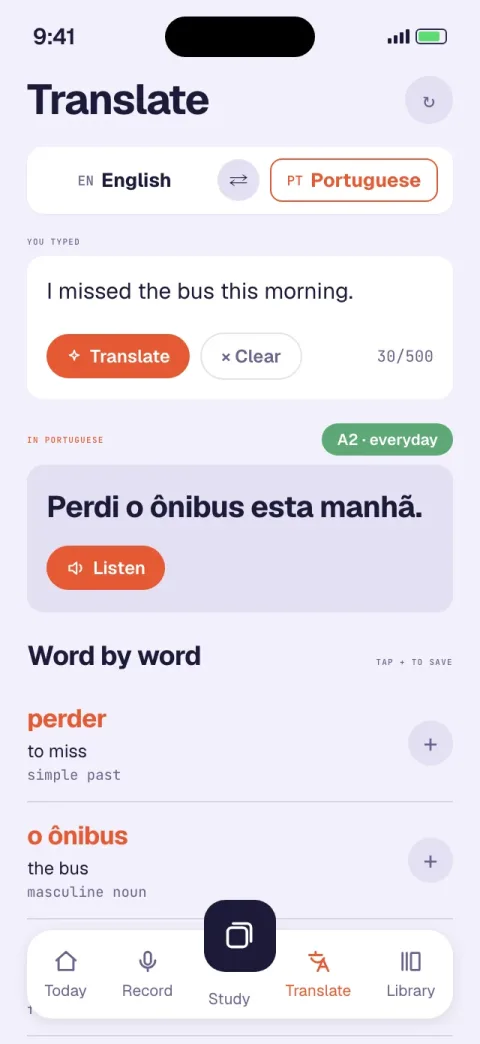
Verbamor translates a phrase, breaks it down word by word, and saves the words you tap as cards.

The checker
Type an English word above, or paste a short list.
One English word, or a short list separated by commas, spaces or line breaks. Everything runs in this page and nothing is sent anywhere. Tab to the box and type; results update as you go and are announced to a screen reader. With JavaScript off, the suffix rules and 14 of the 48 false friends are printed below, which is the useful half anyway.
Cognates are the words you get for free. For the rest, the comparison table sets Verbamor against Duolingo, Anki and Babbel in 11 rows, and marks the rows Verbamor loses.
You walked into Spanish knowing thousands of words already. Hospital, animal, familia, importante. English took in an enormous Latin and French vocabulary after 1066, Spanish grew out of Latin directly, and the overlap is your unfair head start.
A handful of those words are lying to you, and that handful is what this tool is really for.
How often is the cognate checker wrong?
About 3 times in 10 on a generated form, and every one of those rows is labelled. The tool has two sources of answer and never blends them.
Attested. A list of 44 English headwords whose four translations I looked up by hand before typing them in. Those rows say "attested, checked by hand" and you can lean on them.
Generated. Everything else runs through a suffix rule: swap the English ending for the Romance one and print what comes out. Nothing checks that the result is a word. Those rows say "generated by the -tion rule, not checked", and here is the part most tools like this leave out.
I ran 20 rule-triggering English words, 80 generated forms across the four languages, and checked every one by hand:
| Result | Count | Share |
|---|---|---|
| Exactly right | 57 of 80 | 71% |
| Right apart from a missing accent | 66 of 80 | 83% |
| Wrong as printed | 23 of 80 | 29% |
So a generated form is wrong about 3 times in 10, and the misses are not random. French swallows the accents the rule can't predict (célébration comes out as celebration). Italian and Portuguese assimilate consonants English keeps (ottimismo, not optimismo). And an English stem that drifted takes the whole guess with it: tourist gives tourista, and the word is turista.
A 3-in-10 miss rate is what a letter-level rule can do, and I would rather print the number than describe it as "approximate". Use the generated forms the way the post on cognates suggests using them: guess boldly in conversation and let your tutor catch the misses. Do not put one on a flashcard without checking it first.
The false friends, and where the list came from
Now the lie. Some pairs look related and drifted, or never were related. The classic is embarazada: it looks like embarrassed and it means pregnant, and generations of learners have announced a pregnancy to a dinner table while trying to apologise for one.
False friends are nasty for a memory-specific reason. You're fighting an existing, deeply automatic association, and under pressure the old habit wins. A brand-new word has no competition. Éxito has 30 years of "exit" pushing against it.
The false-friend list is mine. 48 entries, compiled from the cognates post and the standard teaching examples, typed by hand. I'm releasing it under CC0: take it, use it, no attribution needed. It comes from no third-party word list, because a licence I can't verify is a worse problem than a shorter list.
Two honest weaknesses in the false-friend list. It leans Spanish, 20 of the 48, because that's where the post's evidence is and where I can check my own work fastest. And 48 is small. The good news buried in that: common false friends genuinely do number in the dozens, against tens of thousands of honest cognates, so the tax rate on the inheritance is low. You just have to know which relatives to watch.
| Looks like | Actually means | The word you wanted |
|---|---|---|
| embarazada (es) | pregnant | avergonzada |
| éxito (es) | success | salida |
| sensible (es) | sensitive | sensato |
| constipado (es) | congested, with a head cold | estreñido |
| librería (es) | bookshop | biblioteca |
| préservatif (fr) | condom | conservateur |
| journée (fr) | day | voyage |
| monnaie (fr) | change, coins | argent |
| camera (it) | room | macchina fotografica |
| parente (it) | relative | genitore |
| educato (it) | polite | istruito |
| puxar (pt) | to pull | empurrar |
| esquisito (pt) | odd, weird | requintado |
| costume (pt) | custom, habit | fantasia |
The suffix rules, written out
Fifteen suffix rules, applied to the stem after the English ending is stripped. The order in the file is the order they're tried, and the first match wins. Twelve are below; the three left out are -ary, -ate and -ct, which are the rough ones.
| English | Spanish | French | Italian | Portuguese |
|---|---|---|---|---|
| -tion | -ción | -tion | -zione | -ção |
| -sion | -sión | -sion | -sione | -são |
| -ity | -idad | -ité | -ità | -idade |
| -ous | -oso | -eux | -oso | -oso |
| -ical | -ico | -ique | -ico | -ico |
| -ally | -almente | -alement | -almente | -almente |
| -ist | -ista | -iste | -ista | -ista |
| -ism | -ismo | -isme | -ismo | -ismo |
| -ance | -ancia | -ance | -anza | -ância |
| -ence | -encia | -ence | -enza | -ência |
| -able | -able | -able | -abile | -ável |
| -ible | -ible | -ible | -ibile | -ível |
Two rules I deleted rather than shipped, which is worth saying because the deletions are the interesting part.
No general -ly rule. English adverbs build on an adjective the rule can't recover. "Famously" isn't famous plus mente, it's famosa plus mente, so the rule returned famousmente in three languages out of four. A rule that's wrong every time is worse than no rule.
No -ment rule. Same problem in the stem. "Movement" is movimiento, mouvement, movimento, and the rule produced movemento and got none of them.
What survived on top of the endings is two spelling swaps, applied to Spanish, Italian and Portuguese and not to French: ph becomes f, th becomes t, and a y in a stem those two touched becomes i. That's how physical reaches fisico instead of physico. The real Spanish word is físico, with the accent the rule cannot predict, and that near-miss is the single commonest way a generated form is wrong. French keeps its ph, which is why it gets none of this.
What this does not tell you
A generated form may not be a word. Repeated here because it's the whole risk. Three in ten are wrong as printed, and the tool has no dictionary to check itself against. Every row tells you which kind it is; believe the label.
Gender, articles and plurals are all missing. The tool returns a bare form. Whether it's el or la, whether the adjective agrees, and what happens in the plural are all things you still have to learn, and a card built from a bare noun will teach you the wrong habit.
The drift zone is not covered. Between honest cognates and outright liars there are pairs that share most of a meaning with edges that moved. Asistir usually means to attend. Discutir leans toward arguing. Those are trickier than false friends because they're right often enough to keep your guard down, and the tool only flags the clean cases.
Cognates pay out on the input side. Recognising información while reading costs you nothing. Producing it correctly, right stress, right vowels, no English -tion sneaking in, still takes reps. The head start makes your reading vocabulary enormous on day one while your speaking vocabulary stays honest.
And the pronunciation trap. Hospital the Spanish word shares letters with hospital the English word and almost none of the sounds. A cognate is the word most likely to be read with an English mouth, which is why it especially needs native audio attached from the first encounter.
Sources
The research behind why cognates are worth chasing is in cognates and false friends: de Groot & Keijzer (2000) for cognates being learned faster, recalled better and forgotten more slowly, and Costa, Caramazza & Sebastián-Gallés (2000) for the cognate facilitation effect in picture naming. The attested list and the false-friend list on this page were both compiled by hand for it, and the false-friend list is CC0.
If you'd rather check a whole page of text than one word, the coverage checker tells you what share of a text sits inside the first few thousand words of a language.
Questions people actually ask
Are the words this tool returns real words?
Some are checked and some are guesses, and the tool tells you which is which on every row. A form marked attested was looked up by hand before it was typed into the list. A form marked generated was produced by swapping an English ending for a Romance one, and nothing verified that the result exists. On a 20-word sample checked by hand, 57 of 80 generated forms were exactly right and 66 of 80 were right apart from a missing accent. So roughly 3 in 10 generated forms are wrong as printed.
What is a false friend?
A word pair that looks related and has drifted, or never was related. Spanish embarazada looks like embarrassed and means pregnant. Spanish exito looks like exit and means success. They punish exactly the confidence that real cognates teach you, because you are fighting an existing automatic association rather than learning a new word from nothing.
Where does the false friend list come from?
The false friend list is this site's own compilation, built from the published post on cognates plus the standard teaching examples, and it is released under CC0, so copy it freely with no attribution. It is not drawn from any third-party word list, because a licence that cannot be verified is worse than a shorter list typed by hand. It is Spanish-heavy, which is a real limitation rather than a claim that the other three languages have fewer.
Do cognates actually help?
Yes, and the lab result is unusually clean. De Groot and Keijzer (2000) had Dutch speakers learn foreign vocabulary that was either cognate or non-cognate with Dutch and found cognates were learned faster, recalled better, and forgotten more slowly. Costa, Caramazza and Sebastian-Galles (2000) found bilinguals name pictures faster when the word is a cognate. The catch is pronunciation: a cognate shares letters with its English pair and almost none of the sounds.
A cognate still needs the right mouth.
Verbamor puts native audio and a real sentence on every card, which is the part a spelling rule can never give you.
Start 7 days freeThe 7-day free trial is on the yearly plan.
More free tools
All 8-
39 Spanish word patterns Learn one rule and get a whole group of words: -tion to -ción, el agua, me gusta. Thousands of words, with a free PDF.
-
How many Spanish words do you know? Tick the words you know from a frequency-banded sample. Fake words catch the guessing.
-
How much of a text do you already know? Paste any text and see what share of it sits inside the first 1,000 to 5,000 words.
-
The forgetting curve, drawn properly Put in the days since your last review and see how much of a word is left, on the real FSRS-6 curve.
-
What do 20 new cards a day cost you? Project your daily reviews for two years from a new-card rate and a retention target.
-
What a tutored word really costs Your lesson price divided by the words you still have next week, with the arithmetic in full.
-
Count the hours a term abroad buys The hours a semester abroad really adds, next to what the same money buys in tutoring.
- All 8 free tools Every tool on one page, plus the free debrief sheet.