Verbamor
Sound before spelling: why native audio matters
Native audio matters because memory files a new word as a sound first: learn it from text and your English reading rules invent the sound, then every review rehearses the mistake. So hear a native voice, say the word, attach the meaning, and only then read the spelling.
Every learner has a word they learned from text and have said wrong ever since. Mine was jamón. I'd read it in a menu app years before I heard it and filed it with an English J.
Then I spent an embarrassing amount of time in Madrid asking for something that sounded like "jam-on."
My jamón mistake wasn't laziness. It was order of operations. I gave my eyes the word before my ears, and the eyes come with baggage: 30-odd years of English reading habits, all of them wrong for Spanish.
01 / 05How well you parrot a meaningless sound predicts how fast you build a vocabulary
Working memory has a dedicated subsystem for holding and rehearsing speech sounds. Baddeley called it the phonological loop.
In a 1998 paper with Gathercole and Papagno he made a bigger claim: the loop's main evolutionary job is exactly what you're doing right now, learning new words.
The evidence for the phonological loop is hard to argue with. People's ability to repeat back unfamiliar sound sequences (nonword repetition) predicts their vocabulary growth, in children and in adult language learners. Patients with damaged phonological loops learn new vocabulary at dramatically impaired rates while the rest of their memory works fine.
The nonword-repetition finding deserves a second look, because it's strange and useful. Being good at parroting sounds you've never heard, with no meaning attached, predicts how fast you'll build a vocabulary.
That implies the bottleneck for many learners is upstream of meaning entirely: it's the fidelity of the sound recording. Sharpen the recording and everything downstream gets easier.
The phonological loop is a word-learning device. Feed it the real sound, and it does its job. Feed it your guess, and it learns your guess.
Here's the operational point: a new word enters memory as a sound pattern. If you've never heard the word, your brain doesn't skip that step. It synthesizes a pronunciation from your native reading rules and stores that instead.
The loop is always fed; the only question is whether it's fed the truth.
02 / 05Seeing the spelling helps when its rules match the sounds, and hurts when they conflict
Written forms are supposed to be a neutral record of words. For a second-language learner, they're not neutral at all.
Bassetti's research on orthographic effects (how spelling shapes speech) shows second-language (L2) learners' pronunciation bending toward the spelling. They produce double letters as long sounds because Italian spells them doubled, voice silent letters, and give vowels their native-language values.
Spanish looks safe (the spelling is famously regular) and still bites English speakers constantly, because the rules for reading the letters differ.
The J of jamón. The silent H of hola. The V of vaca that sounds like a B. The vowels, all 5 of them, cleaner and shorter than any English vowel wants to be.
The vowels are the sneakiest tax, because English speakers can't hear themselves paying it. English drifts unstressed vowels toward a lazy "uh," so importante comes out impuhrtuhnte, every vowel slightly melted.
No single sound is wrong enough to flag, and the accumulated smudge is most of what makes a gringo accent a gringo accent. A native recording of the word, imitated before the spelling ever loads the English habits, sidesteps the whole tax.
Erdener and Burnham (2005) found the effect cuts both ways. Seeing spelling while learning helped when the writing system's rules matched the sounds, and pulled pronunciation off course when they conflicted. Text is an instrument that plays in your native key until you retune it.
03 / 05Can you train your ear to hear a sound contrast it misses?
Yes, you can train your ear, though the problem starts deeper than pronunciation: some sound contrasts, you can't even hear yet. The famous case is Japanese speakers and English /r/ versus /l/, a distinction Japanese doesn't make. You can't store a difference your perception doesn't register.
The good news comes from a classic training study. Logan, Lively and Pisoni (1991) trained Japanese speakers on /r/–/l/ using many words spoken by many different voices, and perception measurably improved. The variety was the active ingredient: hearing a contrast survive across 5 voices teaches the category, where 1 voice teaches only that recording.
The approach is now called high-variability phonetic training and it's a small industry in speech research.
Spanish has its own hard-to-hear contrasts for English ears: the tapped R of pero against the trilled RR of perro, or catching where está is stressed. Trainable, all of it, given enough varied native input. That's an argument for real recorded speech over one synthetic voice reading your whole deck.
Spanish's confusable pairs aren't academic, either. Pero/perro is "but" versus "dog." Papa/papá is potato versus dad, and año is a word you truly want to keep distinct from ano.
Spanish speakers will usually rescue you from context, the way you rescue people who mangle English vowels. But every contrast your ear can't hold is a whole family of words your memory files in the same slot, and confusable things filed together stay confused.
04 / 05A wrong first pronunciation gets rehearsed by every review afterwards
So the sequence that respects how the machinery works:
Hear a new word first, from a native voice. Imitate it immediately, while the sound is still ringing in the loop; the mouth movement becomes part of the trace. Attach the meaning (ideally an image, keeping English out of it).
And only then look at the spelling, which now gets interpreted through the sound you already own instead of the other way around.
Learners who meet words in conversation get the ear-first ordering for free. Every word your tutor speaks arrives ear-first by definition. The word you read in a menu app, like my jamón, arrives eye-first and crooked.
That's one more reason lesson-harvested vocabulary tends to be pronounced better than list-harvested vocabulary.
The order matters most in the first seconds of a word's life because first codings are sticky. A pronunciation stored wrong doesn't sit there waiting politely to be replaced; it gets rehearsed by every review, every inner-voice reading, every time you think the word.
My jam-on had years of accidental practice before Madrid. Unlearning is real work, and it's entirely avoidable work.
05 / 05So we put native audio on the front of every card
- Native audio on every card, playing on the front. Every review then doubles as ear training. Over a year that's thousands of free listening reps.
- Say your answer out loud before flipping. The card tests your mouth, and pronunciation drifts get caught in days instead of years.
- Real voices beat one synthetic voice. The high-variability work says your categories are built from variety. Your tutor's voice plus the card audio is already 2 voices; shows and podcasts add the rest.
- When a word keeps failing, listen closer. A card that won't stick is often a word you can't quite hear yet. Play the audio 3 times slow, exaggerate the imitation, and it usually starts holding.
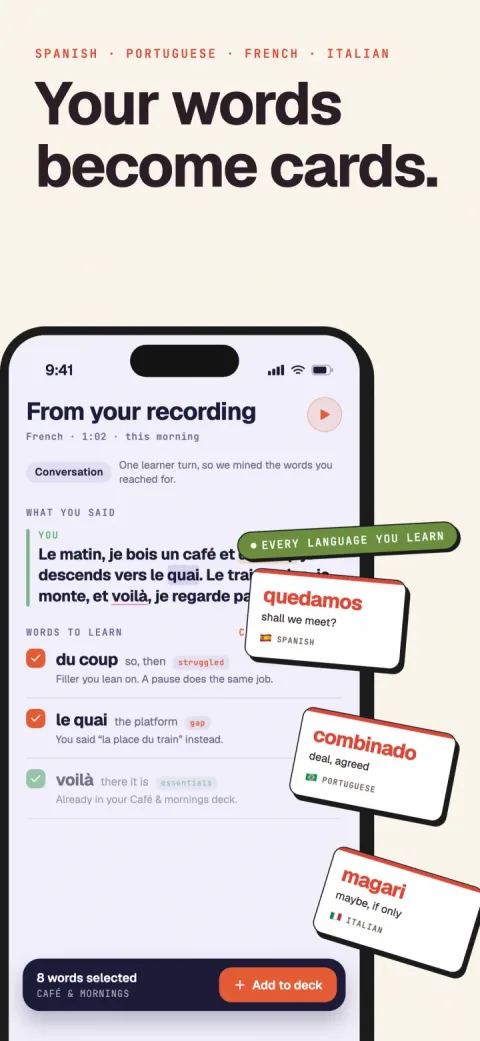
Verbamor ships native audio on every card so each word arrives ear-first, and pulls new words from recorded lessons where you heard them spoken in the first place. Your jamón deserves better than mine got.
And the arithmetic on card audio is quietly enormous. Sixty due cards a day, audio on each, is around 20,000 native-accent listens a year riding along on reviews you were doing anyway. That's a small ear-training curriculum, acquired for free, one bosque at a time.
Sources
Memory stores words as sound
- Baddeley, A., Gathercole, S., & Papagno, C. (1998). The phonological loop as a language learning device. Psychological Review, 105(1), 158–173.
Spelling distorts pronunciation
- Erdener, V. D., & Burnham, D. K. (2005). The role of audiovisual speech and orthographic information in nonnative speech production. Language Learning, 55(2), 191–228.
- Bassetti, B., & Atkinson, N. (2015). Effects of orthographic forms on pronunciation in experienced instructed second language learners. Applied Psycholinguistics, 36(1), 67–91.
Varied voices train the ear
- Logan, J. S., Lively, S. E., & Pisoni, D. B. (1991). Training Japanese listeners to identify English /r/ and /l/: A first report. Journal of the Acoustical Society of America, 89(2), 874–886.
Hear words before reading them
- Wyner, G. (2014). Fluent Forever: How to Learn Any Language Fast and Never Forget It. Harmony Books. (The ear-training-first sequence popularized.)
Your ears get there first.
Verbamor harvests words from spoken lessons and puts native audio on every card, so the sound is the thing you learn.
Start 7 days free