










Still know it next week.
Record your lesson. Every word your tutor taught you becomes a card, handed back right before you'd forget it.
Free on the App Store, iPhone and iPad. Or take the paper sheet and run it by hand.
Lesson 12, recording
Je n'arrive pas encore à me débrouiller au téléphone.
I still can't manage on the phone.
se débrouiller
to manage, to get by
Comes back Thursday“Your tutor teaches you great material, you forget most of it before the next lesson, and building flashcards is a second job.”
You're paying good money for lessons and keeping maybe a third of what's in them. That gap is the whole reason Verbamor exists.
Ebbinghaus, 1885
In controlled studies, most newly learned material is gone within days if it isn't reviewed. First measured by Ebbinghaus (1885), replicated by Murre & Dros (2015). “A third” is rhetoric; the curve is not. Full sources →
Three steps. You do one of them.
Record a lesson and Verbamor turns it into a deck, then runs the review. The whole loop, three real screens from the app.
Your lesson, transcribed
Record it or paste your notes. It comes back with your tutor and you in different colors, new words already flagged.
Your deck builds itself
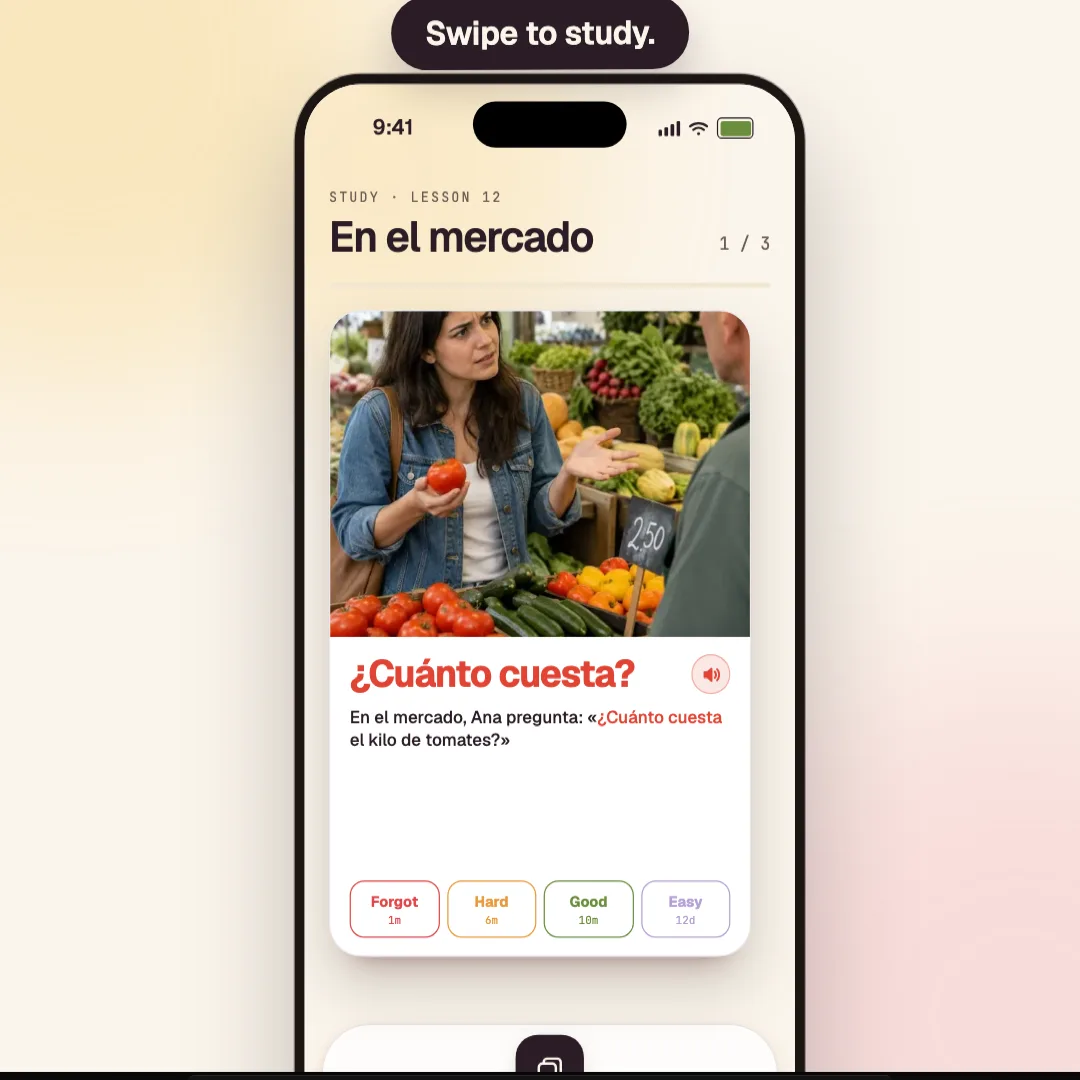
Cards appear with images, native audio, and fill-in-the-blank prompts. You never touch a template.
A schedule tuned to you
Research-grade spaced repetition, checked against your real reviews. You just swipe: four buttons, a few minutes a day.
New words fade fast: most are gone within days if nothing brings them back. Spaced repetition schedules each review for the moment right before a word would slip, and every catch pushes the next review further out. Days become weeks, then months, until the word is simply yours. The research behind it →
You'll see it working.
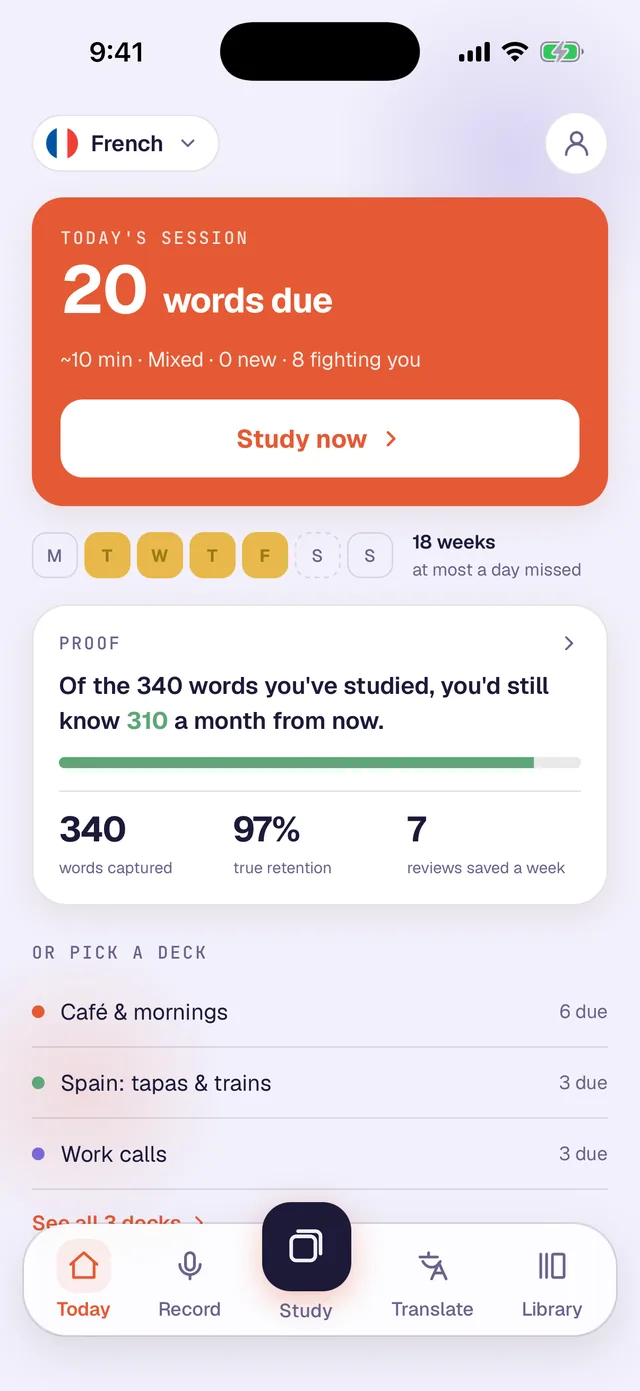
The home screen itself. Every number is computed from your own review history, and each one opens up to show the work. The figures below are one learner's, four months in.
And here's the work behind them.
Four things the schedule is doing while you're not looking, plus the deck you start from.
Time given back
Your tuned schedule next to the standard one. It holds the same retention on fewer reviews.
Open SRS benchmark
Refitting the scheduler's 21 parameters to your own review history improves prediction accuracy over stock settings (open SRS benchmark). Better predictions mean fewer wasted reviews. Full sources →
The forgetting forecast
What you'd remember in 30, 60, 90 days if you stopped today, next to what a few minutes of upkeep holds onto.
Cepeda et al., 2008
The longer you need to remember, the longer the ideal gap between reviews. Cepeda et al. (2008) mapped it precisely. Forecasting forgetting is what makes the schedule work. Full sources →
Captured from your lessons
Every word your tutor taught you, pulled from your recordings and notes, tracked to mastery.
How you speak
FrenchEvery recording gets read back for what your speaking shows: the strengths, and the habits worth fixing.
-
✓
Gender agreement is landingle phare, la voile, une petite tasse all matched
-
✓
Your passé composé is solidj'ai appris, je suis allé landed right
-
!
“du coup” is your go-to filler9 times this session. Try alors or en fait.
Your head start: the base 650
Before your first lesson is even captured, Verbamor seeds your deck with 650 base words, drawn from the top of the frequency curve, where a small set of words does most of the talking. They arrive with full study, images, and native audio, so you're learning from day one.
base words, ready day one
Word frequency is brutally top-heavy: the most frequent ~1,000 word families account for roughly 85% of everyday speech. The base 650 sit at the very top of that curve: concrete, picturable, and useful in almost any language.
Adolphs & Schmitt, 2003
Coverage figures from spoken-corpus studies (Adolphs & Schmitt, 2003; Nation, 2006). The 625-word base list follows Wyner's Fluent Forever (2014). Full sources →
None of this is our idea.
The memory research under Verbamor is over a century old and unusually well replicated. Our contribution is the plumbing. Four load-bearing findings:
Forgetting has a shape
Ebbinghaus plots the forgetting curve: steep, fast, predictable. Replicated, faithfully, 130 years later.
Murre & Dros, 2015 ↗Spacing beats cramming
The definitive meta-analysis: across 317 experiments, spaced review reliably outperforms massed study.
Cepeda et al., 2006 ↗Recall beats re-reading
Retrieval practice, meaning being tested, drives long-term retention of foreign vocabulary. Re-studying barely moves it.
Karpicke & Roediger, Science ↗Scheduling gets machine-tuned
FSRS: a memory model trained on real review logs, benchmarked on ~1.7 billion reviews. Verbamor fits its 21 parameters to you.
Ye et al., KDD '22 ↗Who this is for
- You take lessons with a tutor, on iTalki, Preply, or in person.
- You have a real deadline: a move, a trip, an exam, a partner's family.
- You want spaced repetition run properly for you, whether you've sworn by it for years or just learned the name today.
- Your evenings are worth more than deck maintenance.
- You're chasing a streak, not a goal.
- You dabble. A lesson here, a podcast there, no stakes.
- You genuinely enjoy building and tuning your own decks at midnight. (Respect. You already have everything you need.)
Weighing us against something else? These say where the other one wins.
- vs Ankiwho ends up building the cards
- vs Duolingothey barely compete
- vs Quizletwhat's gated, and what isn't
- vs your lesson notesthe competitor is a Google Doc
Or the roundups: spaced repetition apps, apps for Spanish, apps for French, apps worth running alongside a tutor. All of them in one place.
The ones you're about to ask
“Why keep reviewing after my trip?”
Forgetting is the default state. Everything you built decays without upkeep, and upkeep here costs a few minutes a day. Keep the app for exactly that phase. And if you're truly done, just stop.
“Do I still need my tutor?”
Yes. Your tutor teaches; Verbamor makes it stick. It's the memory system for your lessons, built to ride alongside them, and it works best when the lessons keep coming.
“Is the ‘science’ actually science?”
Yes, and none of it is ours. The forgetting curve was measured in 1885 and replicated in 2015. Spacing beat cramming across 317 experiments in the definitive meta-analysis. Retrieval practice has a paper in Science, using foreign-language vocabulary, no less. Every load-bearing claim on this site is sourced, with links, on the research page.
“How do I cancel?”
Apple handles the billing, so it lives in your iPhone settings: your name, then Subscriptions, then Verbamor. Cancelling keeps your access until the end of the period you've already paid for.
“Who do I email when something breaks?”
A person, at support@verbamor.com, usually within one business day. Tell us what you were doing, what happened, and which iPhone you're on. That one saves a round trip. The full support page has the rest.
“What happens to my recordings?”
They're yours to delete whenever you want, and we'll put together a copy of your data if you ask for it. The Privacy Policy spells out what goes where.
Keep what your lessons teach you.
Everything Verbamor automates, written out so you can run it by hand after your next lesson. No app required. Print it and write on it.
- The post-lesson debrief sheet. The 10 minutes after you hang up, in 5 steps with a time budget on each. One page, one lesson.
- The first ~650 words, in frequency order. Its own file, in Spanish, French, Italian or Portuguese, with 3 tick boxes next to every word.
- An honest Anki setup, and its bill. The settings that work, then the hours per week that route really costs you, counted in a table.
The app is free to download and does all 5 steps for you. Prefer paper? Put in your email and the sheet arrives in a few minutes, with the word list in the 4 languages so you can take whichever you're learning.
You're keeping about a third of what you learn.
The post-lesson debrief
The 10 minutes that get the rest back, written out to run by hand.