 Verbamor
Automating flashcard creation from your actual lessons
Automate your lesson flashcards if you take 2 or more lessons a week or you've abandoned a manual deck before; otherwise build them by hand. Hand-written cards are remembered slightly better, but a good one takes about 90 seconds, and a generated card you review for a year beats a hand-built deck that stops in week 5.
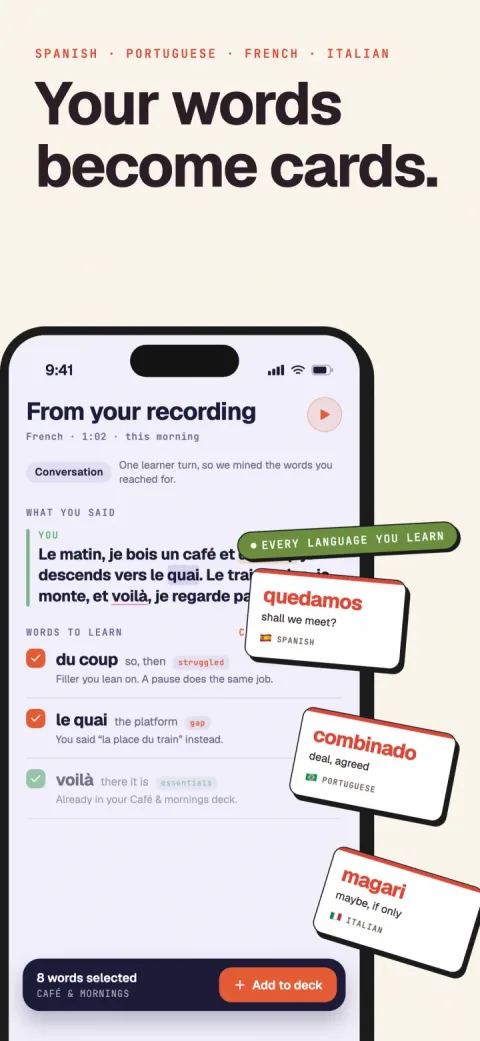
Verbamor turns the words from your own lessons and recordings into flashcards, and brings each one back before you’d forget it.

Automate your lesson flashcards if you take 2 or more lessons a week or you've abandoned a manual deck before. Cards you write yourself are remembered slightly better, because writing them is encoding work (the generation effect). But a generated card you review for a year beats a hand-built deck that stops in week 5, and stopping is what usually happens.
Making flashcards from your own lessons is the single best use of a flashcard app, and almost nobody sustains it.
The reason manual decks stall is arithmetic. A good card takes about 90 seconds: find the sentence, delete the right word, add the article, get the audio, check the meaning. Nine cards a lesson is 13 minutes. Two lessons a week is nearly an hour a month of admin standing between you and the studying.
Week 1 you build the cards. Week 3 you build them late. Week 6 you have a backlog of 4 lessons and the backlog is now the reason not to start.
Why manual systems fail
Manual systems fail because of where the work sits.
The card-building cost is paid up front, before any benefit. You do 13 minutes of admin tonight to get a review in 3 weeks that you can't feel. Every incentive is pointed the wrong way, and it gets worse as the deck grows, because the reviews take longer too.
The failure is also invisible. Nothing tells you you've stopped. You just have a deck that ends in March and a vague sense the app didn't work out.
What automation actually does
Automation moves the 90 seconds off you. That's the whole pitch, and it's worth more than it sounds, because a system that runs when you're tired is a different category of thing from one that runs when you're motivated.
The automated chain is: record or import the lesson, transcribe it, pull candidate words and phrases, build each into a sentence card with audio, schedule it. Verbamor is the one I build, and it does this end to end, up to 90 minutes of audio per lesson, with speaker labels so your tutor's speech and yours stay separate. Assume I'm biased and check the alternatives.
The stages that chain together to make this work are worth knowing whichever tool you pick.
The step worth insisting on, whatever you use, is that you approve the list. A tool that silently generates 200 cards from a transcript has automated the wrong stage. Selection is where a deck is won, and a review queue full of words you already knew is how people quit.
The one real cost
Writing a card yourself makes you process the meaning, and that processing builds memory before you ever review it.
Slamecka and Graf named this the generation effect in 1978: material you produce yourself is remembered better than the same material handed to you. Choosing which word matters, finding the sentence, deciding where the blank goes, that's all encoding work. Automation deletes it.
Anyone selling you automated cards who doesn't mention this is either unaware of it or hoping you are.
How much does the generation effect matter?
The generation effect matters enough to name, but not enough to make automated cards useless.
Here's the comparison that actually matters. It isn't hand-built cards against generated cards, both reviewed faithfully for a year. It's hand-built cards for 5 weeks against generated cards for a year, because that's the real fork.
Spacing effects are large and they compound. Cepeda and colleagues reviewed 317 experiments in 2006, and the gains from distributed practice are consistent and substantial. A generated card you review 8 times over 6 months beats a beautifully hand-crafted card you reviewed twice in October.
If you're the person who genuinely builds cards every week, keep doing that. You're getting the encoding benefit and the spacing benefit both, and no tool improves on it.
Keeping some of it
You can get part of the generation effect back without paying the full 90 seconds.
Approving the candidate list is itself a decision about meaning. When you look at 22 candidates and keep 9, you're doing the selection work, which is the most useful half of the encoding.
Editing a generated card also counts. Fix a sentence that doesn't match how your tutor used the word, and you've just processed it properly.
And the strongest way back to the generation effect: say the word out loud when you approve it. It costs 2 seconds and it's production practice, which is the thing the cards exist to train.
How to decide
Build your cards yourself if you've sustained a manual deck for more than 2 months, you take fewer than 2 lessons a week, or you enjoy the craft. Anki costs nothing on a computer or an Android phone and $24.99 once for the iPhone app, it ships no content of its own, and in the right hands it's better than anything automated.
Automate if you've abandoned a manual system before, you take 2 or more lessons a week, or the lessons cost enough that losing most of them is the expensive failure. Cards that exist beat cards that would have been better.
If your lessons are on italki or Preply, those pages cover what each platform already saves.
If you're not sure, the honest test is your own history. Look at whether you've ever kept a deck going past 8 weeks. That answer is more reliable than any argument on this page.
Questions people actually ask
Can flashcards be created automatically from my lessons?
Yes, flashcards can be created automatically from your lessons. The chain is recording or importing the lesson, transcribing it, pulling candidate words and phrases, building each into a sentence card with audio, then scheduling it. The stage worth keeping manual is approving which candidates become cards, since a tool that generates everything from a transcript hands you a queue full of words you already knew.
What do I lose by not writing my own flashcards?
You lose the generation effect. Slamecka and Graf showed in 1978 that material you produce yourself is remembered better than the same material given to you, and choosing the word, finding the sentence and placing the blank is all encoding work that builds memory before the first review. Automation removes it, and that's a real cost rather than a marketing caveat.
Are automated flashcards worse than hand-made ones?
Per card, automated flashcards are slightly worse, because you skip the encoding work of building them. The comparison that matters in practice is different: hand-built cards for 5 weeks against generated cards for a year. Spacing effects are large and compound, so a generated card reviewed 8 times over 6 months beats a hand-crafted card reviewed twice in October.
How long does it take to make a flashcard by hand?
A good flashcard takes about 90 seconds by hand: finding the sentence, deleting the right word, adding the article, getting audio, checking the meaning. Nine cards from a lesson is around 13 minutes, and at 2 lessons a week that's nearly an hour a month of admin before any studying happens.
Can I get some of the generation effect back with automated cards?
Partly: automated cards can win back some of the generation effect. Approving the candidate list is itself a judgment about meaning, and choosing 9 from 22 is the most useful half of the encoding work. Editing a generated sentence so it matches how your tutor used the word counts too, and saying the word out loud as you approve it adds production practice for about 2 seconds of effort.
Should I automate if I only take one lesson a fortnight?
Probably not, at one lesson a fortnight. At that rate the manual method is around 13 minutes a fortnight, which most people sustain, and you keep the encoding benefit. Automation earns its place when the admin load is what's stopping you, which usually means 2 or more lessons a week or a history of abandoned decks.
Sources
The generation effect
- Slamecka, N. J., & Graf, P. (1978). The generation effect: Delineation of a phenomenon. Journal of Experimental Psychology: Human Learning and Memory, 4(6), 592–604.
Why reviewing for longer wins
- Cepeda, N. J., Pashler, H., Vul, E., Wixted, J. T., & Rohrer, D. (2006). Distributed practice in verbal recall tasks: A review and quantitative synthesis. Psychological Bulletin, 132(3), 354–380.
Why recall beats rereading
- Karpicke, J. D., & Roediger, H. L. (2008). The critical importance of retrieval for learning. Science, 319(5865), 966–968.
Anki's platforms and price
- Anki downloads for the free desktop and Android versions, and the AnkiMobile App Store listing for the US$24.99 one-time price.
Hand-built cards for 5 weeks, or generated ones for a year.
Verbamor writes the cards from your own lesson, so the sentences are the ones your tutor used. You still approve which words are worth keeping.
Start 7 days freeThe 7-day free trial is on the yearly plan.