Verbamor
How to turn a language lesson into flashcards that survive the week
Jot two or three words per item during the lesson, cut the 30-odd keepable items to about 9 within a few hours, then turn each into the lesson's own sentence with one blank and an English hint. Review them that night, on day 3 and before the next lesson. No tool required.
Your tutor spent 10 minutes untangling por and para for you. You got it. Two weeks later you're staring at a sentence, picking one at random, and watching your tutor's face for the flinch.
Flashcards fix that two-week blank, but only if they're built out of the right 9 things and phrased so they make you produce rather than nod along. Most of the work is in the choosing and the phrasing, and it takes about 20 minutes.
Here's the whole method. No tool required.
Capture: what to write during the lesson
Write almost nothing while the lesson is running. Two or three words per item, enough to rebuild it later. "por/para thing". "se me cayó". "pretérito on 'saber'?"
Full sentences during a lesson cost you the thing you're paying for. You're transcribing instead of listening, and the tutor is waiting.
What earns a jot is narrow:
- Words you reached for and missed. The gap you hit mid-sentence is the highest-value item in the whole hour, because you've already proven you want to say it and can't.
- Corrections to mistakes you keep making. If your tutor has fixed the same gender twice, that's a card.
- A one-off slip, though, is just a slip. You said el mano once at the end of a tiring hour. Let it go. Cards are for patterns.
- Phrases your tutor produced that you wouldn't have. The natural construction you'd have built clumsily out of dictionary parts.
Recording the lesson makes capture easier, since you can jot even less and rebuild from audio. If your tutor is fine with it, ask.
Plenty of people arrive at the capture step with something other than a notepad, and the move is the same in every case: get it into one plain list, then cut. If you used italki Classroom, the private notes pane and your teacher's saved notes are already on your account, so paste both into one document. If you have a recording, scrub it rather than transcribing it, because the moments worth keeping are the ones where you stalled or got corrected, and those are audible.
A shared Google Doc or PDF from your tutor is usually a curriculum rather than a record of what you got wrong, so mine it for the 2 or 3 things you personally fumbled and ignore the rest. Same with a screenshotted whiteboard: retype the handful of items you couldn't produce today. The cut in the next section is doing the real work, and it only works on a list you can see all at once.
Cut: 30 items down to 9
Do the cut within a few hours of the lesson, while "por/para thing" still means something. By Friday it's a note from a stranger.
An hour surfaces 30 or more keepable items. I keep about 9, and the number is mine, not a finding. The papers further down this page say nothing about how many cards to build; the 9 is a working figure from my own lessons, and the failure I see most often is a learner who kept all 30, faced a 30-card pile on Tuesday, and never opened it again.
Cut these without ceremony:
- Words you already recognise. Recognising ventana when you read it is not the same as producing it, but if it's already coming out of your mouth unprompted, it doesn't need a card.
- Words you won't say this month. Alcachofa is a fine word. Do you talk about artichokes? Word frequency in any language is lopsided enough that your early effort belongs on the words you'll actually reach for, which is what the frequency curve is about.
- Anything a dictionary would have told you. If you could have looked it up without the lesson, the lesson wasn't where the value was.
- Grammar phrased as a rule. More on why below.
Deciding an item doesn't deserve a card requires judging whether you can already produce it. That's a retrieval attempt wearing a disguise.
Nine cards you review on Thursday beat 30 cards you built beautifully on Monday and never opened again.
Phrase: the blank is the whole design
Phrasing is the step that decides whether the cards work, and it's the step every three-click tutorial skips.
Take the sentence the item appeared in during the lesson. Delete the target word. Leave a gap. Put a short English hint underneath. That's the card.
Two rules govern the blank, and a third thing that isn't quite a rule.
One blank per card. Two gaps in a sentence means a half-right answer, and a half-right answer is a grade you can't give honestly. That matters more than it sounds, because the scheduler believes whatever grade you feed it.
Use the sentence from your lesson, not an invented one. You already have a memory of hearing it, in your tutor's voice, in a conversation that went somewhere. That context is doing work a dictionary example can't.
The third: the card has to be answerable out loud before you look. Say the word, then check. Recognition after the flip is the weaker test. In Karpicke and Roediger's 2008 Science study, students learned Swahili-English pairs and then either kept being tested on an item or kept restudying it after their first correct answer. A week later, repeated testing had produced a large positive effect on recall. Repeated studying had produced none at all.
A two-sided card only tests retrieval if you supply the discipline every single time. A blank supplies it structurally.
What to add after the blank
Each of these is worth 20 seconds.
Put the article inside the blank. Write ______ ventana and the answer is la ventana. Gender learned separately from the noun is gender you'll guess at in conversation, and you'll guess wrong at roughly the rate you'd expect.
Get the sentence in audio. Ask your tutor to record the sentences at the end of the lesson, or record them yourself off the lesson audio. Learn a word from its spelling first and you tend to build a pronunciation you then have to unlearn. Bassetti and Atkinson measured that in 2015, on learners who'd had years of instruction: the written form was still bending how they said the word. The rest of the argument is in the native audio post.
Add an image where the word is concrete, and don't trust it. This one comes with a caveat most guides skip. Carpenter and Olson tested pictures against native-language translations for Swahili vocabulary and found pictures didn't beat translations at first. What they did do was make learners more confident than they should have been. Once that overconfidence was corrected, by retrieval practice or a plain warning, pictures helped.
So draw the sketch, and then grade yourself harshly on the cards that have one. The longer argument is in the dual coding post. Skip images for abstractions: nobody draws sin embargo.
Review: the schedule that holds it
Cards you don't review are craft supplies. Four touches, about 18 minutes across the week:
| When | How long | What you do |
|---|---|---|
| Same day, at build time | ~20 min | Building the cards is the first review. You're reconstructing sentences from memory while you write them. |
| That night | 3 min | Run the 9 cards out loud. Gais and colleagues tested high-school students on English-German vocabulary 48 hours after learning. The ones who slept within a few hours of learning recalled more than the ones deprived of sleep that first night, and the deficit was still significant after a recovery night. |
| Day 3 | 5 min | Cold. This is the touch people skip and the one carrying the most weight. You'll fail some. Good. |
| Before the next lesson | 5 min | Test, then bring the failures to your tutor. Now the lesson starts from your real gaps. |
The night touch is the one that looks like filler and isn't. Gais, Lucas and Born ran two experiments on high-school students learning English-German vocabulary, and tested recall 48 hours after learning. Students who slept within a few hours of learning beat the ones kept awake that first night. Everyone got a recovery night before the test, and the deprived group was still behind, which is what rules out the boring explanation that they were simply tired on test day. More in the sleep post.
Cepeda and colleagues went through 317 experiments across 184 articles on distributed practice. One finding is worth carrying around: the best gap between sessions gets longer as the deadline you're studying for gets further away. For a language you intend to speak for years, that argues for gaps measured in days and then weeks, not one long Sunday.
If a card fails 4 times running, reread the card. Usually the blank is ambiguous, or you've packed two ideas into one sentence. Rewrite it. There's more on this in the guide on why lessons evaporate.
Four cards I'd throw away
Concrete failures, because "make good cards" is advice you can't act on.
- "The subjunctive is used after expressions of doubt." You can recite this and still freeze mid-sentence. Blank the verb in No creo que ______ verdad instead.
- "hacer = to do, to make, to cause, and in weather expressions." Four meanings on one card means you'll answer with whichever surfaces first and call it a pass. Split it, or blank hacer inside one specific sentence.
- A blank with 5 valid answers. Ayer ______ al cine accepts fui, fuimos, íbamos. Add enough sentence to pin it down: Ayer yo ______ al cine solo.
- The whole lesson transcript, chopped into cards. Every sentence your tutor said is not worth 9 months of reviews. This is the failure mode automation walks straight into if nobody's filtering.
What do you lose by automating your flashcards?
You lose the generation effect, which is the part the tutorials selling you software leave out.
Choosing which sentence to use, deciding where the blank goes, working out what hint pins the answer down: that's you processing the meaning, and it lays down a memory before you review the card once.
Slamecka and Graf named this the generation effect in 1978. Material you generate yourself is remembered better than the same material you simply read. As far as I can tell it has held up since.
So a generated card starts behind. Look at the fourth card in the figure above: it's a perfectly good card, arguably better built than the one I wrote by hand, with audio and an image I'd never have bothered to add on a Tuesday. And it cost you the encoding. The first time you meet that sentence is the first time you review it.
What automation gives back is consistency and volume. Every card gets the article, the audio and the image, on the day, whether or not you felt like it. The cards exist during the weeks when you'd have built nothing.
Whether hand-built or automated cards win depends on a question only you can answer: were you actually going to build them? Twenty minutes after every lesson, in week 7, in the week you're travelling. Most people are honest about this if you ask them in November rather than January.
You have 3 lessons a month and you enjoy the craft
At 3 lessons a month the pile stays small enough to review by feel, and you're collecting the generation effect on every card. Index cards and a pen genuinely work here. Adding software to a habit that already runs buys you a due-date calculation you don't need yet.
Manual review breaks in week 3. Three lessons in, you have 27 cards and no signal about which 6 are fading today. So you review everything (slow, and mostly wasted on cards you know cold) or you review nothing.
Spotting which cards are fading is the job software actually does. FSRS models each card's decay separately and puts it in front of you near the point of forgetting. Anki does it well, once you enable it, since Anki ships SM-2 by default and FSRS is a setting you turn on. Anki also ships no language content at all, so you're back to building every card yourself, which for this particular workflow is either the point or the problem.
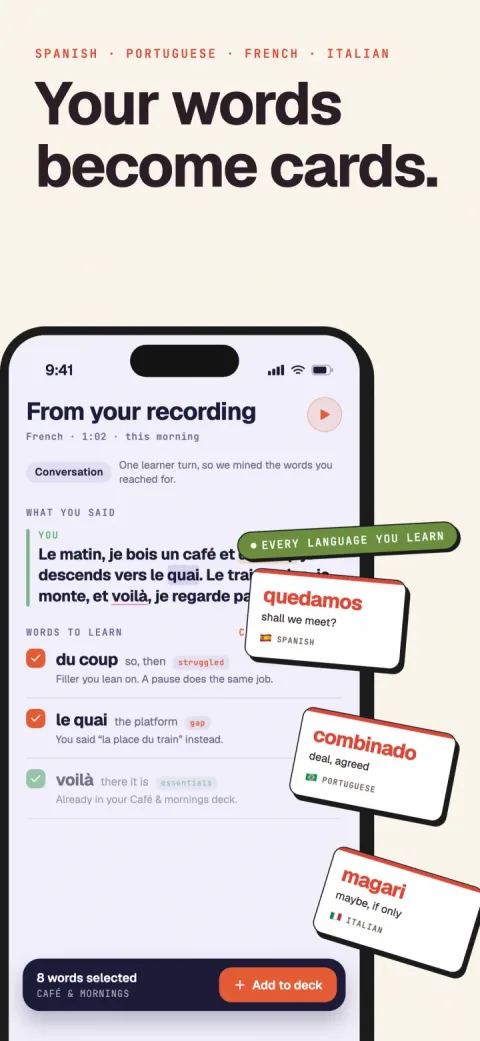
Verbamor sits at the other end: it records the lesson, mines it for anything you actually stumbled on, a word or a whole phrase, and writes the cloze card with native audio and an image attached. That fourth card in the figure is what comes out. You lose the generation effect. You gain the 9 cards existing on a Tuesday in November.
Both trades are defensible. Pick the one that matches how you actually behave in week 7.
If you'd rather run this on paper, the free handbook has the capture sheet and the debrief as printable pages, with no purchase attached.
Questions people actually ask
How many flashcards should I make from one lesson?
Around 9 from a 60-minute lesson, which is a working number rather than a result. An hour surfaces 30 or more keepable things, and the learners who keep reviewing are the ones who kept fewer. Pick the items you reached for and missed, the corrections to mistakes you keep repeating, and the phrases carrying grammar you haven't automated. Nine cards you actually review beats 30 you abandon in week 2.
Should a flashcard have a single word or a whole sentence on it?
The best card is a sentence with one blank in it. A bare word gives you nothing to produce from, and a sentence with several gaps tests too much at once. One blank per card, so a failure tells you exactly what you didn't know. Use the sentence from your lesson: you already have a memory of hearing it, and that context does work a dictionary example can't.
Is it better to make flashcards by hand or use a generator?
Hand-built cards are genuinely better in one respect. Choosing the sentence and writing the blank forces you to process the meaning, and that encoding effort produces a memory before you ever review the card. Slamecka and Graf called it the generation effect in 1978 and it has held up. Automation trades that away for consistency and volume. Which wins depends on whether you were ever going to build them.
What should I not put on a flashcard from a lesson?
Words you already recognise, words you won't say within the month, anything a dictionary would have told you, and grammar phrased as a rule. A card reading "the subjunctive is used after expressions of doubt" tests nothing, because you can recite the rule and still fail to produce the verb. Blank the verb in a sentence instead.
How soon after a lesson should I make the cards?
The same day, within a few hours. Forgetting seems to run fastest in the first day or two, so a note reading "that thing about por" is recoverable on Tuesday evening and meaningless by Friday. Building the cards is also a review in itself, since you're reconstructing the sentences from memory as you write.
Do I need a flashcard app, or will paper work?
Paper works, and for one lesson's worth of cards it works well. It stops working in week 3, when you have 3 lessons stacked up and no signal about which of the 27 cards are fading today. Manual review defaults to reviewing everything or reviewing nothing. Software's real job is knowing which cards are due.
Sources
Why writing the card yourself helps
- Slamecka, N. J., & Graf, P. (1978). The generation effect: Delineation of a phenomenon. Journal of Experimental Psychology: Human Learning and Memory, 4(6), 592–604.
Producing beats recognising
- Karpicke, J. D., & Roediger, H. L. (2008). The critical importance of retrieval for learning. Science, 319(5865), 966–968.
- Roediger, H. L., & Karpicke, J. D. (2006). Test-enhanced learning: Taking memory tests improves long-term retention. Psychological Science, 17(3), 249–255.
Spacing the four touches
- Cepeda, N. J., Pashler, H., Vul, E., Wixted, J. T., & Rohrer, D. (2006). Distributed practice in verbal recall tasks: A review and quantitative synthesis. Psychological Bulletin, 132(3), 354–380.
- Gais, S., Lucas, B., & Born, J. (2006). Sleep after learning aids memory recall. Learning & Memory, 13(3), 259–262.
Why spelling first costs you
- Bassetti, B., & Atkinson, N. (2015). Effects of orthographic forms on pronunciation in experienced instructed second language learners. Applied Psycholinguistics, 36(1), 67–91.
Adding the image, with a caveat
- Carpenter, S. K., & Olson, K. M. (2012). Are pictures good for learning new vocabulary in a foreign language? Only if you think they are not. Journal of Experimental Psychology: Learning, Memory, and Cognition, 38(1), 92–101.
Turning FSRS on in Anki
- Anki Manual. Deck options. FSRS described as an alternative to the legacy SM-2 algorithm, and where to enable it.
The lesson was the expensive part.
Verbamor records the lesson, pulls out the words you actually stumbled on, and builds the cards with native audio while you make coffee.
Start 7 days free