Verbamor
Why you forget what your tutor taught, and the fix
You forget what your tutor taught because a lesson is one exposure and nothing makes you retrieve the material while it fades; the forgetting curve is steepest in the first 48 hours. The fix is four short recall tests, within the hour, that night, on day 2 or 3 and before the next lesson, about 18 minutes a week.
Say your tutor spent 20 minutes on se me olvidó and why it isn't lo olvidé. You got it. You made a joke with it. The lesson ended and you felt like you'd earned the hour.
Nine days later the phrase is gone, and what's worse is you don't know it's gone until you need it and produce a flat olvidé instead. The tutor gently corrects it. Again.
Losing a lesson you understood is the most common complaint from people paying for lessons, and it gets misdiagnosed as a personal failing about as often as it gets diagnosed at all.
It isn't your memory
The rate at which people forget new vocabulary is steep and pretty consistent across learners. You're not unusually forgetful. You're on the same curve as everyone else, and the curve is brutal in the first 48 hours.
What separates people who keep their lessons from people who lose them is whether anything pulls the material back out of their head while it's fading. Nothing about that is aptitude. It's scheduling.
You don't have a memory problem. You have a calendar problem, and it costs you whatever you're paying per hour.
What the curve actually measures
Hermann Ebbinghaus mapped the forgetting curve in 1885 by memorizing thousands of nonsense syllables and testing himself at intervals, using himself as the only subject. His finding: recall drops fastest immediately after learning, then the decline flattens.
The obvious objection is that 1885 self-experiments don't replicate. This one does. Jaap Murre and Joeri Dros re-ran it in 2015 with a proper sample and reproduced the curve's shape. It's one of the oldest results in psychology that survived contact with modern methods, which is rarer than it sounds.
The practical read for a tutored learner: the steepest part of the loss happens before your next lesson. If you see your tutor weekly, the curve has already done most of its damage by the time you're back in the chair. Full detail on the mechanism is in the forgetting curve post.
Where a tutored lesson leaks
A lesson is dense. An hour with a good tutor can surface 20 or more items worth keeping: words, a correction to a verb you've been mangling, an idiom, the reason a preposition changed.
Each of those items got exactly one exposure. You understood it in the moment, with your tutor's face and gestures and the sentence around it all propping the meaning up. Comprehension in context is not the same as being able to produce the word cold, 9 days later, with none of that scaffolding present.
So the leak isn't in the lesson. The lesson worked. The leak is in the 6 days afterward when nothing asks you to produce any of it.
Does rereading your lesson notes help?
Not much, though rereading the lesson notes is most people's fix. It feels productive and it's close to useless, which is an annoying combination.
Roediger and Karpicke ran the cleanest test of rereading in 2006. One group read a passage twice; the other read it once, then tried to recall it with nothing in front of them. After 5 minutes, the rereaders looked better. After a week, the recall group had them beaten by a wide margin.
The version that matters most for language learners came in Science two years later. Karpicke and Roediger had students learn 40 Swahili-English pairs, then varied what happened after the first correct answer. Items that kept being tested came back at about 80% a week later. Items that were only restudied came back at about 36%.
Reading your notes is the 36% column. That's the whole problem with the tidy Google Doc: it's built out of the study behaviour that loses.
Karpicke and Roediger's students couldn't feel the difference, either. Their own predictions were flat across all 4 conditions, which is worth sitting with if you've been judging your progress by how familiar the notes feel. More on that in the testing effect.
The four touches that hold a lesson
Here's the schedule I'd defend. It's built on 2 findings: the curve is steepest early, and spacing beats massing.
Spacing has a big evidence base behind it. Cepeda and colleagues reviewed 317 experiments on distributed practice and found the same total study time produces better retention when it's spread out than when it's piled up.
| When | How long | What you actually do |
|---|---|---|
| Within the hour | 5 min | Before opening any notes, write down what you remember. The gaps you find are the real lesson output. Check the notes only after. |
| That night | 3 min | Run the list once more, out loud, producing each item from the English side. Sleep does consolidation work on what you touched that day. |
| Day 2 or 3 | 5 min | Same test, cold. This is the one people skip and it's the one carrying the most weight. You'll fail items here. That's the point of doing it. |
| Day 7, before the next lesson | 5 min | Test again, then bring the items you missed to your tutor. Now the lesson starts from your actual gaps. |
Total: about 18 minutes across a week, against an hour of lesson you already paid for. The ratio is the argument.
The night touch isn't filler. Sleep after learning does measurable consolidation work, and the vocabulary you engaged with that day is what gets processed, which is covered in the sleep post.
One rule holds the whole thing together: produce before you check. Every touch has to start with you trying to pull the word out of nothing. The moment you read first, you're back in the 36% column.
Doing it by hand, honestly
You can run the four-touch schedule with a notebook and no software, and it works. I want to be plain about that, because plenty of pages on this query exist to tell you the manual version is broken so you'll buy something. It isn't broken.
What the manual version needs is for you to write the items down during or right after the lesson, and then actually reopen them 4 times on a schedule nobody's reminding you about. If you're the kind of person who does that, you don't need an app, and I'd rather say so than pretend otherwise.
The manual version's failure mode is specific and it isn't laziness. It's that week 3 has 3 lessons' worth of items in one document, and no signal about which of them are fading today. Manual review defaults to reviewing everything or reviewing nothing, and both lose to reviewing the 9 items that are actually about to go.
Timing is the one job software does better: it knows which items are due. FSRS models each item's decay separately and surfaces it near the point of forgetting. Whether that's worth paying for depends entirely on whether you kept doing the manual version past week 3.
You already keep a review habit
If your notes get reopened on a schedule and you test yourself from them rather than reading them, you have the thing that matters. Adding a subscription won't improve a working system. Come back if the habit lapses, because that's the failure this fixes.
If you'd rather have the routine on paper, the free handbook has the post-lesson debrief as a printable page, no purchase involved.
Questions people actually ask
Why do I forget everything from my language lessons?
Forgetting is the default, and a lesson is one exposure. The steepest loss happens in the first day or two, before you get back to the material. An hour can introduce 20+ items you retrieved exactly once each. Recall drops without retrieval, and understanding something in context isn't retrieval.
How soon after a lesson should I review?
Once the same day, then again after a night's sleep. The same-day touch can be 5 minutes. Trying to recall what came up, before looking at your notes, does more than half an hour of rereading them.
Do I need flashcards, or are lesson notes enough?
Notes are enough if you reopen them and test yourself from them. The evidence isn't about format, it's about whether you produce the word from memory or read it. If your notes make you produce it, they're working.
Is it my memory, or am I doing something wrong?
Neither. The forgetting rate for new vocabulary is roughly the same for everyone and it's steep. The difference between learners who keep lessons and learners who lose them is whether anything makes them retrieve the material while it's fading.
What if I only have 5 minutes a day?
Five minutes a day beats an hour on Sunday. Across 317 experiments, spreading the same total study time out produced better retention than piling it up. The daily 5 minutes is also the version people keep doing.
Sources
The forgetting curve
- Ebbinghaus, H. (1885/1913). Memory: A Contribution to Experimental Psychology. Full text at Classics in the History of Psychology.
- Murre, J. M. J., & Dros, J. (2015). Replication and analysis of Ebbinghaus' forgetting curve. PLOS ONE, 10(7), e0120644.
Retrieval beats restudying
- Karpicke, J. D., & Roediger, H. L. (2008). The critical importance of retrieval for learning. Science, 319(5865), 966–968.
- Roediger, H. L., & Karpicke, J. D. (2006). Test-enhanced learning: Taking memory tests improves long-term retention. Psychological Science, 17(3), 249–255.
Spacing beats massing
- Cepeda, N. J., Pashler, H., Vul, E., Wixted, J. T., & Rohrer, D. (2006). Distributed practice in verbal recall tasks: A review and quantitative synthesis. Psychological Bulletin, 132(3), 354–380.
The lesson was the expensive part.
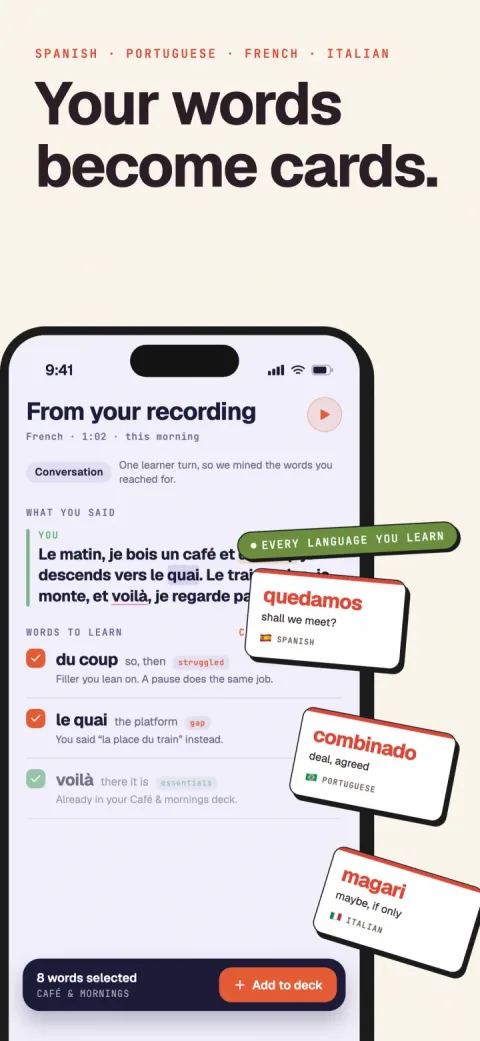
Verbamor records the lesson, builds the cards from what your tutor actually taught, and puts each one back in front of you near the day it would have gone.
Start 7 days free