Verbamor
The hour after your lesson matters more than the lesson
Review a lesson in three short touches, about 15 minutes in all: within the first hour, write down everything you can recall before opening your notes; that night, test yourself aloud for 4 minutes before sleep; on day 3, test yourself cold. If you only do one, make it day 3. Your tutor's homework comes first.
Your tutor spent 11 minutes untangling por and para for you. She used an example about a bus ticket that finally made it click. You said "ohhh" out loud.
Nine days later you're in the same hole, and your tutor's drawing the same diagram. Neither of you says anything about it.
The problem is the 6 days after the lesson, when nothing asks you to produce any of it. That's a schedule problem, and you can fix it in about 15 minutes a week.
Start with your tutor's homework
Before any of this: if your tutor set you a task, do that task. Properly. It beats every generic routine on this page, including mine.
Your tutor watched you fail at something specific. She heard which verb form you dodge and which construction you route around every time. A task aimed at that is worth more than a schedule designed by someone who has never heard you speak.
So if you reliably do your tutor homework, you're already ahead of most people reading this, and I'd rather say that plainly than pretend you need a system. Use the routine below to cover the days the homework doesn't reach, or the weeks nothing gets set.
The routine, on a clock
Three touches. About 15 minutes total, against an hour you paid for.
| When | How long | What you do |
|---|---|---|
| Within the first hour | 6 min | 4 minutes writing what you remember with the notes closed, then 2 minutes checking. Mark the gaps. The gaps are the output. |
| That night | 4 min | Cover the target-language column. Say each item out loud from the English side. Short on purpose. It's a handoff to sleep. |
| Day 3 | 5 min | Cold test, nothing in front of you. You'll fail items. That's what makes this the touch that counts. |
One rule runs through all three touches: produce before you check. Every touch starts with you pulling the word out of nothing. The second you read first, you've swapped the exercise for a worse one.
Touch 1: within the first hour, 6 minutes
Close the notes. Open a blank page. For 4 minutes, write down every word and correction you can drag back out of the lesson.
Your recall list will feel thin. You had an hour of material and you'll produce maybe 12 items, half of them fuzzy. Write the fuzzy ones anyway, with a question mark.
Then, and only then, 2 minutes with your notes open. Don't reread them start to finish. Scan for what you missed and mark those items. Six or 7 misses wouldn't surprise me for a dense hour.
Why blank-page first rather than notes first: rereading loses. Roediger and Karpicke ran the clean version of this in 2006 with prose passages. One group read a passage repeatedly, another read it once then took recall tests. With the final test 5 minutes later, the rereaders genuinely won. At 2 days and at a week, the recall group had them beaten. That's the testing effect, and it's why the order of those 6 minutes matters more than their length.
Now the part I should be straight about. That study justifies producing before you check. It says nothing about doing it inside an hour, and I don't have a paper that puts a clock on this touch the way Cepeda puts one on day 3.
The hour is my number, not a finding. It's there because that's roughly how long you can still rebuild the lesson without help, while your tutor's phrasing and the order things came up in are still sitting there, and that window shuts fast. Ninety minutes is fine. The next morning is a different exercise, and a harder one.
A word list isn't always what you walk away with, though. If the hour was mostly conversation, write down the 3 or 4 sentences you tried to say and got corrected on, both versions, yours and hers. Those are the items.
And if the lesson was a grammar untangle like the por/para one, don't copy your tutor's explanation. Write the rule in your own words, then invent one fresh example she never gave you. Generating your own material is remembered better than reading someone else's, which Slamecka and Graf pinned down in 1978, and the invented example is the thing you'll test yourself on later.
Four minutes of failing to remember is worth more than 20 minutes of reading a tidy document. The failing is the mechanism.
Touch 2: that night, 4 minutes
Before bed, take the recall list. Cover the target-language side. Go down the English column and say each one out loud. If it doesn't arrive in about 5 seconds, mark it and move on.
Four minutes is deliberately not enough time to study properly. It's a handoff: the material goes in front of a night's sleep while it's still active.
Gais and colleagues tested sleep after learning in 2006 with high-school students learning English–German vocabulary, checking recall 48 hours after learning. Students who slept within a few hours of learning did better than students kept awake that first night, and the deprived group was still behind after a recovery night's sleep, which is what rules out simple tiredness as the explanation. Sleep does filing work on what you touched that day, covered properly in the sleep post.
Say each word out loud rather than in your head. Producing the sound is closer to the thing you'll need to do in the next lesson, and it stops you from silently upgrading a half-remembered guess into a pass.
Touch 3: day 3, 5 minutes
Two days later, cold. No list in front of you until you've tried.
Day 3 is the touch people skip, and it's the one carrying the most weight. By day 3 the material has faded enough that pulling it back is genuinely hard.
You'll fail items on day 3. Good. Kornell, Hays and Bjork ran 6 experiments in 2009 on questions built so the guess would fail, and a failed attempt followed by the answer still beat being handed the answer straight. That's the evidence the day-3 touch stands on.
There's a name for the category the day-3 touch belongs to. Elizabeth and Robert Bjork call conditions like this desirable difficulties, and their 2011 chapter names spacing and self-testing in the list, defining them as difficulties that earn the word by triggering "encoding and retrieval processes that support learning, comprehension, and remembering." Their caveat travels with it: a difficulty stops being desirable if you lack what you'd need to get through it. A cold test on a list you never wrote down is just a bad afternoon.
So why day 3 rather than the same evening or the following Sunday? Cepeda and colleagues taught facts to more than 1,350 people in 2008, varied the gap before a review, and tested up to a year later. The best gap gets longer as your deadline gets further away, while shrinking as a share of it: about 20 to 40% of a 1-week delay, falling to roughly 5 to 10% when the test is a year out.
Cepeda's conditional result is the finding to hold onto, and it's the one their earlier review of 317 experiments on distributed practice landed on too. The gap that wins depends on how far away you need the material. Spreading study out generally beats piling it up, but the useful question was always how far apart, and that answer moves.
Cepeda's shortest delay was a week, and a lesson cycle is about that, so the top of the range points at day 2 or 3. I round to day 3 for 2 reasons: day 2 collides with the night touch for a lot of people, and a slightly-too-long gap costs less than a slightly-too-short one. Day 2 is defensible and I won't argue with anyone who prefers it. The honest version is that anywhere in that window beats the two things people actually do, which are the same evening and never.
Either way, day 3 is far enough from touch 2 that you've genuinely forgotten some of the material, which is the difference between a review and a formality. Cram all three touches into one evening and you get the illusion of having studied and little else, which is the whole problem with cramming.
End by carrying your day-3 misses into the next lesson. That turns a review into an agenda, and your tutor starts from your actual gaps rather than from wherever the textbook happened to stop.
If you only ever do one touch
Most people won't run all three. Fine.
Doing one touch well matters more than the schedule. A single honest retrieval attempt on day 2 or 3, where you produce the words from nothing before checking, beats three sessions of scrolling your notes.
The size of the gap between retrieval and rereading is the reason I'll defend one touch. Karpicke and Roediger had college students learn 40 Swahili-English pairs, then varied only what happened after the first correct answer. Items that kept being tested came back at about 80% a week later. Items that were repeatedly restudied but dropped from testing came back at 36%.
Karpicke and Roediger's students couldn't feel the difference either. Every group predicted they'd recall about half the list, and those predictions didn't shift between conditions, which is worth sitting with if you've been judging your progress by how familiar the notes look.
So pick the day-3 touch if you're picking one. It's the one with the widest gap between how it feels and what it does.
Can you run this routine on paper?
Yes, the whole routine runs on a notebook and a covered column. No software involved, and it works.
Where the paper routine breaks is week 4, when 4 lessons' worth of items sit in one document and nothing tells you which of them are fading today. Manual review then defaults to reviewing everything or reviewing nothing, and both lose to reviewing the handful that are actually about to go. That's the one job software genuinely does better, and if your paper habit is holding, you don't need any.
The free handbook has the three-touch routine as a printable post-lesson page if you want it on paper. And if you want the longer version of why the material disappears in the first place, that's in the guide on remembering what your tutor teaches.
Questions people actually ask
What should I do right after a language lesson?
Spend about 6 minutes before you open your notes. Write down everything you can pull back from memory alone, give that 4 minutes, then open the notes for 2 minutes and mark only what you missed. The gaps you find are the useful output. Writing it before you look is what makes the exercise retrieval, and retrieval is the version that holds a week later. The retrieval part is the bit with a study behind it. The one-hour timing is my judgement rather than a finding: it's when you can still reconstruct the lesson unaided, and that window shuts fast.
How long after a lesson should I review?
Review in three touches: once within the first hour, once that night before you sleep, and once on day 3. That's roughly 15 minutes total against a 60-minute lesson. Cepeda and colleagues tested gaps of up to 3.5 months with more than 1,350 people and found the best gap grows as the delay grows, while shrinking as a share of it: about 20 to 40% of a 1-week delay, falling to about 5 to 10% at a year. On a weekly lesson cycle that puts the cold test somewhere around day 2 or 3.
Is it better to do my tutor's homework or my own review routine?
Do your tutor's homework. A task your tutor set, done properly, beats a generic review routine, because your tutor watched you fail at something specific and aimed the task at that. Someone who reliably does their tutor homework is already ahead of someone running a schedule off a blog post. Use the routine to fill the days the homework doesn't cover, or when no homework was set.
What if I can only review once?
If you can only review once, make that one touch a real retrieval attempt rather than a reread, and put it on day 2 or day 3 rather than immediately after the lesson. Doing one touch well matters more than the schedule. Karpicke and Roediger found items that kept being tested came back at about 80% a week later against about 36% for items that were repeatedly restudied but dropped from testing, so the quality of the single touch is worth more than adding a second sloppy one.
Does rereading my lesson notes count as reviewing?
Rereading your notes doesn't really count as reviewing. Rereading feels productive and performs badly. Roediger and Karpicke found that reading a passage twice beat recall practice when the test came 5 minutes later, and lost to it clearly once the test was 2 days or a week out. Notes work if they make you produce the word from memory, with the answer covered. Notes you read are the losing condition in that experiment.
Should I review before bed or does the timing not matter?
Before bed is a good slot for the second touch. Gais and colleagues taught high-school students English–German vocabulary and tested them 48 hours later. Students who slept within a few hours of learning recalled more than students who were kept awake that first night, and the deprived group was still behind after a recovery night's sleep, which rules out simple tiredness. The night touch is deliberately short, about 4 minutes, because its job is to put the material in front of a night's sleep rather than to be a full study session.
Sources
Retrieval beats rereading
- Karpicke, J. D., & Roediger, H. L. (2008). The critical importance of retrieval for learning. Science, 319(5865), 966–968.
- Roediger, H. L., & Karpicke, J. D. (2006). Test-enhanced learning: Taking memory tests improves long-term retention. Psychological Science, 17(3), 249–255.
Why day 3, and not the same evening
- Cepeda, N. J., Pashler, H., Vul, E., Wixted, J. T., & Rohrer, D. (2006). Distributed practice in verbal recall tasks: A review and quantitative synthesis. Psychological Bulletin, 132(3), 354–380.
- Cepeda, N. J., Vul, E., Rohrer, D., Wixted, J. T., & Pashler, H. (2008). Spacing effects in learning: A temporal ridgeline of optimal retention. Psychological Science, 19(11), 1095–1102.
The night touch
- Gais, S., Lucas, B., & Born, J. (2006). Sleep after learning aids memory recall. Learning & Memory, 13(3), 259–262.
Why failing on day 3 is fine
- Kornell, N., Hays, M. J., & Bjork, R. A. (2009). Unsuccessful retrieval attempts enhance subsequent learning. Journal of Experimental Psychology: Learning, Memory, and Cognition, 35(4), 989–998.
- Bjork, E. L., & Bjork, R. A. (2011). Making things hard on yourself, but in a good way: Creating desirable difficulties to enhance learning. In Psychology and the Real World (pp. 56–64). Worth.
Writing it yourself
- Slamecka, N. J., & Graf, P. (1978). The generation effect: Delineation of a phenomenon. Journal of Experimental Psychology: Human Learning and Memory, 4(6), 592–604.
You already paid for the hour.
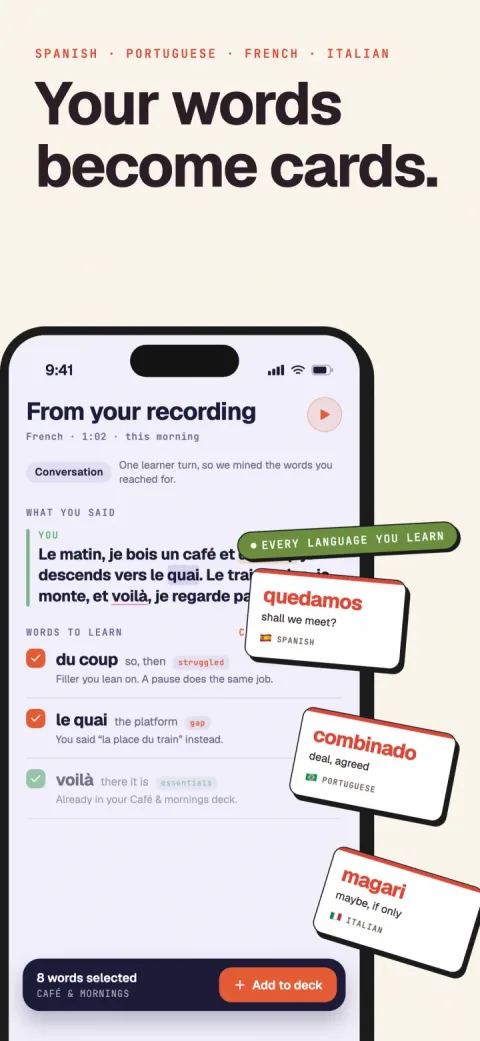
Verbamor records the lesson, pulls the cards from what your tutor actually taught, and puts each one back in front of you near the day it would have gone.
Start 7 days free