Verbamor
The testing effect: why recalling a word beats rereading it
Recalling a word beats rereading it because retrieval changes the memory, while rereading only makes the page feel familiar. In Karpicke and Roediger's 2008 Science study, Swahili-English pairs that kept being tested after learning survived a week at 80%, against 36% for pairs only restudied. Guessing wrong doesn't hurt, as long as you see the right answer afterward.
Walk through any library during finals week. Highlighters, chapters read for the third time, notes copied out in neater handwriting.
Rereading is the most popular study technique on earth, and students in survey after survey rank it as their go-to.
The memory literature has been trying to talk students out of rereading for about 20 years. The alternative costs nothing: close the book and try to pull the answer out of your own head.
Psychologists call the result the testing effect, and for vocabulary it's about the closest thing to a cheat code the field has found.
01 / 06The feeling of fluency is only recognition
The second time through a chapter, everything feels familiar. Sentences flow. Terms you stumbled on yesterday slide right past. Your brain reads that ease as mastery.
Rereading's ease is actually just recognition. The text is easy to process because you've seen it. That says almost nothing about whether you could produce any of it with the book closed.
Familiarity and recall are different systems, and only one of them helps you mid-conversation with your tutor.
When Dunlosky and colleagues graded 10 popular study techniques for a 2013 review, rereading landed in the low-utility bin. Practice testing got the top rating, alongside distributed practice. Those two ratings, sitting in one table, are basically the design spec for every serious flashcard system since.
Familiarity and recall are different systems. Only one of them shows up when you need the word mid-sentence.
Testing looked worse after five minutes and better after a week
Roediger and Karpicke ran the clean version in 2006. College students learned short prose passages two ways.
One group read a passage twice. The other read it once, then took a free-recall test on it: no feedback, no second look, just write down what you remember.
Five minutes after studying, the rereaders looked better. A week later, the testers had them beaten soundly, remembering around 14% more of the passage. They'd spent part of their "study" time with no text in front of them at all.
Both of Roediger and Karpicke's groups spent the same time with the material. One spent part of it struggling to remember, and the struggle paid. This is the same performance-versus-learning trap that makes cramming feel productive: the strategy that looks best after 5 minutes loses after 7 days.
03 / 06Restudying a word you already got right does almost nothing
Two years later, Karpicke and Roediger published the study that matters most for language learners, in Science. Students learned 40 Swahili–English word pairs (mashua–boat, that kind of thing) under 4 different regimes.
The clever part: once a student got a pair right, the regimes differed in whether that pair kept being studied, kept being tested, or was dropped entirely.
Read the 36% against the 80%. Extra passive exposure after you've "got it" did close to nothing.
Extra retrievals took one-week recall from roughly a third of the deck to 4 words in 5. Same students, same words, same total time in the lab.
Students' own predictions were flat across all 4 groups. They genuinely couldn't feel the difference while it was happening, which should make you a little suspicious of your own study instincts. (It makes a good case for grading yourself honestly, too.)
04 / 06The literature keeps finding the technique that feels worse works better
The short version: retrieval is an act, and acts change things. When you reconstruct bosque from "the forest," you re-run the routes that lead to that word and leave them wider than you found them. Rereading never runs the routes at all; it just admires the destination.
There's a family of related effects pointing the same direction. Slamecka and Graf (1978) showed that merely generating a word, versus reading it, improves memory for it. Kornell, Hays and Bjork (2009) found that even failed retrieval attempts help, as long as you see the answer afterward.
Effort in, memory out.
And the testing effect scales. Adesope, Trevisan and Sundararajan (2017) pooled 272 independent effects for a meta-analysis, a study that combines the results of many studies. They found practice testing beat restudying with a solid medium-to-large effect, across ages, subjects, and test formats.
Karpicke and Blunt (2011), also in Science, found retrieval practice even beat elaborate concept-mapping (drawing diagrams that link ideas), the technique study-skills courses love most.
My favorite detail from Karpicke and Blunt's paper: participants predicted concept mapping would win. The literature keeps producing this exact shape, a technique that feels worse and works better.
05 / 06Does getting a word wrong make the mistake stick?
No, as long as you see the right answer afterward. It's a reasonable worry, though: test yourself, get it wrong, and maybe you're practicing the error. It's the main reason people prefer rereading; at least the page is never wrong.
The research is reassuring on wrong guesses. Butler and Roediger (2008) found that testing with feedback beat testing without it, and both beat restudying. The correction after a miss does its job, and errors don't fossilize when the right answer follows them.
Kornell's pretesting studies push it further: guessing before you've ever learned the material, and guessing wrong, still improved memory for the correction. The wrong guess seems to till the ground the answer lands in.
So the failure mode to avoid is testing yourself into a void. Retrieve, then check, every time. A flashcard does this automatically, which is most of what a flashcard is: a retrieval attempt stapled to its own feedback.
Timing-wise, immediate feedback works fine for vocabulary. The one thing to keep between attempt and answer is a genuine commitment: a spoken word, a typed answer, something that can't be revised after the flip.
That commitment is what separates a real retrieval from a glance with extra steps. It's also the honest input your grade depends on.
06 / 06Produce the word, out loud, before you look
The practical rules fall out directly:
- Never study a card by flipping it over first. Commit to an answer, even a wrong one, before you look.
- Produce, don't recognize. A fill-in-the-blank prompt that makes you generate bosque beats a multiple-choice lineup where you just spot it.
- Say it out loud when you can. You're training for speech, and your mouth is part of the memory.
- Wrong answers are fine. Kornell's pretesting work says the failed attempt still deposits something, provided you get the correction right after.
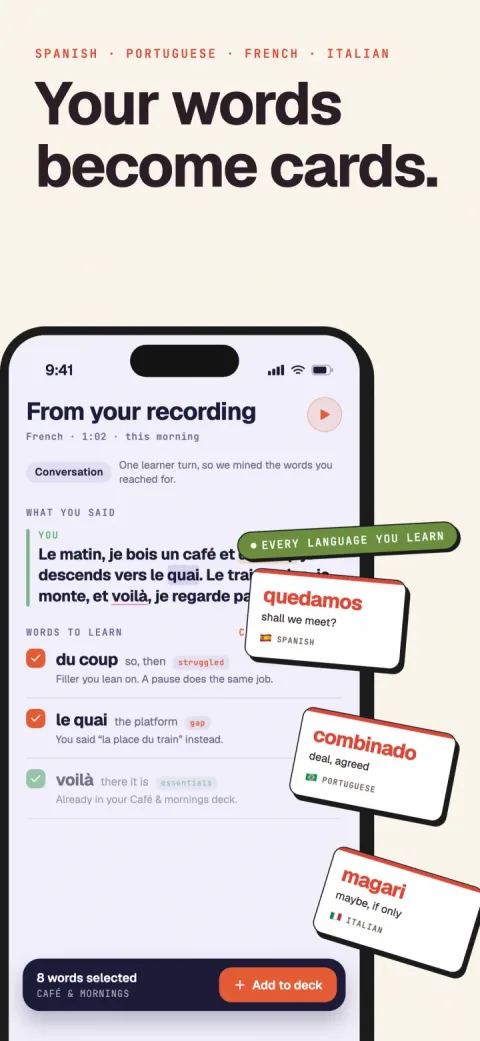
Every Verbamor card is built as a test for that reason: a blank in a sentence from your own lesson, graded by whether you produced the word.
The FSRS scheduler, an algorithm that predicts when you're about to forget each card, decides when you retrieve. The card format makes sure a retrieval is what actually happens.
And your tutor session is the final boss version, retrieval practice with a pulse. Every word you drag out of memory mid-conversation, slightly too slowly, under mild social pressure, is getting the strongest rep it will ever get.
Sources
Testing beats rereading
- Roediger, H. L., & Karpicke, J. D. (2006). Test-enhanced learning: Taking memory tests improves long-term retention. Psychological Science, 17(3), 249–255.
- Dunlosky, J., Rawson, K. A., Marsh, E. J., Nathan, M. J., & Willingham, D. T. (2013). Improving students' learning with effective learning techniques. Psychological Science in the Public Interest, 14(1), 4–58.
Retrieval doubles vocabulary retention
- Karpicke, J. D., & Roediger, H. L. (2008). The critical importance of retrieval for learning. Science, 319(5865), 966–968.
Retrieval works and scales
- Adesope, O. O., Trevisan, D. A., & Sundararajan, N. (2017). Rethinking the use of tests: A meta-analysis of practice testing. Review of Educational Research, 87(3), 659–701.
- Karpicke, J. D., & Blunt, J. R. (2011). Retrieval practice produces more learning than elaborative studying with concept mapping. Science, 331(6018), 772–775.
- Slamecka, N. J., & Graf, P. (1978). The generation effect: Delineation of a phenomenon. Journal of Experimental Psychology: Human Learning and Memory, 4(6), 592–604.
Feedback rescues wrong guesses
- Kornell, N., Hays, M. J., & Bjork, R. A. (2009). Unsuccessful retrieval attempts enhance subsequent learning. Journal of Experimental Psychology: Learning, Memory, and Cognition, 35(4), 989–998.
- Butler, A. C., & Roediger, H. L. (2008). Feedback enhances the positive effects and reduces the negative effects of multiple-choice testing. Memory & Cognition, 36(3), 604–616.
Every card is a test. On purpose.
Verbamor turns your lesson vocabulary into fill-in-the-blank retrievals and schedules each one at the moment it strengthens memory most.
Start 7 days free