Verbamor
The word-frequency curve: why 650 words does so much
650 words does so much because word frequency collapses fast: the first 1,000 word families cover roughly 85% of recorded conversation, while going from 2,000 to 7,000 buys about 3 more points. So 650 high-frequency words put a floor under you, though comfortable listening needs about 95% coverage, or 2,000 to 3,000 families.
Count every word in a giant pile of Spanish conversation. Rank them by how often they appear.
The result is one of the most lopsided distributions in nature. De, que, no, la appear millions of times, while tens of thousands of perfectly good words appear once or never.
The lopsided ranking is the fact your first 6 months should be built around. It means the words are wildly unequal, and the inequality is on your side.
01 / 06Frequency collapses fast, and the inequality is on your side
George Zipf, a Harvard linguist, documented the pattern in the 1930s and 40s, and it now carries his name. Zipf's law: the 2nd most common word appears about half as often as the 1st, the 100th about 1/100th as often. Frequency collapses as you go down the rank list, fast.
Zipf's law holds across languages, across centuries, in speech and writing, with a stubbornness that still puzzles linguists. For a learner, the mechanics matter less than the consequence: a small set at the top of the list does most of the talking.
Zipf's law is stranger than it looks. No one designed it. No academy voted on which words would carry the load.
Yet Spanish, Mandarin, Swahili, and English all allocate their workload the same lopsided way. So the strategy below works well beyond Spanish: it rests on a property of human language you can spend anywhere.
Every word you learn is cheaper than the next one is
Corpus linguists, who count words across large collections of real text, measure a vocabulary's reach as lexical coverage: what percentage of the running words in real speech do you know?
Adolphs and Schmitt (2003) ran the numbers on the CANCODE corpus of recorded British conversation. The most frequent 2,000 word families (a word plus its forms, like play, plays and played) covered nearly 95% of everything said. The first 1,000 alone covered roughly 85%.
Nation (2006) extended the analysis. To hit 98% coverage (comfortable, look-nothing-up comprehension), you need somewhere around 6,000 to 7,000 word families for listening.
So the curve pays out almost everything early. Word 500 might show up daily. Word 7,000 you'll meet a few times a year.
Word 500 shows up in your life daily. Word 7,000 visits a few times a year. Study them in that order.
Do the exchange-rate math. The jump from 0 to 1,000 families buys about 85 points of coverage. The jump from 2,000 to 7,000, five times the studying, buys about 3.
Every word you learn is cheaper than the next one is, forever. That's an argument for front-loading the top of the list and letting everything after come from living your life in the language.
03 / 06Run it on a real sentence: thirteen words, all top-1,000
Abstract percentages hide how coverage feels in practice, so take an ordinary sentence you might hear from a tutor:
"Mi hermana quiere comprar una casa nueva cerca de la playa, pero no tiene suficiente dinero."
My sister wants to buy a new house near the beach, but she doesn't have enough money. Now check it against the top of the frequency curve.
Mi, quiere, comprar, una, casa, nueva, cerca, de, la, pero, no, tiene, dinero: top-1,000 words, all of them, most inside the base 650. Hermana and playa sit comfortably in the first couple thousand. The only word that might stretch a beginner is suficiente, and it's a cognate you can guess.
At street level, 85% coverage means whole ordinary sentences arriving fully decoded, with the occasional gap you can bridge from context.
It's also why learners who front-load frequency report the eerie experience of understanding chunks of a show weeks before they can say much of anything back.
Flip the sentence exercise and it's just as instructive. The words that make Spanish word lists feel productive (el otorrinolaringólogo types, the vocabulary-app party tricks) appear in approximately none of your first thousand conversations.
A word's usefulness is its frequency, and your gut is a bad judge of frequency. The corpus counts; your gut doesn't.
04 / 06Is 650 words enough to understand Spanish?
650 words isn't enough to understand fast Spanish, because coverage is a statistic about words, and it flatters you a little. Knowing 85% of the words in a sentence doesn't mean understanding 85% of sentences. One missing word can be the one carrying the meaning.
Van Zeeland and Schmitt (2013) tested where listening comprehension becomes adequate. They put the working threshold around 95% coverage, which maps to roughly 2,000 to 3,000 word families for casual listening.
So 650 words won't let you follow a rapid dinner argument. What it does is put a floor under you. You can ask, answer, describe, complain, and buy things. Dangerous enough to keep going.
And 650 high-frequency words compound in a way test scores don't capture. Each one makes every future sentence you hear slightly more decodable. That makes the input more comprehensible, which teaches you more words.
Coverage is the flywheel's first push. (More on that loop in input vs. flashcards.)
05 / 06The base 650 breaks from the raw list on purpose
Verbamor's base deck follows Gabriel Wyner's Fluent Forever list, extended slightly to 650. It's frequency-derived, with two deliberate departures from the raw top of the table.
The raw top 650 is mostly grammar glue: articles, prepositions, pronouns, auxiliaries. You'll absorb those from any exposure at all, because they're in literally every sentence.
The list swaps some of that glue for words chosen on 2 extra criteria:
- Picturable. Concrete nouns and verbs (dog, house, run, eat) that can carry an image, so each card gets the dual-coding discount.
- Immediately useful. Words you'll need in your first hundred conversations: family, food, time, feelings, the body, the weather.
The base 650 is the top of the frequency curve, curated for learnability. High-frequency so every word earns its slot, concrete so every card can hold a picture, personal so your tutor sessions have something to run on from week one.
06 / 06After 650, your own lessons beat any frequency list
Past the base 650, frequency lists lose their edge, and this surprises people. Once the universal top slice is in, your most frequent words diverge from the corpus average.
A nurse, a rock climber, and a grandmother learning Spanish for her in-laws need three different word 800s.
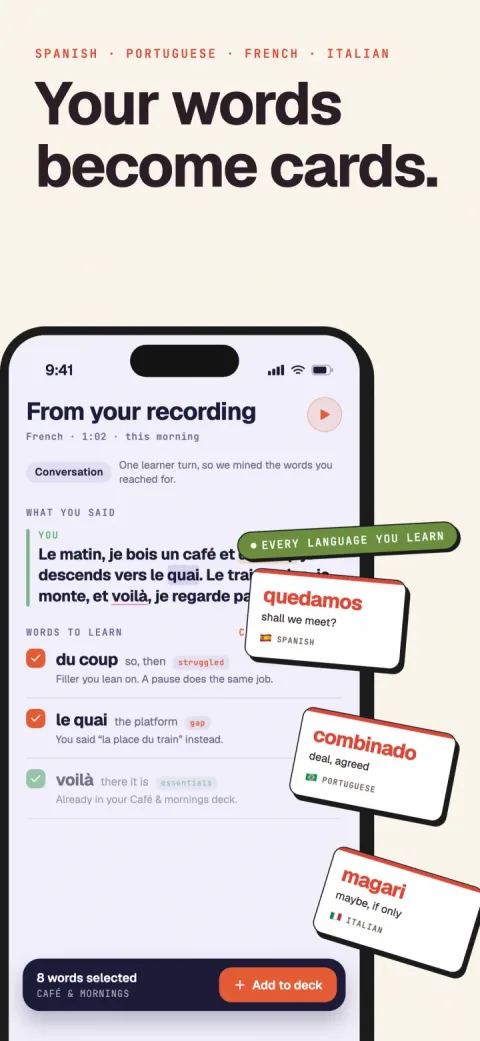
Your own word list drifting from the corpus is why Verbamor stops prescribing at 650 and switches to harvesting. After the base, your deck grows from your own lessons and conversations.
The word you reached for and missed is, by definition, a high-frequency word in the corpus of your actual life. Your lessons become your frequency list.
Harvesting words from your lessons also solves the motivation problem that kills generic lists. Word 800 from a corpus table is a stranger. Word 800 from Tuesday's lesson is the word you needed and didn't have, with the sting still attached.
You remember where it came from, what you were trying to say, who laughed. Frequency built the foundation; relevance builds everything above it.
The pace works out to be very humane, too. Learn 10 base words a day and the 650 are seeded in about 9 weeks.
After that, a typical lesson yields 8 to 15 harvested words. At 2 lessons a week that's roughly 1,000 personal words a year, arriving pre-sorted by relevance to your actual life.
Between the base and 2 years of harvest, you're brushing the 2,000-to-3,000-family zone where the listening research says comprehension gets comfortable.
So the strategy in full: let Zipf hand you the universal 650 at a discount, then let your conversations pick everything after. The curve does the heavy lifting either way. You just have to study it in order.
Sources
Frequency follows Zipf's law
- Zipf, G. K. (1949). Human Behavior and the Principle of Least Effort. Addison-Wesley.
A small vocabulary covers most speech
- Adolphs, S., & Schmitt, N. (2003). Lexical coverage of spoken discourse. Applied Linguistics, 24(4), 425–438.
- Nation, I. S. P. (2006). How large a vocabulary is needed for reading and listening? Canadian Modern Language Review, 63(1), 59–82.
Coverage drives comprehension
- van Zeeland, H., & Schmitt, N. (2013). Lexical coverage in L1 and L2 listening comprehension. Applied Linguistics, 34(4), 457–479.
Curating the base deck
- Wyner, G. (2014). Fluent Forever: How to Learn Any Language Fast and Never Forget It. Harmony Books.
The top of the curve, ready on day one.
Verbamor seeds your deck with the base 650, then grows it from your own lessons, where your personal frequency list actually lives.
Start 7 days free