Verbamor
Comprehensible input vs. flashcards: do you need both?
Yes, you need both: flashcards manufacture the 8 to 10 encounters a word needs to stick, and input teaches the collocation, register and native-speed listening that cards can't. Go cards-heavy for the first 3 months, split evenly until month 12, then go input-heavy from year two, with the deck shrinking to maintenance.
Every language forum eventually hosts the same fight. One side: Stephen Krashen was right, acquisition comes from understanding messages, put the flashcards down and go watch 600 hours of television.
The other side: I learned 2,000 words in 3 months with a deck, where's your show now? Both camps have their saints, their subreddits, and their success stories.
I've watched the input-versus-cards fight for years. The frustrating thing is both sides keep citing real evidence, because both sides have some.
So here's the actual research, and the split-the-hours answer that falls out of it.
01 / 06 · for inputInput alone works if your hours are unlimited
Krashen's input hypothesis (1985) claims languages are acquired one way: by understanding messages slightly above your current level.
Grammar drills, error correction, and yes, vocabulary lists, are at best a warm-up act to the real work of comprehending things.
Krashen's hypothesis gets a big piece right. Vast amounts of what you know about your own language arrived incidentally, without your trying. No one drilled you on the 20,000+ word families you know in English.
Extensive reading research (Krashen loves this literature) shows learners picking up vocabulary, grammar, and spelling from pleasure reading without a single card.
The input position also carries a warning worth hearing even if you reject the rest: study can become a comfortable substitute for contact with the language.
There are learners with 2 years of deck maintenance behind them who've never finished a show or survived a phone call. Reviews feel like progress and input feels like flailing. Krashen's camp calls that out correctly.
If you have unlimited hours, input alone genuinely gets you there. The catch is the exchange rate.
02 / 06 · against input aloneA word needs 8–10 encounters; text rations them
Incidental vocabulary learning has been measured, repeatedly, and the numbers are humbling. Learners typically need somewhere around 8 to 10 encounters with a word in context before it starts to stick.
Webb (2007) put meaningful learning gains at 10+ encounters. Uchihara, Webb & Yanagisawa's 2019 meta-analysis, which pooled many studies, confirmed frequency of encounters as a main driver.
Now feed that 8-to-10 figure through the frequency curve. A word around rank 4,000 might appear once every few hundred thousand words of text. To meet it 10 times, you read millions of words.
That's fine for word rank 500 (you'll trip over it constantly) and hopeless for the long tail on any human schedule.
Case studies make the slow pace vivid. Pigada and Schmitt (2006) tracked a learner through a month of concentrated extensive reading: about 30,000 words of graded readers, books written for learners at set levels.
They found real but modest gains. Most tested words showed some improvement, often in spelling or partial meaning, while full, usable knowledge came to a much smaller set.
A month of diligent reading, and most of the harvest was fractional. Input works; it just pays in installments.
A flashcard is best understood as a frequency cheat. The scheduler manufactures those 10 encounters on demand, spaced for maximum effect, in about 4 total minutes per word. What takes a novel 300 pages to do for one mid-frequency word, your deck does before breakfast.
03 / 06 · for cardsCard-learned words test as real knowledge
Card-learned words hold up as real knowledge when tested. The input-only camp's strongest objection: sure, you "know" the card, but that's fake knowledge, a parlor trick that won't survive real conversation.
It's worth taking seriously, and someone tested exactly this.
Elgort (2011) taught learners vocabulary purely from word cards. Then the study probed the results with priming measures, the kind that detect fast, automatic, implicit word knowledge, the "real" kind.
The card-learned words showed it. Representation and processing looked like genuine word knowledge, from deliberate study alone.
Card-learned words showed fast, automatic, implicit knowledge. The parlor trick turns out to be real knowledge.
Elgort 2011, in effectNation, probably the most cited vocabulary researcher alive, lands here too. His "four strands" framework gives deliberate learning a quarter of study time, with the rest going to input, output, and fluency work.
Even the field's great input advocates keep a slot for the deck.
04 / 06 · against cards aloneA card teaches the word, and context teaches how it’s used
Now the other side of the ledger, because the deck has real blind spots and pretending otherwise ruins learners.
A card teaches you a word's core: form, meaning, sound. It's terrible at everything that surrounds the core.
Collocation, which words go together: you say tomar una decisión, never hacer una decisión, and no card taught you that; a hundred exposures did. Register: which words are for your tutor and which are for the group chat.
Humor, sarcasm, the difference between what a sentence says and what it's doing. All of that lives in context, arrives only through volume, and resists being itemized.
There's also a speed problem cards can't solve. Real listening comes at you at roughly 150 words a minute with no replay button. Parsing at that speed is a fluency skill, trained only by hours of actual listening.
A deck full of well-learned words that you can't catch at native speed is a library with a locked door. Input is the key-cutting service.
So the honest division of labor: cards install the units fast; input teaches you what the units do in the wild, and how to catch them flying past.
05 / 06 · how they meetCoverage is the gearing between the two
Here's the piece both camps miss: the two methods feed each other, and coverage is the gearing.
Comprehension research puts adequate understanding around 95% coverage, the share of words you already know (van Zeeland & Schmitt, 2013, for listening).
Below that, input stops being comprehensible and Krashen's own mechanism stalls. You can't acquire from noise.
Deliberate study is the fastest way to buy that 95% coverage early. Your first few hundred high-frequency words turn shows from static into stories with gaps.
Then input takes over. Every card-learned word now gets free, contextual re-encounters that deepen it (collocations, register, humor, all the stuff a card can't hold). The card plants; the input waters.
Run the flywheel in the other direction too. Words you half-catch in a show or a lesson become cards, get 10 manufactured encounters, and return to your listening as words you now catch fully.
Each pass around the loop, the input gets a little clearer and the deck gets a little more personal.
06 / 06 · the verdictDo you need both input and flashcards?
Yes, you need both, in a specific shape that changes as you go:
- Months 0–3: cards heavy. 20 minutes of reviews daily, plus your tutor sessions. Input is expensive when you understand 40% of it; buy coverage first.
- Months 3–12: even split. Reviews hold at ~20 minutes while shows, podcasts, and reading take every other hour you'll give the language.
- Year 2+: input heavy. The deck shrinks to maintenance and harvest: it exists to catch what your listening surfaces.
And the tutor session sits at the center of cards and input, because it's both at once. It's an hour of comprehensible input tuned exactly to your level, generating the exact words your deck should harvest next.
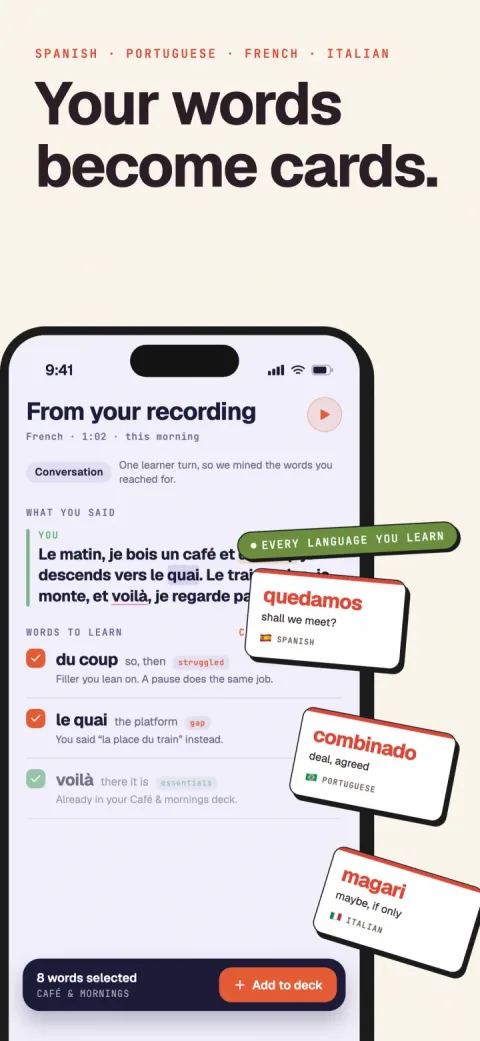
That loop (converse, harvest, drill, converse better) is the whole Verbamor design. The forum fight, it turns out, was a false choice with good marketing on both sides.
Most language apps are built for the other reader, the one with no teacher, and they try to replace one. If you already pay for lessons, that changes which tools are worth your time. I went through them in the roundup for tutored learners.
Sources
Input alone can teach words
- Krashen, S. (1985). The Input Hypothesis: Issues and Implications. Longman. (Full text of the related Principles and Practice free at sdkrashen.com.)
Incidental learning is slow
- Webb, S. (2007). The effects of repetition on vocabulary knowledge. Applied Linguistics, 28(1), 46–65.
- Uchihara, T., Webb, S., & Yanagisawa, A. (2019). The effects of repetition on incidental vocabulary learning: A meta-analysis. Language Learning, 69(3), 559–599.
- Pigada, M., & Schmitt, N. (2006). Vocabulary acquisition from extensive reading: A case study. Reading in a Foreign Language, 18(1), 1–28.
Deliberate study builds real knowledge
- Elgort, I. (2011). Deliberate learning and vocabulary acquisition in a second language. Language Learning, 61(2), 367–413.
- Nation, I. S. P. (2007). The four strands. Innovation in Language Learning and Teaching, 1(1), 2–13.
Coverage makes input work
- van Zeeland, H., & Schmitt, N. (2013). Lexical coverage in L1 and L2 listening comprehension. Applied Linguistics, 34(4), 457–479.
Converse. Harvest. Drill. Repeat.
Verbamor turns your tutor conversations into cards and your cards into better conversations. The flywheel, running on your own words.
Start 7 days free