 Verbamor
What a tutored word costs you, after forgetting
A tutored word costs your lesson price divided by the words you can still produce a week later. A $16 lesson with 15 new words is $1.07 a word; keep 3 of them and each kept word costs $5.33. Keeping a fifth multiplies your real per-word cost by exactly 5. The calculator below runs your own numbers.
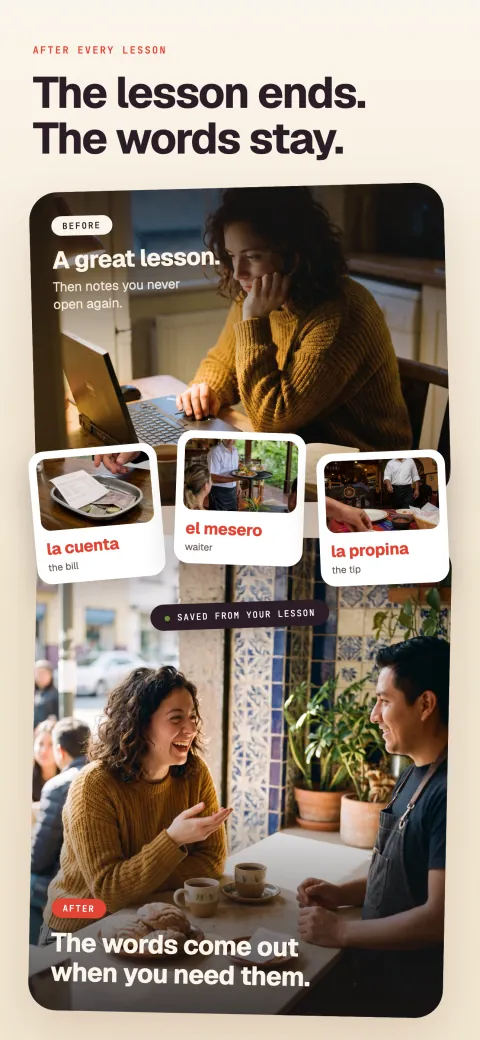
Verbamor records your lesson and turns what your tutor taught into cards that come back on schedule.

The calculator
Every field is a number you can look up on your own invoice or count in your own notes. Nothing is sent anywhere; the arithmetic runs in this page. Tab between the fields and type, or use the arrow keys. With JavaScript off, the formulas and a fully worked example are still below, which is enough to run this on paper.
Why you forget what your tutor taught shows where a lesson leaks and the 4 touches that hold it. That's the field that moves your cost per word.
| If you keep | Words kept | Cost per kept word | A year of weekly lessons |
|---|---|---|---|
| 10% | 1.5 | $10.67 | 78 words, $832 |
| 20% | 3.0 | $5.33 | 156 words, $832 |
| 30% | 4.5 | $3.56 | 234 words, $832 |
| 40% | 6.0 | $2.67 | 312 words, $832 |
| 50% | 7.5 | $2.13 | 390 words, $832 |
| 70% | 10.5 | $1.52 | 546 words, $832 |
| 90% | 13.5 | $1.19 | 702 words, $832 |
The right-hand column is the one that changes people's minds. Same tutor, same 52 invoices, same $832, and the words you walk away with at the end of the year swing by nine times across that table.
A tutor lesson has a price on the booking page. Fifty minutes, a number, done.
What you bought is a set of words you didn't have before. And the share of those you can still produce next Tuesday, in a sentence, with somebody waiting, is the only part of the purchase that lasts. Divide by that instead and the price moves a lot.
The four lines of arithmetic
There is no model here and no fitted constant. Four divisions, in this order:
cost per taught = lesson price / words introduced
cost per kept = lesson price / words kept
the multiple = cost per kept / cost per taught = 1 / retention
The last line is worth staring at, because it means the price and the word count cancel out. Whatever you pay and however many words your tutor lists, keeping a fifth of them multiplies your real per-word cost by exactly 5. That's the whole argument in one reciprocal.
The self-study line. The tool also prints the solo hours your lesson implies, using the shape of the Foreign Service Institute's own week. FSI publishes 23 hours in class against 17 hours of self-study, so the ratio is 17/23, and a 60-minute lesson implies about 44 minutes on your own:
60 × 17 / 23 = 44.35 minutes
The 17/23 ratio is FSI's, from an intensive full-time program for diplomats, and I'm borrowing the balance rather than claiming it applies to your Tuesday evening. Worth knowing that FSI's own arithmetic doesn't fully hold together either: divide its published hours by its published weeks and three categories give 23 while the fourth gives 25.
One case, worked by hand
A $16 lesson, 50 minutes, 15 items in the chat window, and you keep a fifth.
cost per word taught:
16 / 15 = 1.0666666...
= $1.07 rounded
cost per word kept:
16 / 3.0 = $5.33
the multiple:
5.3333 / 1.0667 = 5.000, and 1 / 0.20 = 5.000 ✓
a year of weekly lessons:
16 × 52 = $832
3.0 × 52 = 156 words kept
implied self-study:
50 × 17 / 23 = 36.96 minutes
Type those four inputs into the fields above and the tool prints $1.07, $5.33 and 3.0. If it ever prints anything else, one of us has a bug and it isn't the calculator's fault for being simple.
The 15 and the 3 are not invented. They're the numbers in your tutor taught you 15 words, you kept 3, counted out of one person's real lesson notes, which makes them an example rather than a rate. Count your own and the tool will happily tell you something more cheerful.
How do you work out how many tutor words you keep?
Work out how many tutor words you keep by testing yourself on last week's lesson notes, which takes about four minutes. Guessing this is the one place the tool can be made to lie to you.
Open last week's lesson notes. Cover the Spanish, French, Italian or Portuguese column. Go down the English one and say each item out loud in the target language, first attempt only, no thinking time. Count the ones you got.
Your count is your rate for that lesson, and it's usually lower than people expect, because the feeling of recognising a word when you see it is not the thing being tested. Recognition is cheap and you already have it. Producing the word from nothing, under a bit of pressure, is what a conversation costs.
Two rates are worth having. The one you get with no review at all is your baseline. The one you get after a week of doing something with those words is what the six days are buying, and the arithmetic on those six days goes further into where the money goes.
What this does not tell you
Retention is not a single number. A phrase you failed to produce mid-sentence and a word your tutor introduced from her lesson plan decay at very different rates. Averaging them into one percentage is the tool's biggest simplification, and it's why the honest move is to run it twice, once for the words you reached for and missed, once for the rest.
Words are not the only thing a lesson sells. Pronunciation correction, the confidence of having spoken for 50 minutes, a grammar habit sanded down over months: none of that is countable and none of it appears here. A lesson can be worth every cent at a terrible cost per word.
Nothing here is a measured population rate. The 20% default comes from one learner's lesson notes. There is no study behind that number and I'm not going to dress it up as one.
The calculator prices one lesson, not a habit. The year column assumes 52 identical lessons and identical retention, which nobody has. Read it as a scale, not a forecast.
And a conflict of interest, stated plainly. I sell an app whose whole job is raising the retention number in the third field. So the tool is built to run on your figures and ships no default that flatters me: at 90% retention it prints a cost per word that makes my product look unnecessary, which is the correct output if you're already keeping 90%.
Sources
The 23-and-17 week is from the Foreign Service Institute's own page at the National Foreign Affairs Training Center, read 3 September 2026: "A typical week is 23 hours per week in class and 17 hours of self-study." The internal inconsistency in the hours that page publishes is worked through in FSI's Category IV hours don't divide by FSI's own week. The 15-and-3 example comes from the lesson-notes count, and the weekly cost framing from the six days after the lesson.
No competitor's price is printed on this page on purpose. Marketplace rates move quarterly and the published bands are wide enough to argue anything, so the only price here is the one you typed.
Questions people actually ask
Why divide by words retained instead of words taught?
Because a word you cannot produce next week was not a purchase. Cost per word taught divides the invoice by whatever your tutor put in the chat window, which is a number your tutor controls and you do not. Cost per word retained divides the same invoice by the words that survive to your next lesson, which is what you were actually buying. The two figures come from the same price and can differ by five times.
What retention rate should I put in?
Count your retention rate rather than guess it. Take last week's lesson notes, cover the target language, and try to produce each item from the English. The share you get is your rate for that lesson. The tool starts at 20% because that is the ratio in one worked example on this site, 3 words kept from 15 introduced, and that example is one person's lesson rather than a measured population rate.
Where does the self-study time come from?
The Foreign Service Institute publishes the shape of its own week: 23 hours in class and 17 hours of self-study. That is a ratio of 17 to 23, so a 60-minute lesson implies about 44 minutes of solo work if you copy FSI's balance. FSI trains full-time diplomats in an intensive program, so treat the ratio as a benchmark from one institution rather than a prescription for a weekly evening lesson.
Does this tool tell me what a tutor should cost?
No. It ships no competitor prices at all and asks you to enter the number on your own invoice, because published tutor rates move quarterly and marketplace bands are wide enough to be useless. The arithmetic is the point, and it runs on whatever price you actually pay.
The third field is the one worth moving.
Verbamor turns the words you failed to produce in a lesson into cards that come back on a schedule, so the invoice buys vocabulary instead of an hour.
Start 7 days freeThe 7-day free trial is on the yearly plan.
More free tools
All 8-
39 Spanish word patterns Learn one rule and get a whole group of words: -tion to -ción, el agua, me gusta. Thousands of words, with a free PDF.
-
How many Spanish words do you know? Tick the words you know from a frequency-banded sample. Fake words catch the guessing.
-
How much of a text do you already know? Paste any text and see what share of it sits inside the first 1,000 to 5,000 words.
-
The forgetting curve, drawn properly Put in the days since your last review and see how much of a word is left, on the real FSRS-6 curve.
-
What do 20 new cards a day cost you? Project your daily reviews for two years from a new-card rate and a retention target.
-
Cognate checker Type an English word, see its likely relatives in four languages, and get warned about false friends.
-
Count the hours a term abroad buys The hours a semester abroad really adds, next to what the same money buys in tutoring.
- All 8 free tools Every tool on one page, plus the free debrief sheet.