Verbamor
The six days after the lesson are where the money goes
A lesson's real price is its fee divided by the words you still have six days later, and those six days decide it. On my notes a $16 lesson costs $2.67 a word if all 6 new words stick and $8 if 2 do. Testing yourself on those words instead of rereading them gets you nearer $3.20.
The money goes in the six days after the lesson, because that's when the words either stick or don't. On my own notes, a $16 lesson with 6 new words works out at $2.67 a word if all 6 survive and $8 a word if only 2 do. Same lesson, a 3x spread, settled by what you do before the next one.
Six days after a Spanish lesson that cost me $12, I was trying to say my flight was delayed and I couldn't find retraso. I had written it down. I had said it out loud in the lesson, twice, and my tutor had nodded.
Retraso was gone anyway. And the part that stung: the next lesson opened with my tutor teaching me the same word again. I'd paid twice for it.
01 / 05Divide by the words you keep and the same invoice swings threefold
Every page about whether tutors are worth it prices the lesson. Fifty minutes of a stranger's attention is easy to price, which is why everyone prices it. What you're buying is a set of words you didn't have before and will still have next month.
So the honest unit is lesson price divided by words retained: words you can still produce a week later, in a sentence, under a little pressure.
The lesson is the invoice. The retention is the product.
Which means I needed a denominator, so I went back through six weeks of lesson notes.
Across 6 lessons my tutor put an average of 14 new items in the chat window, words and set phrases. The ones I'd actually failed to produce mid-sentence ran 5 or 6 a lesson.
That's the split I'll divide by. It turns on the difference between recognizing a word and producing it: a word you understood instantly was never a purchase.
Call it 6 words a lesson that are genuinely new to your mouth. At $16 that's $2.67 a word if you keep all 6. Keep 2 and the same lesson cost you $8 a word. Same tutor, same invoice, a 3x spread in what you took home.
Six lessons is a small sample and it's mine, so treat the 14 as my handwriting. Count your own.
The 3x spread lives outside the lesson, decided in the six days afterward by whether anything happened to those words.
02 / 05The bands are per lesson, per hour, and unevenly filled, so I priced 21 listings myself
To divide, you need a numerator. Here are the real ones, from the platforms' own pages.
italki publishes per-lesson bands: community tutors "typically charge between $4-$20 per lesson," professional teachers "typically charge between $10-$40 per lesson." Per lesson, not per hour. Almost every affiliate roundup quietly converts one into the other, whichever way makes the page's argument land.
Preply's own rate table, updated 2 March 2026 and labeled "Average Price on Preply," is per hour and says so. It lists $16/hr for speaking practice, $17 for beginners, $20 for DELE prep, $21 for SIELE prep (DELE and SIELE are the two official Spanish exams).
Its stated range is $15 to $50. Preply raises the same caution I did: check whether the price buys an hour or 50 minutes.
And prices in a band aren't distributed evenly across it, which is why a bare range is close to useless. On 22 August 2026 I pulled the trial prices for the first 21 Spanish tutors italki showed me:
The middle of those 21 trial prices is crowded and the tails are thin. Most people booking Spanish on italki see something near $12 for a trial, and more once they're a regular.
So I'll build the weekly figure in italki's own unit. A $12 trial implies $17 to $24 for a standard booking, depending on where in italki's discount band it sits.
Call a regular weekly lesson $16, at the cheap end and inside italki's $4-$20 community band. Preply's $16 is the same digits by coincidence, and I'm not stacking the two: that one is per hour.
$16 a week is $832 a year. That's a fair price for a year of talking to a native speaker, and I think it's worth spending. The question is what fraction of it survives to next spring.
03 / 05By day six three quarters of the work is gone, even on the flattering measure
Hermann Ebbinghaus put a number on forgetting in 1885, on himself, with nonsense syllables. He learned a list to perfect recall, waited, then measured the effort to relearn it. That measure is savings, and it's generous: it counts memory that won't surface on its own.
Ebbinghaus's savings figure after 6 days was 25%. Even by the flattering measure, three quarters of the original work was gone, on exactly the interval a weekly lesson leaves open.
The obvious objection: one German man, a pile of syllables, 1885. Murre and Dros re-ran it in 2015 with modern controls, and the curve came back nearly identical.
I wrote about the forgetting mechanism in why your brain forgets Tuesday's vocab by Friday. The budget version: a word you met once on Monday and never touched again is, by Sunday, mostly a feeling that you've heard it somewhere. Which was my state with retraso, with a human being waiting for me to finish my sentence.
The fix is old and dull and very well evidenced: pull the word back out of your head a few times, spaced out, rather than rereading it. That's the testing effect.
In Karpicke and Roediger's 2008 Swahili study, students who kept being tested recalled about 80% a week later. Students who kept restudying recalled about 36%.
The one-week delay is what makes the testing gap visible. When Roediger and Karpicke ran the comparison on prose in 2006, the rereaders won after 5 minutes and lost badly after a week. Whatever you do on the evening of the lesson feels like it worked, because everything does.
Run the 80% and the 36% through the division. Take my 6 keepers from a $16 lesson.
At the restudy rate you'd finish the week with 2, so $8 a word. At the retrieval rate you'd finish with 5, so $3.20. Identical lesson.
The difference is four or five minutes a day spent pulling words back out instead of highlighting them.
So here's the shape I run, which fits in the gaps of a normal week.
Lesson night, 5 minutes. Write your 6 keepers as blanks: a sentence from the lesson with the word cut out, English meaning underneath. That's the only writing you do all week.
Day 1, day 3, day 6. Cover the answers and say each word out loud before you look. A spoken guess can't be quietly revised into a pass once the answer is in front of you.
Then check. Six words takes a minute.
Day 6 is the rep that counts. It lands closest to the interval Ebbinghaus clocked at 25%, and it's your last chance to fix a word before your tutor spends paid lesson time re-teaching it. Skip the other two before you skip that one.
Missing a word costs you nothing. Kornell, Hays and Bjork found failed retrieval attempts still improve later memory, provided you see the answer afterward. What hurts is deciding you basically had it.
I'm mixing two kinds of number there, and I'd rather say so than hope you don't notice. The 80 and the 36 are lab percentages from a controlled Swahili list. My 6 is a count from my own notebook.
Neither licenses the other, so what the arithmetic gives you is the shape of the gap rather than a figure you can hold me to.
Same caveat on Ebbinghaus: nonsense syllables decay faster than real words that hook onto things you already know. So read the 25% as the shape too.
The claim I'll defend: the gap between testing and rereading is bigger than the gap between a $10 tutor and a $20 one.
04 / 05The page ranking for this question names the waste, then walks away from it
The page currently ranking for this question is TruFluency's "Are Language Tutors Worth It?", a tutoring company writing about whether you should buy tutoring. It concludes yes, in the heading, before the evidence.
I want to give TruFluency's page credit anyway, because buried in its cons section is the sharpest sentence anyone has written about this problem. Inconsistent classes, it says, "will keep you paying, while relearning the same information."
TruFluency's sentence is the whole thesis, arrived at by instinct, stated in ten words, then abandoned in the next clause. The page names the waste mechanism and walks away.
Where TruFluency's page goes wrong is the section right after it. Titled "Language Tutors Can Be Expensive," that section resolves the expense as a benefit: the cost, it argues, "may motivate you to not waste your own money." A reader who arrived worried about wasting money is told the waste is motivational.
And on a page about whether a purchase is worth it, no quantity is ever divided by any other. Its only number is the size of the packages it sells.
05 / 05What if you're booking lessons for fluency rather than vocabulary?
If you're booking lessons to get fluent rather than to acquire vocabulary, everything above is noise and you should ignore it.
TruFluency closes on a piano analogy, and on that it's right: you can't learn the instrument without playing it badly for a while.
If your bottleneck is that you freeze, the 50 minutes is the product. Book more hours and stop doing arithmetic about it.
Two other people should skip this arithmetic. If your tutor sets homework you actually do, do that instead, because the thing you'll do beats the thing you won't.
And if you'll genuinely build your own cards, Anki costs nothing on a computer or an Android phone, and that beats paying anybody.
Migaku, an Anki-adjacent company, puts card-building at roughly 30 seconds each, 12.5 hours for 1,500 cards. Be honest about whether you'll spend it.
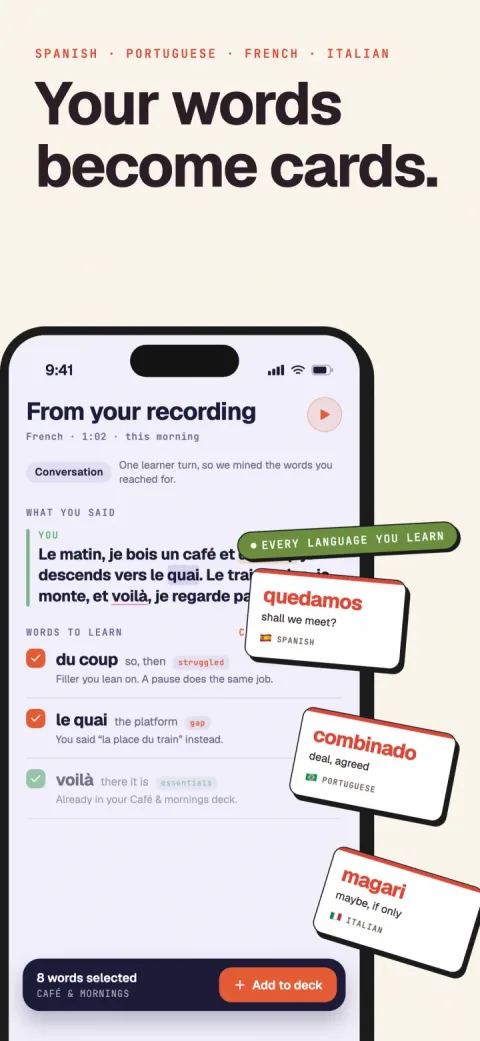
For everyone else, I built Verbamor because I kept losing words like retraso. You record or type what came up in your lesson, and it turns those words into cards that blank each one out of a sentence.
Each card has native audio and an image, and FSRS, an open-source scheduling algorithm, decides when you see it again.
The arithmetic, since arithmetic is the point of this page. Native is $129.99 a year, which against $832 of lessons is about 8 more lessons a year spent keeping the other 44. Explorer is $19.99 a month.
iOS only, five languages, no free tier. Apart from about 650 starter words, it teaches you nothing new, and it doesn't find you a tutor.
Whatever you use, the test is the same. Six days after your next lesson, before you open your notes, write down every word that came up. Then check.
If the list is short, the problem was never the price of the lesson.
Sources
What lessons cost
- italki. How much does italki cost? Per-lesson bands: community $4-$20, professional $10-$40. Trial lessons discounted 30-50%. Read 22 Aug 2026.
- Preply. Spanish tutoring rates. "Average Price on Preply" table, updated 2 March 2026. Speaking practice $16/hr, SIELE prep $21/hr, stated range $15-$50/hr.
- Observed italki Spanish trial prices, 21 listings, collected 22 Aug 2026. Listed in full in the figure above.
Forgetting is steep, and retrieval slows it
- Ebbinghaus, H. (1885). Memory: A Contribution to Experimental Psychology. Duncker & Humblot. Savings after 6 days: 25%.
- Murre, J. M. J., & Dros, J. (2015). Replication and analysis of Ebbinghaus' forgetting curve. PLOS ONE, 10(7): e0120644.
- Karpicke, J. D., & Roediger, H. L. (2008). The critical importance of retrieval for learning. Science, 319(5865), 966-968.
- Roediger, H. L., & Karpicke, J. D. (2006). Test-enhanced learning: Taking memory tests improves long-term retention. Psychological Science, 17(3), 249-255. Rereading leads at 5 minutes and trails at one week.
- Kornell, N., Hays, M. J., & Bjork, R. A. (2009). Unsuccessful retrieval attempts enhance subsequent learning. Journal of Experimental Psychology: Learning, Memory, and Cognition, 35(4), 989-998.
The page this one argues with, and the free alternative
- TruFluency. Are Language Tutors Worth It? Read 22 Aug 2026.
- Migaku. How to make Anki cards. Roughly 30 seconds per card, about 12.5 hours for 1,500 cards.
- Anki. Free on desktop and Android. The iOS app, AnkiMobile, is a separate $24.99 purchase.
Keep what the lesson cost you.
Verbamor turns the words from your own lessons into fill-in-the-blank cards and schedules them so the sixth day isn't a write-off.
Start 7 days free