 Verbamor
What it actually costs to get conversational in Spanish
Every price guide on this question quotes you dollars per hour and then never mentions how many hours. The multiplier is published, it's free, and it changes the answer by a factor of forty.
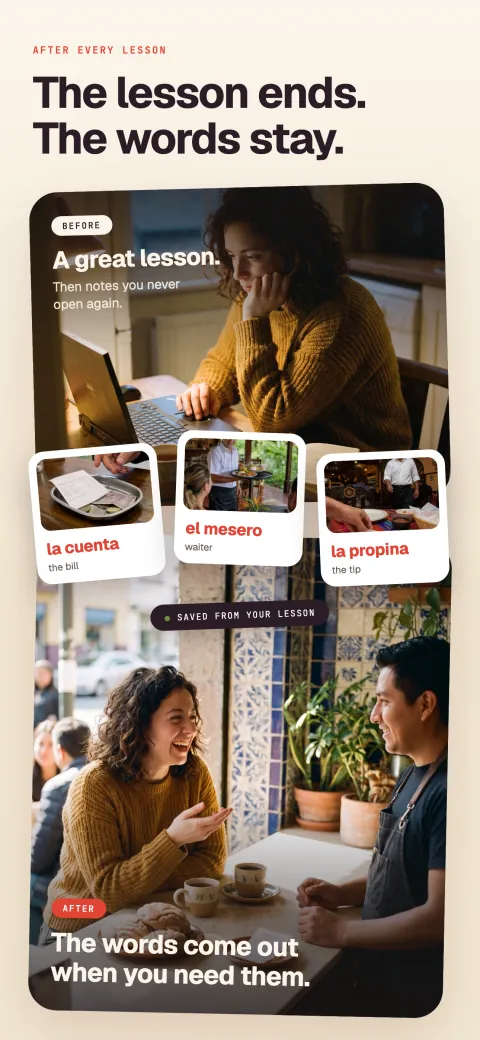
Verbamor records your lesson and turns what your tutor taught into cards that come back on schedule.

Tuesday, 6pm, 50 minutes, $16 on the card. Your tutor fixes the way you've been saying me di cuenta for a month, and it lands. You write it in the margin of a notebook. You feel it stick.
By Thursday it's gone. On Saturday you say the old wrong version to a waiter.
You bought that phrase and it didn't survive the week. That's the part the price guides skip, because "what does it cost to learn Spanish" has two numbers in it and every guide publishes only the first.
No guide publishes the second number, the hours
The Foreign Service Institute trains American diplomats, and it publishes how long its languages take. Spanish sits in Category I, described on the current page as "24-30 weeks (552-690 class hours)," with Spanish specifically listed at 30 weeks.
Two things about that figure before anyone builds a budget on it.
First, the target. FSI says those weeks are "the time usually expected for a student to reach an integrated score of 3 (Speaking + Listening)" on the Interagency Language Roundtable scale. ILR 3 is the level at which a diplomat argues about trade policy in Spanish without embarrassing the embassy.
Second, the week. FSI states plainly that "a typical week is 23 hours per week in class and 17 hours of self-study." Multiply: 30 weeks at 23 class hours is 690 hours in the room, and 30 weeks at 40 hours all-in is roughly 1,200 hours of a full-time job.
FSI also warns that "the actual time can vary based on several factors, including the language learner's natural ability, prior language-learning experience, and time spent in the classroom." Keep that caveat. It's on the source page.
You probably don't want ILR 3. Most people asking this want to hold a dinner conversation without sweating, and FSI publishes no figure for that.
The invented conversational hour counts floating around the internet are exactly what this post exists to complain about. So I'll treat 690 as the ceiling and price a fraction of it. I'll tell you which fraction I picked so you can overrule me.
An hour costs roughly $8 to $25 online, as of August
Every figure below was read off a first-party vendor page on 22 August 2026, and I'm dating it so you can tell when it rots.
italki's own pricing page says community tutors "typically charge between $4-$20 per lesson" and professional teachers "typically charge between $10-$40 per lesson." Note the unit. That's per lesson, not per hour, and italki lessons come in 30, 45 and 60 minute lengths.
Affiliate roundups convert those bands into hourly rates without saying so, which is how a $4 lesson becomes a "$4 an hour" tutor.
italki also sells a subscription called italki Plus at "$5.99 per month, or $4.99 per month if you pay annually ($59.99 per year)."
Preply publishes a labeled table of Spanish tutoring rates, marked "Updated March 2, 2026." It puts speaking practice at $16 an hour, beginners and kids at $17, business Spanish and intensive at $18, DELE prep at $20 and SIELE prep at $21. Its stated overall range is "$15 to $50."
In person costs more. Thumbtack's US page gives an average fixed price of $40 to $60, low around $30, high around $70.
The italki comparison page claims "a private tutor outside of italki typically costs $40 to $100+ per hour," which is a company arguing against its own alternative, so treat it as a ceiling.
To multiply anything I need an hourly figure, having just complained about people who manufacture one. So here's mine, flagged as mine: roughly $8 to $25 an hour online. That's my conversion of those per-lesson bands, and no vendor publishes it.
Preply's $16 is the one hourly rate here that a company states on its own page (italki publishes per-lesson bands), so it does the real work below.
That gap is why these guides read the way they do. A list of rates answers "how much is the road trip" with the price of gas.
Two years of weekly lessons buys about 15% of FSI's hours
Three targets, three rates. Everything in this table is hours multiplied by a dollar figure, and you can check every cell on a calculator.
| What you're buying | $8/hrcommunity tutor | $16/hrPreply, labeled | $50/hrtop of Preply's range | Share of FSI's 690 |
|---|---|---|---|---|
| 690 hoursFSI's full run at ILR 3 | $5,520 | $11,040 | $34,500 | 100% |
| 172 hoursdinner conversation, my quarter-of-ILR-3 guess | $1,376 | $2,752 | $8,600 | 25% |
| 104 hoursa weekly lesson, kept up for two years | $832 | $1,664 | $5,200 | 15% |
Rates read off first-party vendor pages on 22 August 2026. The 690 is FSI's. The quarter is mine, because FSI publishes no conversational figure.
Move it if you disagree and the arithmetic still works, which is more than the ranking pages offer.
The last column is the one that reframes the other nine. Two years of paying every single week, never missing, buys about 15% of the hours FSI budgets to get a diplomat to ILR 3.
Hardly anyone buys the top row. Most people asking this are shopping in the bottom one, where a weekly lesson alone takes a bit over three years to reach the dinner-conversation row.
Which points at the hours you don't pay for.
Underneath the classroom hours sits a second number. FSI's 23-plus-17 week implies roughly 1,200 hours all-in, and the 17 self-study hours a week come to 510 of them that nobody bills you for: reading, listening, review, talking to people who aren't charging you. Add the classroom hours you never buy, and a two-year weekly habit pays for 104 of 1,200.
Paid instruction is a small share of the hours and nearly all of the cost.
Which tells you where the real lever is. Shopping for a cheaper tutor moves the small number. How much of each paid hour survives the week moves everything else.
It's why cramming the night before a lesson is such an expensive habit: it inflates the hour you paid for and deflates the six days you didn't.
The free build costs labour instead of money
I want to be blunt here, because the pages that rank for this query have an affiliate link under every paragraph and structurally can't say it.
You can get conversational in Spanish for the price of a library card.
Here's the whole build, with the handles you need to actually start it this afternoon.
The scheduler. Anki is free on desktop across every major platform, and AnkiDroid on Android is free too. On iPhone the app is $24.99, one time, with no subscription.
Worth knowing before you start: Anki's manual says FSRS, the modern scheduler, is opt-in, sitting "at the bottom of the deck options page." The default is still the 1987 algorithm, so turn it on.
The cards. Shared decks live at ankiweb.net/shared/decks, free, including Spanish frequency decks somebody else already typed out. A pre-built deck teaches you words in a stranger's order rather than your tutor's. That's a real downgrade, and it's also the reason it costs nothing.
The speaking. Language exchange is the free half of tutoring. You trade an hour of English for an hour of Spanish and no money moves.
The italki language exchange runs alongside its paid lessons, and Tandem and HelloTalk do the same thing on the phone. The trade is that your partner is a learner too, so no one is correcting you with any authority.
The input. Whatever your library lends, plus free graded readers (books written for learners at a set level) and free podcasts. Total cash outlay: somewhere between zero and $24.99.
If you're disciplined, and specifically if you'll build your own cards week after week with nobody checking, this is the correct answer and you should stop reading. Paying more mostly buys the feeling of doing something, which is a different product.
The free path fails for one reason, worth naming precisely. It costs labour instead of money, and most people quietly default on the labour. Migaku's own Anki guide puts card-building at about 30 seconds per card minimum, roughly 12.5 hours for 1,500 cards. Twelve and a half hours of typing, spread thin over months, with nothing telling you you're behind.
And 1,500 cards is only the start. At the 10 to 20 new cards a day that most people can sustain, that deck is between 2.5 and 5 months of daily typing before it exists. During those months, the only person auditing your consistency is you.
Paying buys tutor hours first, then protection for them
Given the ratio above, the sensible order to spend money in is tutor hours first, then whatever protects them.
Tutor hours are the only line item that produces the thing you can't manufacture alone. That's the experience of being asked a question in Spanish by a person waiting for an answer.
That pressure is the whole product. It's also why the first few lessons feel awful and why the awfulness is doing work.
Everything after that is protection of an asset you already bought. If a lesson costs $16 and you retain a third of what came up in it, your effective rate is $48 an hour and you'll never see the invoice. A tool that lifts retention from a third to two thirds halves your real cost per word without changing a single price on the page.
That's the honest case for the thing I built, and I'll state the price the same way I'd want a stranger to state it to me. Verbamor is $129.99 a year, billed annually, or $19.99 a month. It's on iPhone and iPad only, there's no free tier, and the 7-day trial exists on the annual plan alone.
It records what came up in your lesson and turns it into fill-in-the-blank cards with native audio. FSRS schedules them, so the vocabulary from Tuesday is still there in October.
Against a $1,664 two-year lesson budget, two years of Verbamor is about $260. That's a rounding error next to the lessons. It's also most useful when lessons feed it, though it doesn't need them: the Translate tab saves any word or phrase you look up.
So: if you have no tutor, get a tutor. If you have a tutor and you'll build your own cards, use Anki, on desktop for free. If you have a tutor and you've watched yourself not build the cards for three months running, that's the gap we sell into, and I'll say it that plainly.
The number at the top of this page is an hour count wearing a dollar sign, and once you can see the hours, the shopping gets much easier. Most of what you need is free. The expensive part is the part where someone waits for you to speak.
Sources
How many hours Spanish takes
- Foreign Service Institute, U.S. Department of State. Foreign Language Training. Category I: 24-30 weeks (552-690 class hours); Spanish listed at 30 weeks; "a typical week is 23 hours per week in class and 17 hours of self-study." Read 22 August 2026.
What an hour of Spanish costs
- italki. How much does italki cost? Community tutors $4-$20 per lesson; professional teachers $10-$40 per lesson; italki Plus $5.99/month or $59.99/year. Read 22 August 2026.
- Preply. Spanish tutoring rates. Labeled table updated 2 March 2026; speaking practice $16/hr, SIELE prep $21/hr, stated range $15-$50/hr. Read 22 August 2026.
- Thumbtack. How much do Spanish lessons cost? US average fixed price $40-$60. Read 22 August 2026.
The free path, and its labour cost
- Anki. Downloads. Free on all major desktop platforms; AnkiDroid free on Android. Read 22 August 2026.
- AnkiMobile Flashcards. App Store listing. $24.99 one-time. Read 22 August 2026, re-read 13 October 2026.
- Migaku. How to make Anki cards. Roughly 30 seconds per card minimum; about 12.5 hours for 1,500 cards. Read 22 August 2026.
The lesson is the expensive part. Keep it.
Verbamor turns the vocabulary from your own lessons into scheduled cards, so the hour you paid for is still working in October.
Start 7 days freeThe 7-day free trial is on the yearly plan.