Verbamor
How many words you actually need before the trip
For a trip, learn the top 1,000 word families plus about 150 words only your errands need. The 10,000-word figure comes from reading research: 98% of speech takes 6,000 to 7,000 families against 8,000 to 9,000 for print, and the famous 95% threshold began as one course's pass mark.
I was at a counter in Seville with about 900 words in my head. The transaction went fine. I asked for the ticket, heard the price, paid, said thanks. Then she asked something unscripted about my bag, and I stood there with my mouth open like a landed fish.
Where does the 10,000-word figure come from?
The big vocabulary figures come from reading research. Nation (2006) put 98% coverage of written text at 8,000 to 9,000 word families. (Coverage is the share of words you know; a word family is a base word plus its inflections.)
Somebody rounded that to "10,000 words to be fluent." Same paper, spoken text: 6,000 to 7,000.
The first 1,000 families cover 81 to 84% of what people say out loud, against 78 to 81% of what they write. By 2,000 you're at roughly 86 to 90% of spoken English.
Aim at the first 2,000 word families. Ha (2022) backs that from the other direction: 2,000 families gets 95% of soap operas and 95% of movies.
That's higher than Nation’s figure, because scripted speech recycles the same domestic words all night.
Pull the words from a subtitle-based frequency list, like OpenSubtitles on GitHub, which ranks by how often people say a word. Check the licence first, since several popular lists forbid commercial use. A newspaper list hands you según and mediante long before correa.
Work the gap at 40 to 50 families a week. That's 7 or so new words a day, which is a real 20 minutes and no more. A reader sitting at 900 families reaches 2,000 in about 6 months.
The remaining 10 to 14% is where the bag question lives. Those words differ for every traveler, so manufacture the failures.
Every night, set a timer for 2 minutes and describe the last thing you bought, out loud, in Spanish, no notes. Every stall is a tail word: say the English, write it on your phone, carry on.
I get 4 or 5 stalls in 2 minutes, so three or four nights of this gives you the 10 you need.
Hand the list of stall words to your tutor with one rule: they withhold the Spanish. They ask questions you can't answer without the word, and you produce it 5 or 6 times in a sentence. Then put the 10 back in your mouth on day 2 and day 9, cold, from the English only.
Say each stall word inside a full sentence in about 2 seconds. Anything slower fails, including the version where the word arrives fast and you assemble the sentence around it at half speed.
A failed word goes back on the list. Retire a word after it passes twice, and spend the tutor time on the next 10.
My bag word was correa, strap. I'd read it on a dozen pages and never once put it in my mouth.
Talking costs 2,000 fewer families than reading
Talking costs 2,000 fewer families than reading. And the gap widens at the bottom of the curve, where you stand in a Lisbon taxi.
In Nation’s Table 14, the second 1,000 families add 8 to 9% in writing but only 5 to 6% in speech. A few hundred words come back every third sentence.
Every number in Nation’s Table 14 is English. As far as I can find, no one has published the Portuguese or Italian Table 14.
I think the shape holds, since the reasons are about how people talk. The price per family goes up though: one Italian or Portuguese verb runs to 40 or 50 conjugated forms where an English one gives 5.
The trip forgives most of those conjugated forms. You recognize all of them and produce two tenses, and cognates hand you a chunk of the meanings free.
Two weeks out, take the top 1,200 lemmas (dictionary headwords) off a frequency dictionary. That's 86 a day.
Here I stop citing and start guessing: I know of no study setting a ceiling on new items per day. Front-load it, 110 in week 1, 60 in week 2, because the forgetting curve decides that split.
600 lemmas at half-second recall will out-talk 1,200 you half-know.
When the schedule slips, drop ranks 800 to 1,200 first, where each lemma buys a fraction of a percent. A trip runs on verbs and nouns you can point at.
At 95% coverage, only a minority of readers understood
Hu and Nation (2000) handed learners the same fiction at 80%, 90%, 95% and 100% coverage. No one at 80% reached adequate comprehension, and a small minority managed at 90%.
At 95%, still only a minority did. That's an unknown word every 20, one a line, and you spend the page patching holes. Only at 100% did most understand what they'd read.
A word family is a base word plus its inflections: hablar, hablo, hablado and hablante count as one, so 2,000 families is more Spanish than it sounds. Nation counted Shrek, about as close to conversation as a film script gets:
- 1,000 word families: 83.01%
- 2,000: 87.91%
- 3,000: 94.28%
- 4,000: 96.74%
- 5,000: 97.62%
Your fifth 1,000 families buy under 1 point. You'd need around 7,000 to hit 98% on a cartoon ogre. That's the frequency curve, and it decides where you stop.
For a starting estimate of your Spanish vocabulary, Nation’s Vocabulary Size Test takes 20 minutes. Most people who call themselves "conversational" land between 1,200 and 2,500. It tests recognition only, so treat that as your ceiling.
Buy Mark Davies’ A Frequency Dictionary of Spanish (Routledge): 5,000 lemmas off a 20-million-word corpus that runs about half spoken. Open it at entry 100, take every 20th to 2,000, and mark the 95 you can define cold.
Multiply by 20, then cut by a third, because Davies counts lemmas and a lemma count flatters you. Mark 45 and you're at 600 families. That puts 2,000 21 weeks away at 20 lemmas a day, 12 at 35.
Say this to your tutor at the top of Thursday's lesson: "I tested at 600 families. Drill me on the next 500 by frequency, and repeat anything I miss until I get it twice." Then count. If you leave the hour having met fewer than 30 new families, the tutor is chatting. Say so on Friday.
The famous 95% is one course’s pass mark
Batia Laufer ran the 95% study in 1989 and published the detail 21 years later. Laufer and Ravenhorst-Kalovski (2010) report that she counted a reader as having "adequate" comprehension at 55%, the passing score of the course her participants happened to be sitting.
"Most educators, including ourselves, would probably not be satisfied with such a low score."
Laufer set 95% up front as the level she'd test at, then checked how many readers cleared 55%.
Enough did, so 95% went into the literature: a pass mark borrowed from a syllabus, at a coverage level chosen before anyone looked.
The threshold you've read a hundred times is one course’s pass mark.
Then Schmitt, Jiang and Grabe (2011) tested 661 readers from 8 countries. They found the curve runs relatively straight: know a bit more, understand a bit more.
They still call 98% "a more reasonable coverage target," and Hu and Nation’s regression lands on 98% too.
Set your own bar. I counted the carta at Bodega Casa Aníbal in Seville: 234 distinct words, drinks and desserts included.
My rule, since I'm about to hold Laufer to hers: word forms, one entry per lemma, so patatas and patata score once, no proper nouns. The savoury half is 187.
But you can finish a menu. You can't finish 7,000 families before Tuesday.
So photograph a one-page menu from where you're going and mark every word you can't say out loud. That's the number between you and dinner.
My ruling: 1,000 word families, plus 150 of your own
Here's my ruling. Learn the top 1,000 word families, plus about 150 that belong to your trip. The 150 is yours alone.
My errand: buy a train ticket at Santa Justa on Sunday. Write the 5 sentences you'd say, in English: two to Córdoba, round trip, I booked online, which platform, is there a fee to change it.
Then circle what a general list won't hand me.
Taquilla, andén, ida y vuelta, recargo, sale a las, billete, vía. Localizador, what the code is called. Cercanías for the local trains, because I'll pick the wrong one otherwise. I drop cambiar, ir and volver: the top 1,000 gave me all 3.
Santa Justa alone is 9 words, for one errand.
The pharmacy: my throat hurts and I've got a fever, it started 3 days ago. Do I need a prescription, I'm allergic to penicillin, how many a day and for how long. Circle.
Garganta, fiebre, receta, jarabe, pastilla. Comprimido, because the box says that and not pastilla. Cada 8 horas. Ayuno, for taking it on an empty stomach. Mareo, tos, estómago, espalda, vientre, sarpullido. Torcerse, for the ankle.
Venda, tirita, analgésico, antihistamínico, efectos secundarios. Desde hace, which is the whole "it started 3 days ago" move and I got it wrong for a year. Empeorar. Embarazada, if it applies to you. Urgencias, seguro médico.
Count them. 25, and the body parts alone ate 5. The other 5 errands:
- Ordering with a dietary restriction. Your allergy, what hides in the sauce, asking the kitchen to change it. About 20 words.
- Checking into the hotel. The deposit and key take 4 words. Describing what's broken takes the other 16. About 20.
- Buying a SIM or transit card. Data, then topping it up. About 15.
- Asking directions. The nouns are almost free. The reply is expensive, so load what you'll hear back: a la izquierda, pasado, enfrente de, la segunda. About 15.
- One emergency. Mine is a stolen bag: file a denuncia, then read it to an insurance phone tree. About 20.
All 7 errands add up to 124. Round up for the 2 or 3 only your trip has: 150.
I wrote down maybe 90 words per errand and kept 10. You're hunting the 10 percent of each errand the general list misses. Then subtract: farmacia is free, so are insulina and alergia, and cognates and false friends covers which embarrass you.
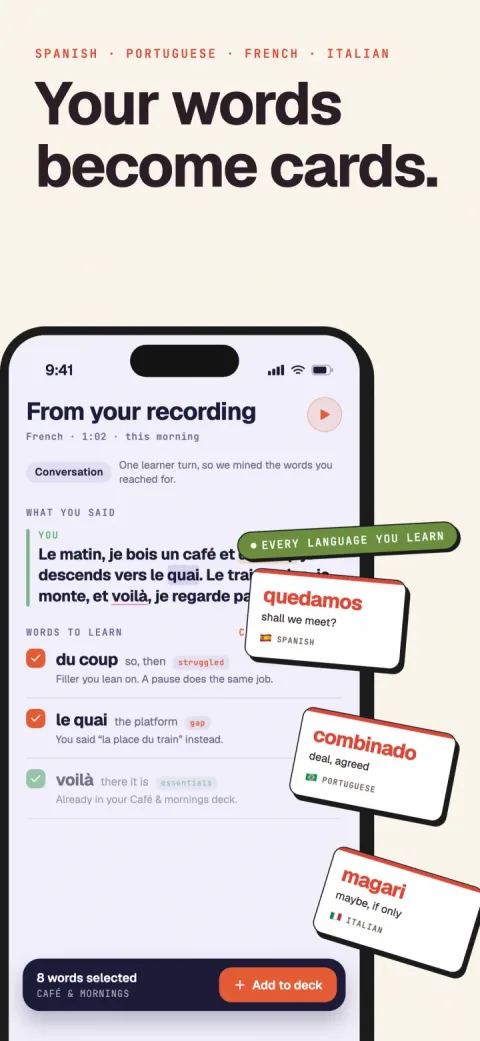
Verbamor was built out of the 150-word problem. Your tutor already says your 150 words out loud, in a real sentence, the week before your trip. So the app records the lesson and turns them into cards.
Nation puts a limit on all of this coverage arithmetic. He writes that "even 98% coverage does not make comprehension easy," citing Kurnia (2003), where few learners understood enough even at 98%.
You'll follow the pharmacist. You'll lose the 2 locals arguing behind you in the queue. Every prepared traveler loses those 2.
Sources
Speech needs fewer words than print, and the first 1,000 families carry more of it
- Nation, I. S. P. (2006). How large a vocabulary is needed for reading and listening? The Canadian Modern Language Review, 63(1), 59-82.
- Ha, H. T. (2022). Vocabulary demands of informal spoken English revisited. Frontiers in Psychology, 13, 831684.
The famous 95% threshold traces back to one course's pass mark
- Laufer, B., & Ravenhorst-Kalovski, G. C. (2010). Lexical threshold revisited: Lexical text coverage, learners' vocabulary size and reading comprehension. Reading in a Foreign Language, 22(1), 15-30.
Two labs disagree about the shape of the curve and still land on 98%
- Hu, M., & Nation, I. S. P. (2000). Unknown vocabulary density and reading comprehension. Reading in a Foreign Language, 13(1), 403-430.
- Schmitt, N., Jiang, X., & Grabe, W. (2011). The percentage of words known in a text and reading comprehension. The Modern Language Journal, 95(1), 26-43.
Hitting the coverage number still leaves comprehension hard
- Nation, I. S. P. (2006). How large a vocabulary is needed for reading and listening? The Canadian Modern Language Review, 63(1), 59-82.
Load the words you will actually use.
Verbamor turns the language from your own lessons into cards, so what you practise is what you will say.
Start 7 days free