 Verbamor
Every Spanish, French, Italian, Portuguese word list
Corpus, year, counting unit, licence and download URL for every published frequency list in the four Romance languages. I checked each licence at its own source on 3 September 2026, because several of the lists people build apps on are noncommercial and say so only in a file you have to download to read.
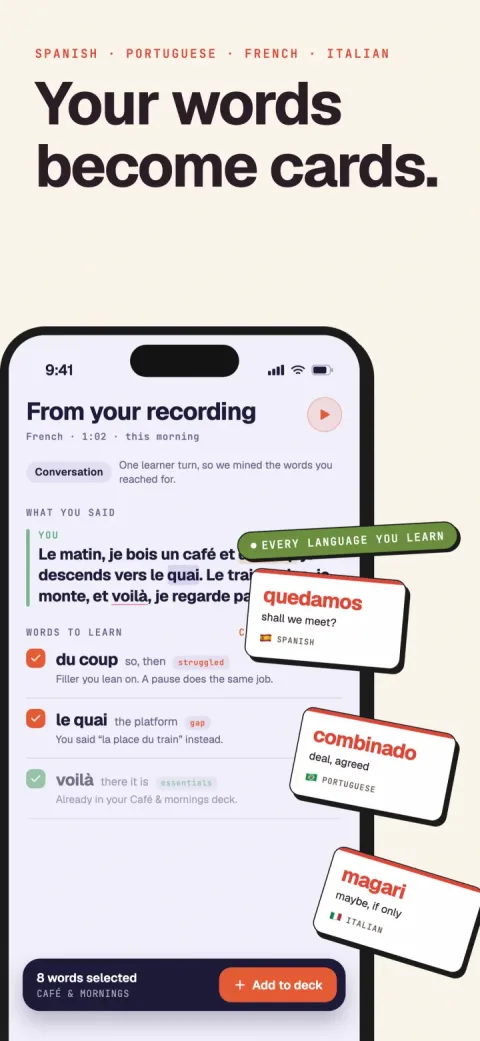
Verbamor turns the words from your own lessons and recordings into flashcards, and brings each one back before you’d forget it.

I needed frequency lists for four languages, and I spent longer on the licences than on the data.
That's the wrong ratio, and the reason for this page. Every roundup says where to download these lists.
Almost none says what you may legally do with them. Several of the most-recommended ones forbid commercial use in a file you have to go looking for.
So this page carries a licence column. I read every cell at its own source on 3 September 2026, instead of copying it from another table. Where I couldn't reach a source, the cell says so.
Several popular lists forbid commercial use, in a file you have to find
Start with the ones most likely to end up inside a language app, because those are the ones that will bite you.
The SUBTLEX family covers all four: ESP for Spanish, IT for Italian, PT and PT-BR for Portuguese. French has none, because Lexique already did that job.
All sit on OSF (the Open Science Framework, a site where researchers post data). Every OSF licence field I checked says only "Other" and points at a file. I downloaded the files.
SUBTLEX-ESP's reads:
The materials on this website is subject to the following CC license: CC BY-NC-SA 4.0. Creative Commons Attribution-NonCommercial-ShareAlike 4.0 International
license.txt, SUBTLEX-ESP on OSF, downloaded 3 September 2026NonCommercial. If you sell a language app, that licence doesn't cover you. The OSF project page prints those four words nowhere a browser will show you: they live in a 471-byte text file you have to download.
SUBTLEX-IT says the same in 109 bytes. SUBTLEX-PT-BR goes further than any other list here:
This work is licensed under a Creative Commons Attribution-NonCommercial-NoDerivatives 4.0 International License.
license.txt, SUBTLEX-PT-BR on OSF, downloaded 3 September 2026NoDerivatives. On a word list, that plausibly rules out the ordinary thing you'd do with one: reformat it, cut it to the top 5,000, add a translation column.
I say plausibly because I haven't seen anyone test what counts as a derivative of a frequency table, and the answer isn't settled.
SUBTLEX-PT has no licence file and no OSF licence set. Silence isn't permission, and a missing licence is the cell I'd email an author about.
CEFRLex does the same more visibly. Its Spanish ELELex and French FLELex download pages both state CC BY-NC-SA 4.0 in the page body. Same restriction, better signposting.
Now the one the internet gets backwards. The hermitdave OpenSubtitles lists are the most-recommended free option for all four languages, and they're widely described as MIT. The repository's own README splits it:
MIT License for code.
CC-by-sa-4.0 for content.
MIT covers the generator. The word lists themselves are share-alike, which is a real obligation: what you make from them has to go out under the same licence.
The repository's LICENSE file contains only the MIT text, which is how the misreading starts. People open LICENSE, see MIT, and never reach the README.
One more thing about that repository, since most people use it. Its content directory holds two vintages, 2016 and 2018, so the prebuilt lists are eight years behind their own corpus.
For learner vocabulary that hardly matters, because the top 5,000 words don't churn. For anything sensitive to current usage, it matters a lot.
I'm not a lawyer, and this isn't legal advice. But the gap between "do what you like with attribution" and "you may not sell this" is worth four minutes with the file.
Every list side by side, and the unit column decides which you can use
The unit column is the one that decides whether a list is usable, and the next section is why.
| List | Langs | Corpus | Unit | Size | Licence |
|---|---|---|---|---|---|
| FrequencyWords (hermitdave) | all 4 | OpenSubtitles 2018 via OPUSsubtitles | surface forms | 50k lists, full lists 770k-1.2M rows | CC BY-SA 4.0 for the data, MIT for the code |
| Lexique 3.83 | FR | film subtitles + booksseparate columns for each | forms and lemmas | 142,695 rows, 25.8 MB TSV | CC BY-SA 4.0 |
| Lexique 4.00 | FR | 316M-word subtitle corpus | forms, with lemmas | 189,863 rows, 33 MB TSV | CC BY-SA 4.0 |
| SUBTLEX-ESP | ES | film subtitles | surface forms | 31,452 entries, 15 columns | CC BY-NC-SA 4.0noncommercial |
| EsPal | ES | 3 databases: web/government/press/literature, plus opensubtitles.org tokens and contextual diversity | forms with lemma and POS | Query interface, no bulk download | None stated. Cite Duchon et al. 2013 |
| SUBTLEX-IT | IT | film subtitles | surface forms | 54 MB CSV, plus an RData build | CC BY-NC-SAno version number given |
| CoLFIS | IT | 3.8M words of 1992-94 newspapers, periodicals and bookssampled against ISTAT reading habits | lemmas and formsseparate lemmario and formario | 89,353 lemma rows, 17 fields | "L'accesso è gratuito", no formal licence |
| KELLY | IT9 languages, none of the other 3 here | web corpus snapshot, c.2010 | lemmas, by CEFR level | 6,866 rows, 4 columns | CC BY-NC-SA 2.0noncommercial |
| SUBTLEX-PT | PT | film subtitlesSoares et al. 2015 | surface forms | 132,710 entries, 12 columns | None statedno licence file, no OSF licence |
| SUBTLEX-PT-BR | PT-BR | 61M words of Brazilian film subtitles | surface forms | 78,908 entries | CC BY-NC-ND 4.0noncommercial AND no derivatives |
| CEFRLex: ELELex | ES | textbooks + graded readers | lemmas, by CEFR level | 14,290 entries, A1 to C1 | CC BY-NC-SA 4.0noncommercial |
| CEFRLex: FLELex | FR | textbooks + graded readers | lemmas, by CEFR level | 14,236 (TreeTagger) / 17,871 (CRF) | CC BY-NC-SA 4.0noncommercial |
| wordfreq | all 4 | 8 blended sourcesfrozen at 2021 | surface forms | 7 sources ES/FR/IT, 5 for PT | Apache for code, CC BY-SA 4.0 for data |
| RAE / CREA | ES | CREA v3.2, texts 1975-2004 | orthographic forms | 1k / 5k / 10k lists + a full list | Not stated anywhere I could find |
| Routledge frequency dictionaries | ES, FR, PTno Italian volume exists | Corpus del Español / do Português and equivalents | lemmas | 5,000 lemmas, print book | Commercial. Bulk corpus data $795 non-academic |
| WorldLex | all 4 | blogs, Twitter and newspapers, 2011-13three registers kept separate | surface forms | 66 languages; French 84.2M words, Italian 79.5M | Not stated on the download page |
One thing is missing on purpose. The Leipzig Corpora Collection belongs there, and I couldn't get in.
Every entry point I tried on 3 September 2026 returned an Anubis proof-of-work challenge (a bot check), and the direct download host returned 403. I won't print a licence I couldn't read, so Leipzig has no row.
If you can reach it in a browser, it covers all four languages and is worth the trip.
The RAE row's blank licence cell is the same story: RAE publishes CREA frequency lists and, as far as I can find, no terms of use for them.
Form lists scatter one Spanish verb across the whole ranking
Most of these lists count surface forms (each spelling as it appears in text), which the download pages rarely say plainly. Every inflection of a verb is a separate row competing for its own rank. Spanish conjugates heavily, so this gets expensive fast.
I took the Spanish 50k list and looked up 48 forms of hablar. 38 of them are in there. Here's where they sit:
hablar occupieshablabais, sits at 47,098.Treated as one word, hablar is the 57th most common thing in the corpus. Treated as forms, no row it owns cracks the top 150.
A learner working down the list collects hablas at 774 and hablo at 1,045, and is still picking up stragglers past 47,000. One verb, smeared across the whole range and quietly demoted.
French does the same with parler: 25 forms present, best rank 143, worst 45,368. Every form list for a Romance language has this property. It's what counting forms means.
Which is why Lexique is the standout here. It ships the form and its lemma as columns in one downloadable file. (A lemma is the dictionary form, the way hablar is the lemma of hablas.)
It also splits film frequency from book frequency, so you can see which register a word belongs to. I downloaded both: Lexique383.tsv is 25.8 MB and 142,695 rows, Lexique400.tsv 33 MB and 189,863.
Spanish has a partial answer in EsPal. It returns lemma and part-of-speech properties for words you paste in, over a written corpus or over opensubtitles.org tokens.
It solves the unit problem as a lookup service rather than a file: no bulk download, databases dated 2012.
The other route, in any language here, is to lemmatise a form list yourself. spaCy publishes news models for all four (es_core_news_sm and its siblings) under MIT. simplemma is MIT too, and faster if you only want lemmas.
Collapsing a 50k list is a short script. What it costs you is responsibility for the tagger's mistakes (the tagger is the software that labels each word's grammar).
A tagger that guesses wrong on porto, which is both a noun and a form of portare, quietly corrupts the rank of two different words at once.
The word-family question sits one level above this, and it changes the numbers again. The unit the famous coverage studies actually count is neither forms nor lemmas.
The top 1,000 words cover more of French than of Spanish
Since I had all the full lists open, I summed them. I can't find these published anywhere, so check my arithmetic before leaning on it.
| Language | Types | Tokens | Top 1,000 | Top 5,000 | Top 50,000 |
|---|---|---|---|---|---|
| Spanish | 1,202,520 | 423,290,924 | 74.9% | 87.4% | 97.6% |
| French | 834,768 | 318,214,450 | 79.4% | 90.1% | 98.4% |
| Italian | 798,017 | 247,073,874 | 74.7% | 87.7% | 97.8% |
| Portuguese (pt) | 770,227 | 216,981,711 | 75.0% | 87.6% | 97.8% |
| Portuguese (pt_br) | 848,043 | 426,260,247 | 76.8% | 89.2% | 98.4% |
French runs about 4.5 points ahead of Spanish at 1,000 words, with the same corpus and the same method. That's a real difference in how top-heavy the two languages are.
And Brazilian Portuguese has its own list with roughly twice the tokens (running words) of the European one. So pt_br is the file you want if that's your variety.
Each percentage is coverage of the corpus the list was built from. Subtitles are dialogue, so these describe speech rather than print, and the shape of that curve matters more to a learner than the exact figure.
Two of these lists have stopped updating, and both say so
The two biggest general-purpose options both have a date past which they won't move, and both say so in public.
wordfreq is frozen at 2021, deliberately. Its README says the data "is unlikely to be updated again," and the maintainer wrote a document explaining why. The first reason:
I don't think anyone has reliable information about post-2021 language usage by humans.
Robyn Speer, SUNSET.md, wordfreq repository, read 3 September 2026Generative AI text flooded the open web wordfreq sampled. Her position is that updating would make the data worse, so she stopped.
The same document refuses CSV export outright, because a CSV has nowhere to carry the share-alike attribution.
CREA is frozen harder and more quietly. RAE's own page gives the numbers:
el CREA cuenta, en su última versión (3.2, junio de 2008), con algo más de ciento sesenta millones de formas [...] producidos en todos los países de habla hispana desde 1975 hasta 2004
Real Academia Española, CREA, via the Internet Archive, read 3 September 2026Version 3.2, June 2008, 160 million forms, texts stopping in 2004. So the RAE Spanish frequency list circulating today samples a language that ends 22 years ago, before smartphones.
RAE's live successor CORPES XXI passed 395 million forms at version 1.0 in May 2023. It publishes no downloadable frequency list at all. The downloadable one is the dead one.
RAE's own site served me nothing. rae.es and corpus.rae.es both returned 403 to every request on 3 September 2026, so the quotes above come from Internet Archive captures.
The frequency-list page they preserve offers four files: 1,000, 5,000 and 10,000 forms, plus a full list as a zip. Most descriptions mention only the single 1,000-word list.
Which list to take depends on what you're building
Building something you'll sell: hermitdave, and honour the share-alike. It covers all four with a licence that permits commercial use. wordfreq's CC BY-SA data does too, and it blends several sources instead of only subtitles, but it's frozen at 2021 and ships as a Python package rather than plain files.
Skip the SUBTLEX lists and CEFRLex whatever their quality, because the licence answers the question before the data does.
Working in French: Lexique, and it isn't close. Lemmas and forms in one file, film and book frequencies separated, CC BY-SA. Working in Spanish and willing to paste rather than download: EsPal.
Teaching, or building a course with levels: CEFRLex for Spanish and French, KELLY for Italian. Both are CEFR-graded, meaning sorted by the European levels from A1 to C2, and both are noncommercial.
CEFRLex was built from textbooks and graded readers, where the rest use a general corpus. That makes it a different object from the rest of this table, which is worth knowing before you compare its numbers to anyone else's.
Working in Italian: CoLFIS, the least-known list here and the only free lemmatised Italian one here that doesn't forbid commercial use. It ships a lemmario and a formario (a lemma list and a form list) separately, the split that makes Lexique good. It also counts multiword expressions as units.
The catch is the corpus: newspapers, periodicals and books from 1992 to 1994, weighted by ISTAT data on what Italians read. Print rather than speech, and 30 years old.
Its download page says "L'accesso è gratuito" and names no licence, a gap worth an email before you ship it.
The honest hole is Portuguese. There's a Routledge volume, but it's a print book. SUBTLEX-PT states no licence at all, and SUBTLEX-PT-BR forbids derivatives.
The free, clearly-licensed, lemmatised Portuguese list doesn't exist, and I'd rather say so than pad the row.
I hit that wall building Verbamor's four starter decks. They're 646 Spanish rows, 628 French, 623 Italian and 642 Portuguese.
Those numbers differ from one concept list because of the unit problem. pequeño / pequeña is one row for us and two entries in a form list, and the four languages disagree about how often that happens.
Verbamor is a $19.99/month iOS app that turns the words you've already met into scheduled recall. A frequency list is where a beginner starts. The app ships an Essentials deck of about 650 common words, then picks up from your own lessons. If the word lists are all you wanted, a premade deck built from any source above does it for free.
Sources
Licences, each read at its own source on 3 September 2026
- SUBTLEX-ESP. OSF project xp6sz. The OSF licence field returns "Other" with the text "Please see the file named license.txt in the OSF Storage of this project." I downloaded license.txt (471 bytes): "CC BY-NC-SA 4.0 ... for noncommercial purposes only." The data file SUBTLEX-ESP.xlsx is 3,763,108 bytes and its sheet dimension is A1:O31453, so 31,452 entries across 15 columns.
- hermitdave. FrequencyWords. README.md: "MIT License for code. CC-by-sa-4.0 for content." The repository LICENSE file carries only the MIT text, which is where the "hermitdave is MIT" claim comes from.
- SUBTLEX-IT (OSF zg7sc), SUBTLEX-PT (OSF 4ebg5) and SUBTLEX-PT-BR (OSF vb5yp). SUBTLEX-IT's license.txt (109 bytes): "released under the Creative Commons Attribution-NonCommercial-ShareAlike license (CC-BY-NC-SA)", with no version number given. SUBTLEX-PT-BR's license.txt (165 bytes): "Creative Commons Attribution-NonCommercial-NoDerivatives 4.0 International License"; its SUBTLEX_PT-BR_CDAbove2_Alpha_SpellcheckTrue.tsv holds 78,908 entries. SUBTLEX-PT carries no license.txt and its OSF node licence is unset; SUBTLEX-PT.xlsx has sheet dimension A1:L132711, so 132,710 entries across 12 columns.
- CEFRLex. ELELex download and FLELex download. Both state "This work is licensed under a Creative Commons Attribution-NonCommercial-ShareAlike 4.0 International (CC BY-NC-SA 4.0) License." ELELex: 14,290 entries, A1 to C1. FLELex: 14,236 lemmas (TreeTagger) and 17,871 (CRF, with multiword expressions).
- Lexique. lexique.org: "Lexique est distribuée sous une licence Creative Commons Attribution - Partage dans les mêmes conditions 4.0." The openlexicon repository independently reports CC-BY-SA-4.0. The Lexique 4.00 README-Lexique.txt states the licence as "CC BY SA40.0" (their typo for CC BY-SA 4.0) and describes the release as "frequency measures from a 316M-word subtitle corpus, contextual diversity, phonological representations, lemmas, morphological structure, prevalence, and lexical decision data for 190,000 French word forms," citing New, Pallier, Schalchli, Bourgin & Gimenes (2026), Behavior Research Methods. I downloaded Lexique400.tsv (33,067,258 bytes, 189,863 rows, columns including
4_Lemmeand12_FreqLemme) and Lexique383.tsv (25,850,780 bytes, 142,695 rows) on 3 September 2026. - wordfreq. Repository README: "freely redistributable under the Apache license ... includes data files that may be redistributed under a Creative Commons Attribution-ShareAlike 4.0 license." Language table read for source counts: 7 sources each for Spanish, French and Italian; 5 for Portuguese.
- EsPal, BCBL. Interface and FAQ, read 3 September 2026. The interface offers "Words to Lemma and POS properties (Submit words to receive their lemma and part-of-speech properties)" across three databases: "Written and Web Tokens (2012-11-06)", "Subtitle Tokens (2012-10-05)" and "Subtitle Contextual Diversity (2012-11-02)". The FAQ names the sources as "1) A large collection of written data from the Web, government sources, newspapers, and literature. 2) Subtitles kindly provided by opensubtitles.org." No licence or bulk download is offered on either page. Cite Duchon, Perea, Sebastián-Gallés, Martí & Carreiras (2013), "EsPal: One-stop shopping for Spanish word properties," Behavior Research Methods 45, 1246-1258, doi:10.3758/s13428-013-0326-1.
- KELLY. The Italian list is distributed from the University of Leeds Kelly page, which states: "The lists are available under the CC BY-NC-SA 2.0 license." Note that the CC-BY-SA 3.0 / LGPL 3.0 terms quoted on Språkbanken's Kelly page apply to the Swedish list, and none of the four languages on this page is Swedish. I downloaded it_m3.xls on 3 September 2026 (488,960 bytes); its BIFF DIMENSIONS record gives 6,866 rows across 4 columns. Cite Kilgarriff et al. (2014), "Corpus-based vocabulary lists for language learners for nine languages," Language Resources and Evaluation 48, 121-163, doi:10.1007/s10579-013-9251-2. KELLY's nine languages are Arabic, Chinese, English, Greek, Italian, Norwegian, Polish, Russian and Swedish, so Spanish, French and Portuguese are not covered.
- CoLFIS, Corpus e Lessico di Frequenza dell'Italiano Scritto. Home and Descrizione: "i dati lessicali estratti dal corpus sono compiutamente lemmatizzati e annotati rispetto alle parti del discorso," and the corpus "Consta di 3.798.275 ricorrenze lessicali" split 1,836,119 newspapers / 1,306,653 periodicals / 655,503 books, drawn from La Repubblica, La Stampa and Il Corriere della Sera, 1992-1994. I downloaded Lemmi_rango_txt.zip (2,101,221 bytes) on 3 September 2026: Lemmi_rango.txt is 36,187,972 bytes and 89,353 rows, with 17 documented fields including per-sector frequency and dispersion. The download page states "L'accesso è gratuito" and names no licence.
- Routledge Frequency Dictionaries series, searched on routledge.com on 3 September 2026. Volumes returned for Spanish, French and Portuguese. No Italian volume is returned by any search I tried, which is why the Italian cell is empty.
- WorldLex. Gimenes & New, blog, Twitter and newspaper frequencies for 66 languages, citing Gimenes, M., & New, B. (2015), Behavior Research Methods. The page's own table gives French at 84.2 million words and Italian at 79.5 million, both collected 2011-12. No licence is stated on that page.
- Mark Davies. corpusdata.org purchase terms. Academic licence $395 for one corpus, non-academic (explicitly "including commercial") $795, and the page states the data is "95% there, 5% removed for reasons of copyright."
- Leipzig Corpora Collection: not verified. wortschatz.uni-leipzig.de/en/download, corpora.uni-leipzig.de/en/download and the browser-driven fetch all returned an Anubis proof-of-work challenge page on 3 September 2026, and downloads.wortschatz-leipzig.de returned HTTP 403. No licence is claimed for it here.
Corpora and dates
- Real Academia Española. CREA. "su última versión (3.2, junio de 2008), con algo más de ciento sesenta millones de formas ... desde 1975 hasta 2004." Read via Internet Archive capture 20250831215212; rae.es returned HTTP 403 to direct requests on 3 September 2026. The frequency-list page (capture 20250306135349 of corpus.rae.es/lfrecuencias.html) offers 1000, 5000 and 10000 form lists plus CREA_total.zip.
- Real Academia Española. CORPES XXI. Version 1.0, May 2023, "más de 395 millones de formas." Version history read from the same page via Internet Archive capture 20250926144400.
- OPUS. OpenSubtitles v2018. 62 languages, 3,735,070 files, 22.10G tokens. Attribution condition stated on the page: "Please, add a link to http://www.opensubtitles.org/ to your website and to your reports and publications." Cite Lison & Tiedemann, LREC 2016.
- hermitdave/FrequencyWords
contentdirectory, listed via the GitHub API on 3 September 2026: two entries,2016and2018. The README names OpenSubtitles2016 and OpenSubtitles2018 as the sources for those two vintages. - The case for building frequency norms from film subtitles rather than print is Brysbaert, M., & New, B. (2009), "Moving beyond Kučera and Francis: A critical evaluation of current word frequency norms and the introduction of a new and improved word frequency measure for American English," Behavior Research Methods 41, 977-990, doi:10.3758/BRM.41.4.977. I could not get past the paywall to read it, so I am citing it as the origin of the subtitle approach and making no claim about its numbers.
- Robyn Speer. SUNSET.md. "I don't think anyone has reliable information about post-2021 language usage by humans."
My arithmetic, from the downloaded files
- Coverage and token totals computed by summing the
_full.txtfiles from hermitdave/FrequencyWords (2018 content) for es, fr, it, pt and pt_br, downloaded 3 September 2026. Types and tokens as printed in the coverage table; cumulative coverage taken at ranks 1,000, 5,000 and 50,000. - The
hablarfigures: 48 inflected forms looked up in es_50k.txt, 38 present, summing to 900,007 tokens. That total would place it 57th if the list were lemmatised; the highest-ranked individual form ishablarat 154 and the lowest present ishablabaisat 47,098.parlerin fr_50k.txt: 25 of 31 forms present, best rank 143, worst 45,368. The 10 missing Spanish forms are mostly vosotros and imperfect-subjunctive variants that fall outside the top 50,000 entirely. - Lexique383.tsv downloaded directly from lexique.org on 3 September 2026: 25,850,780 bytes, 142,695 rows, with
ortho,lemme,freqfilms2andfreqlivresamong its columns.
A list is where you start, not what you learn.
Verbamor turns the words from your own lessons into scheduled recall with native audio.
Start 7 days freeThe 7-day free trial is on the yearly plan.