 Verbamor
"8,000 words" means 8,000 word families
The "8,000 words" figure comes from Paul Nation's 2006 paper and counts word families: his own Table 2 counts average 4.3 written forms per family, so 8,000 families is 34,660 distinct forms. Drop the unit and the target changes by about four times, and for Spanish, where hablar alone runs to about 44 forms, 4.3 is a floor.
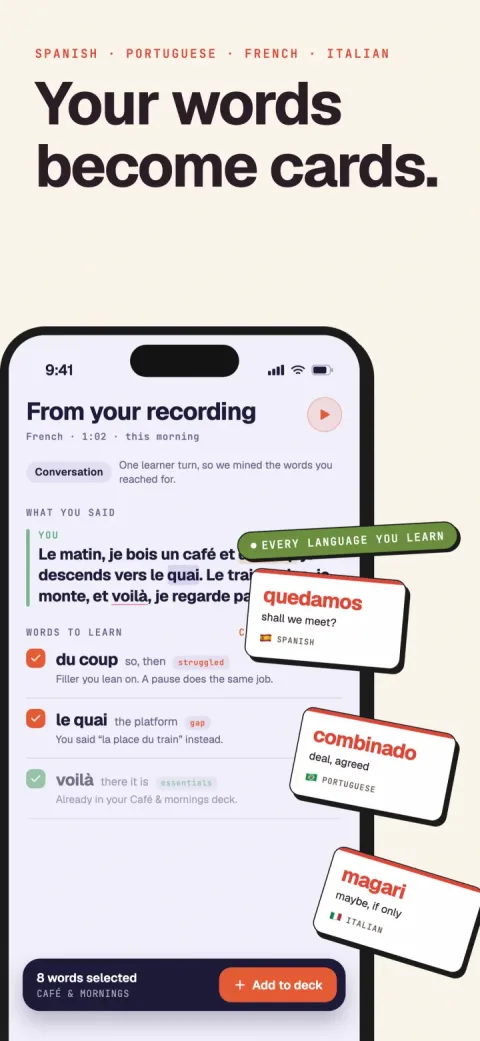
Verbamor turns the words from your own lessons and recordings into flashcards, and brings each one back before you’d forget it.

Somewhere you picked up a target. 8,000 words to read a novel, or 10,000 to be fluent. Then you opened a vocabulary app, watched it count cards, and started measuring yourself against it.
The 8,000 number is real. It comes from Paul Nation's 2006 paper in the Canadian Modern Language Review, and the full PDF is free to read. Here is his conclusion, verbatim:
If we take 98% as the ideal coverage, a 8,000–9,000 word-family vocabulary is needed for dealing with written text, and 6,000–7,000 families for dealing with spoken text.
Nation 2006, p. 79Read the unit. Word families, twice, in a two-line conclusion. Nation isn't being coy: the phrase runs through the paper 75 times, and he spends the better part of two pages defending it.
By the time Nation's figure reaches a blog post it's "8,000 words." The unit falls off somewhere in transit, and what arrives at the other end is a different quantity wearing the same digits.
01 / 06One family absorbs the plural, the tense and the agent noun, and counts as one
A word family, in Nation's sense, is a headword bundled with every inflection and derivation a reader could decode from it. Inflections are endings like -s and -ed; derivations are new words built with affixes, like -ness.
His lists sit at Level 6 of the Bauer and Nation scheme, which he describes plainly:
Level 6 includes inflections and over 80 derivational affixes including -able, -less, -age, -ant, -ward, circum-, neo, -ify, -ist, and -y.
Nation 2006, p. 66Over 80 affixes. So one family absorbs the plural, the past tense, the adverb, the negation, the agent noun and the abstract noun, and counts the lot as one.
The word family is a defensible unit for what Nation was measuring, and I'll make his case further down. The trouble starts when it travels.
A reader meeting "8,000 words" hears 8,000 things to learn, and a flashcard app counts cards. Both are working in a unit Nation had already ruled out.
02 / 06His own example runs to 27 written forms, spellings included
Nation saw the objection coming and answered it with an example. He picked the family nation, from the high-frequency end where families run largest, and printed its members. Here they are, exactly as the paper lists them:
national, nationally, nationwide, nations, nationalism, nationalisms, internationalism, internationalisms, internationalisation, nationalist, nationalists, nationalistic, nationalistically, internationalist, internationalists, nationalise, nationalised, nationalising, nationalisation, nationalisations, nationalize, nationalized, nationalizing, nationalization, nationhood, and nationhoods.
Nation 2006, p. 67, the family members of nation at Level 6Count the members. 26 listed members, plus the headword nation, is 27 distinct written forms sitting inside one tick on an 8,000 tally.
Notice what's in the nation family. Nationalistically. Internationalisation and nationalization, both spellings, counted as the same word you already know. Nation is explicit that this is an assumption about reading and listening:
The assumption that lies behind the idea of word-families is that when reading and listening, a learner who knows at least one of the members of a family well could understand other family members by using knowledge of the most common and regular of the English word-building devices.
Nation 2006, p. 67And Nation adds the caveat that gets lost with the unit: "Most L2 learners, however, will not have word-families as inclusive as those of native speakers."
03 / 06How many written forms does a word family hold?
About 4.3 on average across Nation's own table. The nation family is the extreme case, chosen to make a point.
So the useful question is the average, and Nation publishes the data to compute it, in a table built for another purpose.
Nation's Table 2 exists to validate his lists. Low-frequency words have smaller families. So if the ordering is right, the type count (the number of distinct written forms) should fall band by band while the family count holds at 1,000.
It does. But that same table is a form-count per band, and dividing it out answers a different question entirely.
So the written target in distinct forms: 34,660 to 37,713. The spoken target of 6,000 to 7,000 families works out at 28,015 to 31,436.
The forms-per-family ratio is steepest exactly where a beginner lives. The first 1,000 families carry 6,019 forms, 6.02 apiece, falling to 3.05 by the ninth band because rarer stems take fewer affixes. Front-load the frequency list, which is right anyway, and you're working where families are fattest.
One honest caution on that 34,660. It counts forms as the RANGE program counts them, so nationalise and nationalize are two. Nation also admits homographs like March and march are handled imperfectly.
Read it as the form inventory behind the family count, rather than 34,660 separate memory items. Most of those forms are regular, and that regularity is the argument for the unit.
Second caution, the one that matters for a Romance language. All of this is English on English lists, and the ratio doesn't cross the border unchanged.
Take hablar. An English verb has 4 inflected forms: talk, talks, talked, talking.
A regular Spanish verb has 8 simple tenses at 6 persons each, plus imperatives and non-finite forms like hablando. Syncretism (one form doing two jobs) collapses some of it, since hablaba covers first and third person.
Setting aside the archaic future subjunctive, hablar lands around 44 distinct forms, before a derivation like hablador joins it.
So 4.3 is a floor for Spanish rather than an estimate of it. I could produce a Spanish multiplier by counting stems and averaging, but it'd be worthless.
The answer depends on the verb-to-noun ratio of the band you sample, and Spanish nouns give 2 forms where verbs give 44. Without a Spanish frequency list counted in families, that average is a guess wearing a decimal point.
04 / 06The 80% figure has proper nouns counted inside it
Nation's 2006 paper has a second unit problem, and this one changes a figure quoted even more often than 8,000. "The first 1,000 words cover 80% of English" is everywhere. Nation's conclusion carries an extra clause:
The greatest variation in vocabulary coverage is most likely to occur in the first 1,000 words, and in the proper nouns. The first 1,000 plus proper nouns cover 78%–81% of written text, and around 85% of spoken text.
Nation 2006, p. 79, conclusion point 1Plus proper nouns. Names ride along inside the famous percentage, and in Table 14 they're a separate row worth 2 to 4% of written text.
How much proper nouns are worth is measurable, because Nation prints one text both ways. For The Picture of Dorian Gray, his Table 8 gives 91.20% coverage at 2,000 words and 96.75% at 2,000 plus proper nouns.
Subtract: 5.55 points, exactly the proper-noun figure he reports for that text. Across his five newspaper corpora they run 4.55% to 6.12%, since newspapers "are about people, places, and events."
The practical read on proper nouns is cheerful. Proper nouns are coverage you get without studying, because Madrid is Madrid. How much they are worth swings by genre, which the follow-up post tabulates across all 14 of Nation's texts.
The unhelpful part is that bundling them in overstates what your studied vocabulary does. And no coverage calculator I've seen breaks them out.
05 / 06He picked the big unit on purpose, and calls the result a floor
Now the concession, because a page that only prosecutes isn't much use. Nation chose big families deliberately, and he explains which direction the choice biases his answer:
In the present study, the decision was made to go with large word-families. This will give a low assessment of how many word-families are needed to read newspapers, novels, etc. That is, if learners' word-families are smaller, a larger number of word-families will be needed to do these tasks.
Nation 2006, p. 67Read Nation's caveat carefully, because it flips the usual complaint.
The family unit makes his headline number look smaller than a stricter unit would, and he says so in print. The 8,000 is a floor, labelled as one.
Nation also draws the line where the unit stops working. For speaking and writing, "the lemma would be the largest sensible unit to use, because each lemma takes different collocates and different grammatical patterns." (A lemma is a headword plus its inflections, without the derived words.)
His number was built for receptive comprehension, meaning reading and listening. He tells you it's the wrong unit for what most learners are training for. That's the gap between recognising and producing that runs through any honest coverage figure.
Nation's 98% threshold carries its own warning. (Coverage is the share of running words in a text that you know.)
At 95% coverage, learners are "dealing with 1 unknown word in every two lines of text (1 unknown word in 20), or with 7 unknown words in every minute of speech at 150 words per minute." In the Hu and Nation experiment underneath it, 95% coverage left adequate comprehension to "a small minority."
Twenty years on, the field still hasn't settled the unit. In a 2021 Studies in Second Language Acquisition commentary, Thi Ngoc Yen Dang puts the state of play flatly: "whether lemmas or word families are a more appropriate lexical unit for EFL learners is still a debate."
The case against the word family is that learners lack the derivational knowledge the unit assumes, so a Level 6 family "may underestimate the learning burden of derived forms." Dang grants that "Level-6 word families is probably too large a lexical unit for EFL learners," and then defends it anyway.
Laufer and Cobb found that reaching 95% and 98% coverage needs only basewords, inflections and a small number of affixes.
So the unit is contested at the top of the field, while the number derived from it circulates with no unit attached at all.
06 / 06The "7 repetitions" trail runs cold at a 1962 bulletin I couldn’t get
One more number in the same family of errors, and this one I went looking for expecting to find nothing.
"You need 7 repetitions to learn a word" is a fixture of language-learning copy. StoryLearning's principles page has it in the usual form: "Some estimates say you need to encounter a new word seven times before it is committed to long-term memory."
Some estimates. No citation.
The 7-repetitions trail does end somewhere. The 7 traces to Kachroo (1962), "Report on an investigation into the teaching of vocabulary in the first year of English," in the Bulletin of the Central Institute of English, volume 2.
It surveyed Indian English coursebooks, and found that words repeated seven or more times were known by most learners.
I couldn't read Kachroo's bulletin. It's a 64-year-old departmental bulletin with no DOI (the permanent ID most papers carry), no digital edition I could locate, and no library scan I could reach.
Everything citing it was citing it secondhand. One 2014 paper in International Education Studies prints the reference correctly while misspelling the author "Krachroo" in the body.
So 1962 is where the trail goes cold. Anyone quoting 7 today is quoting a coursebook survey about Indian schoolchildren, unopened for decades, and calling it a fact about you.
The 7 does have a modern defender, and reading the study undoes the claim. Zhang (2022), in Language Teaching Research, taught 20 English words to 98 Chinese secondary students and found "at least seven repetitions were needed for significant gains to take place."
Then look at Zhang's design. Each word was repeated 4, 5, 7 or 9 times.
Four levels, and 7 is simply the lowest one where every proficiency group gained. Nothing between 5 and 7 was tested, so the real threshold could sit anywhere in there.
And 9 beat 7 handily. Zhang's conclusion says "there might not be a 'ceiling' effect of repetition," and calls for research above 9. The paper cited as proof of the magic 7 reports that more than 7 is better.
The meta-analysis behind the repetition claim, Uchihara, Webb and Yanagisawa (2019), pooled 45 effect sizes from 26 studies. (A meta-analysis pools the results of many studies; an effect size measures how big each result is.) It found a medium correlation, r = .34 (r measures how closely two things rise together).
That's a trend across a scatter of studies. It supports "more helps," and it will never yield the single number the copywriters want.
The magic 7 is the word-family failure one layer down. A range with conditions attached gets compressed into a round number, the conditions fall off, and the number goes travelling.
The practical version: how you space repetitions does more work than how many you run. That's the retrieval argument, and it's better evidenced than any count.
Spacing over counting is roughly where Verbamor sits, and the honest description is narrow. It builds cards from your own lessons and schedules them with FSRS, an open-source scheduling algorithm.
So repetitions land when you're about to lose the word, instead of 7 times in a row on a Tuesday.
It doesn't know your word families. Nothing does: your hablar family is whatever you can actually decode, and no app has measured that. If you'd genuinely maintain your own deck, Anki is free and runs the same algorithm.
So when you next meet a vocabulary target, ask what it counted. Families, lemmas and forms are three different answers to "how many words," and in English the gap between the first and the last is about 4x.
Sources
The paper the numbers come from
- Nation, I. S. P. (2006). How Large a Vocabulary Is Needed For Reading and Listening? Canadian Modern Language Review, 63(1), 59–82. Conclusion, p. 79: "a 8,000–9,000 word-family vocabulary is needed for dealing with written text, and 6,000–7,000 families for dealing with spoken text," and "The first 1,000 plus proper nouns cover 78%–81% of written text." Level 6 definition and the 26-member nation family, pp. 66–67. Table 2 type counts, p. 65. Table 8 (Dorian Gray), p. 73. Table 7 (newspapers), p. 72. Table 14, p. 79. Full PDF retrieved 3 September 2026.
The unit is still disputed
- Dang, T. N. Y. (2021). Selecting lexical units in wordlists for EFL learners. Studies in Second Language Acquisition, 43(5), 954–957. Accepted version, CC BY-NC-ND, read in full. "whether lemmas or word families are a more appropriate lexical unit for EFL learners is still a debate"; word families "may underestimate the learning burden of derived forms because EFL learners have insufficient derivational knowledge"; "Level-6 word families is probably too large a lexical unit for EFL learners"; and the Laufer and Cobb (2019) counterpoint that reaching 95% and 98% coverage needs only basewords, inflections and "a small number of affixes." Retrieved 3 September 2026. The empirical paper on the other side of this debate, McLean's flemma study in Applied Linguistics (doi:10.1093/applin/amw050), is paywalled and was not read, so no figure from it is quoted here.
The arithmetic
- Nation's Table 2 prints the number of types in each 1,000-family list: 6,019, 5,527, 4,591, 4,308, 3,988, 3,582, 3,421, 3,224, 3,053 for the first nine bands. Summing gives 34,660 forms across 8,000 families and 37,713 across 9,000, or 4.33 and 4.19 forms per family. The first band alone is 6.02 forms per family, the ninth 3.05. Spoken range: 28,015 forms at 6,000 families, 31,436 at 7,000. The Dorian Gray subtraction is 96.75 − 91.20 = 5.55, matching the proper-noun figure Nation reports for that text. All of this is my own arithmetic on Nation's published counts; he does not present cumulative form totals anywhere in the paper.
The "7 repetitions" trail
- Kachroo, J. N. (1962). Report on an investigation into the teaching of vocabulary in the first year of English. Bulletin of the Central Institute of English, 2, 67–72. The apparent origin of the figure. Not retrieved. No DOI, no digital edition located, and every citation of it I found was secondhand. Reference confirmed from the bibliography of Yan Liqin & Gao Xinlu, "Word Saliency and Frequency of Academic Words in Textbooks," International Education Studies 7(4), 2014, doi:10.5539/ies.v7n4p14, which prints the reference in full while citing it in-text as "Krachroo."
- Zhang, P. (2022). How does repetition affect vocabulary learning through listening to the teacher's explicit instruction? Language Teaching Research. 98 Chinese secondary learners, 20 target words repeated 4, 5, 7 or 9 times. Reports "at least seven repetitions were needed for significant gains," and also that gains "were largest for words repeated nine times," and that "there might not be a 'ceiling' effect of repetition." Full text via the University of Reading repository, retrieved 3 September 2026.
- Uchihara, T., Webb, S., & Yanagisawa, A. (2019). The Effects of Repetition on Incidental Vocabulary Learning: A Meta-Analysis of Correlational Studies. Language Learning, 69(3), 559–599. 45 effect sizes, 26 studies, N = 1,918, r = .34. Paywalled: figures here are from the publisher abstract, and the "up to 20 repetitions" reading is Zhang's characterisation of it, not a line I read in the paper itself.
- StoryLearning, 10 Principles For Language Learning: "Some estimates say you need to encounter a new word seven times before it is committed to long-term memory." No citation given. Retrieved 3 September 2026.
Count the words you actually use.
Verbamor builds cards from your own lessons and schedules them with FSRS, so the repetitions land where they do something.
Start 7 days freeThe 7-day free trial is on the yearly plan.