Verbamor
Speaking anxiety: getting through your first tutor sessions
To get through your first tutor sessions, shrink what anxiety can break: open with 3 prepared sentences, tell the tutor you freeze, pick one correction channel, drill your words to near-automatic beforehand, and book session 2 before you can talk yourself out of it. The dread is real and measurable, and one-on-one lessons already remove its worst classroom triggers.
Here's a thing that happens to competent adults. You run meetings. You've negotiated a mortgage. And 10 minutes before a Spanish lesson with the kindest tutor alive, you're checking whether you could plausibly reschedule.
If you recognize yourself here, you're in good company, and you're not being irrational. Speaking a language badly, on purpose, in front of a fluent adult is a genuinely exposed thing to do. The field has studied this dread for 40 years, and the findings are useful.
01 / 06The dread is its own thing, separate from general shyness
In 1986, Horwitz, Horwitz and Cope argued that foreign language anxiety is its own specific thing, distinct from general anxiety or shyness.
Plenty of confident people fall apart specifically in a second language, because it attacks something unusual: your ability to present yourself as the intelligent adult you are. In your own language you're witty. In Spanish, for now, you're a very polite toddler, and some part of you grieves the difference.
Horwitz, Horwitz and Cope built an instrument to measure foreign language anxiety : the FLCAS, a 33-item scale still used today. Follow-up work kept finding the same pattern: it's common, it's strongest around speaking, and it correlates negatively with performance (more anxiety tends to go with lower scores).
In your own language you're witty. In Spanish, for now, you're a very polite toddler. The anxiety is mostly grief about that gap.
Why do you lose words you know when you're nervous?
Anxiety takes a measurable bite out of the exact cognition you need to find the word, and that's what makes it worth managing rather than just putting up with.
MacIntyre and Gardner (1994) showed anxious learners performing worse across input, processing, and output stages of language tasks. The standard account is attentional: worry is a background process, and it runs on the same working memory that's supposed to be holding the sentence you're building. Every cycle spent on "I sound like an idiot" is a cycle not spent retrieving bosque.
The working-memory tax produces the cruel loop everyone recognizes: anxiety hurts fluency, the stumble confirms the fear, the fear grows.
And it explains a mystery: why you can know a word cold in the app and lose it completely on the call. The word was fine. The RAM it needed was occupied.
The same tax explains why "just relax" is useless advice while "prepare more" quietly works. You can't will the worry process to close, but you can shrink what the main task needs. A word retrieved a hundred times in reviews costs almost no working memory to retrieve the hundred-and-first time, under any conditions.
Overlearning is anxiety-proofing: the parts of your Spanish that run on automation keep running when the conscious machinery gets loud.
03 / 06Off the classroom stage, the anxiety drops substantially
Most of the anxiety literature was done in classrooms, and classrooms are close to a worst case. There's an audience of peers, limited speaking turns you can't control, and evaluation hanging over everything. Young (1990) found students' anxiety dropped substantially when speaking didn't happen in front of the whole class.
A one-on-one tutor session quietly deletes the worst triggers. No audience. No ambush (you can see every question coming in a conversation). No grade.
A tutor is also the one fluent speaker in your life whose entire job is to expect your errors. They hear worse than your worst sentence 5 times a day, from people they like.
I'd go further: the tutor session is the lowest-stakes real conversation you will ever have in Spanish. Every conversation after it (the taxi, the in-laws, the pharmacy) has higher stakes and less patience.
It's the practice room. Nobody's watching the practice room.
04 / 06Anxiety's real cost is the turns you never take
There's a concept in the field that explains why any of this matters for actual learning: willingness to communicate, the moment-to-moment readiness to open your mouth given the chance. MacIntyre and colleagues (1998) built a whole model of it, and anxiety is one of the biggest levers holding it down.
Why willingness matters: speaking is the highest-value practice you have access to. Every turn you take is retrieval under pressure, immediate feedback, and new input tuned to what you just said.
An anxious learner who takes 6 turns in an hour gets a fraction of the practice of a relaxed learner who takes 40. Same hour, same price. Anxiety's real cost is measured in forfeited turns.
Counting turns reframes the goal. You'll feel better as a side effect, but the real reason to manage anxiety is that willingness is the faucet on your practice volume. The faucet responds to comfort.
Every tactic below is really a willingness tactic.
05 / 06Five practical tactics lower the dread before and during the call
- Prepare openers, not scripts. Write 3 sentences you genuinely want to say and open with one. Anxiety peaks at the blank start; owning the first 30 seconds cuts the spike. (This pairs with the pre-lesson routine: light review, real sentences, no panic-drill.)
- Tell the tutor about the anxiety, in English if needed, once. It reclassifies your pauses. A tutor who knows you freeze will wait instead of rescuing, and being waited for kindly is half the cure.
- Ask for one correction channel. "Correct me at the end, not mid-sentence" (or the reverse, whichever you prefer). Unpredictable interruption is its own stressor; picking the channel removes it.
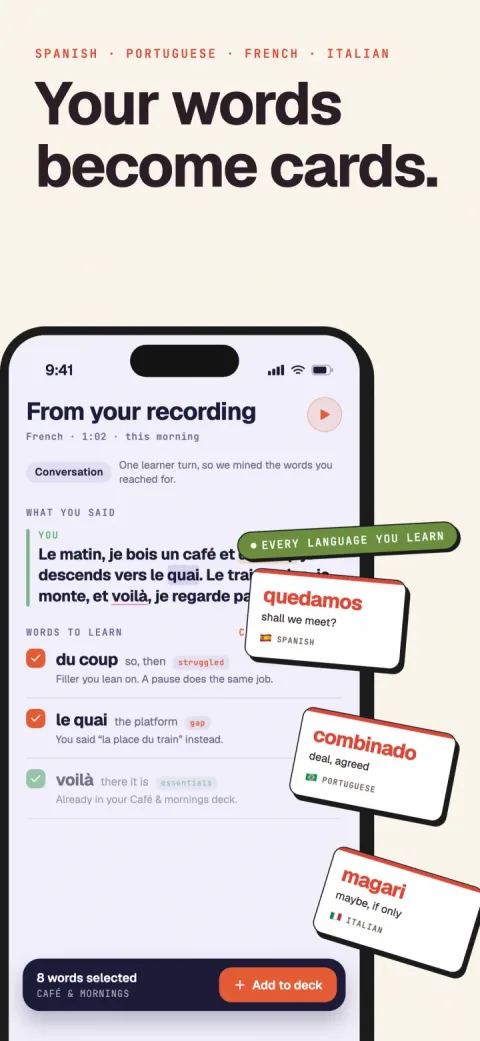
- Front-load the vocabulary elsewhere. Word retrieval is the thing anxiety breaks first, so make retrieval cheap before the call. Words drilled to near-automatic in your reviews survive the working-memory tax; words you sort of know don't.
- Count exposures, not performances. The dread decays with repetition (that's ordinary habituation). Session 1 is the worst you will ever feel about this. Book session 2 before you can renegotiate with yourself.
Notice none of the five tactics is "be braver." Bravery is what you needed to book the first lesson. Everything after that is logistics.
One more, for the catastrophic-feeling moments. Have a planned phrase for drawing a blank, like "¿Cómo se dice...?" plus a gesture. Owned in advance, it converts the worst case from public failure into a normal move fluent people also make.
Knowing the parachute exists lowers the altitude fear of the whole conversation.
06 / 06You don't have to zero out the fear to out-earn it
Newer research reframed the whole problem in a way I like. Dewaele and MacIntyre (2014) surveyed 1,700+ learners. They found foreign language enjoyment and anxiety are surprisingly independent dials, and enjoyment tends to run higher.
You don't have to zero out the fear; you can out-earn it.
Enjoyment in Dewaele and MacIntyre's data came from specific, buildable things: real accomplishment, laughing with the person you're talking to, conversations about things you actually care about.
That's one more argument for spending your speaking time with a human who learns your running jokes and asks about your dog by name. That person also notices when last month's words start showing up on their own.
The anxiety shrinks. The lessons start being the good part of the week. It happens embarrassingly fast, considering how the first one felt.
And keep one piece of perspective within reach for the bad sessions: your tutor has never once ended a call thinking about your grammar. They end it thinking what tutors think, that you showed up, that you tried the subjunctive unprompted, that you laughed at the right moment in their story.
The audience you're performing for is a person rooting for you. That fact doesn't cure the dread, but it survives contact with it better than anything else I know.
Sources
Anxiety taxes performance
- Horwitz, E. K., Horwitz, M. B., & Cope, J. (1986). Foreign language classroom anxiety. The Modern Language Journal, 70(2), 125–132.
- MacIntyre, P. D., & Gardner, R. C. (1994). The subtle effects of language anxiety on cognitive processing in the second language. Language Learning, 44(2), 283–305.
One-on-one lowers anxiety
- Young, D. J. (1990). An investigation of students' perspectives on anxiety and speaking. Foreign Language Annals, 23(6), 539–553.
Willingness drives practice
- MacIntyre, P. D., Clément, R., Dörnyei, Z., & Noels, K. A. (1998). Conceptualizing willingness to communicate in a L2: A situational model of L2 confidence and affiliation. The Modern Language Journal, 82(4), 545–562.
Enjoyment outweighs the fear
- Dewaele, J.-M., & MacIntyre, P. D. (2014). The two faces of Janus? Anxiety and enjoyment in the foreign language classroom. Studies in Second Language Learning and Teaching, 4(2), 237–274.
Walk in with the words already there.
Verbamor drills your lesson vocabulary to near-automatic, so anxiety has less to break when the call starts.
Start 7 days free