Verbamor
How many flashcards a day should you actually do?
Set new cards to about 10 a day if you have 20 minutes, 20 if you have 40, and 5 if you have under 15, because your new-card number sets a daily review pile 8 to 10 times its own size for months. Pick the number your worst week can carry.
Week 1, you set new cards to 50 a day. You did all 50 in about 20 minutes and closed the app feeling good.
Week 6, you open the app and 400 reviews are waiting. You close it again.
The app did exactly what you told it to.
01 / 06One setting decides your next six months
The new-card setting is a standing order. You sign it once and pay every morning after.
A card you learn today comes back tomorrow, then 3 days later, then a week, then 3 weeks. Cards stack on cards, and the pile stops growing only when the oldest stretch far enough to leave the queue.
The pile settles at roughly 8 to 10 times your new-card number. 10 new a day is 80 to 100 reviews, forever. 50 new a day is 400 to 500, the 400 you closed the app on, ordered in week 1.
Anki's stats put a mature review at about 5 to 10 seconds, a new card at 30 to 40. Run 20 new a day all the way down: 180 reviews, 24 minutes, plus 12 for the new cards. That's 35 to 40 minutes every morning for as long as you keep the deck.
Pick the minutes you'll actually have, then work backwards.
- 20 minutes a day pays for about 10 new cards.
- 40 minutes a day pays for about 20 new cards.
- 60 minutes a day pays for about 30 new cards.
- Under 15 minutes a day, set new cards to 5 and go do something else.
All of that assumes you show up 7 days a week. The queue doesn't care that it's Sunday.
02 / 06Your seconds per review set the ceiling, so go measure them
Go measure your own seconds per review, the one input you can check. Open Anki, hit Stats, scroll to the review time graph. Mine sits at 8 seconds on mature vocabulary cards.
Then run the division with your figure. I've watched plenty of tutor students sit still for about 15 minutes a day before they skip. At 8 seconds a card that's 112 reviews, or 11 to 14 new cards a day.
Say your figure comes back at 12 seconds, common if your cards carry full sentences. Your 15 minutes now buys 75 reviews. Divide by the multiplier and the limit lands on 8. A 12-second reader who types in 12 is signing up for 30 minutes a day by March, quits in week 9, and blames the cards.
If you're fast the new-card limit moves the other way. At 5 seconds, 15 minutes is 180 reviews and you can carry 18 to 22 new cards a day.
Check the Future Due graph too, range 30 days. You want a flat ceiling: at 20 new a day the bars top out around 180.
If they're still climbing at day 30, divide the rightmost bar by your new-card number. 280 against 20 new is 14x.
Under 85% on True Retention (the share of reviews you actually pass), every lapse resets a card to a 1-day interval, and lapses bend 9x into 14x. Catch it in week 3, when cutting to 12 fixes it in a fortnight.
03 / 06Tripling the reps in one sitting bought nothing a week later
Doug Rohrer and Kelli Taylor ran a study with 216 students in 2006 that should change how you press the buttons.
Half did 3 practice problems in one sitting. The other half did 9 of the same problems, three times the work. A week later the two groups scored the same. At four weeks they still did.
Then the researchers split 10 problems across two sessions. That group scored nearly double at four weeks. Same problems, same reps. The calendar is the only thing that moved.
The gap is doing the work.
When a card you know comes up and you want to run it again, the answer is no. Do it later.
Nicholas Cepeda and colleagues pooled 839 assessments across 317 experiments in 2006. Massed practice, all in one go: 36.7% correct. Spaced practice: 47.3%. Out of 271 comparisons, only 12 showed no benefit.
Your tutor call is Thursday at 6 and you've been running the whole deck Wednesday night. Stop at Tuesday. Clear what the app hands you and close it, no Custom Study and no Study Now. A Wednesday pass wipes out the gap that makes Tuesday's rep worth something.
Write 5 sentences you want to say on Thursday instead. That's 10 minutes, and it does something a fourth pass of ser versus estar can't. If one shows up mid-lesson and you blank, good: the app hands it back tomorrow with a shorter interval. More on the pre-lesson cram.
Card comes up, you know it cold, press Good, even if the answer took a second. Save Easy for cards that landed before you finished reading the front. Spray it around and your half-known cards get stranded at 4 months, where you'll meet them again as strangers.
04 / 06Lapses push the real cost per card nearer 13 than 10
Cepeda's team also ran over 1,350 people through the cleanest test of spacing anyone has done, published in 2008. They varied the gap between the two study sessions, and how long afterwards they tested.
For target retention intervals of 7, 35, 70 and 350 days, the best gaps were 1, 11, 21 and 21 days. Recall improved by 10, 59, 111 and 77 percent against studying twice in a row.
A card on Cepeda's ratio comes back in 1 day, then about 3, 8, 20, 45, 90, 180, 300. That's 8 reviews in the first year on a card you never miss. You won't.
Forget a card on a 90-day interval and it drops to about a day, then climbs the ladder again. One lapse on a mature card buys 6 extra reviews. At 85 percent retention, where most people live, you fail 1 review in 7, so the load per card lands closer to 13 than 10.
Re-derive the cap with 13 reviews per card. 20 minutes a night at 8 seconds a review is 150 reviews. Divide by 13. Your honest ceiling is 11 new cards a day. 10 minutes a night gets you 6.
You can still aim one card at a date. A word you need 5 weeks out is the 35-day row, an 11-day gap, worth 59 percent more recall on the day. Select it, press D for Set Due Date, type 11. Pressing Again to force an early review logs a lapse instead, costing the 6 extra reps we just priced on a card you knew.
For the other 2,000 cards, FSRS models your personal forgetting curve and picks the gaps per card. (FSRS is an open-source algorithm that predicts when you're about to forget each card.) Its benchmark (Ye and colleagues, 2023) tested it against roughly 1.7 billion real reviews and found it beats SM-2, the old Anki algorithm, at predicting your forgetting.
FSRS's workload curve is your second dial. Daily reviews bottom out near 0.85 desired retention (the recall rate you ask it to aim for) and climb steeply past 0.90.
At 0.90, 112 reviews buys 11 new cards a day. At 0.85 it's closer to 14, paid for by forgetting 15 of every 100 cards instead of 10.
Push to 0.95 and you roughly double your daily reps for 5 percentage points you'd have got anyway next week.
05 / 06How many words from one lesson should you keep?
About 12, even when a 60-minute tutor session hands you a pile of words at once. Mine produced about 40 worth keeping. Keep 12 and bin the other 28.
12 cards a week is about 1.7 new a day averaged out, and the multiplier runs on the average. So you land at 100 to 120 reviews a day, about 15 minutes, and it survives a year.
40 a week is 5.7 a day, settling near 50 reviews for that lesson alone.
Cards that arrive together come back together. Your 12 Thursday cards are due again Friday, then Sunday, then the following Thursday, so Friday is your heavy day and Tuesday nearly free. That rhythm smooths out around week 6 as the intervals drift apart.
You can feed the lesson in over 4 days, 3 cards a day, so the burst never forms.
I take all 12 on Thursday and accept that Friday costs 25 minutes instead of 15. Splitting the pile means opening a text file on Sunday, and I never open it.
Which 12? Go down the transcript line by line. A word earns a card when you stalled and your tutor supplied it, or you said something wrong and your tutor fixed it.
If you understood it when you heard it and couldn't produce it, skip it. That one is half learned and will earn its card later.
06 / 06Pick the number your worst week can carry
The review climb is slow and doesn't feel like a climb. At 10 new a day you're at about 25 reviews in week 2, 45 by month 1, 70 by month 3, and about 90 by month 6, where it stays. If you're 3 weeks in and it feels like plenty, you're early.
- Pick the number your worst week can carry. I set mine on a quiet Sunday and paid every day after. The honest test is a Wednesday when you're behind, 6 minutes before a meeting.
- Cap each night's new words and let the leftovers wait. If 14 words pass on a big night, take the 10 that stung worst.
- Shrink the number before you skip a day. Spacing won in 259 of 271 comparisons (Distributed practice in verbal recall tasks). 5 cards on all 7 days beats 20 banked up for Saturday, and skipping days turns your spacing into cramming.
If you're already staring at 400 due, set new cards to 0 and cap daily reviews at 150. A capped queue is a fixed 20 minute job, and you'll open a fixed 20 minute job.
150 today, 150 tomorrow, 100 the day after: 3 days. Add a couple for the ones you fail and you're clear inside a week.
Some of those 400 you'll fail 6 times before they stick, so suspend them. If the backlog is still over after 2 weeks, delete what you don't care about. I'd rather you kill 200 cards than quit.
Once the due count opens under your limit 3 days running, turn new cards back on at the number your division produced. Never go back to the 20 that buried you.
Every number on this page rests on grading honestly. Press Good on a card you half-guessed and the scheduler pushes it out 3 weeks, long after you've lost it. I wrote up the fix in grading.
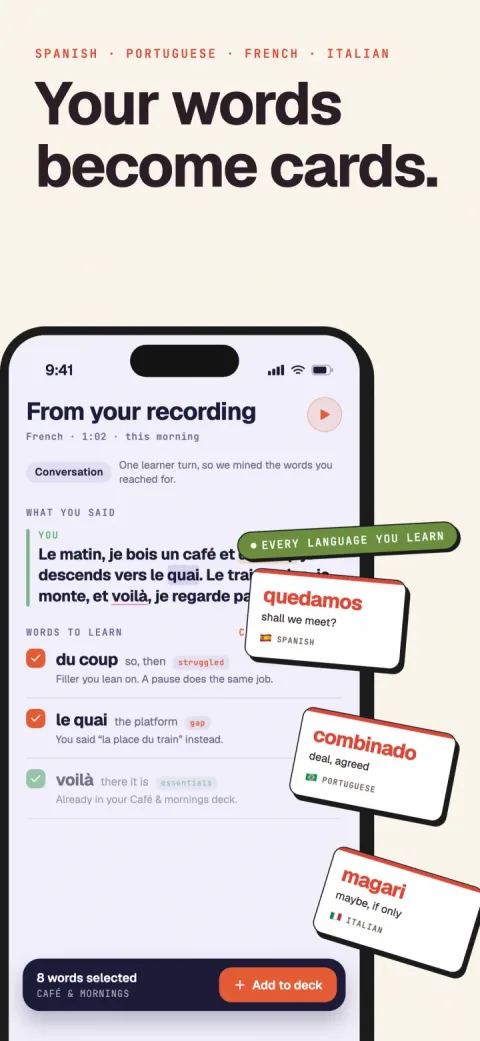
Verbamor makes the cards for you, so the 3 minutes per card the Anki advice budgets for is gone. 10 new a day still puts you near 90 reviews by month 6, no matter who typed them.
Sources
Extra reps on a card you already know buy almost nothing
- Rohrer, D., & Taylor, K. (2006). The effects of overlearning and distributed practice on the retention of mathematics knowledge. Applied Cognitive Psychology, 20(9), 1209-1224.
The same reps moved to a later day nearly double what sticks
- Rohrer, D., & Taylor, K. (2006). The effects of overlearning and distributed practice on the retention of mathematics knowledge. Applied Cognitive Psychology, 20(9), 1209-1224.
- Cepeda, N. J., Vul, E., Rohrer, D., Wixted, J. T., & Pashler, H. (2008). Spacing effects in learning: A temporal ridgeline of optimal retention. Psychological Science, 19(11), 1095-1102.
The best gap shrinks as a share of your horizon
- Cepeda, N. J., Vul, E., Rohrer, D., Wixted, J. T., & Pashler, H. (2008). Spacing effects in learning: A temporal ridgeline of optimal retention. Psychological Science, 19(11), 1095-1102.
Spacing beats cramming almost every time it's been tested
- Cepeda, N. J., Pashler, H., Vul, E., Wixted, J. T., & Rohrer, D. (2006). Distributed practice in verbal recall tasks: A review and quantitative synthesis. Psychological Bulletin, 132(3), 354-380.
FSRS predicts your forgetting better than SM-2
- Open Spaced Repetition (ongoing). SRS benchmark. ~1.7B reviews; FSRS vs. SM-2 and others.
A number you can keep on a bad week.
Verbamor builds cards from your lessons and schedules them with FSRS, so the daily pile stays honest.
Start 7 days free