Verbamor
What to ask for in your first lesson so lesson 2 is better
Ask for two things in lesson 1: one broken structure to drill every lesson, and elicitation, meaning "stop me and make me say it again the right way." Lyster and Ranta coded 686 classroom corrections. Recasts, where the teacher repeats your sentence back fixed, were 55% of them and the least likely to get the student to fix the error.
6 minutes into your first lesson, the tutor asks what you want to work on. You say "um, just, speaking?"
"Just speaking" is the answer that makes lesson 2 a copy of lesson 1.
I've watched "just speaking" play out for friends who pay $25 an hour. They get a warm, pleasant hour of chat.
The tutor corrects them by repeating their sentence back, fixed. They nod. 6 weeks in they're still saying yo he ido wrong.
01 / 05Come to lesson 1 with a target and a correction style
You get maybe 10 minutes of real setup in lesson 1, and what you say in them sets the next 6 months. Tutors are polite and will do exactly what you asked for, forever.
"Just speaking" tells the tutor to fill the hour and stay out of your way.
You need 2 things ready before you click join. A target, and a correction style.
Name one broken thing. Then ask them to change how they correct you.
Start with the target. Pick the structure that keeps collapsing on you and say so: "I want to drill the past tense. Build me sentences where I have to use it, and keep coming back to it every lesson until I stop breaking it."
If you don't know the grammar term, describe the situation: "Every time I try to tell you about my weekend, I get stuck. I want to practice talking about things that already happened." Your tutor will supply the label.
Then change how your tutor corrects you. Hardly any learner asks, and it's the half of the setup that moves your Spanish.
02 / 05The commonest correction was the one students repaired least
Here's the moment. You say yo tengo 30 años with the wrong verb.
Your tutor smiles and says "ah, tienes 30 años," then asks what you do for work. You nod, the lesson moves on, and nothing landed.
A recast is what just happened: your tutor repeats your sentence back in fixed form and keeps the conversation going.
Roy Lyster and Leila Ranta coded every correction in 4 French immersion classrooms in Montreal. 686 feedback moves.
Recasts made up 375 of them, 55 percent, more than every other type combined, and were least likely to get the student to fix the error. Only 94 moves were elicitation, 14 percent, and those got repairs most often.
About half of all the feedback in those rooms landed with no response from the learner at all.
Elicitation is when the tutor stops and makes you produce the right form yourself. On the same wrong yo tengo, three shapes:
- She repeats you up to the error and stops. "Yo...?" Then waits.
- She asks straight out. "How do we say that?" Or ¿cómo se dice?
- She hands you a hint with the answer cut out. "Not tengo. It's the other one."
The tell is who says the correct word. In all 3, you do. If your tutor's mouth produces tienes, you got a recast, however gently it arrived.
Lyster and Ranta's students were 4th graders, in groups with a classroom teacher. What the 686 moves buy you is the ranking.
So ask for elicitation in your first 5 minutes, in English: "When I get something wrong, stop me and make me say it again the right way. Give me a hint if I'm stuck."
Then, 10 minutes in, your tutor will recast you anyway. Recasting is a 20-year reflex and one polite request doesn't sand it off. So you fix it in the room, with one line:
"Wait, let me try that again myself."
Say "let me try that again" the second you hear your sentence come back fixed, then say it again yourself with the correction in. 4 seconds. You'll need it 3 or 4 times in lesson 1, and the repetition is what teaches the tutor.
Learn the line in the language too, because interrupting in English breaks the one rule you both agreed on:
- Spanish: espera, déjame intentarlo otra vez.
- French: attends, laisse-moi réessayer.
- Italian: aspetta, fammi riprovare.
- Portuguese: espera, deixa-me tentar outra vez.
Use the English line in lesson 1 and lesson 2, then switch and never go back. Twice a lesson, maybe 3 times, then stop counting. Interrupting the same person 6 times in an hour buys you a tense hour and not much Spanish.
You'll sit in the gap for 3 awkward seconds while you hunt for tienes. That silence is the work.
Saying this to a stranger feels rude, which is the real reason it stays unsaid. If that dread is stopping you, start with speaking anxiety.
Shaofeng Li's meta-analysis of 33 studies (a study that pools other studies) found a medium effect for corrective feedback.
Quieter, implicit feedback held up better over time than blunt explicit correction. Your espera hands you nothing. You dig out tienes yourself, on the implicit side of Li's line, and it's the elicitation Lyster and Ranta scored highest.
03 / 05Say these four sentences in minute 3
Paste these four sentences into the italki message box the night before, or say them out loud in minute 3.
- "When I get something wrong, give me a hint and let me fix it myself." If your tutor asks what you mean, say this: "Cut off the sentence right before the mistake and let me finish it." And if they push back, you have numbers: the 686 moves Lyster and Ranta logged.
- "Can you record the lesson, or send me your notes at the end?" Most tutors keep a running chat window of corrections already, and you'll forget most of it by Thursday (here's how fast).
- "I need to talk to my partner's mother in July. She's 78 and she doesn't speak English." Give them a date and a person, then type that sentence into the italki lesson notes field before you book. Moeller and colleagues followed 1,273 high school students for 5 years, across 23 schools. Students who worked through a goal-setting process did better at the language, significant at p < .01, meaning unlikely to be chance. Those goals were specific and written down. That's the part you can copy.
- "Can you check in on that goal at the start of every lesson?" You've handed someone else the job of asking whether you're getting closer.
Say all 4 in about 40 seconds. If the words stick in your throat, write them in the chat box.
A tutor who nods and then recasts you for 50 straight minutes has told you something.
Ask again in lesson 2. If lesson 3 still sounds like lesson 1, the tutor is a nice person you're not learning from. Book someone else.
04 / 05How should you judge lesson 1?
Judge lesson 1 on 1 question, asked right after the call: did you enjoy it?
Enjoyment is the strongest number in the research.
Botes, Dewaele and Greiff pooled 96 effect sizes across 28,166 learners in a 2022 meta-analysis of foreign language enjoyment. Enjoyment and willingness to communicate came out at r = .48, the biggest link in the set. (The r measures how closely two things move together.)
Enjoyment and anxiety sat at r = -.31, enjoyment and achievement at r = .30.
2 honest caveats. This is correlational, so it can't show enjoyment causes the talking, and it comes from classrooms, where 1-on-1 tutoring is a different room.
I still think the ruling holds. If you dread the lesson you'll say less in it, and saying things is the entire thing you're buying.
Waiting to find out wastes an hour. Say 2 things out loud instead.
In the first 5 minutes: "I'd rather stumble through talking than do drills, so push me to keep going." In the last 5: "Can we do more of X next time and less of Y?"
Fill in X and Y with what actually happened. More free talking. More correcting me out loud.
Be that literal, because a tutor can't act on "make it more fun".
Watch your own behaviour too. You reschedule.
You go quiet and let the tutor fill the hour. That's your data.
Price the wait. Most tutors run $15 to $25 an hour, so 4 lessons is $60 to $100 spent finding out. Asking out loud in lesson 1 buys the same answer for $0.
Packages are per tutor, so the balance can't move with you, and on italki an unused package expires 1 year after purchase. Switching costs you the discount and the remaining hours both.
So buy single lessons until a tutor has cleared lesson 4. The discount on a 10-pack is usually 5 to 10 percent. You're paying about $10 extra on a $150 package for the right to walk away in week 2, which is cheap.
Send the next tutor 1 sentence the night before lesson 1: "I want to spend most of the hour talking, even badly. Please wait until I finish a sentence before you correct me." A tutor who ignores it has told you something useful for the price of 1 message.
05 / 05Get the words out of your tutor before you hang up
You just heard 60 minutes of your target language. By tomorrow morning most of it is gone.
Hermann Ebbinghaus mapped that decay on himself in 1885. His forgetting curve comes for every word in the lesson.
The ones you fought for slide slower. They still slide.
So save yourself in the last 5 minutes of the call. Ask 2 things:
- "Which words did I get wrong today?"
- "Which 3 words did you have to feed me?"
Type the answers into the chat box as your tutor says them. She has the list in her head and she'll lose it by dinner.
Then spend 10 minutes while the lesson is still warm. Write down each word, the sentence your tutor used it in, and how you got there: quedarse, "Me quedé en casa todo el finde", elicited, took me 3 tries. That third column is the one you'll thank yourself for, because 4 days later every word looks equally familiar.
Now the schedule. Count the passes off your lesson time: tonight about 2 hours after the call, 2 days later, 5 days later, then 1 hour before your next lesson.
That last pass puts the words on your tongue when the call connects. Lessons closer together? Drop the middle passes.
What breaks the schedule is stacking all 4 passes into the night before. That's cramming a week of vocabulary into one sitting: one good lesson, then an empty head by Friday.
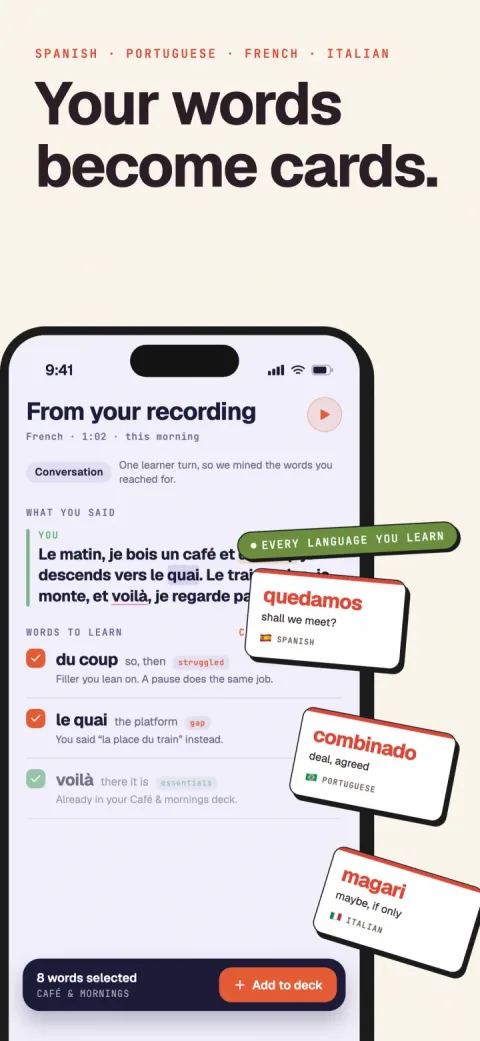
Words sliding out of your head after a lesson is the problem I built Verbamor to solve. It records the lesson and turns what was said into cards. Each one hides the word inside your tutor's example sentence, with an image and 2 native recordings of that sentence.
A notebook and Anki get you there with more typing.
Book lesson 2 before you close the tab, then send your tutor one line: "Please keep eliciting. Don't give me the answer." Do that, and lesson 2 starts where lesson 1 stopped.
Sources
Recasts are the most common correction and the least likely to make you repair the error
- Lyster, R., & Ranta, L. (1997). Corrective feedback and learner uptake: Negotiation of form in communicative classrooms. Studies in Second Language Acquisition, 19(1), 37–66.
Quiet correction holds up better over time than being handed the answer
- Li, S. (2010). The effectiveness of corrective feedback in SLA: A meta-analysis. Language Learning, 60(2), 309–365.
Writing down a specific goal tracks with getting better at the language
- Moeller, A. J., Theiler, J. M., & Wu, C. (2012). Goal setting and student achievement: A longitudinal study. The Modern Language Journal, 96(2), 153–169.
Enjoying the lesson is the strongest known link to whether you speak in it
- Botes, E., Dewaele, J.-M., & Greiff, S. (2022). Taking stock: A meta-analysis of the effects of foreign language enjoyment. Studies in Second Language Learning and Teaching, 12(2), 205–232.
Most of a lesson is gone by the next morning
- Ebbinghaus, H. (1885/1913). Memory: A Contribution to Experimental Psychology. Full text at Classics in the History of Psychology.
Your tutor said it. Now keep it.
Verbamor records the lesson, pulls out what was actually said, and turns it into cards you review before it fades.
Start 7 days free