 Verbamor
A tutor, an app, or both, by what you actually want
Say four things from your last lesson out loud, right now. How that goes decides which of these two purchases you actually need, and here are the real prices of both.
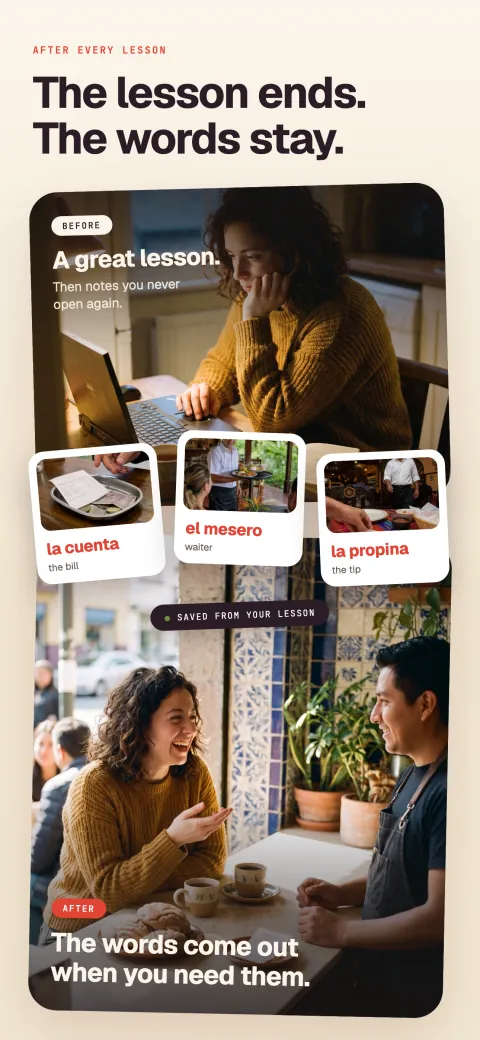
Verbamor records your lesson and turns what your tutor taught into cards that come back on schedule.

When I checked in August, the page ranking first for this question spent about 2,500 words arguing that tutors are expensive. It reviewed italki, Preply, LanguaTalk, Verbling and Tandem, and it prints a dollar figure for exactly one product: its own.
I went through the raw HTML looking for a tutor rate. There isn't one, for italki, Preply or anyone else.
There is, however, $16.99 a month for Ling, the app whose blog it is.
So let's do the thing that page won't. The prices only mean something once you know which question you're asking, so that comes first.
Find out whether your failure is retention or production
A tutor and an app fail you in opposite directions, and the money should follow whichever one is currently breaking.
Here's the test. Think of your last lesson, or the last chapter you finished. Try to say four things that came out of it. Out loud, in the language, right now.
I'll wait.
Four things from the last lesson, out loud, right now. Whichever way that goes tells you where the money should go.
If you couldn't reach any of them, your problem is retention. The lesson happened, the words were briefly in your head, and they're gone.
Buying more lessons is the expensive way to fix a cheap problem.
If the words came but the sentence died in your mouth, your problem is production. You know things you can't yet do under pressure. No amount of card review fixes that, because cards can't make you sweat.
Most people who've been at this for years have the retention problem and keep buying solutions to the production one. Booking an hour feels like commitment. Admitting you forgot last month's hour feels like waste.
Now the arithmetic. One of those failures is fixed by an hour of somebody's professional time. The other is fixed by 10 minutes on a phone.
A weekly tutor hour costs about $832 a year
You can see why the #1 page keeps quiet. A reader looking at $16.99 a month next to a real tutor rate might start doing sums, and sums aren't the friend of that page.
italki's own pricing page says community tutors "typically charge between $4-$20 per lesson" and professional teachers "typically charge between $10-$40 per lesson."
Read that unit carefully. Per lesson, not per hour. Affiliate roundups blur this constantly, and a 30-minute lesson at $4 is a long way from an hour at $40. Trials are "usually 30 minutes long and discounted at 30-50% off regular rates."
On 22 August 2026 I opened italki's Spanish tutor list and wrote down the first 21 trial prices I saw, in order:
Preply publishes a table too, labeled "Average Price on Preply" and updated 2 March 2026. Speaking practice $16 an hour. Intermediate $16. Beginners and advanced $17 each.
Business Spanish and intensive $18. DELE prep $20, SIELE prep $21 (both are Spanish exams). Preply's own stated overall range: "$15 to $50."
Preply also bills differently, and the billing matters more than the rate. Its help centre says each subscription is tied to one tutor and runs in 28-day cycles, with a minimum of 4 lessons per cycle.
Any lessons you didn't schedule before the renewal date expire. You can pause once per cycle for up to 20 days.
Now set them side by side, in the unit that actually hits your account. A weekly Preply speaking-practice hour at $16 runs about $64 to $70 a month, or $832 a year for 52 of them. Drop to a fortnightly hour, 26 of them, and it's $416 a year.
Ling is $16.99 a month. I'm $19.99 a month, or $129.99 a year. Anki is $24.99, once, ever.
Stare at $832 next to $129.99, because the ratio is the whole argument. The $832 buys 52 hours of supervised production. The $129.99 covers the other 313 days, which is when those 52 hours either stick or evaporate.
Which is why the small number is only defensible as insurance on the big one. Spending $129.99 to protect $832 is a reasonable trade. Spending $129.99 to protect nothing is just a subscription.
A tutor hour forces the retrieval an app can't
You're mid-sentence and you need the word for "to complain." It isn't there.
Your tutor is looking at you, waiting, and there's a half-second where you consider abandoning the sentence and saying something easier instead.
That half-second is what the money buys. An app can't manufacture it.
The memory literature has a number for what your brain just did. Karpicke and Roediger's 2008 study in Science had students learn 40 Swahili-English word pairs. Then it split them by what happened after a pair was first recalled correctly.
Pairs that kept getting tested came back a week later at 80%. Pairs that were only restudied came back at 36%.
Same students, same words, same time in the lab. The difference is entirely whether the word got dragged out of memory again after it was "learned." And the students couldn't feel it: their own predictions barely moved across all 4 conditions.
I've written up the full case for the testing effect if you want the meta-analysis behind it. (A meta-analysis pools the results of many studies.)
A tutor hour is retrieval practice with a pulse. The pressure is real and it's social, which is exactly the pressure you'll be under in the country you're saving up to visit.
It's also a diagnostic nothing else can run. An hour of conversation produces a list of exactly the words you reached for and missed. That's a corpus of one, worth more per item than any frequency list ever assembled.
And that material is fragile. In Roediger and Karpicke's 2006 experiments, students who merely reread a passage outscored the tested group after 5 minutes. They lost badly after a week. That's the shape of every good lesson you've ever had.
You walk out feeling like you learned 15 words, because you did, in the sense that they were briefly in your head. By the next lesson most are gone, and you'll ask about 2 of them again, and pay for the privilege.
The "daily beats weekly" claim counts sessions and skips what happens in them
Subscription apps love this line. Daily practice beats one lesson a week.
That #1 page states it twice, once in its key takeaways and once in its tips for beginners. It sources it zero times, which should tell you something about who benefits from believing it.
The claim works by counting sessions and ignoring what happens inside them. Ten minutes of app drilling gets counted as one unit of practice. So does an hour of being watched while you fail to find a word.
Once both are "a session," the app with 7 of them a week wins on arithmetic alone.
The defensible version is narrower and much better supported: whatever you learned in that hour needs to be retrieved again on a schedule, or it's gone. That's spacing and the testing effect, and both are among the sturdier findings in the field.
The forgetting starts immediately and steeply. That's why Tuesday's vocabulary is gone by Friday unless something reopens it.
What that argues for is scheduled. A few retrievals at the right gaps do more than a daily session that lands at the wrong ones, and a scheduler exists precisely so you don't have to guess which retrieval is the one that counts. 10 minutes on the days it asks, and nothing at all on the days it doesn't.
One more thing worth correcting while we're here, because it shapes what a beginner should buy. The received wisdom is that Duolingo gets you to A2 and stops.
Duolingo's own blog, dated 22 April 2026, says anyone learning one of nine languages including Spanish, French, Italian and Portuguese "can now learn through B2 on the CEFR scale, or a Duolingo Score of 129." (CEFR is the European scale of language levels, from A1 up to C2.)
B2 is a serious level, and Duolingo has a real free tier, which almost nothing else here does. If you don't have a daily habit yet, buy nothing and go build one there.
Its limit is structural. A course, however far it goes, teaches you its curriculum. It has no idea which word you couldn't reach for last Tuesday in front of another human, because it was somewhere else at the time.
A tutor fills that gap. It's the same reason a stack of input won't substitute for retrieval.
Buy tutor hours for production, and cheap review for retention
If the four-things test said production, buy tutor hours and stop reading price comparisons of apps. Ask for the right things in lesson one so lesson two is better.
If it said retention, the gap is between the lessons, and that's where the smaller purchase goes.
Here's the concession, and I mean it plainly. On a tight budget, one tutor hour a fortnight beats any subscription, including mine.
If $32 a month is what you've got, spend all $32 on two Preply speaking-practice hours or two mid-range italki lessons. Write the new words in a paper notebook, and review that notebook on the bus. A paper notebook is still better than a good scheduler with nothing to schedule.
And if you'll genuinely build your own cards, Anki is free on desktop and Android and $24.99 once on iPhone and iPad.
It runs the same family of scheduler if you turn FSRS on, which is off by default. (FSRS is an open-source algorithm that predicts when you're about to forget each card.) Anki ships the older SM-2, and you enable FSRS yourself in deck options.
Every person I know who bounced off Anki bounced off the card-making, not the reviewing. If typing isn't your obstacle, this whole category of paid app has nothing to sell you.
I built Verbamor for the retention failure specifically, because it's the one I kept having. You record or type what came up in the lesson, and it turns those words into fill-in-the-blank cards with native audio and an image, scheduled by FSRS.
Other than the 650 or so starter words it ships with, it teaches you nothing new, and it won't find you a tutor. It's on iPhone and iPad only, and there's no free tier. Explorer is $19.99 a month, Native is $129.99 a year.
It's the small purchase that protects the big one. If you're not making the big one, it has far less to protect.
Most people stalling here picked a side years ago and have been annoyed at it ever since. Go say the 4 things out loud first. If you can't reach them, you already paid for those words once.
Sources
Retrieval beats re-exposure, and the gap widens over a week
- Karpicke, J. D., & Roediger, H. L. (2008). The critical importance of retrieval for learning. Science, 319(5865), 966–968. 40 Swahili–English pairs; 80% one-week recall when pairs kept being tested after first correct recall, 36% when only restudied or dropped.
- Roediger, H. L., & Karpicke, J. D. (2006). Test-enhanced learning: Taking memory tests improves long-term retention. Psychological Science, 17(3), 249–255. Rereading wins at 5 minutes, testing wins at a week.
What tutoring actually costs
- italki. How much does italki cost? Community tutors $4–$20 per lesson, professional teachers $10–$40 per lesson, trials discounted 30–50%. Read 22 August 2026.
- italki Spanish tutor listings, 21 trial prices observed 22 August 2026. One snapshot, one language, one day.
- Preply. Spanish tutoring rates. Table labeled "Average Price on Preply", updated 2 March 2026. Stated range $15–$50 per hour.
- Preply Help Centre. How does my Preply subscription work? 28-day cycles, minimum 4 lessons, unscheduled lessons expire, pause once per cycle up to 20 days. Read 22 August 2026.
The page ranking first, and the one price it publishes
- Ling. Online language tutor vs app: which is better for speaking practice? Ling pricing $16.99/month, $64.99/6 months, $89.99/12 months with a 7-day trial. Reviews italki, Preply, LanguaTalk, Verbling and Tandem, and gives a price for none of them. Read 22 August 2026.
Duolingo now teaches to B2
- Duolingo. Our biggest courses now teach advanced content. Nine courses to "B2 on the CEFR scale, or a Duolingo Score of 129." Published 22 April 2026.
Anki pricing and scheduler
- Anki Manual. Deck options: FSRS. FSRS is opt-in and SM-2 is the default: "Enable FSRS under the 'FSRS' section, at the bottom of the deck options page."
- App Store. AnkiMobile Flashcards, Anki Software LLC, $24.99 one-time (re-read 13 October 2026). Desktop Anki and AnkiDroid are free. Read 22 August 2026.
Keep what the lesson cost you.
Verbamor turns the words from your own tutor sessions into scheduled retrievals, so you stop paying twice for the same vocabulary.
Start 7 days freeThe 7-day free trial is on the yearly plan.