Verbamor
Your tutor taught you 15 words. You kept 3.
The 12 words you lost slip away in the six days before your next lesson, the half of the job that's left to you. Keep the 5 or 6 you failed to reach, turn each into a card that makes you produce it, and review on day 1 and day 3.
The tutor hour was the easy part. What you do in the six days after it decides what the hour was worth.
The lesson ends at 7:50pm. Your tutor has pasted 15 things into the chat window.
There's madrugada, estar hecho polvo, a correction on por versus para, and the phrase she used when you couldn't say "I've been meaning to."
Six days later your tutor asks how your week was and you reach for the one about being exhausted. It's gone. You produce 3 of the 15, and 2 you half-knew before the lesson started.
The tutor did her job. So where did the other 12 go?
01 / 06The #1 answer sends you to a tool that closed in 2016
Search that question and the page still at #1 is italki's own, from June 2014. Buried in the middle of it is the sharpest sentence anyone has written about tutor lessons. Here it is: "It's up to you to take the language you learned in your italki lesson and add it to a smart platform to ensure you don't forget your new vocabulary."
italki's line is a marketplace saying something out loud. The half of the work that decides whether your money did anything is a job you do alone, for free, on a Tuesday night.
The tutor sells you the hour. The six days after it are on you, and that's where the vocabulary is decided.
Then italki's post stops helping. It names Quizlet and Anki in passing, then a tool called Lingua.ly, the only one it links and the one the piece discloses a partnership with.
So I went to look at Lingua.ly. The domain resolves, but there's no product on it: a parking shell tagged noindex, meta description ending "This domain may be for sale!"
Wikipedia lists it as "Defunct", shutdown announced October 2016. The #1 answer to this question has spent a decade routing learners to a company that closed before most of them started.
I'm not dunking on the author. Her diagnosis is right and beats most of what's been written since. My problem is the allocation: of the 3 tips, 2 are about managing your tutor, and retention gets 2 sentences and a list of names.
A list of tool names leaves out the method. Which words to keep, how to capture them mid-conversation, what the card should look like, when to review: that's the entire job, and it's why you searched. So here it is.
02 / 06Keep only the words you reached for and missed
Not all 15 deserve to be cards. Make 15 after every lesson and you'll have 240 in 4 months, then quit, which is worse than making none.
My filter is a question about the lesson rather than the word: did I reach for this and fail?
The words worth keeping are the ones where you stalled mid-sentence, said the English, or watched your tutor supply what you were groping for.
That stall is data no frequency list can give you. It's the gap between what you want to say and what you can say, measured in the conditions you're training for.
A word your tutor introduced from her lesson plan, that you nodded at, has no evidence behind it. It might be useful, and you have no way of knowing yet. A word you can't defend keeping becomes a review you resent in 3 weeks.
My rough split from a 50-minute conversation lesson:
- Keep, always: the 3 to 5 words you visibly failed to produce. These are pre-tested by your own mouth.
- Keep, if it's a whole phrase: chunks like estar hecho polvo you'd never assemble from parts. Save the phrase, never the words in it.
- Skip: anything you understood instantly when you heard it. Recognition is cheap and you already have it.
- Skip: grammar corrections. A card can't fix por versus para; that needs another lesson and a lot of input.
Typically 5 or 6 keepers out of 15.
The filter goes wrong the other way too. Finish a lesson with 12 genuine stalls and the lesson was too hard, which calls for a conversation about level rather than a bigger deck.
03 / 06How do you capture new words without leaving the conversation?
Get your tutor to log the words you miss, or record the lesson, because the moment worth capturing is the moment you're least able to.
You stall, your tutor supplies the word, and you have about 2 seconds to keep the conversation alive or start typing. Everyone chooses the conversation, correctly, and the word evaporates.
Two capture routes that work, in the order I’d try them:
- Make the tutor the scribe. Ask at the start: when I fail to reach a word, paste it in the chat and keep talking. Most tutors already do some of this, and asking turns it into a log that costs you nothing during the hour.
- Record the lesson (with permission, always). You capture nothing live and mine it afterward, and the stalls are audible. Hearing yourself fail is uncomfortable and useful. If you must type during the hour instead, type only the Spanish, one word per line: 4 characters is a pointer you can expand later.
The expansion happens after, in the 10 minutes while you can still hear the sentence she said it in. That sentence is the whole asset. Memory is stubbornly attached to the setting it formed in, and a word ripped out of its sentence loses the hooks it arrived with.
Past about half an hour you're reconstructing from the log, and what you write down becomes a dictionary sentence in your tutor's clothes.
04 / 06Make the card generate the word: retrieved pairs came back at 80%
italki's advice stops at "add it to a smart platform." The format of what you add matters more than the platform. Two rules, and the first is load-bearing.
The card must make you produce the word. A card with madrugada on the front and "early morning" on the back trains the direction you already have. What failed was going the other way, from a thing you wanted to say to the Spanish for it, under time pressure.
The produce-the-word rule rests on a measured finding. Roediger and Karpicke ran the clean version in 2006. Students who read a passage once then took a recall test beat students who read it twice, a week later, by around 14%.
Two years on, they tested it on vocabulary specifically, with 40 Swahili-English pairs. Pairs that kept being retrieved after the first correct answer came back at about 80% a week later. Pairs only restudied, or dropped, came back at about 36%.
Same students, same words, same time in the lab. What differed was whether the practice made them generate the word.
Second rule: keep the sentence. Your tutor's sentence, not a dictionary example. It carries her register (how formal she was) and the collocation, the word pairing that sounds native.
Blank the target word out of it and the card tests production in real context.
Say the answer out loud before you check. That reliably beats answering silently, and you're training for speech.
05 / 06The spacing gap that holds up is 8 to 30 days, longer than your six
Ebbinghaus worked this out on himself in the 1880s, memorizing nonsense syllables and re-testing at intervals. Forgetting is steepest right after learning, then flattens. So the first review is worth more than the fifth.
Spreading reviews out beats bunching them. Cepeda, Pashler and colleagues pooled 839 assessments from 317 experiments in 2006, on 14,811 participants. Across every interval in the paper, spaced study recalled 47.3% against 36.7% for massed study, done all in one sitting.
Same material, same study time in Cepeda's comparison. Their 2 to 7 day row, the window you live in between weekly lessons, points the same way and is too thin to lean on. It has 9 studies, 435 people, and a difference that misses significance (the usual bar for ruling out chance) at p = .19.
The gap their table does confirm sits at 8 to 30 days. That's an argument for reviewing past your next lesson rather than only up to it.
See your tutor weekly and you have 6 days of decay running against 5 or 6 new cards. A winnable fight, and it needs maybe 4 minutes a day.
Build the cards in the 10 minutes after the lesson, review on day 1 and day 3, then let the intervals stretch. Stop hand-picking dates; that's the entire job FSRS does, per card. (FSRS is an open-source algorithm that predicts when you're about to forget each card.)
The next lesson is your real exam. A word you drilled all week and then deploy in conversation gets the strongest rep it will ever get, retrieval under mild social pressure.
06 / 06If you will genuinely build the cards yourself, use Anki and skip this
If you'll genuinely build your own cards, use Anki and stop reading. On iOS it's $24.99 one-time, less than 2 tutor lessons, and the desktop and Android versions cost nothing.
It runs FSRS (opt-in, with the switch sitting at the foot of the deck options, despite what half the blogs say), and nothing beats it for control.
The catch is the word "genuinely." Migaku, which sells a card-making tool, publishes its own figure for the labour: roughly 30 seconds per card, 12.5 hours for 1,500. What defeats people about Anki is usually the typing.
I built Verbamor because I kept failing at exactly the step this post is about. It's an iOS app for five languages.
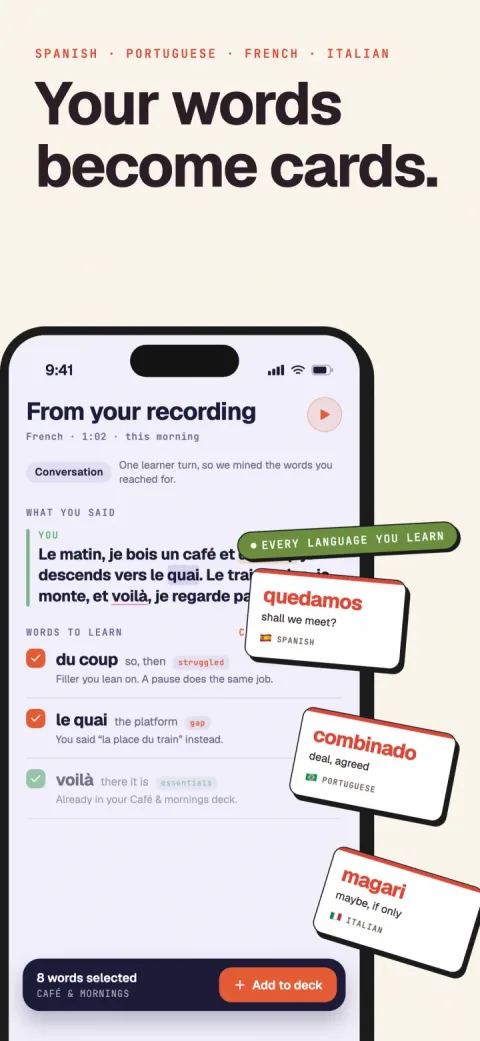
You record or type what came up in your lesson, and it turns those words into cards with the word blanked out of its sentence. Each card gets native audio and an image, and FSRS schedules it.
Other than the 650 or so starter words it ships with, it teaches you nothing new, and it won't find you a tutor. All it does is hold words you've already met, the part I could never do by hand on a Tuesday night.
Explorer is $19.99 a month. Native is $129.99 a year, and it's the only plan with a trial, 7 days long. There's no free tier, so if the $24.99 one-time route fits you, take it.
Whatever you use, the fix has one shape. Pick the words you failed to reach, capture the sentence they lived in, blank out the word, and get 2 retrievals in before the next lesson.
Which brings me back to Lingua.ly.
Ask the internet how to keep what your tutor taught you. The top answer is a marketplace telling you to put your vocabulary somewhere smart, then pointing at a company that announced its shutdown in October 2016.
The Lingua.ly link has been dead for about 10 years and italki's page still carries it. It's still collecting the exact search you just ran, from people who have paid for the hour and can feel the six days after it going to waste.
The hour is the part that gets sold, staffed and measured. The six days are the part you were quietly handed a broken link for.
So take them seriously, because nobody selling you the hour is going to.
If the hour is a Preply subscription, read its billing rules first, because unbooked lessons expire at renewal.
Sources
italki says the retention job is yours
- Meredith (2014, June 20). 3 Ways To Get More Out Of Your italki Lessons. italki. Published in partnership with Lingua.ly, which is named twice in the advice itself, plus a partnership disclosure and a hero-image credit: 4 appearances in all. The closing paragraph repeats the opening teaser with one word moved ("no matter your level" becomes "no matter what your level"). Counted from the live page, 22 August 2026.
The recommended tool is defunct
- Lingua.ly. Wikipedia. Current status: Defunct; shutdown announced October 2016. The lingua.ly domain now returns a parked page marked noindex, offering the domain for sale (checked 22 August 2026).
Retrieval beats restudying for vocabulary
- Roediger, H. L., & Karpicke, J. D. (2006). Test-enhanced learning: Taking memory tests improves long-term retention. Psychological Science, 17(3), 249–255.
- Karpicke, J. D., & Roediger, H. L. (2008). The critical importance of retrieval for learning. Science, 319(5865), 966–968.
Forgetting is steepest early, and spacing beats bunching
- Ebbinghaus, H. (1885). Über das Gedächtnis: Untersuchungen zur experimentellen Psychologie. Leipzig: Duncker & Humblot.
- Cepeda, N. J., Pashler, H., Vul, E., Wixted, J. T., & Rohrer, D. (2006). Distributed practice in verbal recall tasks: A review and quantitative synthesis. Psychological Bulletin, 132(3), 354–380. 839 assessments across 317 experiments in 184 articles. Table 1: 47.3% correct spaced versus 36.7% massed across all retention intervals, and 45.4% versus 31.1% at a 2 to 7 day retention interval.
The free alternative, and its cost
- Deck Options: FSRS. Anki Manual. FSRS is an alternative to Anki's legacy SM-2 algorithm and is switched on from the FSRS section, the last one on the deck options page.
- AnkiMobile Flashcards. App Store listing, $24.99 one-time (checked 22 August 2026).
- How to make Anki cards. Migaku blog: approximately 30 seconds per card, about 12.5 hours for 1,500 cards.
The lesson is paid for. Keep what happened in it.
Verbamor turns the words from your own tutor lessons into fill-in-the-blank cards with native audio, scheduled so they're still there next week.
Start 7 days free