Verbamor
Why you know the word in the app and not at the restaurant
Your brain filed the word with the room you learned it in, and the app only asks you to recognize it, with the English beside it. The waiter asks you to produce it with no cue at all. The fix is producing it out loud in your lessons, inside 4 seconds, on separate days.
At 8am you're on the sofa with coffee, doing your cards. Servilleta. Napkin. You got it in about a second and tapped Good.
At 9pm the waiter is standing there. You want a napkin. You say nothing, then point at one.
01 / 06Cards ask you to recognize; the restaurant asks you to produce
The word sits at an address you can only reach from a sofa.
You were sitting down with all the time in the world, and the English sat 2 inches away in gray text. Then a stranger with an order pad asks for the same word under none of those conditions.
Psychologists have been prodding the gap between recognizing and producing for 50 years. In the classic word-list experiments, the room grips hardest when you have to produce a word out of thin air, and loosens when you only have to recognize one. Godden and Baddeley got that split with divers: recall fell when the room changed, recognition held up. Cards hand you the word and ask if you know it. The waiter hands you nothing.
Being straight about the wider evidence: when Smith and Vela (2001) pooled the studies, test type stopped mattering. Free recall came in at d = .29 and recognition at d = .27, a gap too small to call. (The d is a standard measure of how big an effect is.)
The clean split shows up when the materials are held steady, not across the whole literature.
02 / 06Build the second address in one 20-minute drill
You can build a second address in a lesson. This is the version I run.
- 1. Send your tutor 8 words the night before. Words you can already recognize, not new ones.
- 2. One rule for your tutor: they never say the word. They build a situation where you need it, then stop talking.
- 3. You get 4 seconds. Say it or fail it.
- 4. A fail is a fail whether you pointed at the thing or dropped into English. It goes back in the pile and comes again 10 minutes later, once the conversation has buried it.
- 5. Stop at 20 minutes, whether or not the pile is empty.
Step 2 is the one your tutor will get wrong, so write out an example. For servilleta: "Se te acaba de caer la salsa en los pantalones. ¿Qué me pides?" Then silence. The broken version is "¿Cómo se dice napkin?", which is a card with a human face.
The 4-second limit carries the whole drill. I'm guessing at 4, but give yourself 15 and you'll arrive by translating, which is the sofa again in a nicer chair.
A word retires when you produce it clean inside 4 seconds in 2 separate lessons a week apart. One good Thursday proves you were warm. Two proves the address holds.
03 / 06Why does a word stick to the room you learned it in?
Your brain files a word together with everything else in the room at the time. The couch. The app's white background. The 11pm quiet. La cuenta goes into storage wrapped in all of it.
The name for a word filed with its room is encoding specificity. You remember best when the moment of asking looks like the moment of learning.
The divers study is the one everybody cites. Godden and Baddeley, 1975. Scuba divers learned word lists on land or underwater, then recalled them in both places, and recall was better when the two matched. 50 years of replication attempts have gone both ways, so I lean on it as a picture only.
Essoe and colleagues, 2022, in npj Science of Learning, taught people material inside distinctive VR (virtual reality) environments. The group that learned across 2 different contexts, and who also reported feeling really present in them, kept 92% of the material after a week. The single-context group kept 76%.
Two caveats on Essoe's 16-point gap. The presence half is a self-report split, and the sample is small. And their participants were learning 2 similar-sounding languages, one per environment, so the environments were doing a sorting job.
So here's the ruling. A room counts as a second room when your posture changed, your voice is out loud at speaking volume, and your hands are holding something other than a phone. Same chair turned 90 degrees, muttering in a room you've studied in 200 times: your body treats that as the couch, and the word stays filed there.
04 / 06When something else points at the answer, the room stops mattering
The restaurant hands you an empty pocket. Whatever the room gave you when you learned the word is the only help on offer.
Steven Smith and Edward Vela pooled decades of these room experiments in their 2001 review of environmental context and memory. The room stops mattering once something else at the moment of recall points at the answer. The app is one long strong cue.
Recall stays where you left it.
So make the pocket empty on purpose, somewhere the emptiness costs you something.
Wednesday night, 10 minutes. Open the cards you failed this week. Most of them failed because the card is junk. Cross off any word you can't picture saying to a specific person. Cross off any sentence you'd never say out loud.
Under 5 left? Fill the gaps with words you reached for in English during last week's lesson.
Write each word on a paper slip, in English only. English makes you produce the target language yourself, which is the direction the restaurant runs.
Then say all 5 out loud in a full sentence, article and ending included. About 3 seconds each. Anything slower goes back on the pile.
Thursday, in the lesson. Put the 5 slips face down on the table. Work every one into the conversation before the hour ends. Turn a slip over the moment you've used it. Brief your tutor first, and they'll steer the topic toward your words.
Thursday, when a word won't come. I got this wrong for months. I'd freeze and reach for ¿cómo se dice...?. That question ends the search. Your tutor says the word, you nod, and nothing sticks.
Learn 2 stall phrases instead and say one out loud while you dig. In Spanish I use a ver... and es que.... They hold the floor for 4 or 5 seconds, and the word stays yours to find. After 2 tries, say it in English and keep moving. A 3rd try with someone waiting teaches dread, and dread is its own problem.
Thursday night, 5 minutes. Grade all 5 in 3 buckets:
- Came out unprompted. The word arrived while you were talking about something else. Done. Let the spacing carry it.
- Came out after a stall. You bought yourself 5 seconds and it surfaced. It goes in next Wednesday's 5.
- Never came. You had the slip in front of you for an hour and the word stayed put. That card is a rebuild, so grade it Again tonight and give it a sentence you'd actually say.
Picturing the scene does much of the work a real room change does
Filter your deck to cards the app calls known or mature, pick the ones you've never said out loud, and stop at 12. In Verbamor that's the Library tab filtered to mature; in Anki it's prop:ivl>=21.
Give each word 4 passes on 4 separate days. Sunday, Monday, Tuesday, Wednesday. The days are the lever that pays most.
Cepeda and colleagues (2008) ran more than 1,350 people through gaps of this kind. They found the best gap lifted final recall by 64%, d = 1.1. Their gaps were tuned to how far off the test was, so I'm reading across from a lab to your calendar. But the direction holds: the next lesson matters more than the next 10 minutes.
Start each card on the English side and say the sentence out loud at speaking speed. Spend 5 seconds first putting yourself at the table: the waiter's face, the noise, the menu in your hand.
Smith and Vela's 2001 review found that picturing a scene in your head does much of the work a physical room change would do. Essoe and colleagues (2022) built their design out of distinctive environments plus exactly this mental reinstatement (interaction p = 0.03, unlikely to be chance alone). They needed a headset for half of it. The picturing half is free.
If nothing comes in 5 seconds, guess out loud anyway, wrong verb ending and all. Then flip the card, say the correct sentence twice, and mark it again for tomorrow.
Shuffling the order inside a session is its own lever, written up in interleaving.
06 / 06You already pay for the one hour that tests retrieval under pressure
You already pay for the one place where retrieval happens under restaurant conditions. Someone sits across from you, waiting for the end of your sentence. So run the lesson as recall practice, which costs about 20 minutes of an hour you're already booked for.
- Pick 5 words before the call. Pull them from the cards you got right this week.
- Spend the first minute setting the rule. Say it out loud: "if I stall, please wait. Don't give me the word." Your tutor will rescue you by reflex until you ask them once to stop.
- Let a silence run 10 seconds. Count it. Take the help at 10 and keep going.
- Write down every word that vanished, within 10 minutes of hanging up. That list is your real backlog.
Then flip every vanished word to production direction. English on the front, so the card asks you to build the foreign word instead of confirming it. Grade it hard, the way I argue for in grading.
I use 10 seconds because I timed my own stalls and the word usually arrived in the back half of that window. A tutor's patience runs dry around 3 seconds. My stopwatch, not a published finding, so borrow it loosely.
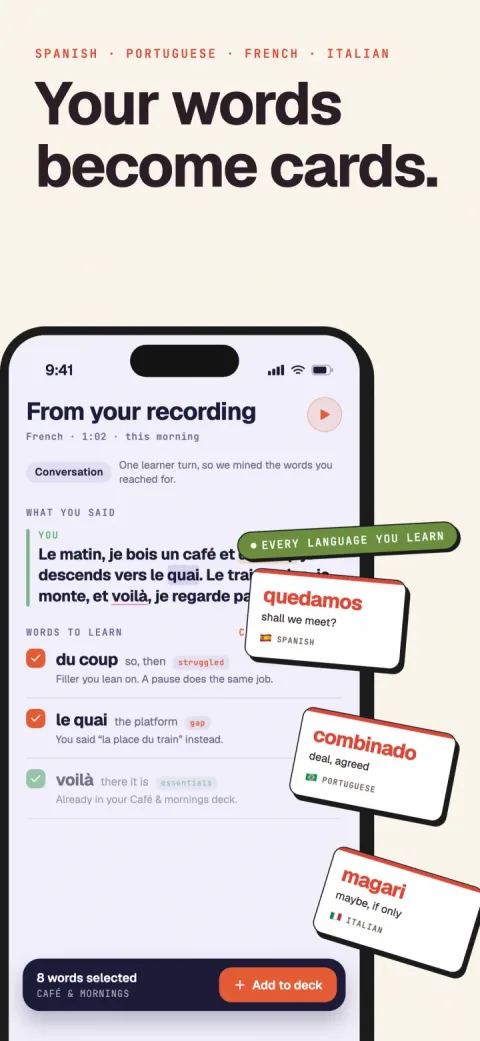
Verbamor builds cards out of sentences from your own lesson, so the sentence you review on Tuesday is one your tutor helped you make on Thursday. That's a thin copy of the room, and thin copies count for something.
A word that survived a stare has an address you can find again. Go pull on it next Thursday.
Sources
Where you learn a word gets filed with the word
- Godden, D. R., & Baddeley, A. D. (1975). Context-dependent memory in two natural environments: On land and underwater. British Journal of Psychology, 66(3), 325-331.
- Essoe, J. K.-Y., Reggente, N., Ohno, A. A., Baek, Y. H., Dell'Italia, J., & Rissman, J. (2022). Enhancing learning and retention with distinctive virtual reality environments and mental context reinstatement. npj Science of Learning, 7, article 31.
The room grips recall and lets go of recognition
- Smith, S. M., & Vela, E. (2001). Environmental context-dependent memory: A review and meta-analysis. Psychonomic Bulletin & Review, 8(2), 203-220.
When you come back matters more than how hard you study
- Cepeda, N. J., Vul, E., Rohrer, D., Wixted, J. T., & Pashler, H. (2008). Spacing effects in learning: A temporal ridgeline of optimal retention. Psychological Science, 19(11), 1095-1102. In-press manuscript on ERIC.
Cards that carry the lesson with them.
Verbamor builds each card from a sentence in your own lesson, so the words keep some of the context they arrived in.
Start 7 days free