Verbamor
Preply reviews: the billing rules behind the 1-star score
Preply scores 4.4 on Trustpilot, and 13% of its reviews are 1-star. I haven't read those reviews, so I can't tell you what they say. I can tell you the billing rules a new buyer runs into, which Preply publishes in plain language.
Preply's Trustpilot page says 4.4 out of 5 across 25,377 reviews. Read on 21 September 2026.
The distribution is the interesting part. 76% five-star, then 7%, 2%, 2%, and 13% one-star.
The complaints pile up at the bottom instead of spreading across the middle. That shape fits a product that works for most people and fails sharply for some.
So I went looking for rules that could produce a cliff like that. I can't prove they do. I found them in Preply's help centre, written plainly, in articles updated last month.
First, the disclosure, because it changes how you should read the rest. I haven't been a Preply student. I haven't bought a subscription, sat a lesson, or filed a refund request.
Everything below is Preply's own published policy, quoted with the date I read it. I sell an iOS vocabulary app, which isn't a tutoring marketplace and doesn't compete with one. No link on this page earns me anything.
The score clusters at five stars and one star
A first-hand review beats a policy read, and I can't give you one. What I can give you is the thing the first-hand reviews keep skipping.
Trustpilot shows you 25,377 people's experiences and can't tell you the policy behind any of them.
The rules are public, free to read, and short.
Unscheduled lessons expire at every 28-day renewal
Preply sells you a rented seat on a tutor's calendar, renewed on a clock. From "How does my Preply subscription work?", read 21 September 2026:
- "Each subscription is tied to one tutor and runs in 28-day cycles."
- "The minimum plan is 4 lessons per cycle."
- "Unscheduled lessons expire at renewal and do not carry over."
- "Any lessons you have already booked are fully protected and will take place as planned, regardless of when your renewal falls."
Read the third and fourth lines together, because the difference between them is where the money goes. The word doing the work is unscheduled.
A lesson survives renewal if it's on a calendar, even one happening weeks later. A lesson you've paid for and not yet booked dies at day 28.
That single asymmetry can cost a buyer money without anyone having been cheated.
You buy 4 lessons. Work eats a fortnight. You book 2, mean to book the others, and the cycle turns over.
At Preply's own published average of $16 an hour for Spanish speaking practice, two lost 50-minute lessons is about $27. Then the next cycle is charged.
28 days is not a month. Start on 1 January 2026 and you are billed 14 times before the year ends.
Which brings up the arithmetic neither the review sites nor Preply's marketing performs. A 28-day cycle isn't monthly billing. Preply's own example walks it: "if your first payment is on 1 January, your next renewal falls on 29 January, then 26 February, and so on."
Run that forward through 2026 and you get 14 charges, because the renewal date marches backwards through the calendar. Budget for 12 and you're short by two minimum plans, roughly $107 at that $16 rate.
There's also no escape hatch to a one-off purchase: "Preply does not offer standalone one-time lesson packs, including through customer support." And one subscription buys one tutor, so a second tutor is a second clock, out of phase with the first.
Refunds exclude the learners who used part of a cycle
Here's the finding I went in for. Preply decides refunds centrally, and it publishes the test it applies. That settles a question the review pages leave floating as "your tutor's discretion."
From "How do refunds work at Preply?", updated 20 August 2026: "Preply may issue a refund when you cancel your subscription and no lessons from that billing cycle have been used."
Approved refunds go back to the original card. "The request must be made within 28 days of the charge," and "Cancelling your subscription does not automatically issue a refund."
Now hold that against the expiry rule, because the two interlock in a way I haven't seen written down anywhere.
The refund test is no lessons used from that cycle. The expiry rule kills unscheduled lessons at renewal.
So think of the learner with the strongest emotional case: the one who took a lesson or two, got busy, and watched the rest evaporate. That's precisely the learner the refund test excludes. Partial use is the common case, and it's the disqualifying one.
The refund window is also 28 days from the charge, the same length as the cycle. Wait for the next bill to notice the problem and the previous charge has aged out.
Cancelling doesn't rescue the lessons either. From "What happens when I cancel my subscription?", updated 20 August 2026: booked lessons "are protected and will take place as planned."
Meanwhile, "Any lessons you have not yet booked expire at the end of your current 28-day billing cycle."
Two more rules worth knowing before you're inside them. Cancelling a lesson "more than 12 hours before it starts" returns it to your balance.
Inside 12 hours, "The lesson does not return to your balance" and the tutor is paid for the reserved time (cancellation policy for students, updated 2 June 2026).
And switching tutors is kinder than the reviews suggest, with a wrinkle. Preply converts the value of your remaining lessons into Preply Credits and spends them with the new tutor, "at their rate on the day you make the switch."
Value carries. Lesson count doesn't, so a pricier tutor means fewer lessons for the same money.
Put together, the honest summary is that Preply's policies are strict and published. I can't say how consistently they're applied. A buyer who didn't read them would meet a clock they didn't know was running.
The score can't be split by who wrote it
One more limit on the score. Trustpilot lists a company's reviews in a single 4.4, and the page doesn't tell you whether each author was a learner, a tutor or someone else.
Preply is a marketplace with two sides, so a low rating could come from a learner about a lesson or from someone on the other side about something else. I haven't checked how the 1-star reviews split.
I'd love to give you a clean learner-only re-cut of that distribution. I can't: I haven't classified 25,377 reviews by author or by complaint, and I'm not going to publish a number I estimated.
So don't read the 13% as a learner complaint rate. Read a handful of the 1-star reviews yourself and see whether they describe lessons, billing or something else.
Buy it if you want a fixed weekly habit with one tutor
Preply's mechanics suit one person very well. Say you want a fixed weekly habit with one tutor, and you've quit tutoring before because no one was expecting you. Then the automatic charge is a commitment device, a cost set up in advance to make you follow through.
And commitment devices work on the people who need them.
The expiry rule is the same mechanism, seen from the other side. It punishes exactly the behaviour that kills tutoring habits.
If your schedule moves around, the 28-day clock will bill you for lessons you can't take.
italki's pay-per-lesson model costs nothing in a bad month, because you pay for each lesson as you book it. That's the opposite trade, and it suits an irregular schedule.
A practical rule before you subscribe anywhere: book every lesson in the cycle the day you're charged, even if you move them later. Booked survives renewal. Intending to book does not.
One thing both platforms sell you is an hour that ends. The vocabulary from it stays your problem, which is where the money actually leaks: you paid $16 for words you'll have lost by Friday.
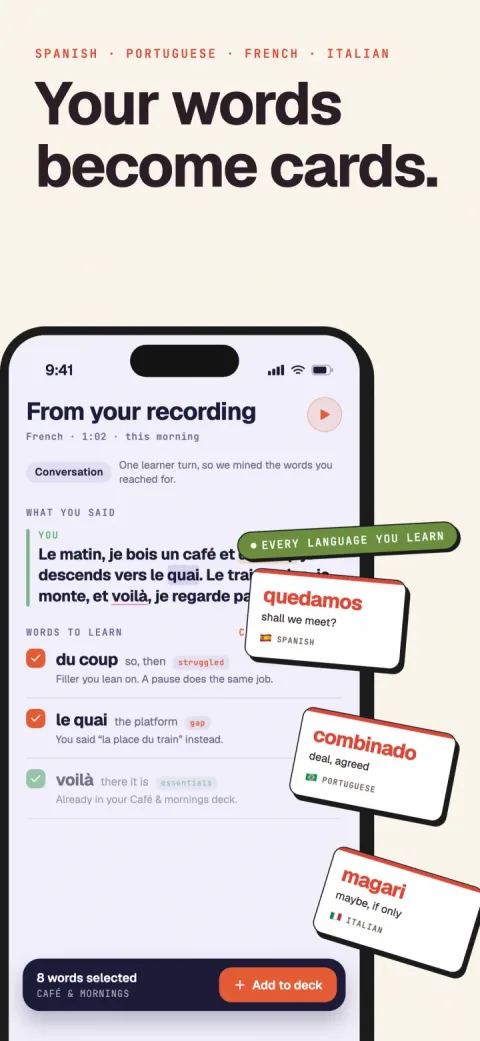
That gap is what I built. Verbamor is an iOS app that turns the words from a lesson you already paid for into fill-in-the-blank cards with generated audio and a picture. They're scheduled so you still have them next month.
Outside its built-in deck of about 650 common words, it teaches you nothing new, and it won't find you a tutor. Five languages, $19.99 a month or $129.99 a year with a 7-day trial on the annual plan.
Both are US prices, read off the app's own plan definitions on 21 September 2026; the App Store sets a different number in other countries. No free tier, which is a fair reason to skip it.
And plenty of people should. If you'll write your lesson words in a notebook on the train home and actually test yourself on them, that beats every app here, mine included. It costs nothing.
Anki is free on desktop and Android and runs a serious scheduler, if you'll build the cards. The people who should pay me have tried twice to keep a deck going and stopped both times.
Sources
The billing rules behind the complaints
- Preply Help Center, read 21 September 2026. How does my Preply subscription work? Source for the 28-day cycle, one tutor per subscription, the 4-lesson minimum, "Unscheduled lessons expire at renewal and do not carry over," the protection of booked lessons, the 1 January / 29 January / 26 February renewal example, and the absence of standalone one-time lesson packs.
- Preply Help Center (updated 20 August 2026). How do refunds work at Preply? Source for the refund test ("no lessons from that billing cycle have been used"), the 28-day request deadline, return to the original payment method, and the line that cancelling does not automatically issue a refund.
- Preply Help Center (updated 20 August 2026). What happens when I cancel my subscription? Source for booked lessons surviving cancellation and unbooked lessons expiring at the end of the current cycle.
- Preply Help Center (updated 2 June 2026). Cancellation policy for students. Source for the 12-hour window and what happens either side of it.
- Preply Help Center. How do I move my lessons to another tutor? Source for conversion of remaining lesson value into Preply Credits "at their rate on the day you make the switch."
The score and the prices
- Trustpilot, read 21 September 2026. Preply reviews. 4.4 out of 5 across 25,377 reviews, distributed 76% / 7% / 2% / 2% / 13% from five stars to one.
- Preply (updated 2 March 2026). How much do Spanish lessons cost? First-party table labelled "Average Price on Preply," in dollars per hour: speaking practice $16, adults $16, beginners $17, Business Spanish $18, DELE prep $20, SIELE prep $21, against a stated range of $15 to $50. Every dollar figure in this post is that $16 speaking-practice average carried through the lesson counts Preply publishes.
What I could not verify
- A learner-only version of the Trustpilot distribution. I did not read the 1-star reviews, so I can't say what share concerns billing, what share comes from tutors rather than learners, or what they say at all, and I have no way to separate 25,377 reviews by author type without reading them. No re-cut figure is published here because any number I gave would be an estimate.
- Whether refund requests that meet the published test are granted in practice, and how often. Preply says "Each request is reviewed individually." I have not filed one.
- Preply hourly rates outside the labelled Spanish table above, and commission percentages. Third-party claims only, so they are not used.
- My own experience as a Preply student. I have none. This page is a policy read, dated, and nothing on it should be taken as a report of how a lesson feels.
Keep the words you already paid a tutor for.
Verbamor turns your lesson vocabulary into fill-in-the-blank cards with spoken audio, scheduled so they're still there next month.
Start 7 days free