Verbamor
Is Preply legit? The company is real. Here is what it verifies.
Preply is a funded firm with 25,377 Trustpilot reviews, so the scam question answers itself in a sentence. The useful question is what Preply checks before a stranger teaches you, and its own help centre answers that more honestly than any review page does.
Preply announced a $150 million funding round on 21 January 2026, led by WestCap, valuing it at $1.2 billion. It says it carries "more than 100,000 tutors" across "more than 90 languages." Its Trustpilot page shows 4.4 out of 5 across 25,377 reviews, read on 21 September 2026.
So the company is real. That's the whole answer to "is Preply a scam," and it fits in a paragraph. One page ranking for this query, Skyline Academic's, takes roughly 4,800 words to get through it.
The disclosure first, because it should change how you read everything below. I have never been a Preply student. I haven't bought a subscription, sat a lesson, or filed a complaint.
Everything here is Preply's own published policy, quoted with the date I read it.
I sell an iOS vocabulary app, which isn't a tutoring marketplace and doesn't compete with Preply for your booking. No link on this page earns me a cent.
And Preply does something I can't: it puts a live human teacher in front of you, weekly, who corrects you in real time. I have no substitute for that.
Preply is legitimate, and the real question is its tutor filter
Every page on this query resolves corporate existence and then keeps going. Funded. Reviewed. Real.
Which leaves the actual worry untouched. When you type "is Preply legit" you're usually asking a narrower thing. This specific stranger is about to take my money for an hour of their time, and I have no idea who vetted them.
That's a question about the marketplace's filter, and it has a documented answer.
Preply publishes its vetting rules, its reliability thresholds and its no-show remedy in plain help-centre articles, the newest updated in August 2026. I read them on 21 September 2026. Not one of the three top-ranking pages quotes a line from any of them.
The ID check happens when a tutor gets paid
Start with the badge, because it's the thing a nervous buyer looks for on a profile.
Preply's evaluation page describes the blue shield with a checkmark as meaning a tutor's "qualifications have been double-checked by Preply to verify the authenticity of their educational background."
Now read the identity verification guidelines, updated 11 December 2024, and the picture sharpens. Identity is confirmed from "a photo of your passport or any government-issued document that can verify your identity (e.g. driver's license)." Preply calls it "part of our continuous efforts to ensure the security of our students and tutors."
Here's the sentence that matters, and I haven't seen it quoted anywhere: "all Preply tutors will need to verify their identity prior to withdrawing their earnings."
The ID check is attached to the tutor getting paid, not to the tutor teaching you.
Read that as a sequencing fact rather than an accusation. The gate sits at the cashier, so a brand-new tutor can teach lessons before the passport is checked and clear the check later, when the money moves. In practice most tutors want paying, so most of them pass through it quickly.
But it's a payout control doing double duty as a safety feature, and the review pages describe it as though it were a pre-teaching background check. The same page also lists where Preply does not verify IDs at all: "Iran, Sudan, Cuba, Syria, North Korea, Crimea, Russia, and Belarus."
Teaching credentials are a separate badge again. The Professional Tutor badge, per an article updated 20 August 2026, goes to tutors holding "a passing grade in Preply's Online Language Teaching Course". It also goes to tutors with "a government-accredited or government-endorsed teaching certificate from a language teaching course of at least 120 hours."
So there are two different marks on Preply and they certify different things. A tutor without the Professional badge has no verified teaching qualification, which is fine if you want conversation practice and matters a great deal if you want grammar taught properly.
Preply publishes the reliability floor, and it's low
This is my favourite find, and it's the strongest reason to read Preply's documents instead of its reviews.
Preply's Tutoring Standards Policy, updated 24 November 2025, publishes the exact numbers a tutor must stay under, measured over a rolling 90 days, to keep appearing in search:
- Absences: "Less than 5 total"
- Short-notice reschedules: "Less than 40% of all lessons"
- Lesson cancellations: "Less than 20% of all lessons"
Sit with the second and third figures for a second. A tutor can reschedule 39% of your lessons at short notice and cancel 19% of them outright, and remain in good standing, fully listed, badge intact.
Nothing about that is hidden. Preply wrote it down and published it.
But a buyer reading "verified tutors" on a marketing page would never guess the tolerance is that wide. And the penalty when a tutor does breach it is soft: "Your profile will be hidden from search results," while they keep teaching their existing students. Which includes you.
Preply even explains its own incentive, in a sentence that quietly concedes the size of the problem. Reschedules made less than 5 days ahead "often cause students to cancel their subscriptions up to 20% sooner."
So the honest framing of marketplace risk is this. Preply isn't going to steal from you. Preply also isn't promising you a reliable individual, and the thresholds tell you roughly how unreliable an individual may be while still looking fine on the page.
That's a real answer to "is Preply legit." It's more useful than a Trustpilot average, because it's the policy that generates the experience rather than a summary of other people's.
A no-show lesson comes back to your balance if you report it in time
The counterweight, and credit where it's due: the remedy is clean, and it's better than the 1-star reviews imply.
From "My tutor didn't join the lesson": message them and "wait 15–20 minutes after the scheduled start time," then report it from your account choosing "Tutor was absent." If Preply confirms the absence, "The lesson is returned to your balance" and "The tutor is not paid."
One timing trap sits inside that, and it's the kind of thing that decides whether you get your lesson back. Lessons auto-confirm "15 minutes after they end" in Preply Classroom, or within 72 hours outside it. Report before that clock runs out or the lesson counts as delivered.
The economics underneath explain a pattern buyers notice and misread. Preply's commission model page states that "The commission for every trial lesson with a new student is 100%."
The standing rate "starts at 33% for new tutors, but after 20 hours of teaching that goes down to 28%," sliding toward 18% with accumulated hours.
A trial lesson pays the tutor nothing. So the person giving you that first impression is working a free shift to win a subscription.
That's why trial quality swings so hard between tutors. It's also why a tutor who has taught 400 hours has a much better reason to keep you than one on their third week.
Book your trial with someone who has hours behind them. That single filter does more for you than any badge on the profile.
Book if you want a live teacher and will actually attend
Yes, if you want a live teacher and you'll actually attend. Preply is legitimate in every sense the word normally carries, and its remedies work when you invoke them on time.
The money risk that remains sits in the billing clock. Preply runs 28-day cycles, unscheduled lessons expire at renewal, and a refund requires that you used none of that cycle.
I've pulled all of that apart against the help centre in what the 1-star reviews are actually about. I've also compared the cost model against italki's in how the two platforms charge you. If you're weighing the purchase rather than the company, read those.
And whichever platform you pick, the hour ends and the vocabulary leaves with it. That's where the money actually leaks: you pay a verified, badged, thoroughly legitimate tutor for words you can't produce by Friday.
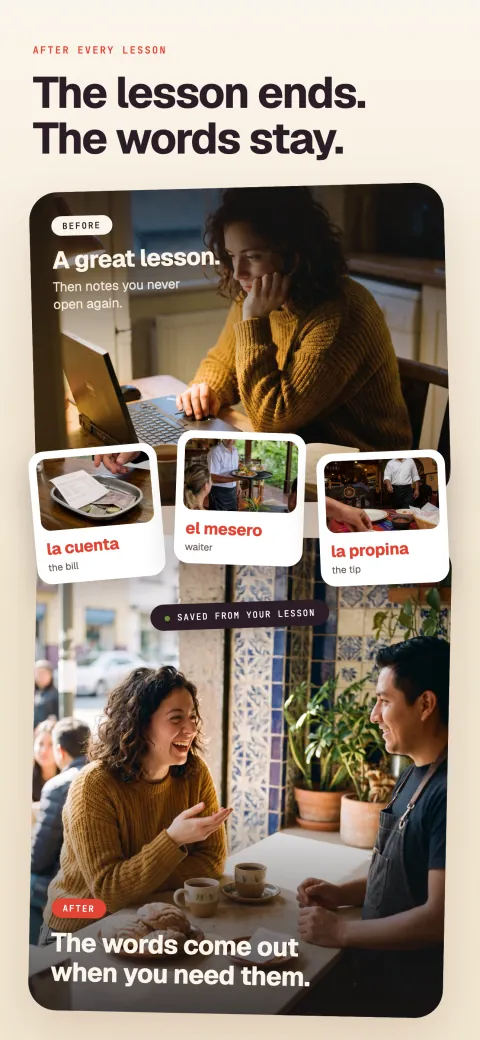
That gap is the thing I built. Verbamor is an iOS app that turns the words from a lesson you already paid for into fill-in-the-blank cards with generated audio and a picture. They're scheduled so you still have them next month.
Apart from about 650 starter words, it teaches you nothing new, and it won't find you a tutor. Five languages, $19.99 a month or $129.99 a year with a 7-day trial on the annual plan. Both are US prices, read off the app's own plan definitions on 21 September 2026; the App Store sets a different number in other countries.
There's no free tier, which is a fair reason to skip it.
Plenty of people should skip it. If you'll write your lesson words in a notebook on the train home and genuinely test yourself on them, that beats every app here. That includes mine, and it costs zero.
Anki is free on desktop and Android and runs a serious scheduler if you'll build the cards yourself. The people who should pay me have tried twice to keep a deck going and stopped both times.
Sources
What Preply verifies
- Preply Help Center (updated 11 December 2024), read 21 September 2026. Identity verification guidelines. Source for the passport or government-ID requirement, the "continuous efforts to ensure the security of our students and tutors" line, the sentence that "all Preply tutors will need to verify their identity prior to withdrawing their earnings," and the list of countries and regions where Preply does not verify IDs.
- Preply Help Center, read 21 September 2026. Evaluation of tutors. Source for the blue shield with a checkmark and the description of qualifications "double-checked by Preply to verify the authenticity of their educational background."
- Preply Help Center (updated 20 August 2026). What is a Professional Tutor? Source for the two qualifying routes: a passing grade in Preply's own Online Language Teaching Course, or a government-accredited teaching certificate from a course of at least 120 hours.
Reliability thresholds and the no-show remedy
- Preply Help Center (updated 24 November 2025). Tutoring Standards Policy. Source for the rolling 90-day thresholds (fewer than 5 absences, short-notice reschedules under 40% of lessons, cancellations under 20%), the "Your profile will be hidden from search results" penalty, the fact that a hidden tutor keeps teaching existing students, and the line about reschedules under 5 days causing students to cancel "up to 20% sooner."
- Preply Help Center. My tutor didn't join the lesson. Source for the 15 to 20 minute wait, the "Tutor was absent" report reason, the lesson being returned to your balance with the tutor unpaid, and the auto-confirmation deadlines of 15 minutes inside Preply Classroom or 72 hours outside it.
- Preply Help Center (dated 19 September 2024). Preply commission model. Source for the 100% commission on every trial lesson with a new student, and for the standing rate starting at 33% and dropping to 28% after 20 hours of teaching, within a stated 18% to 33% band.
The score, and the pages this one is arguing with
- Preply (21 January 2026). Preply raises $150 million. First-party source for the round, WestCap leading it, the $1.2 billion valuation, and the "more than 100,000 tutors" and "more than 90 languages" figures. Preply's founding year is widely reported as 2012 but does not appear on this page, so it is not stated as fact above.
- Trustpilot, read 21 September 2026. Preply reviews. 4.4 out of 5 across 25,377 reviews, distributed 76% / 7% / 2% / 2% / 13% from five stars to one.
- Skyline Academic. Is Preply Legit? Honest Review, Fees, Pros & Cons [2026]. Read 21 September 2026. Roughly 4,800 words across 17 headings, ending in a comparison table that lands on Skyline's own $60 to $100 per hour tutoring. It carries no disclosure that the publisher sells competing tutoring, and states no refund window or credit-expiry rule.
- Brighterly. Preply Reviews 2026. Read 21 September 2026. Cites Trustpilot as 4.3 out of 5 on 21,500+ reviews as of April 2026, against the 4.4 on 25,377 live today, and reports the aggregate without the 13% one-star share. It does state the refund test correctly. Brighterly sells K-12 math and reading tutoring.
- Deutschable. Is Preply Good? It seriously depends. Read 21 September 2026. The only one of the three to disclose its conflict, verbatim: "There are no affiliate links on this page" and "The author of this article is the owner of a business that might be considered to be competing with the reviewed product." It is also the most out of date, written around April 2024, pricing in euros and citing "over 1300 possible options" for tutors.
What I could not verify
- What share of listed tutors hold the identity badge, or the Professional Tutor badge. Preply publishes neither figure, and I am not going to estimate one from a directory page.
- How often Preply enforces the Tutoring Standards thresholds in practice, or how many profiles are hidden. The policy is published; the enforcement rate is not.
- Whether reported tutor absences are confirmed reliably. Preply documents the remedy. I have not invoked it.
- My own experience as a Preply student. I have none. This page is a dated read of published policy, and nothing on it reports how a lesson actually feels.
Keep the words you already paid a tutor for.
Verbamor turns your lesson vocabulary into fill-in-the-blank cards with spoken audio, scheduled so they're still there next month.
Start 7 days free