Verbamor
Your language notebook is write-only
Most advice about lesson notes is about the moment you write them. The moment that decides whether they were worth writing is Thursday, when nobody opens the notebook.
Minute 22 of a 50-minute Spanish lesson. Your tutor says a word you've never heard, uses it in a sentence, and keeps going. You have maybe 3 seconds to write something down before you lose the next sentence too.
What you write in those 3 seconds decides whether Thursday's version of you can still read the line. Whether you still know it next month gets decided on Thursday itself. That happens in a room with no tutor in it, when you either open the notebook or don't.
The advice everyone starts with was tested and failed
Search for how to take notes in a language lesson and the top result will probably tell you to find your learning style first. Auditory learners record and listen, visual learners draw, and then you take notes inside the lane you picked.
The specific claim underneath that is called the meshing hypothesis: instruction works best when its format matches the learner's stated preference.
Pashler, McDaniel, Rohrer and Bjork went looking for evidence of it in a 2008 review for Psychological Science in the Public Interest. Their conclusion is one sentence long: "there is no adequate evidence base to justify incorporating learning-styles assessments into general educational practice."
The rest of the paper is more interesting than the headline. They found "ample evidence that children and adults will, if asked, express preferences about how they prefer information to be presented to them."
They also grant "plentiful evidence arguing that people differ in the degree to which they have some fairly specific aptitudes."
So the preferences are real. You genuinely might like colored mind maps more than bullet lists.
What went missing was the payoff from matching teaching to them, which is the part all the advice is built on. On the evidence they reviewed, the authors conclude, the usefulness of learning-style assessment appears to be just a belief.
The preference is real. The payoff from teaching to it is the part nobody has found.
I want to be careful not to be smug about this, because the belief is close to universal. Nancekivell, Shah and Gelman surveyed it in 2020 and reported that among their participants, 93.7% believed in learning styles.
Split by profession, educators believed at 90.7% and non-educators at 95.9%. Endorsement across the US, Turkey, Portugal, China, Switzerland, the UK and Latin America runs from 80 to 95 per cent.
Your tutor probably believes it. Mine did. It's the single most repeated idea in education, and repeating it doesn't make anyone a fool.
Here's the part that matters for notes. Sorting yourself into a modality (seeing, hearing and so on) changes only the surface of the page.
Drawn or printed, that page sits closed from Monday to Thursday either way. The interval does the damage, and no amount of color fixes an interval.
Notes during a lesson are written under a stopwatch
The standard advice also describes note-taking as if you were alone with a textbook. Mind maps, themed lists, redrawing the page neatly. That's homework, and it's fine homework.
A live lesson gives you none of those conditions, which makes capture a budgeting exercise. It's roughly 3 seconds per item, maybe 15 items in an hour. So the only question worth asking mid-lesson is which 15.
My rule: write what you can't reconstruct later, and skip everything you can. A conjugation table is reconstructable in 20 seconds from any dictionary. Your tutor wincing when you said embarazada is not.
Four things worth the 3 seconds
The four categories I write down, in priority order when the lesson moves fast:
- The word you reached for and couldn't find. The highest-value item in the hour, and almost nobody records it. You wanted to say "I'll be late" and produced a shrug. Write the English. That gap is a frequency list of exactly one learner.
- The correction, with your wrong version kept. Write era → fui, with your error on the left. The error is half the memory. Delete it and you'll have a card that can't explain why it exists.
- The sentence it arrived in. Six words of context cost barely more than the word alone, and they turn a note you can only read into one you can use. See context-dependent memory.
- A sound hint, if the word surprised your mouth. Four syllables you can't yet aim at are worth a second of phonetic scribble.
Here's what that looks like, from a Monday lesson of mine, wrong parts included:
mon · 22
"I'll be late" ??? ← couldnt say it
era → fui (fui al medico, past)
me da igual = don't care / whatever
madrugar = mad-roo-GAR, get up early
  "odio madrugar entre semana"
recoger?? she winced. rec-o-HER not -GER
"the thing for the" ??? = el trasto?
Notice what didn't make it. No grammar explanations, nothing already printed in the material she sent me beforehand. That's how a page fills with 40 items you'll never triage.
One more rule that saves the system: write the timestamp at the top and nothing else. No formatting during the lesson. Do that after, or not at all.
Three days later, most notes fail the Thursday test
Run that Monday page forward three days. It's Thursday morning, the notebook is on the shelf where you left it, and nothing has happened to it since minute 22.
Five of those 8 lines carry Spanish you could be asked to produce: fui, me da igual, madrugar, recoger, el trasto. Cover the page and try all 5 cold.
Two survive for me. Me da igual, because I'd heard it before the lesson. Fui, because the wrong version is sitting next to it, and era → fui is a small argument my memory can replay.
Three don't. Madrugar goes every time unless something asked for it first, phonetic hint and example sentence and all. El trasto was half-guessed once and never met again.
Recoger goes too, which stings. The wince is the most vivid thing on the page, and the note still didn't survive 72 hours of being ignored.
The "I'll be late" line isn't a word yet. "I'll be late" is still an open gap. I never went and got the Spanish, so on Thursday I'd shrug at my tutor in the same place I shrugged on Monday.
So: 2 of 5, and both survivors had something extra holding them up. It failed because 72 hours passed and nobody asked.
That makes the size of your daily review the number that decides your outcome.
Now scale it. Fifteen items a lesson, one lesson a week, and two months on that's about 120 lines in the state madrugar is in. You'd recognize every entry on the page, which feels like knowing them, and produce almost none of it cold.
Recognizing your own handwriting is the cheapest feeling in learning. It costs nothing and means nothing.
So the real test for any note-taking method, mine included, is one question. What puts that page in front of your eyes on Thursday, when nobody is asking you to look at it?
If the honest answer is "I'd have to remember to look," the note is decoration. Forgetting runs fastest in the first few days, exactly the window when the notebook stays closed.
Your memory is the broken component here, so it can't be the thing you rely on to open it. The forgetting curve has the shape of it.
And the reopening has to be a retrieval. Roediger and Karpicke ran the clean version in 2006. One group reread a passage, and the other took a recall test on it with no feedback and no second look.
At 5 minutes the rereaders were ahead. At a week they had lost to the people who had been tested instead.
Reading your notes on Thursday is the losing side of that experiment, run on your own vocabulary. There's more in the testing effect.
A queue that comes to find you reopens a note best
Very few mechanisms survive a normal week, and all of them are duller than any note-taking method you'll be sold.
A recurring calendar reminder works for a while, then you travel and it's gone. The honest failure mode of anything running on willpower.
Bolting the review onto something immovable holds up better. Mine happens in the 10 minutes before the next lesson, a slot I can't skip without skipping the lesson I paid for.
Then there's a queue that comes and finds you, which I'd rank first even if I hadn't built one. The lesson vocabulary becomes cards, and something else decides when each is about to slip. It keeps working during the week you stop caring, and there's always such a week.
Cards aren't the only thing that reopens a word. Meeting madrugar again in a show does the same job, more pleasantly and less reliably. That's the trade input versus cards is about.
Whichever you pick, convert within a day. Those scrawled lines are hints addressed to a version of you who was in the room.
You have a day or two before "the thing for the ???" stops meaning anything.
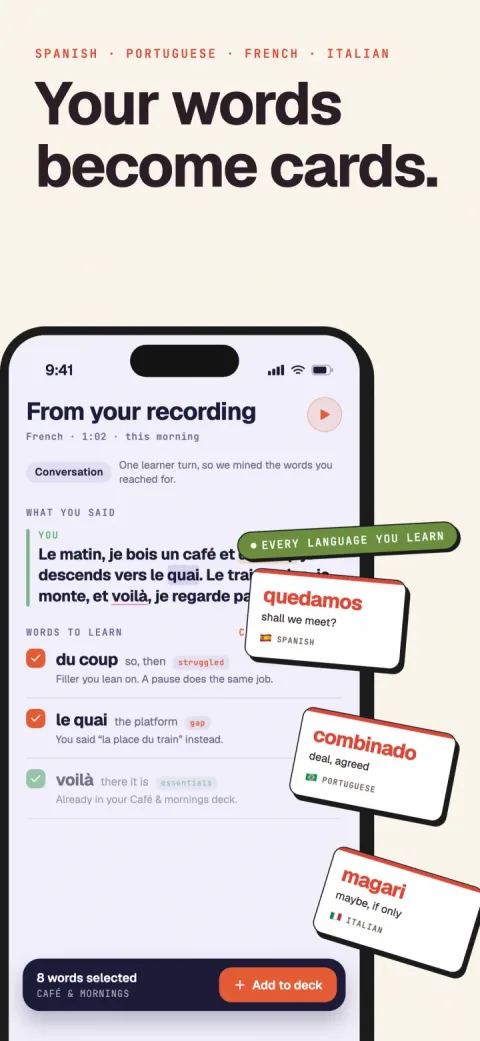
This is the part I ended up building for. Verbamor takes what came up in your lesson, by voice or typed, and turns it into fill-in-the-blank cards with native audio. Then it schedules each one with FSRS, an open-source algorithm that predicts when you're about to forget each card.
Apart from a starter deck of about 650 common words, it doesn't teach you anything; your tutor did that. What it removes is the typing between the note and the deck, where my own notebooks always died.
The honest limit: it does nothing during the lesson. The stopwatch problem this post spends two sections on is still yours to solve with a pen. The app only turns up afterward, for the Thursday half.
It's iOS only, with no free tier. $129.99 a year, or $19.99 a month.
If your notebook already works, ignore all of this
Some people do open the notebook. If you're one of them, you already have the thing this post is about, and you got it for the price of a notebook.
I'd rather you kept doing that than moved to anything I built. A ritual you've proven you'll keep is worth more than a better algorithm bolted to a habit you haven't formed. Spread those minutes across the week, though, for the reasons cramming fails.
The reader I'd point somewhere else is one who enjoys building and tuning their own cards. For them, Anki is free on desktop and Android, runs FSRS if you switch it on, and gives you control nothing else does.
AnkiMobile on iOS is a one-time $24.99, no subscription.
For a learner who will genuinely do the typing, that's the better deal, and I'm not going to pretend otherwise.
For everyone else, the test stands. Write less during the lesson than you think you should, then answer the Thursday question before buying a nicer notebook.
Sources
Matching instruction to a learning style has no evidence base
- Pashler, H., McDaniel, M., Rohrer, D., & Bjork, R. (2008). Learning styles: Concepts and evidence. Psychological Science in the Public Interest, 9(3), 105–119.
Almost everyone believes it anyway, including teachers
- Nancekivell, S. E., Shah, P., & Gelman, S. A. (2020). Maybe they're born with it, or maybe it's experience: Toward a deeper understanding of the learning style myth. Journal of Educational Psychology, 112(2), 221–235.
Rereading a note loses to retrieving from it
- Roediger, H. L., & Karpicke, J. D. (2006). Test-enhanced learning: Taking memory tests improves long-term retention. Psychological Science, 17(3), 249–255.
Anki pricing and scheduler
- Anki. Deck options: FSRS. Anki Manual, read 22 Aug 2026. FSRS is opt-in and SM-2 is the default. AnkiMobile for iOS is a one-time $24.99 per its App Store listing.
The note is only worth what reopens it.
Verbamor turns the vocabulary from your own lessons into cards and schedules each one for the day it's about to slip.
Start 7 days free