 Verbamor
Handwriting vocabulary: the evidence is about lectures
Every "write it by hand" article traces back to studies where undergraduates took notes on TED talks. Four studies have actually tested handwriting against typing for foreign-language words. Their answers are smaller, shorter-lived, and in one case point the other way.
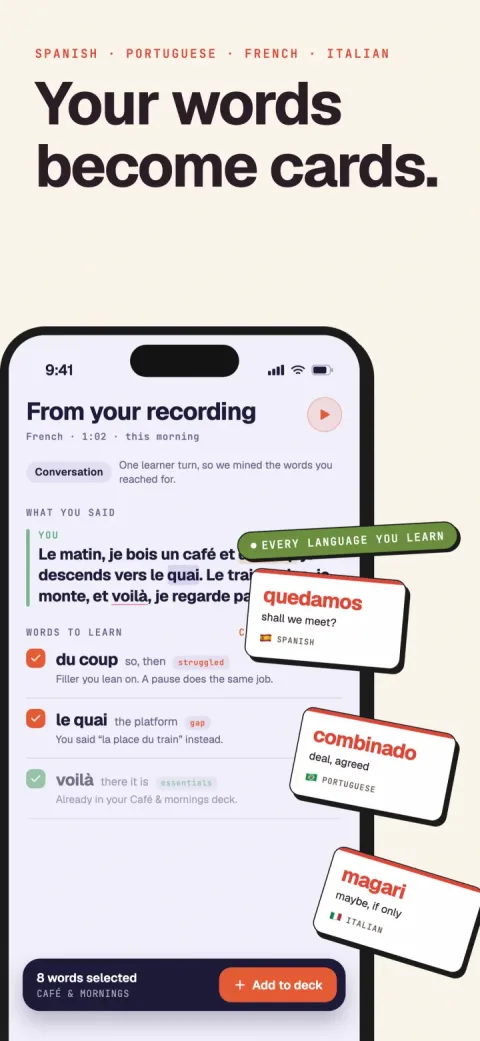
Verbamor turns the words from your own lessons and recordings into flashcards, and brings each one back before you’d forget it.

I should tell you where I'm standing before I start. Verbamor has no keyboard in it. You tap a card, you say a word, you never write anything. So "handwriting doesn't help much" is the finding that suits me. Read the rest knowing that.
So I went looking for the study that would hurt. I found one, and it's in here.
Taking lecture notes and learning a word are two different questions
Ask whether handwriting beats typing and you'll get pointed at Mueller and Oppenheimer, 2014. Undergraduates watched TED talks, took notes by laptop or by hand, and answered questions afterwards.
That's a question about capturing a lecture. Somebody talks for 15 minutes, and you decide in real time what's worth writing down, in your own compressed words or theirs.
Learning bosque means forest is a different job. The target is sitting on the page. No selection, no summarising, no racing the speaker, just stamping a form and a meaning together.
The note-taking literature has almost nothing to say about the second job, and it keeps getting quoted as if it does.
So I'll say each time which question a study belongs to.
The famous lecture studies give the pen a small edge
Across the whole lecture literature, the pen wins by a small margin. It starts with Mueller and Oppenheimer's Study 1, which ran 65 usable participants on five TED talks.
On factual recall the two groups were indistinguishable: laptop M = 0.021, longhand M = 0.009, F(1, 55) = 0.014, p = .91.
That's the half that rarely gets quoted. On remembering stated facts the pen did nothing. The famous result is the conceptual-application questions, where laptop users scored worse, F(1, 55) = 9.99, p = .003.
Their explanation was transcription. Typists wrote 309.6 words to the longhand group's 173.4, with 14.6% verbatim overlap against 8.8%, and more overlap predicted worse scores.
The paper carries a 2018 corrigendum, a published correction, fixing five categories of error. Most were z-scores computed before excluded participants were removed.
Then it got replicated, twice. Morehead, Dunlosky and Rawson ran a direct replication with extra groups, including one that took no notes at all.
Their abstract: "Some trends suggested longhand superiority; however, performance did not consistently differ between any groups (experiments 1 and 2), including a group who did not take notes (experiment 2)."
A meta-analysis (a study pooling other studies) of the direct replications found "small (nonsignificant) effects favoring longhand." They close by calling any verdict "premature."
Urry and colleagues then ran a preregistered replication of Study 1, with its plan published in advance, on 142 participants. They found the same word-count and verbatim-overlap differences as the original, and no quiz difference at all: "laptop participants did not perform better than longhand participants on the quiz."
Eight similar studies pooled together "echoed this pattern."
Now the finding that cuts against me. Flanigan and colleagues meta-analysed 24 studies, 3,005 participants, 49 effect sizes, and handwriting wins: Hedges' g = 0.248, p < .001, 95% CI [0.181, 0.315]. (Hedges' g is a standard measure of how big a difference is.)
That confidence interval clears zero comfortably. Tests for publication bias, where studies that find nothing go unpublished, came back clean: Egger's t(47) = 0.550, p = 0.585.
So here's the honest summary of the lecture literature. The most cited study didn't replicate, and the pooled body of work still favours the pen by a small margin.
How small? Convert g = 0.248 to the probability that a randomly picked handwriter beats a randomly picked typist, and you get 57.0%, against 50% for a coin.
That's my arithmetic on their number, and it's the shape of the whole effect: real, and nothing like the way it gets sold.
One moderator in that paper, a factor that changes the size of the effect, matters more than the headline. Studies giving students a formal period to review their notes showed g = 0.421 [0.287, 0.554]. No review, 0.208. Optional review, 0.195.
In the meta-regression the review variable was the only significant predictor, β = 0.230, p = 0.014. Assessment timing came in at β = 0.001, p = 0.992.
Divide and the reviewed effect is 2.02 times the unreviewed one. So a decent slice of what looks like a handwriting effect is a studying effect wearing the pen's coat.
That lands on the same point as the testing-effect research: what you do with the page later does much of the work.
Four studies tested words, and none found a lasting pen advantage
Here's the part of the literature the listicles skip, mostly because there's so little of it.
| Study | What was learned | n | Result on the memory test |
|---|---|---|---|
| Van Hove et al. 2017 | 36 French L2 words, stylus vs keyboard vs multiple choice | 282 | No main effect of medium, F(1,170) = 0.80, p = .45 |
| Candry et al. 2018 | 24 German L2 words, written vs oral repetition | 67 | Written ahead immediately, d = 0.42; gone at one week, p = .88 |
| Ihara et al. 2021 | 60 Indonesian L2 words, ink pen vs digital pen vs keyboard | 33 | No effect of writing tool on words recalled, F(2,62) = 1.72, p = .19 |
| Naka & Naoi 1995 | Chinese characters, words, syllables, graphic designs | 4 experiments | Repeated writing helped designs, not characters or words |
Van Hove is the biggest and most useful: 282 Belgian pupils learning real French vocabulary for school. Everybody learned plenty, 20.41% on the pretest and 71.85% after. The medium made no difference to how much they retained.
And the detail I promised would hurt me. On diacritics (accent marks) the typewriting group hit 66.68% against multiple choice at 50.24%, p < .001, "whereas the handwriting condition did not differ significantly from the other conditions."
Getting the accent on café right is a form skill, and a keyboard taught it at least as well as a stylus did.
The one result in that paper where writing by hand did beat something is spelling. There handwriting scored 76.51% and typewriting 81.04%, both ahead of multiple choice at 67.43%.
Writing the word beats picking it off a list, whichever implement you use. And the pen still doesn't beat the keyboard.
Candry is the one that shows the pen doing something. Dutch speakers learning German recalled the word's form better right away after written repetition than after saying the words aloud: 63% against 52%, d = 0.42. A week later: 41% against 43%.
Their own summary is that form recall is "marginally better" for writing, "though this advantage disappeared after one week." On meaning recall there was never a difference at all.
Note what that study does and doesn't compare. Its rival condition is speaking, not typing. So it tells you writing beats saying a word for holding onto the spelling.
That edge has a shelf life measured in days, and Thursday's conversation isn't on Monday.
Naka and Naoi is the oldest and strangest. Japanese repeated-writing practice, tested properly: "Experiment 1 showed that repeated writing improved memory for graphic designs but not for Chinese characters, words, or syllables."
Experiment 3 pinned down why. Writing improved free recall that itself involved writing, and didn't improve recognition.
The benefit lived in the match between how you practised and how you were tested. That's encoding specificity, and it isn't a general memory boost.
Four studies, one of them 31 years old. Anyone telling you the science is settled for vocabulary is describing a literature that doesn't exist yet.
A null result from a small study is mostly a statement about the study, so I worked out what each could have caught.
At 80% power (an 80% chance of detecting a real effect), Ihara's 33 people could only detect about d = 0.49. Candry's 52 at the delayed test could detect about 0.39, and Van Hove's groups of 94 about 0.41.
Set those against the pooled lecture effect of 0.248. Every one of these studies would have missed an effect that size. Ihara's floor is twice it.
Catching 0.248 needs about 128 people if each person tries both methods, or 255 per group if they're split. That study hasn't been run on vocabulary.
A handwriting effect as large as the lecture one could still be sitting undetected in all four papers. That's my arithmetic, and it's the best argument against the position I profit from.
The EEG papers say less than their titles do
The modern handwriting revival runs on brain imaging. The citation you'll meet most is Ihara et al. 2021, titled "Advantage of Handwriting Over Typing on Learning Words."
They taught 33 Japanese speakers 60 Indonesian words, 20 per condition, 10 minutes each. The N400 repetition priming effect, a brain-wave sign of recognising a repeated word, was larger for pen conditions, p = 0.04 and p = 0.03.
Then they gave a test. Their own figure caption: "The numbers of memorized words in the posttest and task accuracy in the EEG experiment were not affected by the writing tool." And the abstract: "the behavioral indices were not influenced by the writing tool."
Weight their two groups by size and the ink pen produced 11.24 words out of 20 against the keyboard's 10.15. That's my arithmetic on their means: 1.09 words, 5.5 percentage points. Their own statistical test (an ANOVA) says it's noise.
The typing group also ran 22.6% more repetitions per word, 11.33 against 9.24. So typing bought more practice in the same 10 minutes, and that didn't show up either.
Pinet and Longcamp published a commentary in Frontiers in Psychology on the widely covered 2023 handwriting-connectivity study.
Their objection is blunt: "the protocol did not include any learning," and "behavioral measures are not reported. Establishing a solid behavioral pattern is usually a requirement before interpreting neurophysiological measures."
A difference in brain activity is a lead about mechanism. It becomes evidence about learning when somebody measures learning. On words, when somebody measured, the difference didn't turn up.
Chinese is a separate literature, and it disagrees
One reason the handwriting case sounds stronger than it is: much of the best work is about characters.
Chai and Ma tested 74,362 learners of Chinese from 67 first languages on HSK data (China's standard proficiency exam). High character-writing proficiency predicted reading scores 12.48 points higher, SE = 0.34, p < 0.001.
For a logographic script, where each character stands for a word or part of one, hand-forming the character plausibly teaches the visual form.
That's correlational, and it's about reading instead of vocabulary recall.
Even inside the Chinese literature the answer splits. Lyu and colleagues' review found "typing has a greater effect on Chinese learners' phonology recognition and phonology-orthography mapping than handwriting, and this advantage was more salient in Chinese than in English." (Phonology is sound; orthography is the written form.)
The same review draws the script line for you. Handwriting helped Chinese learners on orthography recognition and meaning at character and word level, "unlike in English, where it only benefited orthographic recognition of letters."
Letters. Those authors, making the case for handwriting, put the alphabetic benefit at the level of knowing what a b looks like.
You already know how to form every letter in servilleta. So whatever handwriting does for someone building a mental picture of 汉, it isn't doing that for you.
Write the words you can’t spell, and spend the rest on retrieval
Write vocabulary by hand if you like writing by hand. The effect is small, the evidence for second languages is thin, and none of it should override a habit that already gets you to the desk.
Three things I'd take from the papers instead.
Write the words you can't spell. That's where the evidence concentrates.
Candry's advantage was on form recall, and Naka and Naoi found the benefit only when the test involved writing too. Practise the output you need.
Don't buy the pen and skip the review. The reviewed studies in Flanigan doubled the unreviewed ones. Notes you never reopen are the failure mode, which is why most language notebooks are write-only.
Spend the marginal minute on retrieval. Pulling a word out of memory cold is a different mechanism with much larger numbers behind it, and saying it out loud is cheaper than copying it.
Verbamor sits on the wrong side of this, and I'd rather say so than pretend. Cards are tapped. So if a real handwriting effect for alphabetic vocabulary turns up in a properly powered trial, that's a hole in what I built.
The app's bet is that scheduling and retrieval matter more than the input device. Van Hove's null is the closest thing to a test of it.
If you keep a paper notebook and it works, keep it. The gap this fills is between writing a word down and ever seeing it again.
Sources
Lecture note-taking, not vocabulary
- Mueller, P. A., & Oppenheimer, D. M. (2014). The Pen Is Mightier Than the Keyboard. Psychological Science, 25(6), 1159-1168. Study 1: 65 usable participants, five TED Talks. Factual recall F(1, 55) = 0.014, p = .91; conceptual F(1, 55) = 9.99, p = .003 (my calculation from F and the degrees of freedom; the .03 in my notes does not match that F). Word count 309.6 typed vs 173.4 longhand; verbatim overlap 14.6% vs 8.8%. Full text read.
- Mueller, P. A., & Oppenheimer, D. M. (2018). Corrigendum. Psychological Science, 29(9), 1565-1568.
- Morehead, K., Dunlosky, J., & Rawson, K. A. (2019). How Much Mightier Is the Pen than the Keyboard for Note-Taking? Educational Psychology Review, 31(3), 753-780. Quotes are from the published abstract; the full text is paywalled and I could not read it.
- Urry, H. L., et al. (2021). Don't Ditch the Laptop Just Yet. Psychological Science, 32(3), 326-339. Preregistered direct replication, laptop n = 74, longhand n = 68. Abstract read in full.
- Flanigan, A. E., Wheeler, J., Colliot, T., Lu, J., & Kiewra, K. A. (2024). Typed Versus Handwritten Lecture Notes and College Student Achievement: A Meta-Analysis. Educational Psychology Review, 36:78. 24 studies, 21 articles, 3,005 participants, 49 effect sizes. g = 0.248 [0.181, 0.315]; I² = 64.39%; review subgroups 0.421 / 0.208 / 0.195; meta-regression review β = 0.230, p = 0.014. Every included study is a lecture study. Full text read.
Second-language vocabulary
- Van Hove, S., Vanderhoven, E., & Cornillie, F. (2017). The tablet for Second Language Vocabulary Learning: Keyboard, Stylus or Multiple Choice. Comunicar, 50, 53-62. 282 pupils, 36 French words, stylus 94 / keyboard 93 / multiple choice 95. Memorization: no main effect of practising modality, F(1,170) = 0.80, p = .45. Diacritics: typewriting 66.68% vs multiple choice 50.24%, handwriting not significantly different from either. Full text read.
- Candry, S., Deconinck, J., & Eyckmans, J. (2018). Written repetition vs. oral repetition. Journal of the European Second Language Association. 67 Dutch-speaking learners of German, 24 words. Immediate strict form recall 63% written vs 52% oral, d = 0.42; delayed 41% vs 43%, p = .88. Meaning recall: no difference.
- Ihara, A. S., et al. (2021). Advantage of Handwriting Over Typing on Learning Words: Evidence From an N400 Event-Related Potential Index. Frontiers in Human Neuroscience, 15:679191. 33 participants, 60 Indonesian words. Posttest words recalled: no effect of writing tool, F(2,62) = 1.72, p = .19. Repetitions per word: keyboard 11.33, ink 9.24, digital 9.10. Full text read.
- Naka, M., & Naoi, H. (1995). The effect of repeated writing on memory. Memory & Cognition, 23(2), 201-212. Abstract read in full; the paper itself is paywalled.
Writing system, and what EEG can carry
- Chai, X., & Ma, M. (2022). Exploring Relationships Between L2 Chinese Character Writing and Reading Acquisition. Frontiers in Psychology. 74,362 learners, 67 first languages. Writing proficiency effect on reading γ₃₀ = 12.48, SE = 0.34, p < 0.001. Correlational.
- Lyu, B., Lai, C., Lin, C-H., & Gong, Y. (2021). Comparison studies of typing and handwriting in Chinese language learning: A synthetic review. International Journal of Educational Research, 106, 101740. Abstract read in full via the Semantic Scholar API; the publisher full text returned 403, so I have not read the body, and the quoted lines are from the abstract.
- Pinet, S., & Longcamp, M. (2025). Commentary: Handwriting but not typewriting leads to widespread brain connectivity. Frontiers in Psychology, 15:1517235.
The arithmetic
- g = 0.248 converted to a common-language effect size: Φ(0.248 / √2) = 0.570, so 57.0% against a 50% coin. Review moderator ratio: 0.421 / 0.208 = 2.02. Ihara's posttest means weighted by group size, (10.25 × 12 + 11.81 × 21) / 33 = 11.24 words for the ink pen and (8.75 × 12 + 10.95 × 21) / 33 = 10.15 for the keyboard, a gap of 1.09 words out of 20, or 5.5 percentage points, on an ANOVA the authors report as non-significant. Repetition gap: 11.33 / 9.24 = 1.226, so 22.6% more repetitions when typing.
- Minimum detectable effect at 80% power, two-tailed α = .05, from the published sample sizes. Within subjects, d = (1.96 + 0.842) / √n: Ihara n = 33 gives 0.49, Candry's delayed n = 52 gives 0.39. Between subjects, d = (1.96 + 0.842) × √(2/n per group): Van Hove at about 94 per group gives 0.41. Required n to detect 0.248: ((1.96 + 0.842) / 0.248)² = 128 paired, or 255 per group. All mine, computed from the published sample sizes; none of these figures appear in the papers.
The pen is not the part that decides.
Verbamor takes the words from your own lessons and schedules them back to you, so the page gets reopened whether or not you wrote it by hand.
Start 7 days freeThe 7-day free trial is on the yearly plan.