Verbamor
When you are actually ready for your first novel
You're ready for your first novel when one page stops you about 5 times: that's near 98% coverage, roughly the 8,000 to 9,000 words Nation says a novel takes. At 12 stoppers the book is readable but it's work; at 25 you're decoding, and a graded reader is the better buy.
You're ready for your first novel when a page of it stops you about 5 times. That puts you near 98% coverage (the share of words on the page you know). At 12 stoppers, around 95%, it's readable but it's work, and at 25 you're decoding.
Nation puts a novel at 8,000 to 9,000 words. Here's how to get your own count.
Pick up the novel you want to read. Open it to page 40, past the throat-clearing of chapter 1.
Read 1 full page. Count the words that stop you. Make an actual tally in the margin.
A word counts as a stopper only if you halted and couldn't keep going. Skip names of people and places, skip a conjugation or plural of a root you already know, and skip anything you guessed and kept moving past.
Without the stopper rule you'd count Macondo and hablaban and land on 25 where a stricter reader lands on 5.
Five stoppers a page and you’re reading; 25 and you’re decoding
Do the one-page count 3 times. Page 40, page 120, page 200. Take the middle number.
If page 40 gives you 5 and page 200 gives you 20, trust the higher count.
Your denominator is the page itself. A Spanish paperback page holds roughly 250 to 300 words.
So a median tally of 5 puts you near 98% coverage, 12 lands around 95%, and 25 drops you to about 90%.
Nation (2006) ran 5 English novels through a frequency count. 2,000 word families (a word plus its forms) covered 87.83% of that corpus. Even 4,000 families plus every proper noun only reached 94.8%.
Nation put the number plainly: a vocabulary of 8,000 to 9,000 words is needed to read a novel, and even then, 1 word in 50 will be unfamiliar.
5 stoppers a page and you're reading.
At 5 or under, buy it and start tonight. You'll finish it.
At 12 you're on the minimal threshold from Laufer and Ravenhorst-Kalovski (2010), who put it at 4,000 to 5,000 word families and 95% coverage. The book is still readable if you change how you read it. Read a whole chapter straight through, then look up only the words you saw 3 or more times.
At 25 you're decoding. Buy a graded reader instead. Olly Richards' Short Stories in Spanish for Beginners sits around A2 to B1, and Difusión publishes the Lecturas readers, graded A1 through B1 and sold by level on the cover.
Run the tally on the reader before you pay for that too. If it gives you 25 stoppers, drop a level and count again. Do it in the bookshop, standing up.
How many unknown words does 95% coverage leave?
95% coverage leaves about 1 unknown word in 20, going by the numbers Nation ran on Lady Chatterley's Lover. Know the 4,000 most common word families plus every proper noun, and you understand 95.06% of the page.
1 unknown word in every 20 comes to about 15 on a 300-word paperback page. You stop 15 times, and the next page hands you 15 more. Knowing 9,000 word families takes you to 98.22%, which is 1 in 50, or about 6 a page.
Agree with yourself on what an unknown word is, because the whole ruling hangs on it. Skip proper nouns: Nation's 95.06% already assumes you know every name in the book, so counting Constance and Wragby pads you into a band above the one you're in. And a word you can only guess from the sentence around it counts as unknown, because guessing is the exact skill under test.
Average 3 pages from the middle:
- Under 6 a page: read it on your own, because you're at 98% or better on this book.
- 6 to 15 a page: read it with your tutor. Bring one page.
- Over 15 a page: put it down and pick up something a level below. Try the count again in 3 months.
Say your average came out at 12, which sends you to a tutor.
The student brings the page they're actually up to in the book that week. Give the cold read 20 minutes: the student reads it aloud, no stopping, while the tutor marks the stumbles and says nothing yet.
Then the tutor explains only the words that block the plot, in Spanish where that's possible. Usually that's 4 or 5 words out of the 12.
The other 7 or 8 unknown words are the lesson. The student guesses each one from the sentence around it, out loud, before the tutor confirms. A wrong guess that gets corrected sticks hard, so let the student be wrong.
Last 5 minutes: the student reads the same page again, alone, no glossing. Still stumbling on the second pass means the wrong book.
Hold the pace at one page a week. A tutor who covers a whole chapter has spent 50 minutes translating out loud, and the student's own reading never gets tested.
The under-6 and over-15 cutoffs come out of what Hu and Nation found in 2000. They gave learners the same fiction passage at 80%, 90%, 95% and 100% coverage.
At 80%, no one reached adequate comprehension. At 90%, a small minority did.
At 95%, the level Olly Richards recommends as your filter, a small minority still. Only at 100% did most readers pass.
The words separating 4,000 families from 9,000 sit far out on the frequency curve, where each word barely earns its keep, so a course never reaches them.
The largest sample found a steady slope, with no cliff edge at 98%
My ruling: start a real novel at 95% and expect it to feel like work. Wait for 98% if you want it to feel like reading.
Near 20 is the count I see most, and I'd tell you to buy the book.
Read the first 3 chapters with a dictionary open, then count again at chapter 4. My own reading suggests authors spend their widest vocabulary while building the setting, and the well narrows once the world is standing. A book counting 20 on page 30 often counts 12 by page 100.
If you count 30, drop 1 shelf. A Spanish translation of a novel you know by heart is the cheat I use most: the plot carries you over the words you're missing.
Batia Laufer and Geke Ravenhorst-Kalovski named the 95% and 98% thresholds in 2010 and hung a vocabulary size on each. Optimal is 98% coverage, around 8,000 word families. Their count includes proper nouns, so a page thick with place names is easier than your tally says.
In 2011, Norbert Schmitt, Xiangying Jiang and William Grabe ran the coverage question past 661 people in 8 countries. Comprehension climbed in a straight line: every extra slice of known vocabulary bought about the same extra understanding. A sample that size can expose a cliff edge at 98%, and it showed a slope instead.
Nation then points at Kurnia's 2003 work. Few learners reached adequate comprehension of a non-fiction text even at 98% coverage. Nation's verdict is that 98% still leaves comprehension hard.
I lean toward the straight line. It's the bigger sample and the tighter design, and it explains why 2 readers at 95% describe the same book so differently. Every point of coverage you add buys real comprehension, so push past 12 when you can.
A whole novel returned 14% on a meaning-recall test
In 2010, Ana Pellicer-Sánchez and Norbert Schmitt gave 20 advanced learners the unmodified text of Things Fall Apart, about 67,000 words. The learners took a month to finish it.
Pellicer-Sánchez and Schmitt measured learning in 28% of cases, or 9.39 words out of 34. Learners picked the right definition off a list 43% of the time, spelling came in at 34%, and part of speech fell to 20%.
Then came meaning recall, where the word sits on the page bare and you say what it means from memory alone. Learners scored 14%.
A whole novel. A month of reading. About 5 words in 34.
Pellicer-Sánchez and Schmitt ran no delayed post-test, a limitation they flag themselves, so we don't know how much of that 14% survived a week. Probably less.
Now run the arithmetic on a real book. At 8,000 to 9,000 word families you read with 1 word in 50 unfamiliar.
In 67,000 words that's roughly 1,300 unknown tokens, counting every repeat. Apply 14% and your novel pays out about 180 words a month.
Here's what the novel does buy you, and it's worth the money.
Those same 20 learners walked 67,000 words of prose without a dictionary, roughly 2,200 words a day of sitting with sentences you only half understand and reading on anyway. A novel makes you hold that confusion for 300 pages, and holding it is the skill. A card ends the moment you flip it.
Get the rest of your new words from a deck that shows them to you 10 times in 10 days. I've written up the split in input vs. cards.
Count unknown words per 250, then scale to your page
Before you count anything, size the page. Count the words in 3 lines, take the middle number, and multiply by the number of lines on the page.
A trade paperback usually lands near 250 to 300. A graded reader can be 130.
The thresholds are per 250 words, not per page. Under 5 unknowns per 250, that book is easy reading and you should buy it. Between 5 and 10 it's work, but it holds, so buy it anyway.
Exactly 10 goes back on the shelf, and so does anything above it. That's around the 90% coverage line, and Hu and Nation (2000) found very few readers do well down there.
So scale your average to the page you measured. On a 300-word page, multiply your count by 0.83 before you rule on it.
On a 130-word graded reader page, every threshold halves: under 3 is easy, and 5 sends it back. Skip this and a graded reader at 92% coverage looks like a pass, when it's below the line I just set.
Pick a book you've already read in English. You know the ending, so every unknown word shows up with the plot already holding it in place and your guesses have something to stand on.
Cross the proper nouns off, and the cognates. Martínez and Guadalajara cost you nothing to learn, and the cognates piece sorts the safe cognates from the traps.
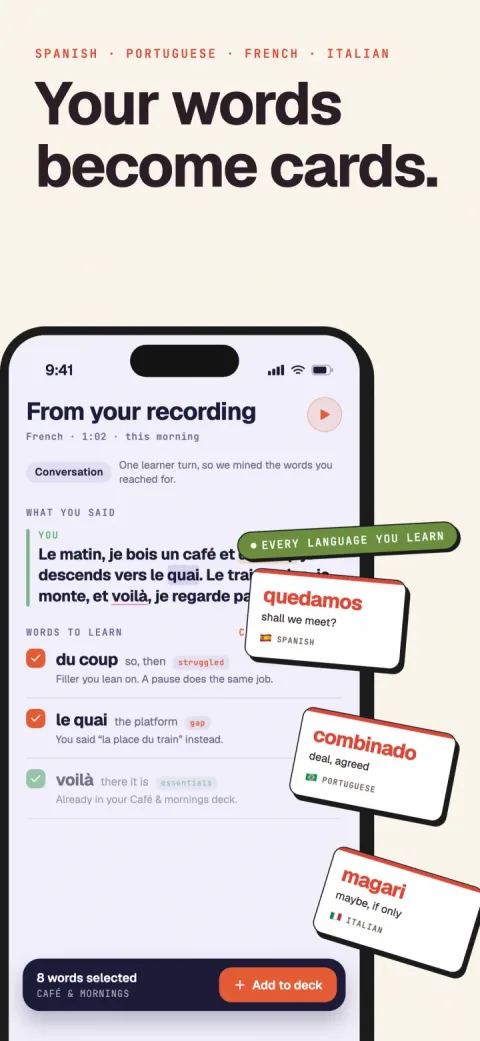
Then set a date. Roughly 600 to 800 new words moves your rate by a few unknowns, about 8 to 10 weeks at 10 new cards a day. Verbamor turns the words your tutor said out loud into cards, and schedules the review before you drop the word.
Put the rejected novel back in your hands at week 10 and count page 30 again. You'll probably be 3 or 4 words lower per 250, and 3 or 4 words is the whole difference between a book that beats you and a book that holds.
Sources
A novel needs 8,000 to 9,000 word families, and 98% coverage still leaves 1 word in 50 unknown
- Nation, I. S. P. (2006). How large a vocabulary is needed for reading and listening? The Canadian Modern Language Review, 63(1), 59-82.
Where the thresholds sit, and why 95% is a floor you limp along at
- Laufer, B., & Ravenhorst-Kalovski, G. C. (2010). Lexical threshold revisited: Lexical text coverage, learners' vocabulary size and reading comprehension. Reading in a Foreign Language, 22(1), 15-30.
- Hu, M., & Nation, I. S. P. (2000). Unknown vocabulary density and reading comprehension. Reading in a Foreign Language, 13(1), 403-430.
Whether comprehension jumps at a threshold or climbs in a straight line
- Schmitt, N., Jiang, X., & Grabe, W. (2011). The percentage of words known in a text and reading comprehension. The Modern Language Journal, 95(1), 26-43.
A whole novel returns about 14% recall, so the new words have to come from somewhere else
- Pellicer-Sánchez, A., & Schmitt, N. (2010). Incidental vocabulary acquisition from an authentic novel: Do Things Fall Apart? Reading in a Foreign Language, 22(1), 31-55.
The words you looked up, kept.
Verbamor schedules the vocabulary from your lessons so the next book gets easier than the last.
Start 7 days free