 Verbamor
LingQ review: the price, settled
The three reviews ranking for this quote three different prices, and one is 33% low. Apple's own US listing ends the argument. Then the harder question: what LingQ's famous known-word counter is actually counting.
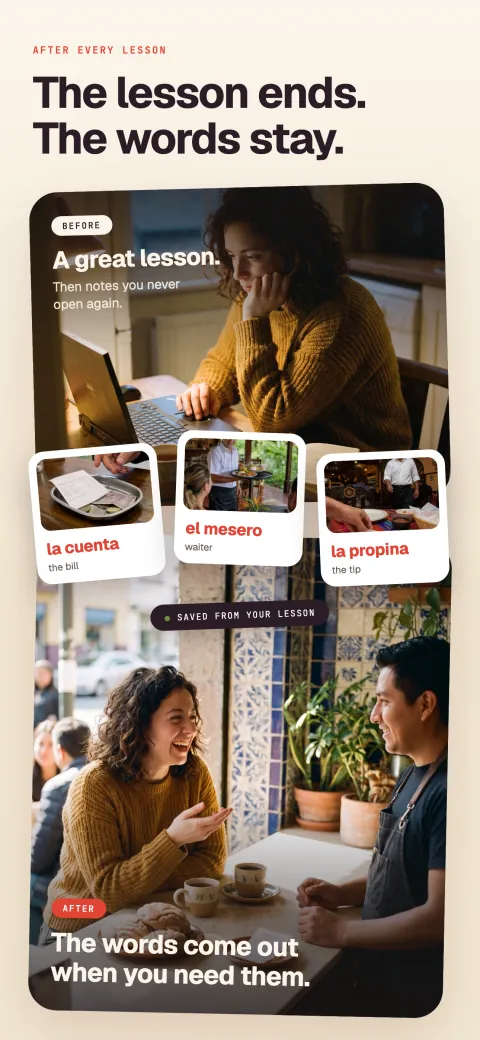
Verbamor records your lesson and turns what your tutor taught into cards that come back on schedule.

I haven't used LingQ. Everything here comes from LingQ's own live pages and Apple's US App Store listing, all read on 21 September 2026. I also read the three reviews ranking for "lingq review," fetched the same day.
I build a competing app, so discount my taste and check my arithmetic. Arithmetic is the part of this results page that falls over.
Search "lingq review" and the top three answers quote $14.99, $10 and $41.99 for various tiers, and give the language count as 23, 30+ or 50+.
No one is lying. They're stale at different rates, and none of them separates the sticker price from the per-month rate you get for prepaying.
So here's the money question first, because the best review in these results buries its pricing verdict under about 7,500 words of memoir.
LingQ costs $14.99 a month, or $119.99 a year
In US dollars, Premium is $14.99 month to month and $119.99 for 12 months. LingQ's own pricing page is useless for this, and the reason is interesting.
I opened lingq.com/en/signup on 21 September 2026 and it served me Brazilian reais: R$52.90 a month, R$284.90 for 12 months, R$509.90 for 24. The footer says "All prices in BRL."
Prices render by region. Which explains the whole mess above: every reviewer is quoting a screenshot from wherever they were sitting.
There's a first-party source in US dollars that no one on this results page uses. Apple publishes LingQ's in-app purchase list, priced by LingQ, with the billing term attached to each one.
Read off the US listing on 21 September 2026:
Now the correction that matters to your wallet. AutoLingual states a flat "$10 per month" with no tiers and no date anywhere on the page.
That's the annual rate. Budget from it and you'll be 33% short the first month, because month-to-month is $14.99.
And All Language Resources, dated 8 September 2026, puts Premium Plus at $41.99/mo. Apple says $29.99. One of those is stale and the page gives you no way to tell.
Two more numbers worth having. Premium includes 600 minutes of audio transcription a month, which LingQ enforces with an explicit over-limit error. Premium Plus advertises "6x Audio Transcription" on the signup table.
And the free tier is small enough to be a demo. LingQ's own comparison table caps it at 20 saved words, 5 imported lessons and 1 audio playlist.
If you want LingQ, buy the 12 months. $119.99 against $179.88 for the same year bought monthly is the largest saving on the page. And it's the tier every reviewer is accidentally quoting anyway.
The known-word number counts every word you didn’t click
Now the part I'd want explained before paying, and no review on this page touches it.
LingQ's credibility rests on a counter. Lingtuitive's author reports 111,000+ known words in Finnish, 28,000+ in Spanish, 19,000+ in Cantonese, over 6 years and a 2,200-day streak.
AutoLingual reports 37,551 in Arabic. Those numbers are why you trust the review.
So what is a known word? LingQ's own knowledge base is clear. A saved term moves through "2 - Recognized", "3 - Familiar", "4 - Learned", and "When LingQs reach Status 4, they are then count as Known."
That's a real learning trajectory. But there's a second road in, and it's the default.
"When you first join LingQ, your Reader settings will be configured to mark all blue words as Known when you turn a page."
That sentence is LingQ's, from its knowledge-base article "How to Increase your known word count?". Blue is LingQ's colour for a word you've never seen.
Out of the box, turning the page reclassifies every word you didn't click as one you know.
So the counter is measuring words you declined to look up. For a fluent reader that's mostly fair, because you skipped them by recognising them. For anyone below that, it counts every word you shrugged past.
I'm not calling the number fake, and LingQ isn't hiding this. It's in a help article with instructions.
The company's own forum carries years of threads from people asking how to undo an accidental sweep. That tells you the mechanic surprises paying users.
What it means for you is narrow and practical. A LingQ known-word total isn't comparable to a vocabulary-size estimate from a test.
It isn't comparable to a count of word families either, which is the unit the research uses.
Treat it as reading mileage. It's a good motivation instrument and a bad measurement one.
This is the same trap flashcards set, from the other side. A word you recognise on sight is a word you may not be able to produce. That's the gap that shows up when you try to speak.
A beginner below about 2,000 word families will click more than read
My short answer: get your first couple of thousand words somewhere else. The search results openly contradict each other here.
Lingtuitive says complete beginners through advanced. All Language Resources says the opposite. AutoLingual hedges toward pairing it with a course.
LingQ's own FAQ answers yes, and concedes in the same breath that the platform "can feel a bit overwhelming due to its lack of structure."
Here's a threshold instead of an opinion. AutoLingual's advice is to "stick with texts that have around 15% unknown words." That's the only usable calibration anyone on this results page offers.
Run it against Paul Nation's coverage work and it stops being a vibe. (Coverage is the share of words in a text you already know.)
Nation (2006) found that 3,000 word families plus proper nouns give over 95% coverage of spoken text, and 6,000 to 7,000 are needed for 98%. At 95% coverage, in his own words, a learner meets "7 unknown words in every minute of speech at 150 words per minute."
95% coverage means 5% unknown. So AutoLingual's 15% band sits well below the level where text is comprehensible on its own.
That's the point: LingQ is a tool for reading above your level with a dictionary welded on. That works.
It just means the dictionary does the heavy lifting at the start. And every click is a decision you make. No one planned it as a lesson.
My read: below roughly 2,000 word families you'll spend more time clicking than reading, and the known-word default will quietly inflate while you do.
Get the first couple of thousand words from something structured, then LingQ becomes the cheapest way to keep going. Above that, it's a strong buy.
Script changes the answer. Lingtuitive's own frustrations are in Cantonese, where the parser struggles enough that the author reaches for a separate dictionary app.
Starting Japanese or Chinese from zero, the click-a-word loop has to fight the writing system first.
Leaving costs you $2 a month, or your saved words
One review covers this, and it's the question a subscription review usually dodges.
Your LingQs are hostages. LingQ's Zoran replied on the company's forum about keeping your data.
He says keeping your data and progress on the account means activating "the Vacation plan," which holds it "as long as you want for $2/month. That includes your imports, LingQs and learning stats."
Read the implication. Drop to free and the free tier's 20-LingQ ceiling is the ceiling, so years of saved words don't survive the downgrade.
$2 a month is cheap insurance, and it's also a subscription that never ends.
All Language Resources adds that downgrading requires manually deleting your lessons down to the free limit first. I couldn't verify that from a LingQ page, so treat it as their observation, not a documented policy.
That makes the lifetime tier a real question, and I can't price it. All Language Resources quotes $229 for a single-language lifetime membership.
LingQ runs a "LingQ for life" offer page that rendered no figure I could read. And Apple's list carries two unlabelled Premium purchases at $99.99 and $109.99 with no term attached.
So I'm not publishing a lifetime price. Open the offer page in your own browser, in your own currency, before you believe anyone's.
The thing to weigh: a lifetime plan on a platform whose value comes from an imported library is a bet on the company.
That's a fine bet to take knowingly. It's a bad one to take because a review calculated it "pays for itself in 2.5 years" using a price it got from its own affiliate link.
Buy something else if you want structure or don’t enjoy reading
Skip LingQ if you want structure. It teaches no grammar and sets no curriculum, by design, and its own FAQ says the lack of structure overwhelms people.
Skip it if you don't enjoy reading. The entire method is reading with the dictionary attached, and 600 transcription minutes a month won't make it an audio course.
Skip it at zero in a new script, for the reason above.
And skip it if what you actually want is to hold on to a specific set of words. LingQ's review layer is the weakest part of the product.
Anki is free, better at that job, and runs a serious scheduler once you change the defaults. It's $24.99 once on iPhone, free everywhere else, against $119.99 a year.
That last case is roughly what I work on, so here's my one paragraph. Verbamor is an iOS app that turns the words from your own lessons and conversations into fill-in-the-blank cards with spoken audio and a picture. FSRS schedules them (an open-source algorithm that predicts when you're about to forget each card).
Six languages: Spanish, French, Italian, Portuguese, Russian, German. $19.99 a month, or $129.99 a year with a 7-day trial on the annual plan, no free tier at all. Both are US prices, read off the app's own plan definitions on 21 September 2026. The App Store sets a different number in other countries.
Beyond a starter deck of about 650 common words, it teaches you nothing new and holds what you already met. That makes it useless at exactly the beginner stage where LingQ is also the wrong purchase.
The honest comparison is that LingQ and I solve different halves. It's very good at putting you in front of a lot of language and letting you click.
Neither of us will make you say the words out loud, and retrieving a word from memory is what helps it move from recognition toward production. And a notebook plus a stubborn habit of self-testing beats both of us for free.
Sources
What LingQ costs
- Apple App Store (US), LingQ | Learn Languages, published by LingQ Languages Ltd. Read 21 September 2026. Source for every dollar figure above: Premium Monthly $14.99, Premium 6 Months $80.99, Premium 12 Months $119.99, Premium Plus Monthly $29.99, Premium Plus Yearly $269.99, plus two unlabelled Premium entries at $99.99 and $109.99 with no billing term attached. App version 6.0.27, updated 16 September 2026, iOS 17.0 or later, rated 4.7 across 10,238 US ratings.
- LingQ, membership pricing page. Read 21 September 2026. Rendered in Brazilian reais for this location (R$52.90 for 1 month, R$284.90 for 12, R$509.90 for 24, footer "All prices in BRL"), which is the evidence that LingQ prices by region. Also the source for the free-tier limits quoted above: 20 saved words, 5 created lessons from imported content, 1 audio playlist. The same page says "40+ languages," while LingQ's own blog says "50+", so I have not published a language count.
- LingQ Language Forums, the thread on the transcription limit. Source for the 600 minutes per month figure and the wording of the over-limit error. "6x Audio Transcription" for Premium Plus is quoted from the signup page above.
What a known word counts
- LingQ Knowledge Base, How LingQ statuses work? (24 June 2023). Source for statuses 1 to 4 (New, Recognized, Familiar, Learned) and for "When LingQs reach Status 4, they are then count as Known."
- LingQ Knowledge Base, How to Increase your known word count? (24 June 2023). Source for the quoted default: "When you first join LingQ, your Reader settings will be configured to mark all blue words as Known when you turn a page." Also states that both Learned and Known words count toward the total.
- Nation, I. S. P. (2006). How large a vocabulary is needed for reading and listening? The Canadian Modern Language Review, 63(1), 59–82. Source for 3,000 word families giving over 95% spoken coverage, 6,000 to 7,000 for 98%, and the "7 unknown words in every minute of speech at 150 words per minute" figure.
The pages this one is arguing with
- Lingtuitive, LingQ Review 2026: Is It Worth It After 6+ Years? Last updated 28 July 2026, about 7,500 words. Its USD prices match Apple's listing, which is why I credit it as the accurate one on price. Source for the author's reported 6+ years, 2,200+ day streak, 40 to 50 books, and known-word totals of 111,000+ Finnish, 28,000+ Spanish and 19,000+ Cantonese. Names Anki, Pimsleur and Pleco, but compares LingQ against none of them on price or outcome.
- All Language Resources, LingQ Review, dated 8 September 2026. Quotes Premium Plus at $41.99/mo against Apple's $29.99, and a single-language lifetime membership at $229. Source for the 15% tutor commission and the manual-deletion step on downgrade, neither of which I could confirm on a LingQ page. The only one of the three to price the exit.
- AutoLingual, LingQ Review, by Mille Larsen. No publication or update date anywhere on the page. States "$10 per month" with no tier breakdown, which is the annual rate rather than the monthly one. Source for the "around 15% unknown words" text-selection rule, which is the most useful thing on this results page, and for the author's 37,551 known Arabic words.
What I could not verify
- Any lifetime price. LingQ's lifetime offer page returned no figure I could read, and Apple's two unlabelled $99.99 and $109.99 entries carry no term. The $229 single-language figure above is All Language Resources' number, not one I confirmed. No lifetime price is stated as fact in this post.
- The vacation plan's current price. The $2/month figure is quoted from LingQ's Zoran on the company's own forum, in a reply dated 26 February 2022. It is first-party and it is four years old. Confirm it with support before relying on it.
- LingQ's language count. LingQ's signup page says "40+" and LingQ's blog says "50+". Two of its own pages disagree, so this post gives no number.
- The downgrade deletion requirement and the 15% tutor commission, both from All Language Resources only. Not found on a LingQ-owned page.
Keep the words you already paid a tutor for.
Verbamor turns your lesson vocabulary into fill-in-the-blank cards with spoken audio, scheduled so they're still there next month.
Start 7 days freeThe 7-day free trial is on the yearly plan.