 Verbamor
The words you understand and cannot say
Your tutor mentions the heat and you follow every word. She asks what your apartment is like in summer, and the word for "stuffy" won't come, even though you'd recognize it instantly on a page. Recognizing a word and producing one are different skills, and for almost every learner they are nowhere near the same size.
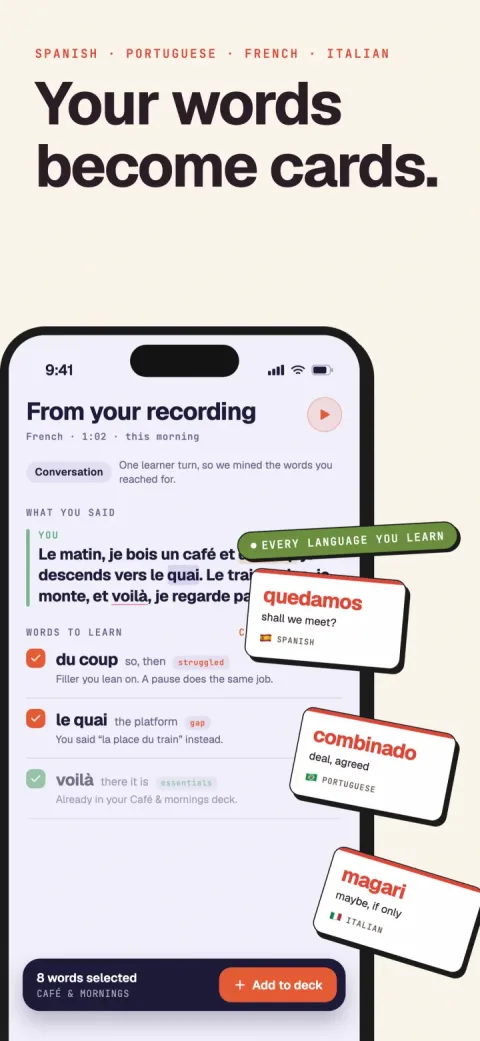
Verbamor turns the words from your own lessons and recordings into flashcards, and brings each one back before you’d forget it.

Your tutor says something about the weather being unbearable this week and you follow every word. Then she asks what your apartment is like in summer. You want to say "stuffy". Nothing comes.
You know you've met that word. You've read it, you've heard it, you'd recognise it instantly on a page. Standing here, with a person waiting, you can't produce it. You say "hot" again and move on.
That gap has a name. Researchers who study vocabulary call the first kind of knowledge passive, or receptive, and the second kind active, or productive.
The word you can understand when someone hands it to you is passive. The word you can pull out of your own head when you need it is active. They're two separate stores, and yours are different sizes.
Conversation happens on the fourth rung
The passive-active split is really a ladder with four rungs. The ladder comes from Batia Laufer and Zahava Goldstein, who built a vocabulary test around it (Language Learning, 2004). They ranked four ways of knowing a word by difficulty:
- Passive recognition. You see sofocante and pick the right meaning from four options. Easiest.
- Active recognition. You see "stuffy" and pick the right Spanish word from four options.
- Passive recall. You see sofocante and say what it means, with no options given.
- Active recall. You want to say "stuffy" and you produce sofocante from nothing. Hardest.
Their finding was that this order held at every word-frequency level they tested. Words climb, and most of your words are sitting on rung one or two while you're trying to have a conversation on rung four.
Laufer and Goldstein put it plainly: many words are first acquired passively, and active knowledge is a more advanced degree of knowledge.
This is why the freeze feels so unfair. The word is in there. You're being asked for a harder version of a memory you genuinely have, and the harder version was never practised.
There's a reason the top rung is harder. Producing a word means starting from a meaning and searching for a form, with every other word you know competing to arrive first. That search is the thing conversation demands, and reading never asks you to do it once.
The gap is normal, and it doesn't close by itself
Laufer tracked 48 Israeli secondary students, in grades 10 and 11, through one year of English study. She measured three things. The first was passive vocabulary. The second was controlled active vocabulary (produce the word when the first letter is given). The third was free active vocabulary (the words that actually show up when you write freely).
The result was published in Applied Linguistics in 1998. In her own words: passive vocabulary progressed very well, controlled active vocabulary progressed too but less than the passive, and free active vocabulary did not progress at all.
A year of instruction, and the words that came out unprompted were the same words as before.
Laufer and T. Sima Paribakht followed this with a study of 79 adult English learners in Israel and 103 in Canada (Language Learning, 1998). Passive vocabulary was larger than active vocabulary in every group.
The learners living in Canada, surrounded by English, did close the gap. But the benefit only started showing up after roughly two years of residence. Immersion works on this problem slowly.
A passive vocabulary that dwarfs the active one is the ordinary result, the shape the research finds in nearly everyone, including learners doing everything their course asks.
Test yourself in eight minutes
Guessing at your own gap doesn't work. The moment you look at a word list, you're testing recognition, which is the rung you're already good at. Run the direction backwards instead.
Do this today:
- Pick a topic you'd actually talk about. Your job, your last trip, what you cooked yesterday.
- Set a timer for four minutes. Write about it in your target language. Keep going the whole four minutes. Don't look anything up, and don't stop to fix anything.
- When the timer stops, mark every place you dodged. Mark every time you used a plain word because the precise one wouldn't come. Mark every time you shortened a sentence to avoid a verb form, and every time you wrote something in English in brackets.
- Now find about 200 words of writing in that language and underline every word you understand but would never have written. Use the front page of a news site in your target language, or the next page of whatever book you're already reading. Spend four minutes on it.
The dodges from step 3 are the words you wanted and couldn't reach. The underlines from step 4 are the words you own on rung one but not on rung four.
Both lists are your gap, in writing, with specific words attached. That's what you now have instead of a feeling.
Keep the sheet. Run it again in three weeks with a different topic and compare the dodges. If the same five words go missing both times, those five are the ones to fix first, and you now know them by name rather than by frustration.
One warning about the test. It'll feel worse than your real ability, because writing under a timer strips out the gestures, restarts and near-synonyms that carry you through a live conversation.
Read the sheet as a list of specific missing words, and pay no attention to the general impression of how badly it went.
Retrieval is what moves words from passive to active
The mechanism is retrieval. Producing a word from memory, and specifically failing and then seeing it, is what builds the ability to produce it again.
The clearest demonstration is Jeffrey Karpicke and Henry Roediger's 2008 study in Science. Students learned 40 Swahili-English word pairs. One group kept testing themselves on the pairs. Another group kept restudying pairs that had already been dropped from testing.
A week later, the repeatedly tested group recalled about 80 percent of the pairs. The repeatedly restudied group recalled 36 percent.
Both groups predicted they'd recall about half, and those predictions didn't differ between conditions. The restudiers felt exactly as prepared and were less than half as good.
Direction matters too. Stuart Webb had Japanese-speaking students of English in Japan study word pairs in both directions (RELC Journal, 2009). He tested five aspects of what they'd learned with ten separate tests per word.
Studying in the productive direction meant English meaning first, with the target word to be produced. It gave larger gains in productive knowledge of meaning, and also in the written form of the word. Studying in the receptive direction gave larger gains in receptive knowledge of meaning. His conclusion, if you only have time for one direction: study productively.
If your flashcard shows you the foreign word and asks what it means, you're practising rung three. If it shows you a gap in a sentence and makes you produce the foreign word, you're practising rung four, which is the rung the conversation happens on.
This is also the part that costs time, and the professionals budget for it. The US Foreign Service Institute times its courses to a Speaking and Listening score of 3 on the Interagency Language Roundtable scale. So the clock it publishes is a clock on production.
Spanish and French run 30 weeks, Italian and Portuguese 24, inside a Category I range of 552 to 690 class hours. The shape of the week is the useful part: FSI says a typical week is 23 hours in class and 17 hours of self-study.
Even for full-time students, 17 of those 40 weekly hours are self-study. The class hours are the part that gets quoted.
Three changes you can make to how you study, in order of how much work they are:
- Flip the direction. Take twenty cards you already have and turn them around, so the prompt is in English and the answer is the word you must produce. Do this before you add a single new card.
- Say it out loud before you check. A spoken guess can't be quietly upgraded to "I knew that" after you see the answer. Write it if you can't speak.
- Produce into a sentence. A gap in a real sentence gives you the grammar and the company the word keeps, which is most of what "knowing" a word means beyond the translation.
Readers and beginners can ignore most of this
If your goal is reading, ignore most of this. Someone studying Italian to get through opera libretti, or Portuguese to read technical papers, needs a large passive vocabulary and doesn't need to produce anything.
Passive-first study is the correct study for that goal, and it's much faster per word. The gap is only a problem if speaking is the point.
If you're in your first few weeks with a language, also ignore most of this. You need a base of recognised words before there is anything to activate, and drilling production on fifty words is a slow way to acquire your first five hundred. Read and listen greedily for a while.
Start with the four minutes
Set a timer for four minutes and write about yesterday in your target language, right now, before you read anything else about method.
The dodges you make in those four minutes are the exact words to work on this month, and there are probably fewer of them than you fear.
Then take the ten words you dodged most and put each one into a sentence you'd actually say, with the word missing. Practise producing it. That's the whole conversion, one word at a time, in the direction the conversation runs.
Producing a word beats recognizing it.
Verbamor's cards can ask you to produce the word from a gap in a sentence, the same retrieval a real conversation demands, so review time trains the skill that goes missing at dinner.
Start 7 days freeThe 7-day free trial is on the yearly plan.