 Verbamor
The State Department says 30 weeks for Spanish. Here is what that leaves out.
FSI puts Spanish at 690 class hours, the official diplomat training figure. That number hides another 510 hours of required homework, plus a target built for professional fluency rather than ordering dinner. The plateau most learners hit around A2 has a specific cause: your first thousand words cover almost 88 percent of spoken Spanish, and each thousand after that pays a lot less.
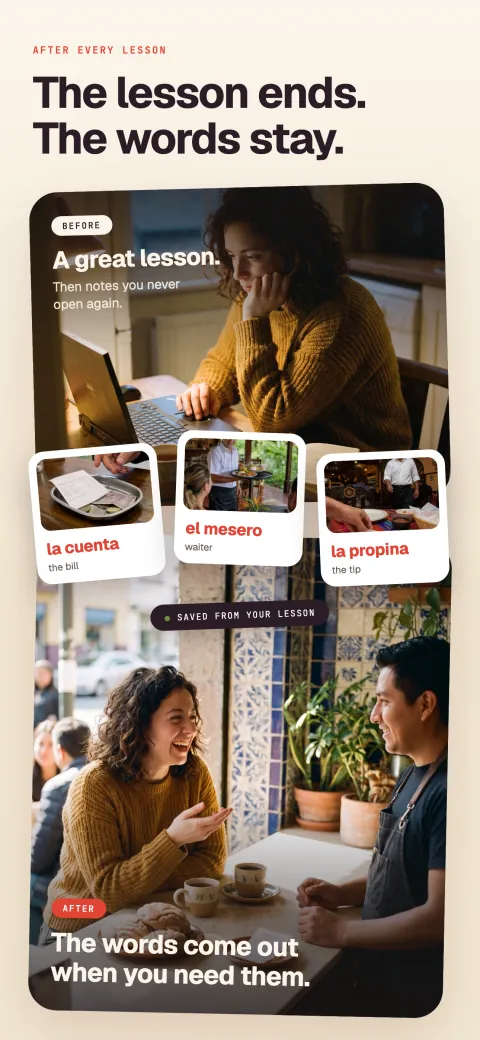
Verbamor records your lesson and turns what your tutor taught into cards that come back on schedule.

FSI, the US Foreign Service Institute, trains American diplomats. It currently puts Spanish at 30 weeks, or 690 class hours. Everyone quotes 600.
The 600 figure comes from the archived version of the same page, and it's still the number that gets pasted into every thread about learning Spanish. The live page groups Spanish with French in Category I at 24 to 30 weeks, or 552 to 690 class hours, and lists Spanish at the top of that band.
FSI's own page says: "A typical week is 23 hours per week in class and 17 hours of self-study." Almost nobody quotes it.
FSI's 690 hours count only the time in class
30 weeks at 23 class hours is exactly 690, which is how Spanish lands on the top edge of the published band. Now add the homework.
23 hours of class plus 17 hours of self-study is 40 hours a week. 30 weeks of that is about 1,200 hours of total contact with Spanish.
The 690 counts only the hours a teacher was in the room. The other 510 hours are real, required, and invisible in every article that quotes the figure.
Three other conditions come attached, and every one of them flatters the number:
- The students are selected. FSI trains people who passed the Foreign Service exam, and many of them already learned a language once before.
- The classes are tiny, taught by native speakers, with the learner speaking out loud for a large part of every hour.
- It's the student's actual job. Nobody is fitting it around a commute or a toddler.
FSI is honest about the softness. Its page says the timelines are what a student "usually" needs, and that real time varies with "natural ability, prior language-learning experience, and time spent in the classroom." Treat 690 as one school reporting its own averages for its own students.
The target is higher than most people picture, too. FSI trains toward an integrated score of 3 on the Interagency Language Roundtable scale, the level where a diplomat can do professional work in Spanish.
You're probably aiming somewhere else. You want to order dinner, follow your partner's family at a table, understand the show without subtitles.
This is why the 600-hour number does so much damage in casual use. It's a professional certification timeline, borrowed to answer a question about ordering coffee. People measure themselves against it, fall short, and conclude they're bad at languages.
Your real target is probably B1, about a third of the diplomat's total
Run the division twice, against two different targets. Use the week you actually have, and leave out the one you hope for.
To a diplomat's ILR 3, at 1,200 total hours. Before you read these, know that 1,200 FSI hours and 1,200 of your hours are different goods.
690 of FSI's were small-group instruction with a native speaker correcting you in real time. Nobody has measured what that instruction is worth against solo study. So treat these as a floor rather than an estimate.
- 1 hour a day, every day: about 40 months.
- 30 minutes a day, 5 days a week: about 9 years.
- A 3-hour class every Saturday: about 7.7 years.
To B1, the level where you can hold the conversation, at 350 to 400 hours. That range is Cambridge English's published cumulative guided learning hours for B1, which it calls guidelines only.
B1 is the level whose official descriptor is "can deal with most situations likely to arise whilst travelling in an area where the language is spoken."
Guided learning hours means class time plus set homework, so the same caution applies. The gap is smaller, though, because more of a B1 learner's hours are ordinary practice.
- 1 hour a day, every day: 12 to 13 months.
- 30 minutes a day, 5 days a week: 2.7 to 3.1 years.
- A 3-hour class every Saturday: 2.2 to 2.6 years.
The second block is the one most readers are actually standing in. It's roughly a third of the first.
Spaced sessions and self-testing get more from the same hours
Twenty minutes a day for 30 days is 10 hours. One 10-hour Saturday is also 10 hours. The clock can't tell them apart. The research can.
Cepeda and colleagues reviewed 317 experiments on distributed practice, meaning study spread over separate sessions, in 2006. One finding survives across all of them. Split the same total study time into sessions with gaps, and you retain more than from the identical time piled into one block.
On that evidence the 30 daily sessions beat the single Saturday, and it isn't close. The Saturday learner is running the massed condition (everything in one block), which is the losing arm in the majority of those 317 experiments.
Their follow-up in 2008, with more than 1,350 people, measured how big the gaps should be. The optimal gap grows as the delay before your test grows.
Measured as a share of that delay, the best gap for a one-week delay was about 20 to 40 percent. For a one-year delay it fell to about 5 to 10 percent. Do the multiplication, because the percentage hides the answer.
Five to ten percent of a year is 18 to 36 days. If you want a word in twelve months, its later reviews belong about a month apart. A weekly review at that stage is roughly four times too frequent.
That's also why 45 minutes daily beats 3 hours every other Saturday. Daily is 5.25 hours a week against 1.5, so the daily learner wins on raw minutes as well, and then wins again on placement.
What you do inside the minutes counts as much as their placement. Karpicke and Roediger tested this in 2008 with 40 Swahili-English word pairs.
Students who kept being tested on pairs they'd already got right recalled about 80 percent a week later. Students who kept restudying those pairs instead recalled 36 percent.
Same material, same time, more than double the retention for the group that had to pull the word out of memory rather than read it again.
The students predicted their own performance at about 50 percent in every condition, and their predictions didn't distinguish between the groups. They couldn't feel which method was working.
This is the trap in a rereading habit. The method that feels productive is the one that leaves the least behind, and your own sense of progress won't warn you.
At an hour a day, B1 takes about a year
The levels come from the Common European Framework of Reference, the six-level scale (A1 through C2) used across European language exams. The hours come from Cambridge English's guided learning hours table: 90 to 100 hours to A1, 180 to 200 to A2, 350 to 400 to B1. At one hour a day that's roughly three months to A1, six to seven months to A2, and about a year to B1.
A1, around month 3. The descriptor is "can interact in a simple way provided the other person talks slowly and clearly and is prepared to help." That's ordering, buying a ticket, saying where you're from.
Native speakers talking to each other still sound like one continuous word.
A2 into B1, months 7 to 12. A2 is "simple and routine tasks requiring a simple and direct exchange of information." You start following television with Spanish subtitles. You still lose most of a conversation between two natives at full speed, and this is the stage where people quit.
B2, year 2 and beyond. Cambridge puts B2 at 500 to 600 cumulative hours. B2 is "a degree of fluency and spontaneity that makes regular interaction with native speakers quite possible without strain for either party." Group conversation and phone calls stay hard, because both remove the mouth and the context you've been leaning on.
The plateau around A2 has a measurable cause, and it's Zipf's law. In any large sample of language, a small number of words account for most of the words actually spoken.
Mark Davies measured this for Spanish in a 2005 paper from the Hispanic Linguistics Symposium, using a corpus (a large collection of texts) with a spoken section.
The top 1,000 lemmas cover 87.8 percent of all tokens in spoken Spanish. (Lemmas are dictionary forms, and tokens are the running words.) The second thousand adds 4.9 points, and the third thousand adds 2.3.
Your first thousand words buy you 87.8 percent of ordinary speech. Your third thousand buy you 2.3.
Your rate of learning hasn't dropped. The payoff per word has, by a factor of roughly 38.
Immersion, a narrow goal or an earlier language changes the numbers
If you live in a Spanish-speaking country and speak Spanish daily at work, ignore all of this. Your hours accumulate in the background at a rate no study plan matches. Clock-counting will only make you anxious about a process that's already working.
Say you're learning Spanish for a narrow purpose, such as reading papers in one medical field or handling a fixed set of work exchanges. Then the FSI timeline overshoots.
Nation's 2006 study of vocabulary size put the requirement for understanding unscripted speech in general at 6,000 to 7,000 word families (a base word plus its related forms). One predictable domain sits well under that, on a body of repeated terms nobody has counted for your particular field.
That's a different order of work from general fluency.
And if you have already learned a second language as an adult, the published averages run long for you. FSI names prior language-learning experience as one of the factors that moves its own numbers.
Pick a small daily block today, then measure what you keep
Pick the smallest daily block you'll still be doing in six weeks. For most adults that's 15 or 20 minutes, not an hour. Write it in your calendar at a fixed time attached to something you already do without deciding, such as after coffee or on the train.
Then set two rules for that block:
- Recall before you look. Whatever you study, say the Spanish out loud before you check the answer. Reading the answer first is the 36 percent condition.
- Space the reviews, and stretch the gaps. Day 3, then the following week, then the month, then leave it alone. The month comes straight from Cepeda's ratio, which is the 5 to 10 percent of 365 days worked out above. The two early gaps are my own rounding down from the same curve, because the ratio is larger at short delays.
Then measure yourself instead of trusting an average. Write down 20 Spanish words or phrases you meet this week and the date.
Six weeks from now, cover the Spanish side and try to produce all 20 from the English. Count how many you get.
That percentage is your actual retention rate under your actual schedule. It's worth more than any published figure, FSI's included.
If you keep 15 of 20, your schedule works and you can scale the hours. If you keep 4, adding hours won't fix it, because the hours are leaking.
Fifteen minutes, spaced right, beats an hour crammed.
Verbamor schedules your reviews with FSRS, spacing each word at the interval where you're about to forget it, so your daily minutes count for more than raw hours ever could.
Start 7 days freeThe 7-day free trial is on the yearly plan.