 Verbamor
The FSI number everyone quotes is the old one
Spanish moved from 24 weeks to 30, and Category I went from 600-750 class hours to 552-690. Both government pages are live and quotable. And buried in the new one is the only FSI figure that transfers to your life: 23 hours in class, 17 alone.
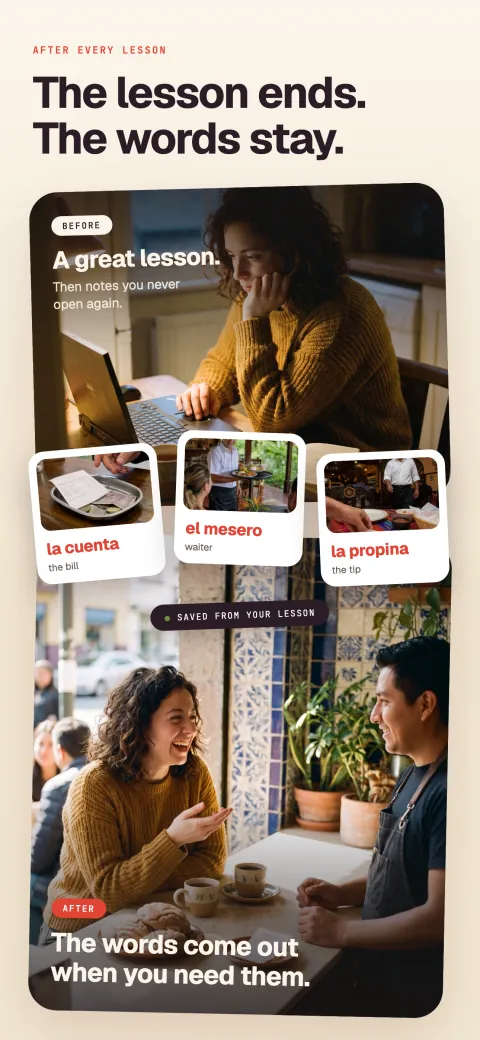
Verbamor records your lesson and turns what your tutor taught into cards that come back on schedule.

Somewhere on a notepad or in a phone note, you wrote down 690. Or 600. You got it from a page crediting the State Department. Then you did the obvious thing: divided by an hour a night, landed just under two years, and sat with that a while.
I've done that arithmetic too. Two years of evenings to speak Spanish, starting tonight.
Then I ran curl against the State Department URL that page cites as its source. HTTP 404, no redirect, final URL unchanged.
The number on your notepad traces to a government page that hasn't existed at that address for years. Meanwhile, State quietly rewrote the figures underneath it.
Spanish used to be 24 weeks. The same department now says 30.
Most of this post is that correction, from two government URLs you can open yourself. But one sentence further down the current page is worth more to you than the correction is. Take it now, in case you leave early.
FSI, the Foreign Service Institute, is the State Department's language school. An FSI week is 23 hours in class and 17 hours of self-study. That second number is 42.5 percent of the week, spent alone, with no instructor in the room, turning class into memory.
You'll never do 17. But the ratio is the part that scales down to an hour of tutoring on a Thursday. It's the only thing on this page that tells you what to do on Monday.
The source everyone cites is a 404
Here's the citation, verbatim, from the references section of Pro Calculator UK's timeline page, the top Google result for this question when I checked. It's a language-timeline calculator on a British site that otherwise costs out roof replacements and road tax:
U.S. Department of State, Foreign Service Institute. (2025). Foreign Language Training. Retrieved from https://www.state.gov/foreign-service-institute/foreign-language-training
Read 22 August 2026. The URL returns HTTP 404.Read the retrieval date. Somebody typed "(2025)" next to a URL that returns nothing. That's a very specific kind of fiction: precise enough to look checked, and never checked.
Credit where it's due, paid after the hit: that page keeps a references section at all. That's more citation hygiene than any other result I opened bothers with. The dead link is the failure of a page that was at least trying.
And the same page makes a second error that gives the game away. Its prose says FSI students attend "25 hours of class weekly, plus 15-17 hours of homework."
State's live page says 23 in class and 17 of self-study. That invented 25 is the input to the exact calculation that produces the figure it's quoting, which turns out to be the whole story.
The next two Google results, checked the same day, don't link State at all. One prints "600 classroom hours for Spanish, French, or Italian" at roughly 24 weeks; the other prints 600-750 hours and 24-30 weeks. Same retired numbers, no source, all the way down.
I'm describing what I read on 22 August 2026 without naming them. The specific pages matter less than how many of them there are, and by the time you read this the list will have shuffled.
This is what a citation chain looks like when every link in it is copied and never read. The figure has drifted for years from a page that has since been rewritten, and nobody went back to look.
State's current page moved Spanish from 24 weeks to 30
Here is the archived page, still live at the 2017-2021 subdomain, verbatim:
Category I Languages: 24-30 weeks (600-750 class hours)
2017-2021.state.gov, with Spanish listed at 24 weeksAnd here is the page State publishes now, same category, same span of weeks:
Category I Languages: 24-30 weeks (552-690 class hours)
state.gov, with Spanish listed at 30 weeksSpanish moved. It used to sit in the 24-week group with Italian and Portuguese. It now sits in the 30-week group with French.
The other categories moved too, in the same direction. Category II went from approximately 900 class hours to 828. Category III from 1,100 to 1,012.
Category IV, the Arabic and Mandarin and Japanese tier, is unchanged at 88 weeks and 2,200 hours. That one is worth a second look: 2,200 over 88 weeks is 25 hours a week, and the same page says 23.
I've worked through what that gap does to the number in the post on Category IV.
Open both links. You'll see the numbers change under your own eyes, which is the only reason I'm confident writing this at all.
The bottom row of that figure changed too, and I haven't seen anyone write about it.
The old page measured you reaching "Professional Working Proficiency," defined as "a score of Speaking-3/Reading-3." The current page measures "an integrated score of 3 (Speaking + Listening)."
Reading is gone from the target. Listening replaced it.
So the new hours estimate a diplomat who can hold a professional conversation, where the old ones also required reading a professional document. If you're chasing this number because you want to speak, the current one is closer to what you meant anyway.
552 is 24 times 23, exactly
Now the part that convinced me the new numbers are a recalculation rather than a revision.
The current page publishes a detail the old one never did: "A typical week is 23 hours per week in class and 17 hours of self-study."
Multiply. 24 weeks × 23 hours = 552. 30 weeks × 23 hours = 690. Those are the exact endpoints of the new range, to the hour, with nothing left over.
So State didn't decide Spanish got easier. The week span held still, 24 to 30 in both versions. What changed is the rate used to convert weeks into hours.
The retired 600-750 range implies 25 class hours a week. The current one uses the 23 that FSI actually publishes.
Check that the same way. 24 × 25 = 600. 30 × 25 = 750. The retired range, to the hour, from a class week State has never printed anywhere.
Which is exactly the 25 the Pro Calculator UK page states as fact about FSI's schedule. It divided the old hours by the old weeks, got 25, and published the quotient as the timetable. It never noticed that State prints the real one.
An FSI week is 40 hours, so the real total is 1,200
Every page quoting these hours presents class hours as though they were study hours. The same sentence that gave us the 23 gives us the rest.
23 hours in class. 17 hours of self-study. That's 40 hours a week.
An FSI language student has a full-time job, and the job is Spanish.
Picture the Tuesday. Roughly 5 hours of class either side of lunch, in a small group with a native-speaker instructor, then something like 3 more hours of drilling that evening.
Wednesday, again. For 30 weeks.
1,200 hours, then, where the commonly quoted figure is 690. The quoted number covers 57.5 percent of the real commitment and overstates the class hours while it does it.
Now put 1,200 back on the notepad. At an honest hour a day, every day, no birthdays off and no flu, you finish in 3.3 years. At 30 minutes a day, 6.6 years, which is a child starting school and leaving primary before you order confidently.
And that's the arithmetic for the model student: aptitude-screened and paid to be there. You're doing it after work.
My own guess is that this arithmetic does its damage a few months in. I'll flag it as a guess, because I have no data on quit rates worth citing. It hits at the point where the target still looks the same distance away as it did at the start.
I've written about what that stall actually is. The short version is that it's usually a measurement problem rather than a learning problem.
The FSI figure measures diplomats, and only its ratio scales to you
Here's the concession, and it's also the thesis.
FSI trains diplomats. Its students are screened for language aptitude and taught full-time, and the standard they're measured against is an ILR 3: someone who can conduct government business in the language. The page says the timeline "can vary based on several factors, including the language learner's natural ability, prior language-learning experience, and time spent in the classroom."
If you want to order dinner in Oaxaca and follow the reply, none of that was ever about you. You want something well below an ILR 3, in a domain roughly the size of a menu and a taxi ride.
So what's the right number for that? Nobody publishes a credible one, and I won't invent one to round off this section. No government body tests holiday Spanish.
That vacuum is why the FSI figure keeps getting borrowed. It's the only hours number anyone official has printed, so it gets pressed into service answering a question State was never asking.
It's a staffing estimate for a training institute. Adopting it as a personal target is how a reachable goal turns into a 3-year sentence you quietly abandon.
Which brings it back to the 23 and the 17, because that's the piece of FSI that does survive the trip to your life.
The total doesn't scale. The proportion does. FSI puts 42.5 percent of a Category I week into time spent alone, consolidating class into memory, because that's where a pleasant morning becomes something you still have in March.
Take an hour of tutoring a week and do nothing between sessions, and you're running FSI's model with the self-study set to zero. In FSI's week, the 17 hours were doing real work.
Shrink the week to your size and the shape holds: deliberate time between lessons, decided in advance. That's the case for spacing the practice out instead of stacking it, and for making the between-lessons work retrieval rather than rereading your notes.
That gap is the thing I built Verbamor to sit in. It takes the vocabulary from your own lessons and turns it into fill-in-the-blank cards with native audio.
FSRS, an algorithm that predicts when you're about to forget each card, schedules them. So the self-study half of the FSI week has something in it besides good intentions.
It's a $19.99/month app, iOS only, and apart from about 650 starter words, it teaches you nothing new. It just holds words you've already met.
If you're the kind of person who'll genuinely build and maintain your own deck, Anki is free, runs the same algorithm family, and you should use that instead. I mean this: a maintained Anki deck beats a subscription you stop opening.
And if you're working toward a real ILR 3 for a professional reason, no card app substitutes for the 23 hours. Go find the classroom.
Sources
The current FSI figures
- U.S. Department of State, National Foreign Affairs Training Center. Foreign Language Training. Category I: 24-30 weeks (552-690 class hours), Spanish at 30 weeks; "A typical week is 23 hours per week in class and 17 hours of self-study"; target "an integrated score of 3 (Speaking + Listening)" on the ILR scale. Retrieved 22 August 2026.
The retired figures still being quoted
- U.S. Department of State (archived 2017-2021). Foreign Language Training. Category I: 24-30 weeks (600-750 class hours), Spanish at 24 weeks; target "Professional Working Proficiency ... Speaking-3/Reading-3." Retrieved 22 August 2026.
The dead citation
- state.gov/foreign-service-institute/foreign-language-training returned HTTP 404 on 22 August 2026, checked with curl, no redirect, final URL unchanged.
- Pro Calculator UK. How Long to Learn a Language | FSI Data 2026. The top Google result for this question when checked. It cites the 404 URL above with a "(2025)" retrieval date, states that FSI data "comes from full-time students attending 25 hours of class weekly, plus 15-17 hours of homework," and prints Spanish at 600-750 classroom hours and 2.6-3.3 years. State's live page publishes 23 class hours and 17 of self-study. Retrieved 22 August 2026.
The arithmetic
- 24 × 23 = 552 and 30 × 23 = 690, matching the published class-hour range exactly. 24 × 25 = 600 and 30 × 25 = 750, matching the retired range exactly, which is how the retired figures resolve to a 25-hour class week State does not publish. 30 × (23 + 17) = 1,200 total hours, of which 690 class hours is 57.5 percent. Self-study is 17 of 40 hours, or 42.5 percent of the week. My own multiplication of State's published weekly split; State does not print a total-hours figure.
The 17 hours are the half you control.
Verbamor turns the vocabulary from your own lessons into scheduled retrievals, so the time between sessions does something.
Start 7 days freeThe 7-day free trial is on the yearly plan.