 Verbamor
Is Anki worth it? A straight answer for Spanish and French
Anki is worth it for Spanish and French if your words arrive in a list, you'll use a shared deck, or you want to own your data; the iPhone client is $24.99 once, and desktop is free. If your words arrive as conversation, think hard: building 1,500 cards costs about 12.5 hours of typing, by one vendor's estimate.
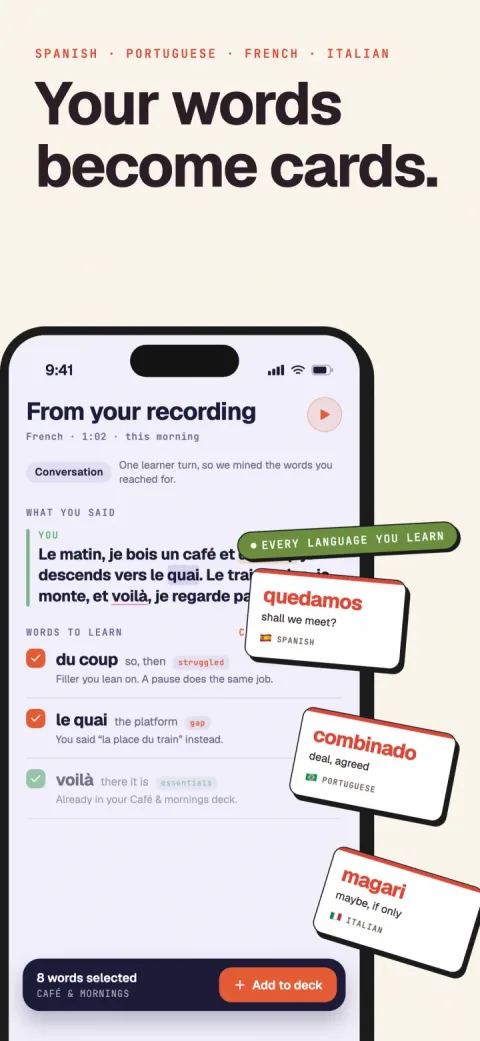
Verbamor turns the words from your own lessons and recordings into flashcards, and brings each one back before you’d forget it.

The notebook from Tuesday's lesson is still open on the desk, at the page where you wrote down nine words in a hurry while your tutor waited. It's Sunday. You haven't typed a single one of them into anything.
The untyped notebook is the moment the Anki decision actually turns on, and it lands weeks after you buy the software.
Anki costs $24.99 on iPhone. One payment, forever, no subscription. If you want the wider field, I compared the flashcard apps that rank for this question and checked their citations.
On the day I checked, 22 August 2026, Apple's own listing showed AnkiMobile at #1 on the top-paid Education chart in the US App Store. Chart positions move, so go and look.
A flashcard app with a plain grey icon, at the top of a chart people pay to enter.
So Anki is obviously worth it for somebody. Whether that somebody is you takes arithmetic almost no page on this topic will do. Most Anki writing is also, quietly, about Japanese, which is its own problem if you're learning Spanish.
01 / 05 · the case for itThe software is free and excellent, and the cost lies somewhere else
I'm not about to talk you out of Anki. You can run Anki on a desktop or an Android phone without paying anything. The $24.99 buys the iPhone client, and what Anki costs has every platform and the regional prices. If you're choosing between Anki and my app, Verbamor vs Anki is the head-to-head.
Anki runs a genuinely modern scheduler. Its manual is better documentation than most commercial software ships with, written by people who've actually read the memory research they're implementing.
If you want a tool that will still be yours in 10 years, nothing else in this category qualifies.
Anki is an empty box, and filling the box is a job.
Filling the box is the whole difficulty, and it has nothing to do with the interface or the algorithm. Both are fine. The box is the problem.
02 / 05 · the costBy one Anki vendor’s own estimate, 1,500 cards is 12.5 hours of typing
Here's a figure I didn't have to go looking far for. Migaku, a company that sells an Anki companion tool, publishes this in the FAQ of its own card-making guide:
"If you spend 30 seconds per card (Typing front, back, maybe adding an image), that's 750 minutes or about 12.5 hours."
Migaku's 12.5 hours is for 1,500 cards, at 30 seconds each, which is fast. It assumes you already know what goes on the card and never stop to check a conjugation or hunt for a picture.
Migaku goes further, and this is the honest part: "If you're trying to learn 2000 common words, creating individual cards for each one is a serious time investment. You could spend that time actually reading or listening to your target language instead."
A company selling you Anki tooling wrote that. It's the sharpest sentence I found anywhere on this topic.
Now price the 12.5 hours. Preply publishes a labeled table of average Spanish tutoring rates, updated 2 March 2026, and speaking practice sits at $16 an hour.
So 12.5 hours of typing flashcards is roughly 12 hours of conversation with a native speaker, given away.
Reviewing is cheap by comparison. Migaku's same page puts a new card at 10 to 15 seconds including thinking time and rating. That part scales fine.
Building the cards is what quietly eats a year. Card-making lands at exactly the moment your motivation is lowest: after the lesson, tired, with a notebook full of words and no structure.
A shared deck dodges the card-building cost entirely, and for a lot of people that's the right move. I'll come back to what it does to this arithmetic, because it does something drastic. Both have a place.
03 / 05 · the settingAnki ships the better scheduler, then leaves it switched off
Here's something the other reviews I read don't mention once, even one updated in October 2024.
Anki's modern scheduler, FSRS (an open-source algorithm that predicts when you're about to forget each card), is off by default. From the Anki manual, verbatim: "The Free Spaced Repetition Scheduler (FSRS) is an alternative to Anki's legacy SuperMemo 2 (SM-2) algorithm. By more accurately determining how much information you are likely to forget, it can help you remember more material in the same amount of time."
An alternative. To the legacy algorithm. Which means the legacy algorithm is what you get.
And turning FSRS on isn't a welcome-screen question. The manual tells you to enable it in the 'FSRS' section, which is the last thing in deck options.
The very last thing. On a screen most people open once, to change how many new cards they see a day.
You'll find blog posts claiming FSRS became the default in version 23.10. They're wrong, and the manual is right there. I've written about what FSRS actually does if you want the mechanics.
The buried switch matters here. A lot of people who bounced off Anki bounced off SM-2 intervals at default settings. They decided spaced repetition didn't suit them, and never learned there was a switch.
04 / 05 · romance languagesSpanish and French need fewer cards, but harder ones
Back to the Japanese problem, because it changes what you build. Kanji decks, JLPT levels, Heisig: the canonical Anki advice was written by people solving a writing system, and Spanish doesn't have one.
Two things change for us.
First, Spanish and French have real cognate density with English, meaning many words look and mean alike in both. So a plain word-to-word card is often too easy to be worth 30 seconds of construction.
La situación doesn't need a flashcard. Knowing which words you can skip is most of the efficiency available to a Romance-language learner, and it shrinks your 1,500 cards considerably.
Second, the words that actually break you are grammatical. Gender. Por versus para.
The French subjunctive triggers. Whether it's me acuerdo de or me recuerdo.
In French it's the same shape with different furniture. Bon against bien, which helper verb (avoir or être) a verb takes in the passé composé, and the fact that une personne stays feminine no matter who you're talking about.
None of those grammar traps survive a two-sided vocabulary card. They need a sentence with a blank in it, so the form has to come out of your mouth under pressure.
There's a paper behind why a blank beats a word pair. Slamecka and Graf named the generation effect in 1978: a word you produce yourself is remembered better than the same word handed to you to read.
And the gender rides along for free. A word-pair card leaves the article to chance; a blank makes you commit to el before you've had time to be clever about it. That commitment is why retrieval beats rereading at every delay that matters.
Anki handles all of these grammar cards. Cloze deletion (a sentence with the word blanked out) is built in, and it's excellent.
The grading discipline that makes any of it work is the same whichever tool you use.
But notice what just happened to the arithmetic. Good cards, the kind that fix gender and preposition errors, take longer than 30 seconds each. Migaku's estimate was for the cheap version.
The cost of a good card cuts against me too, and I should say so out loud. A generated card still has to be checked and graded honestly, and a sentence that came out of a machine sometimes wants correcting.
Nothing here makes a good card free. It moves who does the typing.
05 / 05 · the verdictWho should buy Anki?
Buy Anki if you're the kind of person who enjoys the tool as much as the language. You know if you are. You'll tune the deck options, turn FSRS on within a week, and end up with something better than anything you could pay for.
Buy Anki if your words arrive in a list. A textbook chapter, a frequency deck, a wordlist your class handed out.
Batch-building 40 cards from chapter 6 is a pleasant 20 minutes, because the hard part, deciding what goes on the card, was already done for you.
And buy Anki, frankly, if you want to own your data, because nothing else in this category will let you export the whole collection tomorrow and walk. I say that as someone selling an alternative.
And buy Anki if you'll genuinely use a shared deck, which takes my best number away from me.
Somebody else already did the typing, so your card-building cost drops to roughly zero. That $200 of forgone tutor time is an invoice I have no business sending you.
The shared-deck case is a real hole in this page, and it's worth knowing how big it is. For the people it covers, it's the whole argument. A premade deck that holds the words you need makes Anki the end of the decision, at $24.99 once.
Now the other side.
If your vocabulary arrives as conversation, I'd think hard. My own lessons throw off something like a dozen words an hour, half of them phrases, scattered across speech and never in a list.
Turning that into cards means first transcribing your own memory of the lesson, and transcription is where people stop.
People don't quit at review. Review is 10 seconds a card and mildly enjoyable, and it's the part they never reach.
Six months of unbuilt cards is a worse deck than the free one you'd have downloaded on day one.
The review side has its own bill. Anki's manual puts 20 new cards a day at about 200 reviews.
The gap between the lesson and a finished card is what I built Verbamor for. You record or type what came up in the lesson, and it makes the cloze cards, with native audio and an image, scheduled by FSRS.
It covers Spanish, French, Italian, Portuguese, Russian and German, though the grammar above is the two I know best. It's iOS only, there's no free tier, and it can't import your Anki decks. So if you've already built a collection you like, staying put is the right call.
The monthly plan is $19.99; the yearly one is $129.99, and it's the only one that comes with a 7-day trial.
Here's the test I'd actually apply, and you can run it tonight for free.
The stopwatch is the only part of this page I'd defend to the last. Everything else here is argument, and you can out-argue me. You can't out-argue the clock on a Sunday with Tuesday's notebook still open.
Sources
Anki's price, and FSRS being opt-in
- Anki. Deck options. Anki Manual. Verbatim: "The Free Spaced Repetition Scheduler (FSRS) is an alternative to Anki's legacy SuperMemo 2 (SM-2) algorithm" and "Enable FSRS under the 'FSRS' section, at the bottom of the deck options page." Read 22 August 2026.
- Anki Software, LLC. AnkiMobile Flashcards. Apple App Store listing: $24.99, chart position #1, top-paid Education (US), read 22 August 2026. The chart badge's own link target is apps.apple.com/us/iphone/charts/6017?chart=top-paid.
What card-building actually costs in hours
- Migaku. How to make Anki cards. FAQ, verbatim: "If you spend 30 seconds per card (Typing front, back, maybe adding an image), that's 750 minutes or about 12.5 hours." Read 22 August 2026.
- Preply. Spanish tutoring rates. First-party table labeled "Average Price on Preply", updated 2 March 2026: speaking practice $16/hr, stated overall range $15-$50/hr.
Why cloze cards beat word pairs
- Slamecka, N. J., & Graf, P. (1978). The generation effect: Delineation of a phenomenon. Journal of Experimental Psychology: Human Learning and Memory, 4(6), 592–604. Self-generated words are retained better than words that are simply read. Cited above for why a blank beats a word pair.
- Roediger, H. L., & Karpicke, J. D. (2006). Test-enhanced learning: Taking memory tests improves long-term retention. Psychological Science, 17(3), 249–255. The one-week retrieval advantage quoted above; covered in full in the testing effect.
The cards get built either way. The question is by whom.
Verbamor turns the vocabulary from your own lessons into cloze cards with native audio, scheduled by FSRS.
Start 7 days freeThe 7-day free trial is on the yearly plan.