Verbamor
Anki for language learning: the bill arrives in month three
Anki's own manual says 20 new cards a day becomes roughly 200 reviews a day. That sentence decides whether Anki works for you, and none of the three pages ranking above this one quotes it.
Anki is free on desktop, free on Android, and $24.99 on iPhone. I pulled that price off Apple's own store record for app 373493387 on 21 September 2026, alongside version 25.09.
Three pages rank above this one for "anki for language learning." All three give you that price. One of them rounds it to $25, which tells you how carefully the rest was checked.
And all three stop there, as though $24.99 were the decision.
The thing that actually decides it is printed in Anki's own documentation, in a section on daily limits. It's in a sentence I haven't seen quoted on any page about this.
Here it is, and it should be the first thing anyone reads about Anki.
"If you are consistently learning 20 new cards a day, you can expect your daily reviews to be roughly about 200 cards/day."
So take the answer up front. If your words arrive already listed, from a frequency deck or a textbook chapter, install Anki tonight and don't pay anybody for this.
If your words arrive scattered through a conversation you had on Tuesday, the review curve below will decide it. Read the arithmetic before you start typing.
Anki's manual says 20 new cards a day means 200 reviews
That 20-to-200 line comes from the Deck Options page of the Anki manual, and the paragraph around it is blunter still.
Two sentences later: "More than one Anki user has excitedly studied hundreds of new cards over their first few days of using the program, and then has become overwhelmed by the reviews required."
That's the software's own authors warning you about the failure mode of the software. The pages selling you on Anki leave it out.
The ratio is roughly 10 reviews a day for every new card you add daily. It isn't a hard rule, and the manual presents it as illustrative. But it's the manual's own illustration, from the people who wrote the scheduler.
Now watch what happens when you put real numbers through it. Migaku's guide ranks third for this query, and it's the only one of the three to do any of this arithmetic.
It tells you to "Start with 10-15 new cards daily," then says you can "increase to 20-25 new cards once you're comfortable with the routine."
Follow that advice and here's where it puts you, in Migaku's own words. After a month: "you'll have 300-450 new items and probably 50-100 daily reviews." After three: "you might be reviewing 150-200 cards per day."
And at the top end, "At 30 new cards daily, you'll be reviewing 300+ cards per day within a few months, which takes 45-60 minutes."
Read those three figures in order. The workload doubles or triples between month one and month three, on a habit you never changed.
This is compound interest with the sign flipped. Every new card you add today is a small recurring payment you make for months, and the payments stack.
Miss a week in month three and over a thousand cards wait
The competing pages all show you a tidy weekly table. One lays out 20 new cards a day Monday to Friday, 50 to 100 reviews, zero at the weekend, totals summed neatly at the bottom. A calm steady state that never arrives.
Here's what the tables leave out. Anki doesn't forgive. A card due on a day you skipped is still due the next day, and so is that day's own batch.
Miss a week in month three, at 150 to 200 reviews a day, and you come back to something north of a thousand cards waiting.
That's the number that ends Anki habits. A screen with 1,000-odd cards on it after a work trip, and the entirely rational decision to open something else instead.
You can cap it, and you should: Maximum Reviews/Day exists in the same Deck Options screen. But a cap only queues the debt.
The cards keep coming until the backlog clears. If 150 to 200 reviews fall due each day and your cap is 200, a 1,000-card debt shrinks by a few dozen a day at best, so you spend weeks in full sessions before you see a new word.
None of the three ranked pages mentions a backlog at all. That's strange, because getting buried is the most common thing that happens to people who try Anki, and it's the thing the manual itself warns about.
My honest read: the review load is survivable if you're deliberate about the input. Add 10 new cards a day rather than 25, accept that you're building slowly, and the curve flattens into something you can carry.
What a sustainable daily number looks like is a whole argument on its own, and the answer is lower than you want it to be.
The better scheduler ships switched off
Now the fact that genuinely surprised me, checked against the manual's source on 21 September 2026. None of the three pages ranking for this query mentions FSRS. Not one, not once.
FSRS is Anki's modern scheduler. It fits a memory model to your own review history instead of applying the fixed 1987 formula Anki inherited from SuperMemo. And it's off unless you turn it on.
The manual, verbatim: "The Free Spaced Repetition Scheduler (FSRS) is an alternative to Anki's legacy SuperMemo 2 (SM-2) algorithm. By more accurately determining how much information you are likely to forget, it can help you remember more material in the same amount of time."
An alternative to the legacy algorithm. That means the legacy algorithm is what you get out of the box.
And switching over isn't a welcome-screen question: "Enable FSRS under the 'FSRS' section, at the bottom of the deck options page."
You'll find blog posts claiming FSRS became the default in version 23.10. Built in since 23.10 is right. Default isn't, and the manual is one click away from anyone writing about this.
This matters for the curve above, because fewer wasted reviews is exactly what a better scheduler buys you. Turn it on the day you install.
While you're in there, the default desired retention is 90%. The manual describes it as scheduling cards "so you have a 90% chance of remembering them when they come up for review again."
Lower it slightly and your daily count drops; the tradeoff is real and it's yours to make. I've written up what FSRS is doing underneath if the mechanics interest you.
A good card blanks the word inside a sentence you heard
Every guide tells you to make your own cards. Almost none shows you one. The format is the difference between a deck that teaches you Spanish and a deck that teaches you a lookup table.
Russian makes this sharper still, because a card can be actively wrong. Pair человек with "person" and you've taught yourself the nominative singular, the basic dictionary form. Its genitive plural, the form Russian uses after words like many, is людей, and it shares almost no letters with the one on your card.
You'll hear людей in week one and not recognise it. A form worth knowing deserves its own card, with the form in a sentence.
This is the real time cost. Migaku, which sells Anki tooling, publishes its own estimate on a separate page: "If you spend 30 seconds per card (Typing front, back, maybe adding an image), that's 750 minutes or about 12.5 hours" for 1,500 cards.
That 30 seconds assumes you never stop to check which of five meanings you meant. I've costed that build out properly elsewhere.
Install Anki tonight if your words arrive in a list
Anki is the right answer for more people than a page like mine is supposed to admit, so here is the honest split.
Install it if your words arrive in a list. A frequency deck, a textbook unit, a chapter vocabulary box.
You know what the next 200 cards are, you can build them in batches on a Sunday, and the scheduler underneath is as good as anything commercial. It'll still be yours in 10 years, and it costs nothing on desktop and Android.
Install it if you want to own the data. Anki's export puts your collection on your own disk in a format you control, which no subscription offers.
Skip it if your words arrive scattered through a lesson. Nine words in a notebook from Tuesday, half of them forms rather than headwords, and a Sunday where you haven't typed a single one.
That's a card-building problem, and Anki was never built to solve it. It's where most people who bounce off Anki actually bounce.
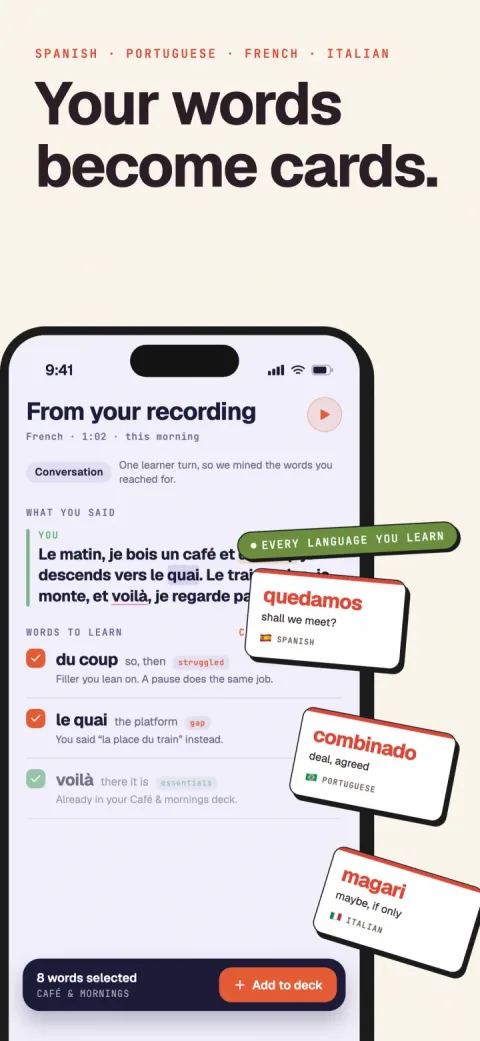
That gap is the thing I built. Verbamor is an iOS app for Spanish, French, Italian, Portuguese and Russian. It takes what came up in a lesson you already paid for and turns it into fill-in-the-blank cards with spoken audio and an image. FSRS schedules them, with no settings screen to find.
Apart from a starter deck of about 650 common words, it teaches you nothing new, and it doesn't find you a tutor. $19.99 a month, or $129.99 a year with a 7-day trial on the annual plan.
Both are US prices, read off the app's own plan definitions on 21 September 2026, and the App Store sets a different number in other countries. No free tier, and iPhone only, both of which are real reasons to skip it.
And say you'll write Tuesday's nine words into a notebook on the train home and cover the answers and test yourself on Thursday. That beats every app on this page, mine included, and it costs nothing at all.
Sources
Anki's own documentation
- Anki Manual, Deck Options, read from the manual's source repository on 21 September 2026. Source for the verbatim 20-new-cards / 200-reviews ratio, the "overwhelmed by the reviews required" warning, the FSRS quotations ("an alternative to Anki's legacy SuperMemo 2 (SM-2) algorithm" and "Enable FSRS under the 'FSRS' section, at the bottom of the deck options page"), the Maximum Reviews/Day setting, and the 90% default desired retention.
- AnkiMobile price and version: Apple's own App Store record for app 373493387, read 21 September 2026. US$24.99, version 25.09, no in-app purchases listed. Regional prices differ (£24.99 UK, €29.99 eurozone, A$39.99 Australia), so quote the US figure as US dollars.
The review-load arithmetic
- Migaku, Anki Language Learning: How to Use It (and Better Options), read 21 September 2026. Source for "Start with 10-15 new cards daily," the increase to 20-25, "you'll have 300-450 new items and probably 50-100 daily reviews," "you might be reviewing 150-200 cards per day," and the 45-60 minutes at 30 new cards a day. Migaku sells a competing product, which is worth knowing; these figures still line up with Anki's own ratio.
- Migaku, How to make Anki cards. Source for the 30-seconds-a-card estimate and the resulting "750 minutes or about 12.5 hours" for 1,500 cards.
Why the blank beats the arrow
- Slamecka, N. J., & Graf, P. (1978). The generation effect: Delineation of a phenomenon. Journal of Experimental Psychology: Human Learning and Memory, 4(6), 592-604. The citation for material you generate being remembered better than the same material read.
The pages this one is arguing with
- Ranked 1, 2 and 3 for "anki for language learning" on 21 September 2026: memo.cards, FluentU and Migaku. All three were read in full that day. None of the three mentions FSRS, the default SM-2 scheduler, or a review backlog. memo.cards states the iOS price as "a one-time fee of $25"; it is $24.99. FluentU's effectiveness claim, that learners "can improve their vocabulary retention by using an SRS for just ten minutes a day," names no study and no researcher, and its verdict section closes with a 40%-off promotion for FluentU.
What is illustrative rather than measured
- The two Spanish cards and the Russian example are written to show a principle, not drawn from a study or from measured learner data. The generation-effect citation supports the format; the specific words are mine.
- The 1,000-card backlog figure is arithmetic on Migaku's own month-three range (150-200 a day across 7 skipped days), not a measured observation.
The cards get built either way. The question is by whom.
Verbamor turns the words from your own lessons into fill-in-the-blank cards with spoken audio, scheduled by FSRS with nothing to configure.
Start 7 days free