 Verbamor
The best flashcard apps for language learning, with citations that exist
In August 2026, the page ranking first for this question cited three research organizations I could not find anywhere, and carried exactly one outbound link: to the product it ranked first. Its site has since gone offline. Here is the checkable version.
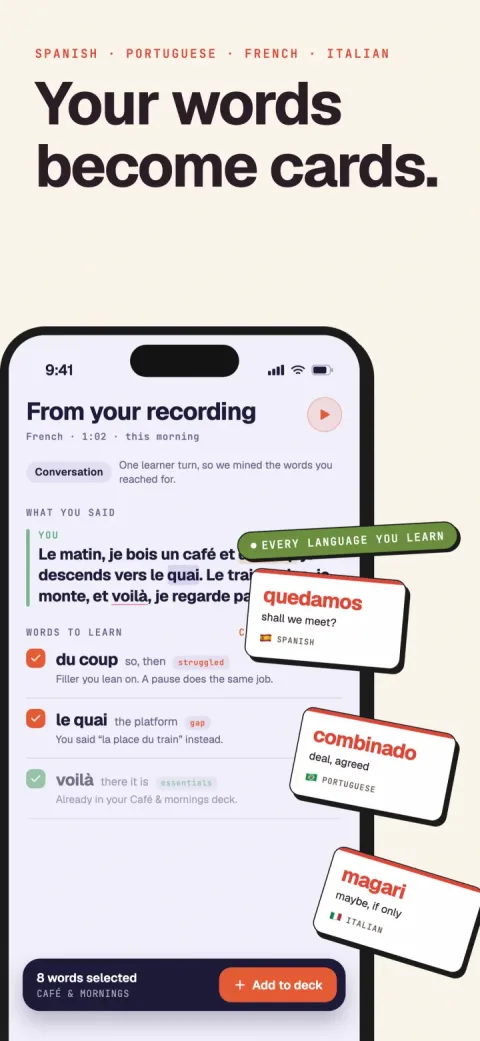
Verbamor turns the words from your own lessons and recordings into flashcards, and brings each one back before you’d forget it.

I spent a while on 22 August 2026 looking for the Immersion Learning Institute. Then the SRS Efficacy Research Group. Then the Polyglot Research Network.
All three were cited by the page that ranked first in August for "best flashcard app for language learning 2026," a roughly 4,800-word comparison. Its site has since been suspended by its host, and the Wayback Machine never saved the page, so I quote it as it read on 22 August.
Between them they carried its research claims. Comprehension milestones reached 2.3x faster, retention varying by 18%, vocabulary retention up 34%, and learners 67% more likely to still be studying after six months.
Searching any of the three names returned that article and one near-identical sibling, still online and published the day before. The sibling reuses the same names for a different figure ("2.4x faster vocabulary acquisition").
No homepage. No publications. No DOI (the permanent ID a real published paper gets).
The article's first sentence was the citation: "According to the 2026 Language Acquisition Technology Report by the Immersion Learning Institute."
None of the three organizations was linked. In 4,800 words, there was nothing to click through to any of them.
The page's one link pointed at the app it ranked first
There was exactly one outbound link in that article's body. It was the anchor text "best flashcard app for language learning," and it pointed at migaku.com.
Migaku was the product ranked first.
Once you knew that, the page became legible. It explained why Migaku took the top slot, and why Migaku alone got a "not the best choice for" section.
It also explained why every reader that section excused got routed to another product on the same list.
The nearest thing to a disclosure was a line in the author bio, "Learn more about Migaku at migaku.com," sitting after the verdict.
The one research-flavoured number not pinned on the phantom three belonged to Migaku too. It was roughly 1,500 words getting you to 80% comprehension of Netflix, credited to Migaku Academy's own courses.
It also explained an absence. Anki is free, and it was missing from a flashcard roundup entirely. So was Quizlet. So was any named scheduling algorithm.
A statistic you cannot trace is decoration shaped like evidence.
To be fair about why that page ranked, on one axis it earned it. Every product got a spec table and a "best for this specific person" verdict in the heading.
Best for Japanese kanji. Best for audio-only commuters. That's real shopping furniture, and most competitors don't build any.
The prose was clean and it read as authoritative. That's what made the invented citations worse than sloppy. A reader who trusts the tone has no reason to go looking for footnotes.
Nine products got a write-up under a headline promising 11. Five of the nine aren't flashcard apps: a reading platform, a chat app, a tutoring marketplace, an audio course, a general lesson app.
A flashcard app here has to take your own material
So here is my method, and I'm putting it above the recommendations instead of burying it.
A flashcard app, for this post, does three things. It stores discrete prompt-and-answer items. It schedules them over days and weeks instead of showing them in a fixed order. And you can add your own material to it.
That last condition removes most of the field, including 5 of the 9 entries on the page I was arguing with. A fixed sentence bank you can't add to is a course with a review feature attached. That's a different thing from what you searched for.
Excluded on purpose: tutoring marketplaces (they sell hours, not cards), and reading and video platforms (they sell input, and I've written about whether you need both).
Everything below links to the page I read it on. If a link contradicts me, believe the link.
Anki wins if you'll build or download the deck
Anki is free on desktop and Android, and syncs across devices with a free account. It's open source, and it has run for well over a decade with no subscription attached.
Its one price is on iPhone: AnkiMobile Flashcards is $24.99, one time. That's the entire cost of ownership for the app most of the spaced repetition world is built on.
Compare that to a nine-entry table with the free option quietly absent.
Anki is the correct answer for a specific person, and you might be them. Maybe you already have a deck you like, or you'll happily download a shared one, and you enjoy tuning deck options. Then stop reading and go get Anki.
You'll pay once and own your data in a file you can export.
Nothing I sell competes with that on cost or control, and pretending otherwise would be the trick I just spent 600 words objecting to.
There's a second case I'd hand over. If a classmate or teacher has already put your material in a Quizlet set, follow them there. A set someone else typed costs you nothing to study.
The caveat is that I couldn't verify a word of Quizlet from Quizlet. Every page I tried returned a 403 (a blocked-access error). So that recommendation rests on shared-set behaviour anyone can see on a public set, and goes no further.
FSRS is off by default, and it's still the best scheduler anyone ships
Here's where I get to correct almost everybody, including the SEO blogs that do mention FSRS. (FSRS is an open-source algorithm that predicts when you're about to forget each card.)
FSRS isn't Anki's default. The Anki manual says, verbatim, "The Free Spaced Repetition Scheduler (FSRS) is an alternative to Anki's legacy SuperMemo 2 (SM-2) algorithm."
It tells you to "Enable FSRS under the 'FSRS' section, at the bottom of the deck options page." You have to switch it on. Every blog claiming it's been the default since version 23.10 is repeating something the manual contradicts.
One more detail from that page catches people out: "FSRS can only be enabled globally; you cannot enable it for some presets and disable it for others." One decision for your whole collection.
Now the part where I refuse to overclaim. The open-spaced-repetition benchmark is the largest public comparison of review schedulers that exists, and I've actually read it.
On that dataset, FSRS-7 scores a Log Loss of 0.3401 and an RMSE(bins) of 0.0634. Both measure how far a scheduler's predictions of recall sat from what happened. Lower is better on both.
A research model called RWKV-Instant scores 0.2773 and 0.02502, beating FSRS on both metrics by a wide margin. No app ships RWKV-Instant. It sits in a benchmark table while FSRS runs on your phone.
And SM-2, the algorithm FSRS was built to replace, doesn't appear in that table at all. Distrust anyone quoting the repo to say FSRS beats SM-2 by some percentage. Click their link and the comparison isn't there.
The honest claim: FSRS is the best-performing scheduler anyone actually ships, tuned per user, validated on roughly 350 million real reviews. That sentence survives contact with its own source.
I wrote a longer walkthrough of how it schedules a card if you want the mechanics.
Typing the cards costs about 12.5 hours per 1,500
Every comparison table in this category prices the subscription. None of them prices the typing.
The best number I've found comes from Migaku, the product that single link points at.
In its own guide to making Anki cards, Migaku writes: "If you spend 30 seconds per card (Typing front, back, maybe adding an image)" then for 1,500 cards "that's 750 minutes or about 12.5 hours."
Twelve and a half hours. Migaku's figure, about Anki, on Migaku's site, and the most useful number in this market.
Thirty seconds is optimistic for vocabulary out of lessons. You're reconstructing what your tutor said 40 minutes ago, picking a sentence, checking a gender, hunting for audio. Call it a minute and the figure doubles.
This is the real reason people abandon Anki, and the algorithm has nothing to do with it. The scheduler is free and excellent. The data entry is a second job.
If you're weighing that up, how many cards a day you can actually sustain matters more than which app you pick.
So I'll put the recommendation on that number instead of on a feature grid.
So which one? It depends on who types the cards
Answer the labour question first. Will you type your own cards? Be honest the way you'd be honest about a gym membership. That means assuming the version of you that exists on a Tuesday in November.
If yes, you're done: Anki. Pay the $24.99 on iPhone, take it free everywhere else, and switch FSRS on in deck options because it won't be on.
The 12.5 hours is your real payment, and you've decided you'll make it. I'd give a friend that answer without pausing.
If your material is a textbook or a frequency list, you don't owe the 12.5 hours to anyone. Somebody already built that deck.
Take a good shared one. The frequency curve explains why the first few hundred words repay you so heavily.
If your class already keeps its sets on Quizlet, use the set that exists. Someone in that room has already paid the 12.5 hours on your behalf.
Which leaves the case where you'd answer no, and the deck you need doesn't exist to download. That's the one I built for.
| Axis | Anki | Quizlet | Verbamor |
|---|---|---|---|
| Price | Free on desktop and Android. $24.99 once on iPhoneApp Store listing, read 22 Aug 2026 | Not published hereEvery page I tried returned a 403 | $19.99 a month, or $129.99 a year7-day trial on the annual plan only |
| Who types the cards | You do. About 12.5 hours per 1,500Migaku's own figure | You, or whoever shared the setVisible on any public set | Generated from the lesson you record or type |
| Scheduler | SM-2 by default, FSRS once you enable itGlobal setting, not per deck | Not checkedSame 403 | FSRS, on by default |
| Platforms | Windows, macOS, Linux, Android, iOS, web sync | Not checkedSame 403 | iPhone and iPad onlyNo Android, no web app |
| Price verified first-party today | Yes | No403. That's why the Quizlet cells above are holes | Yes, it's mine |
Quizlet's column is mostly holes because every page I requested on 22 August 2026 returned a 403, pricing and features and teacher pages alike. I won't fill those cells from somebody else's roundup.
Babbel would have had a row too, but its pricing page 404s and its help centre 403s.
A blank cell is the honest output of a failed check. Fill it in and you've published a guess.
Verbamor is an iPhone and iPad app for Spanish, French, Italian, Portuguese and Russian. It takes the vocabulary from your own lessons and conversations, the one source you can't download a deck for.
It turns that vocabulary into fill-in-the-blank cards with native audio and a generated image, scheduled by FSRS.
You record or type what came up, and it writes the cards. There's no free tier and no Android version.
What you're buying is those 12.5 hours back. If you'd happily have spent them, it does nothing for you that Anki doesn't do for less.
Every figure on this page has a link under it, which is the whole argument. Go break one of them.
Sources
The page being compared against
- John, F. (2026, April 25). The best flashcard app for language learning in 2026: 11 platforms compared. The Inscriber Magazine. Read 22 August 2026. One outbound link in the article body, on the anchor text "best flashcard app for language learning," pointing to migaku.com, the product ranked first. None of the three cited organizations is linked. No Anki, no Quizlet, no named scheduling algorithm. The Wayback Machine held no snapshot of this URL when I checked on 22 August 2026, so everything I quote from it is as it read that day. On 13 October 2026 the URL returned an "Account Suspended" page from its host.
- The best language learning software 2026: research-backed rankings for serious learners. NewsWatch, 24 April 2026. The sibling page reusing the same three organization names for different figures.
Anki's price and its scheduler
- Anki Software, LLC. AnkiMobile Flashcards. Apple App Store listing, read 22 August 2026. $24.99, one-time purchase. The often-quoted "No ads, no monthly payment" line sits inside a customer review on this listing, not in Anki's own description; the developer copy says only that "the app is priced as a computer application."
- Anki. Deck options. Anki Manual, read 22 August 2026. FSRS as an opt-in alternative to SM-2, enabled globally.
Scheduler benchmark figures
- Open Spaced Repetition. srs-benchmark. Read 13 October 2026. A dataset of about 727 million reviews from 10,000 Anki users; 9,999 collections and 349,923,850 reviews in the evaluation without same-day reviews; FSRS-7 Log Loss 0.3401, RMSE(bins) 0.0634; RWKV-Instant Log Loss 0.2773, RMSE(bins) 0.02502. SM-2 is not in the main table.
What card building costs
- Migaku. How to make Anki cards. Read 22 August 2026. "If you spend 30 seconds per card" then 1,500 cards is "750 minutes or about 12.5 hours."
Your tutor is the one deck you can't download.
Verbamor turns the words from your own lessons into fill-in-the-blank cards with native audio, scheduled by FSRS.
Start 7 days freeThe 7-day free trial is on the yearly plan.