Verbamor
What Anki costs, checked today
Free on Windows, macOS, Linux, Android and the web. US$24.99 once on iPhone and iPad. I read every figure off Apple's own store on 21 September 2026, including the regional prices two of the three top results get wrong.
Anki costs nothing on Windows, macOS, Linux, Android and in a browser. On iPhone and iPad it's US$24.99, paid once.
That's the whole answer. The rest of this page is the regional figures, the arithmetic against a subscription, and the four kinds of person who should keep their $24.99.
US$24.99 on iPhone, checked on 21 September 2026
I went looking for this page because the three results above it don't give you a number you can act on.
Anki's own FAQ ranks first and never states the current price. It spends its length arguing about the price.
The only dollar figures on it, $60 for SuperMemo and $29.95 for MentalCase, are dated 2013-10-04 on the page itself. Those comparisons are 13 years old.
The third result is stamped December 2025 and has a 2025 in its title, on a query people re-check every year.
So here's my date, printed rather than implied: 21 September 2026. I pulled it from Apple's store record, not a screenshot or a memory. That's why I can also give you the version number sitting next to it, 25.09.
The price changes by country, and the eurozone pays €29.99
Apple sets a different number in each country. The developer says why on his FAQ: "Apple sets the price in each country based on the local taxes and costs of doing business there."
I checked eleven storefronts the same afternoon.
- United States: $24.99
- United Kingdom: £24.99
- Eurozone: €29.99, identical in France, Germany, Italy, Spain, Ireland and the Netherlands
- Japan: ¥4,000
- Canada: CA$34.99
- Australia: A$39.99
The eurozone figure is the one worth stopping on. The page ranking second for this query puts it at "24.99 EUR".
It's €29.99, and has been in every euro storefront I opened. A European reader following that page budgets 5 euros short.
The developer also closes the door on regional pricing himself: "it's not practical to vary the price depending on where you live." Australians pay A$39.99, and there's no appeal.
Over four years, $24.99 is about 52 cents a month
One payment is hard to compare against a monthly bill, so do the conversion. Over 4 years, $24.99 works out to about 52 cents a month, and then it keeps going at zero.
That figure is as far as the competing pages take it. The comparison a buyer actually wants runs the other direction: how long before a subscription passes $24.99 and never comes back.
I've kept my own product in that chart because it would be cowardly to leave it out. At $19.99 a month, Verbamor costs more than AnkiMobile before your second bill clears.
Where a subscription earns the difference is a separate argument. I make it further down, in one paragraph instead of in every section.
One more thing the sticker hides, and both competing pages are right about it: the real bill for Anki is the typing. A deck is empty when you install it, and somebody has to fill it. That somebody is you, at maybe 2 minutes a card once you're practised.
Where I part company with them is the next sentence. Both pages treat that cost as unavoidable, because their product is the fix. It isn't unavoidable.
Anki hosts thousands of shared decks, free. For high-frequency Spanish or the 2,000 most common Japanese words, somebody has already done the typing. Look there before you accept anyone's estimate of your hours.
One purchase pays for the free versions, says the man who set the price
Damien Elmes answers this himself, and since his page ranks first for the query, you may as well have the load-bearing quotes without the 2013 comparisons attached.
On what the money buys: "AnkiMobile is not a standalone app - it is intended to be used in conjunction with the online synchronization service and open source computer version that I've made available for free for the last 10 years. Working on these three platforms is a full time job, and AnkiMobile is my way of putting food on the table."
On a sale, which people ask about every year: "I have experimented with different price points in the past, and reducing the price resulted in a net decrease in income... neither a price change nor a sale is likely in the foreseeable future."
On promo codes: "Sorry, I do not offer promo codes, as preparing them takes time away from development."
So one purchase funds a free desktop app, free Android, and free sync, with no ads and nothing sold on the side. That's an unusual shape for software in 2026. It's the strongest thing on the price page nobody quotes properly.
Anki defaults to the 1987 algorithm, and the fix takes five minutes
The page ranking second, written by a competitor's CMO, builds its case on the algorithm: "Anki's default algorithm is SM-2, designed by Piotr Wozniak in 1987."
That sentence is true, and I've written the same thing myself.
Anki's manual, which I re-read today, still calls FSRS "an alternative to Anki's legacy SuperMemo 2 (SM-2) algorithm." It still tells you to "Enable FSRS under the 'FSRS' section, at the bottom of the deck options page." Off by default, in September 2026.
Here's the part that page leaves in a subordinate clause. Turning FSRS on is one switch and one button. (FSRS is an open-source algorithm that predicts when you're about to forget each card.)
The manual's own short guide runs to four steps. Enable it, click the button that fits the parameters to your review history, then pick a desired retention. That's the recall rate you're aiming for, and 90% is the default it recommends.
Five minutes, no add-on, no payment, and the modern scheduler is yours inside the $24.99 you already paid.
Which makes the algorithm a weak reason to buy something else. It's a real reason to spend five minutes in deck options.
Four kinds of people should keep their $24.99
Keep your $24.99 if you're one of these.
You're on Android. AnkiDroid is free, and it's a full Anki client rather than a viewer. Nothing on this page applies to you.
You study at a laptop. The desktop version is free, more capable than the phone app, and the only one where building cards in volume is tolerable.
You want to try before paying. Sign in to AnkiWeb in Safari and review there. It costs nothing and it's the same collection.
Three honest limits. It needs a connection. It's a browser page and not a native app, so the gestures are clumsier. And the manual treats it as a review surface, where you don't build decks.
As a way to find out whether you'll keep a deck alive for three weeks, it's free and it's decisive.
You've tried Anki twice and stopped twice. A third $24.99 won't fix what stopped you, and it's usually the empty deck rather than the app.
That last one is the group I sell to, so treat my next paragraph with the suspicion it deserves.
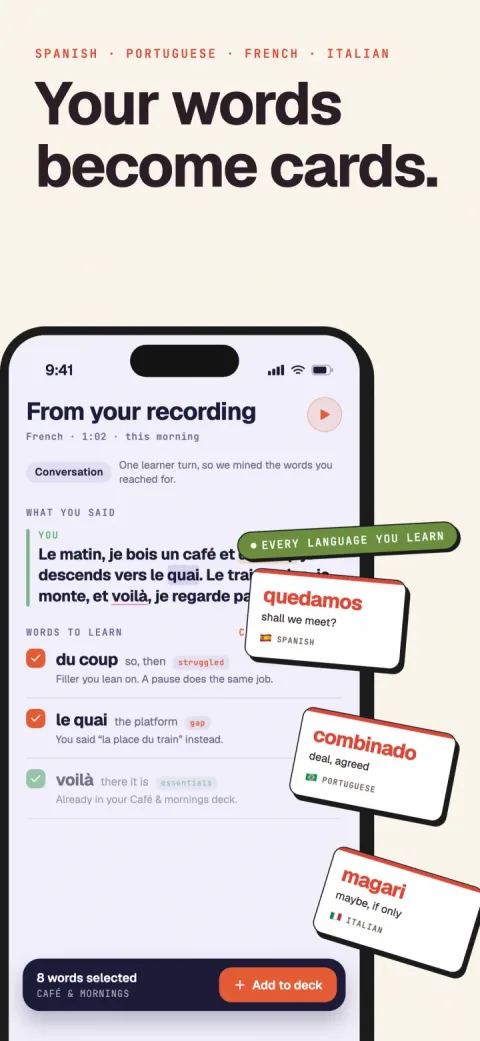
Verbamor is my iOS app. It records a tutor lesson, finds the words you tripped on, and builds the cards for you with audio and a picture. So the part that kills Anki decks never lands on your desk.
It teaches 5 languages: Spanish, French, Italian, Portuguese and Russian. $19.99 a month, or $129.99 a year with a 7-day trial on the annual plan. Both are US prices, read off the app's own plan definitions on 21 September 2026, and the App Store sets a different number in other countries.
There's no free tier, which is a real reason to skip it. And if you're a med student, a law student, or learning Japanese, it does nothing for you at all. It isn't a general-purpose flashcard app, and Anki is the right answer.
Questions people actually ask
Is Anki free on iPhone? No. AnkiMobile is $24.99 once, the only paid piece of the whole system. You can still study free on an iPhone through AnkiWeb in Safari.
Does Anki have a subscription? No. Apple's store record for AnkiMobile shows one price and no in-app purchases. Sync through AnkiWeb has been free throughout. Elmes explains on his FAQ why he didn't charge for it instead: "Apple's app store provides a safe and friction-free way of making purchases."
Do I pay again on my iPad? No. From the same FAQ: "once purchased, you can use AnkiMobile on up to 5 of your iOS devices, provided they use the same Apple ID. AnkiMobile also supports family sharing."
Is there a free trial? Not on iOS. Apple's store record lists no trial and no introductory offer. AnkiWeb in a browser is the free way to find out whether you like it.
Is there a student discount? No, and the developer answers it directly: "Please compare it to the price of the average textbook and then consider how many hours of use you get out of each."
Why is Android free when iOS isn't? Different people wrote them. Anki's download page credits AnkiDroid to contributors and says "all purchases help fund Anki's development" about AnkiMobile only. Elmes writes the iOS app; volunteers write the Android one.
Is AnkiWeb free forever? It's free now, and Anki's download page calls it "the free AnkiWeb synchronization service" with no paid tier mentioned anywhere. Nobody can promise forever. What I'll say instead is that a developer who wrote a public FAQ entry explaining why he chose not to charge for it is a reasonable bet.
Buy it if you're on an iPhone and you know you'll feed the deck. It's the cheapest serious software I pay for, per hour used, and the man who wrote it earns it twice over by giving the other four platforms away.
Sources
Prices, read 21 September 2026
- Apple. AnkiMobile Flashcards store record (app id 373493387), queried per storefront on 21 September 2026. US $24.99, GB £24.99, FR/DE/IT/ES/IE/NL €29.99, JP ¥4,000, CA CA$34.99, AU A$39.99. Version 25.09, seller Anki Software LLC, no in-app purchase entries.
- Anki. Download page. Source for desktop version 26.09.2, for "The free AnkiWeb synchronization service", and for the split credit between AnkiMobile ("all purchases help fund Anki's development") and AnkiDroid ("free and developed by contributors").
- Google Play. AnkiDroid Flashcards listing, read 21 September 2026: install price free, with no in-app purchases and no ads declared.
The developer's own words
- Anki FAQs. Why does AnkiMobile cost more than a typical mobile app? Source for every Elmes quote above: the three-platform funding argument, the 5-device and Family Sharing rule, the refusal of sales, promo codes, regional pricing and a student discount, and the reasoning against charging for AnkiWeb. Its own comparison figures ($60 SuperMemo, $29.95 MentalCase) carry the page's stated date of 2013-10-04.
- Anki Manual. Deck Options. Read 21 September 2026. Source for FSRS as "an alternative to Anki's legacy SuperMemo 2 (SM-2) algorithm", for "Enable FSRS under the 'FSRS' section, at the bottom of the deck options page", and for the 90% default desired retention.
The pages this one is arguing with
- Tachibana, K., Memly CMO (published 3 June 2026, updated 26 July 2026). Is Anki Worth It in 2026? Ranked second on 21 September 2026. Source of the "24.99 EUR" eurozone figure corrected above, and of the SM-2 1987 framing. Its Anki facts are accurate; its competitor prices are self-labelled estimates and are not reused here.
- FlashRecall Team (11 December 2025). Anki Cost: Hidden Fees, Best Alternatives. Ranked third. Its entire price inventory is three figures, and it states no price for FlashRecall itself.
What I could not verify
- Competitor subscription prices. The second-ranked page quotes Quizlet Plus, Brainscape and RemNote figures hedged as approximate. None is repeated here, because I could not read any of those companies' live prices.
- The shared-deck count. AnkiWeb publishes no total I could read, so "thousands" above is deliberately qualitative.
- Card-building time. The 2 minutes a card is my own rough figure from building decks by hand, not a measured study.
The cards are the work. Skip that part.
Verbamor turns your lesson vocabulary into fill-in-the-blank cards with audio, scheduled so they're still there next month.
Start 7 days free