 Verbamor
Anki alternatives on iOS, honestly compared
If you'll keep feeding a deck you like, stay with Anki: AnkiMobile costs $24.99 once and Anki is free everywhere else. If typing cards is what ended the habit, look at Wokabulary (free to 60 words), Space (the only one claiming to import your Anki history) or Verbamor, which builds cards from your speech.
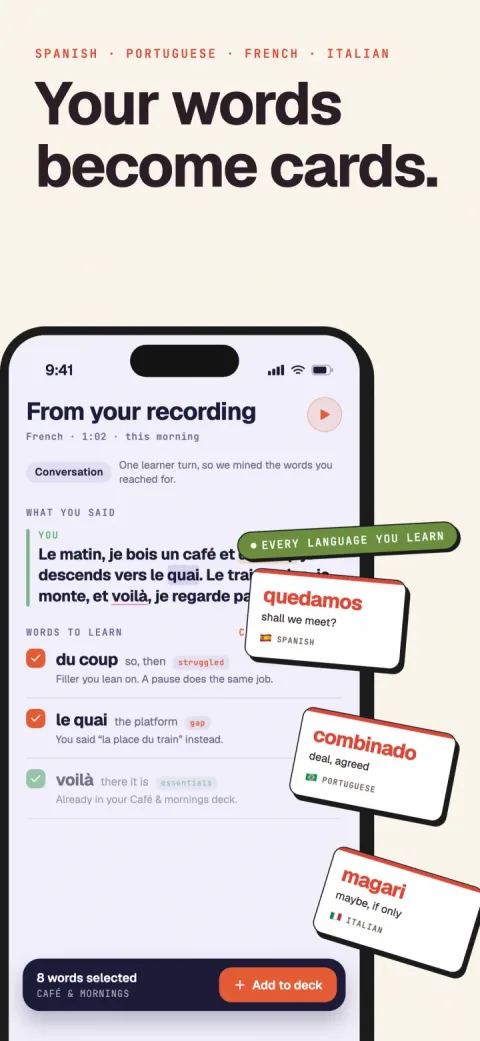
Verbamor turns the words from your own lessons and recordings into flashcards, and brings each one back before you’d forget it.

11pm on a Tuesday. The lesson ran twenty minutes long, my tutor is offline, and there are 14 words on a notepad in front of me.
One of them is madrugada. I asked about it because she used it and I had no idea what it meant, and I won't be able to define it by Thursday.
Making a card out of madrugada means typing a sentence, typing a translation, finding audio, picking an image. Call it 30 seconds. Times 14, times every lesson, forever.
I didn't enter those 14 words. The page is still in the notebook. I know what it says without opening it, which is somehow worse.
Typing cards by hand is the actual reason people go looking for an Anki alternative on iOS. The search usually starts one step later, at the App Store listing for AnkiMobile, where the Get button should be and $24.99 is instead.
01 / 06Is AnkiMobile worth $24.99?
Yes, if you'll keep feeding a deck. Anki on desktop is free. AnkiDroid is free. The sync service is free. So are the decks other people have already built for Spanish and French, and some of them are very good. The regional prices and the four-year arithmetic are on their own page.
Anki runs FSRS, has an add-on ecosystem nothing else comes close to, and your review history is yours, in a file, exportable forever.
The $24.99 is one payment. At $19.99 a month, our own cheaper plan passes it in under seven weeks and keeps going. I'd rather say that than hope you don't do the arithmetic.
Anki's own listing explains where the money goes, and the explanation is fair:
Sales of this app support the development of both the computer and mobile version, which is why the app is priced as a computer application.
AnkiMobile Flashcards, App Store descriptionThe listing describes AnkiMobile as written by the lead developer of Anki and AnkiWeb, and the program itself as free, multi-platform and open-source. One paid app funds the free ones everywhere else. Calling that a paywall misses what it's paying for.
So here's the concession, up front, where it costs me something. If you have a deck you like and you'll keep feeding it, buy AnkiMobile and close this tab. Nothing beats a tuned Anki deck belonging to someone who enjoys tuning it, and no app I could build will change that.
Keep reading only if that sentence describes a person you've been failing to become.
02 / 06FSRS ships switched off, and needs your history to get good
Here's what half the roundups I read get wrong. FSRS is off by default. The Anki manual is unambiguous: FSRS is "an alternative to Anki's legacy SuperMemo 2 (SM-2) algorithm."
You switch it on yourself, in the FSRS section that sits last on the deck options screen. Bottom of the page. Global toggle.
So a lot of people running Anki are on the legacy SM-2 scheduler while assuming they're on the modern one. A blog told them FSRS became the default, and it didn't.
A second FSRS wrinkle matters more if you're new. FSRS gets good by fitting itself to your history, analyzing "your review history" to "generate parameters that are optimal for your memory."
And the manual lists a "Low number of reviews (less than a few hundred)" as a reason it underperforms. So the algorithm everyone recommends Anki for is the thing Anki can't give a beginner on day one.
Worth being precise about how good FSRS is, since every competing page waves at it in one clause. The open benchmark scores schedulers across 9,999 collections and 349,923,850 reviews. FSRS-7 posts a log loss around 0.3437. (Log loss scores how far a scheduler's predictions sat from what happened; lower is better.) A research model called RWKV-P beats it at 0.2773, and nobody ships RWKV-P in anything you can install.
Sit with that gap. A neural model scores better than FSRS on a third of a billion real reviews, and you can't install it.
So FSRS is the best scheduler that ships in something you can download and tunes itself to a real person. That claim is defensible. The stronger version people write isn't.
03 / 06Anki's scheduler never beat me; the data entry did
Building cards turns out to be a job. It ends more Anki habits than the algorithm and the $24.99 combined.
Migaku publishes the honest number in a guide arguing for making your own cards. That's why I trust it: "If you spend 30 seconds per card (Typing front, back, maybe adding an image)." For a 1,500-card deck, "that's 750 minutes or about 12.5 hours."
Twelve and a half hours, at a pace assuming you never stop to check a gender or rewrite a sentence. Thirty seconds is optimistic, and the optimism is theirs.
Anki's scheduler has never once been the thing that beat me. The data entry is undefeated.
And the failure has a shape. You do it for a week, diligently. Then one lesson runs long, you promise yourself you'll enter the words tomorrow, and that page is still untouched in March.
The cards you built keep coming up. The words your tutor watched you grope for never entered at all. That gap matters more than how many cards a day you do.
The typing problem doesn't make cards the whole method. If you're doing zero reading and zero listening, fix that before you fix your app. But it's why "alternative to Anki" is a strange query taken literally. Anki's scheduler is not the part that failed you.
04 / 06Wokabulary is free to 60 words; only Space says it brings your Anki history
So far I've named one app and my own. Here's the rest of the shortlist, and my method so you can discount it.
I pulled App Store listings from Apple's own lookup API on 22 August 2026, and took every capability claim from what the developer publishes about themselves. There's no controlled trial, and I'm the last person you should take as neutral. Read the who-it-suits line and ignore my adjectives.
Wokabulary, version 8.1.0, is the alternative you'll most likely meet first, and a better product than that fact made me want to admit.
It's a real native app across iPhone, iPad, Mac and Watch. It syncs through your own iCloud account instead of someone's server, and it's free up to 60 words with no signup and no time limit. It does one job: holding vocabulary you collected yourself.
If you want a tidy Apple-native word list you own outright, and you're happy typing the entries, it beats Verbamor on platform coverage and on being free to try. I'd send a Mac-first learner there before I'd send them to me.
Two caveats. Past 60 words, its own listing says "a subscription is needed." That's the same model its landing page dings Anki for, and the figure appears nowhere. And its scheduling is words sorting into learning levels, asked more or less often. That's a spaced repetition system, and nothing there claims FSRS.
Mochi, version 26.7.1, free to download, is markdown notes and flashcards in one place, with cards made from notes you already wrote. (Markdown is a plain-text way of formatting notes.) It suits anyone who takes structured notes anyway and resents copying them into cards a second time.
Space, version 5.3.0, also free to download, builds cards from a PDF, a URL or a photo of your notes. If your source material is a document, that's the shortest path from document to deck here.
Space is the only one of the three that takes your Anki history with you. Its App Store listing says it imports “Anki (with your learning progress intact), CSV, Excel, Google Sheets”, and its 5.0.0 notes say the import “now preserves your learning progress”.
I haven’t tested it, so that’s the developer’s claim. It’s also the single most useful line on this page for anyone with a deck they care about.
Verbamor has no Anki import at all. Moving here means starting the deck fresh from your next lesson. If the history is what you’re protecting, Space deserves the look before I do.
And notice what the shortlist is sorted by. Every app here competes over where the cards come from: your typing, your notes, your documents, or your speech.
05 / 06Anki warns about apps like mine, and two of the three charges land
The AnkiMobile listing has a line aimed squarely at products like mine, and I'd rather quote it than pretend it isn't there:
Beware other apps using "Anki" in their name that have sprung up recently - they are not compatible with the rest of the Anki ecosystem, and they offer far fewer features, despite charging expensive subscriptions.
AnkiMobile Flashcards, App Store descriptionTwo of the three charges land on us. We have far fewer features than Anki. We charge a subscription, and it costs more than $24.99 once. Only the name part misses.
My defense is that a feature list only pays out on cards that exist. Anki has every feature I lack, and it still lost to my notepad. You get to decide whether that describes you, and there's six months of evidence in a notebook.
06 / 06You're buying back Migaku's 30 seconds, and some typing stays
Then Thursday. Madrugada came up again, and I asked what it meant a second time. My tutor was kind about it.
She typed it into the chat window with a little sentence underneath, the way you'd write something down for a child. I felt the specific heat of having wasted both our time on a word I'd already been given.
Madrugada cost me two lessons. The vocabulary I failed to record was the most expensive thing in the room, and the only thing I could have kept for nothing.
So: Verbamor costs $129.99 a year, with 7 free days first, or $19.99 a month with no trial. No free tier. iOS only, five languages, and it cannot import your Anki deck. If you switch, you start empty and rebuild from your next lesson forward.
What Verbamor sells is Migaku's 30 seconds. You say madrugada into it, and the sentence, the translation, the native audio and the image come back built, scheduled by FSRS.
The tempting sentence is that the typing goes to zero. It doesn't, quite. You still say or type 1,500 words to get 1,500 cards.
It beats typing a sentence, hunting a translation and finding an image by hand. But I don't have a measured figure to put next to Migaku's 30 seconds, and I'm not going to invent one to sit beside a number a competitor actually published.
You still have to open the app on the night the lesson ran long, the exact habit Anki failed to get out of me.
Faster, with some typing left, against 12.5 hours of it. I'd rather publish that honestly than claim the zero.
I built Verbamor because I was the man with the untouched notebook. I'd spent long enough trying to be the other man to stop believing I'd become him.
That's the trade: money for the 12.5 hours, and less control than Anki gives you.
And if you go with Anki, which for a lot of you is the right call, do the one thing those roundups forgot. Open deck options, scroll to the bottom, turn FSRS on.
It's a 30-second job most of the internet told you was already done.
Sources
AnkiMobile pricing and the publisher's own framing
- Anki Software LLC. AnkiMobile Flashcards, App Store listing. Price $24.99, version 25.09. Price and description text confirmed 22 Aug 2026 via the listing and the iTunes Lookup API (id 373493387).
FSRS is opt-in, and needs your history
- Anki. Deck options: FSRS. Anki Manual. Read 22 Aug 2026.
How schedulers actually score
- Open Spaced Repetition. srs-benchmark. 9,999 collections, 349,923,850 reviews (evaluation excluding same-day reviews). FSRS-7 log loss 0.3437, RWKV-P 0.2773. Read 22 Aug 2026.
What card-building costs in hours
- Migaku. How to make Anki cards. Read 22 Aug 2026.
The other iOS apps named, and what each publishes about itself
- Coding Friends GmbH. Alternative to Anki for Mac, iPhone, and iPad, and the Wokabulary App Store listing (id 1667619825, version 8.1.0, free to download). The 60-word free allowance, the iCloud sync, the iPhone / iPad / Mac / Watch support and the "a subscription is needed" line are all the developer's own wording. Read 22 Aug 2026.
- Matthew Steedman. Mochi: Flashcards and notes, App Store listing (id 1507775056, version 26.7.1, free to download). Read 22 Aug 2026.
- Till Friebe. Space: Spaced Repetition, App Store listing (id 1546202212, version 5.3.0, free to download). Read 22 Aug 2026.
The cards get built either way. The question is by whom.
Verbamor turns the vocabulary from your own lessons into fill-in-the-blank cards with native audio, scheduled by FSRS.
Start 7 days freeThe 7-day free trial is on the yearly plan.