Verbamor
Verbamor vs Anki: who builds the cards
With Anki you build every card yourself; Verbamor builds them from your own lessons and conversations. Anki is free everywhere except iOS, where AnkiMobile is US$24.99 once, and wins on control, desktop study and anything that isn't a language. Verbamor costs US$19.99 a month and saves roughly 25 minutes of card-building per lesson hour, by my estimate.
Search "anki alternative for language learning" and you'll get lists. One of the ones ranking today still recommends TinyCards, which Duolingo killed in 2020. That page has a byline claiming years of hands-on testing, and it's recommending software that hasn't existed for six years.
So here's a comparison written by someone with an obvious commercial interest, who is going to tell you exactly when Anki is the better buy anyway. You can check every factual claim below against its source.
The axis that actually separates them
Anki is a scheduler and a card renderer. It ships no language content of its own. Every card in your deck is one you typed, or one you imported from a deck a stranger typed.
Shipping no content is a design decision, and a good one. It's why Anki works equally well for kanji and bar exam statutes. The tool has no opinion about what you're learning, and its neutrality is the source of both its power and its abandonment rate.
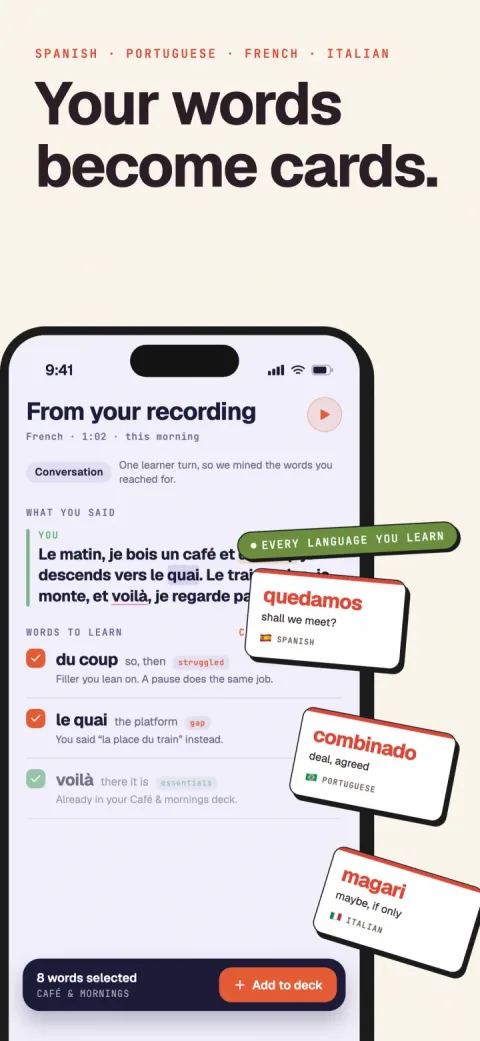
Verbamor takes the opposite position. It records your tutor lesson, mines the transcript for what you actually got wrong, single words and whole phrases alike, and builds the cards from that. The scheduling underneath is the same idea Anki has been running for years. The difference is who does the manufacturing.
Anki's card library is empty on purpose. Whether that's freedom or homework depends entirely on you, and most people find out the hard way.
Where Anki wins, plainly
I'd rather put Anki's wins near the top than bury it under a feature table.
Pick Anki if you want control. Custom note types, arbitrary HTML and CSS on the card template, your own field structure, LaTeX, conditional replacement, cloze deletions shaped however you want them. Verbamor gives you one card format, tuned for vocabulary in a sentence. Anki gives you a blank canvas and a manual.
Pick Anki if you study on a desktop. Verbamor is an iOS app, so it's a phone and a thumb. Anki runs on Windows, macOS and Linux, and its browse window will let you select 4,000 cards and rewrite a field across all of them in one action. Nothing on a phone touches that.
Pick Anki if you're learning something that isn't a language. Verbamor only does Spanish, French, Italian, Portuguese and Russian. Anki does anything with two sides.
Pick Anki if you want it free. Desktop is free. AnkiDroid is free. AnkiWeb sync is free. Only iOS costs money.
And Anki's ecosystem. Released in 2006, so close to two decades of well over a thousand community add-ons and a shared-deck library nothing else comes near. Verbamor will never match that, and pretending otherwise would be silly.
Anki is, genuinely, one of the best pieces of software in this category. The critique below is narrow and it's about one thing.
The build cost nobody quotes you
Say you finish a 60-minute lesson with your tutor. She corrected your use of se me olvidó, gave you a lo mejor for "maybe," fixed the gender on el problema, and introduced about 14 other things worth keeping. Call it 17 cards.
To get those 17 cards into Anki: open the app, decide which of your notes are card-worthy, type each front, type each back, write or find an example sentence for each, decide whether to add audio, source that audio from somewhere, find or skip an image, tag it, and repeat.
Now the number this whole argument leans on, so I'll be explicit about where it comes from. I'm estimating 90 seconds a card, and that's my working figure rather than a measured result. It assumes you're quick, you're not being fussy about the example sentence, and finding audio is a copy-paste rather than a hunt. Your number will differ, and if you build cards regularly you already know yours better than I do.
The arithmetic is there for you to redo with your own figure: 17 cards at 90 seconds is about 25 minutes. For a 60-minute lesson. Every week. Forever.
Halve my estimate and it's still 13 minutes a week of data entry attached to every lesson you take.
Week 1 you build the cards. Week 2 you do it. Week 3 the lesson runs late, you tell yourself you'll batch it Sunday, and Sunday has three lessons' worth of backlog in it. The deck stops growing. A month later you stop opening it, because the cards in it are from a version of your Spanish you've moved past.
Card building is a per-session tax on the thing you already paid for, charged at the exact moment your motivation is lowest.
Your Anki deck is still alive
If you added cards this week and you cleared your reviews yesterday, you have the habit that matters and you should keep it. No app fixes a system that already works. Come back if the deck goes quiet for a month, because that lapse is the specific failure this is built for.
The obvious counter is shared decks. Download somebody's 5,000-word Spanish frequency deck and skip the building entirely. That works fine for high-frequency vocabulary in a big language, and I'd recommend it over building 5,000 cards by hand.
What a shared deck can't do is contain the sentence your tutor corrected on Tuesday. And there's a measurable penalty to studying a stranger's list: Slamecka and Graf's work on the generation effect found material you produce yourself comes back better than the same material read. Building cards by hand has a real benefit, which is precisely why the abandonment matters.
Scheduling, and the FSRS claim you'll see everywhere
You'll read that Anki switched to FSRS by default in version 23.10. That's wrong, and it's repeated on dozens of SEO pages.
Here's what's true about FSRS in Anki. FSRS has been built into Anki natively since 23.10, released October 2023 (before that it was the fsrs4anki add-on). But it's opt-in. Anki's own manual calls it "an alternative to Anki's legacy SuperMemo 2 (SM-2) algorithm" and tells you to switch it on in the FSRS section, the last one in deck options. Leave those settings alone and you're studying on SM-2, the algorithm Piotr Wozniak published in 1987.
Turn FSRS on and Anki's implementation is very good. It runs FSRS-6, which tracks 21 parameters fitted to your own review log, with a default desired retention of 90%. RemNote is in the same position, by the way: SM-2 by default, FSRS behind a beta toggle.
So the algorithm isn't the differentiator, and any page telling you Anki can't schedule as well is selling you something. What differs is the default and who does the setup. Anki hands you a deck options page with roughly 30 settings on it; the person who never opens it is studying on a scheduler from 1987, which works fine, and isn't what they think they're on.
The mechanical difference between the two is worth understanding if you're choosing: SM-2 applies a fixed formula with a per-card ease factor, while FSRS models each card's difficulty, stability and retrievability separately and fits its parameters to your history. We wrote that up in how FSRS schedules your reviews, and the broader mechanism in spaced repetition for language learners.
One caveat on the numbers you'll see quoted. The "20 to 30% fewer reviews for the same retention" figure comes from FSRS's own documentation, so treat it as self-reported rather than as an independent result.
Both tools also depend on you grading honestly, and that's a bigger lever than the scheduler choice. Koriat and Bjork showed that judging your knowledge while the answer is visible produces confidence that doesn't survive the test. Our grading rubric applies equally well to an Anki deck.
Audio, images and the sentence around the word
Anki supports audio and images perfectly well. It just doesn't supply them. You attach the file, or you install an add-on that pulls from a TTS service, or you use a shared deck and inherit whatever quality that deck's author accepted.
Verbamor generates two recordings of the example sentence for each card. The front gets a cloze clip, with the answer word replaced by a tone so you have to produce it. The back gets the complete read with the word spoken. Voices are synthetic, and they alternate between male and female across cards, so a deck doesn't end up in one voice.
And Verbamor generates an image per card, which needs a caveat most marketing pages skip. Carpenter and Olson's 2012 study found pictures did not initially beat native-language translations for Swahili vocabulary, and learners recalling from a picture were more overconfident than learners recalling from a translation. Only once that overconfidence got corrected, by retrieval practice or an explicit warning, did the pictures help. So images earn their place under conditions, and a flat claim that pictures make words stick better isn't supported.
The sentence context matters more than either. A word learned inside the sentence your tutor said it in has something to hang on, which is why turning a lesson into cards is mostly a question of capturing the whole sentence while you still remember it.
What does Anki cost on each platform?
Nothing anywhere except iOS, where AnkiMobile is a one-time US$24.99. That pricing is unusual and worth stating precisely, because plenty of comparison pages get it wrong in both directions.
Free on Windows, macOS and Linux. Free on Android via AnkiDroid. AnkiWeb sync, free. iOS is the only paid platform: AnkiMobile is a one-time US$24.99 purchase that funds development of everything else. Regional prices differ, so check your own store.
For a desktop or Android learner, Anki's total cost is zero money and the build time from the section above. That's a serious offer and you should weigh it honestly.
Verbamor is an iOS subscription: US$19.99 a month, or US$129.99 a year, which works out at about $10.83 a month. The 7-day free trial is on the annual plan only. Same caveat as Anki's price, applied to my own: those are US figures and the App Store converts by region, so check your own store.
Weigh whatever price your store shows against the hour of tutoring you're already paying for weekly and losing most of by Friday. That's the budget this actually competes for.
The comparison, side by side
| Axis | Anki | Verbamor |
|---|---|---|
| Who builds the cards | You do, or a stranger did | Generated from your lesson transcript or a translation |
| Content included | None. It's an engine | Spanish, French, Italian, Portuguese, Russian |
| Default scheduler | SM-2, with FSRS-6 available once you enable it | FSRS, on by default |
| Audio | Supported, you supply it or add an add-on | Two generated recordings per card, cloze and full |
| Platforms | Windows, macOS, Linux, Android, iOS, web sync | iOS |
| Price | Free everywhere except iOS, where AnkiMobile is a one-time US$24.99 purchase | US$19.99 a month or US$129.99 a year, about $10.83 a month. The yearly plan comes with a 7-day trial; the monthly doesn't |
| Customisation | Deep. Note types, templates, add-ons, scripting | One card format, no template editing |
| Other subjects | Anything with two sides | Languages only |
Which one you should pick
Pick Anki if you like building cards, want to own your data and your templates, study on a computer, need it free, or learn anything besides these five languages. Also pick Anki if you already have a deck you're actually reviewing. The habit is the hard part and you've got it.
Pick Verbamor if the pattern above is uncomfortably familiar: you built a deck, you meant to keep adding to it, and it went quiet in week 3 while you kept paying for lessons.
Plenty of people run both, and that's a reasonable answer too. Anki for the frequency deck you downloaded and the kanji, Verbamor for the words your tutor corrected this week.
Anki asks you for 25 minutes a week, forever
Anki does more and costs less. What it wants in exchange is the card assembly, roughly 25 minutes for every hour of lesson by my estimate above, and that ask is where most language learners quietly drop out. If you'll pay it, Anki is the right answer and you don't need us.
Questions people actually ask
Is Anki good for language learning?
Yes, Anki is one of the best tools ever built for language learning, with one condition: you have to make the cards. Anki is a scheduler and a card renderer. It ships no language content of its own, so every word you review is one you typed in, or one you pulled from a shared deck somebody else typed in. If you enjoy that work, or you already do it, Anki is hard to beat, and it won't cost you anything on a computer or an Android phone. The people who bounce off Anki almost never bounce off the reviewing. They bounce off the building.
Does Anki use FSRS by default?
No. FSRS has been built into Anki since version 23.10 in October 2023, but it's opt-in: you switch it on yourself, in the FSRS section that closes out the deck options. Out of the box Anki still runs SM-2, the algorithm Piotr Wozniak published in 1987. Plenty of blog posts claim FSRS became the default in 23.10 and they're wrong; the Anki manual describes FSRS as an alternative to the legacy SM-2 scheduler. Once you enable it, Anki's FSRS implementation is excellent, currently FSRS-6 with 21 parameters fitted to your own review history.
Is Anki free? What does AnkiMobile cost?
Anki is free on Windows, macOS and Linux, AnkiDroid is free on Android, and AnkiWeb sync is free. iOS is the exception: AnkiMobile is a one-time US$24.99 purchase that funds development of everything else. Regional prices differ. If you study on a desktop or an Android phone, Anki costs you nothing but your time.
What is the best Anki alternative for language learning?
The best Anki alternative depends on which part of Anki isn't working for you. If the scheduling is fine and the card building is what stalls, you want something that produces cards from material you're already generating, which is what Verbamor does with tutor lessons and translations. If you want a bigger shared-deck library and study non-language subjects too, Anki is already the better answer and switching is a downgrade. Be careful with roundup articles here: several still recommend TinyCards, which Duolingo shut down in 2020.
Can I just download a shared Anki deck instead of making cards?
You can use a shared Anki deck, and for high-frequency vocabulary in a major language it's a reasonable start. The limit is that a shared deck contains a stranger's words, not the ones your tutor corrected you on last Tuesday. Slamecka and Graf's generation effect research found that material you produce yourself is remembered better than the same material read, so there's a real cost to studying somebody else's list. Shared decks also vary wildly in quality, and nobody maintains most of them.
Should I switch from Anki to Verbamor?
If your Anki deck is alive and you review it most days, no. Keep it. You already have the habit that matters, and a subscription won't improve a working system. Switch only if the pattern is familiar: a deck you built enthusiastically for three weeks, then stopped adding to, then stopped opening. The building is what broke. Fix that and the deck stays alive, which is the specific problem Verbamor exists to remove.
Sources
Anki's scheduler and pricing
- Anki manual, deck options, on FSRS as an alternative to the legacy SM-2 scheduler and where to enable it. Checked 11 August 2026.
- Anki downloads for platform availability, and the AnkiMobile App Store listing for the US$24.99 one-time price.
Building your own cards
- Slamecka, N. J., & Graf, P. (1978). The generation effect: Delineation of a phenomenon. Journal of Experimental Psychology: Human Learning and Memory, 4(6), 592–604.
Images on vocabulary cards
- Carpenter, S. K., & Olson, K. M. (2012). Are pictures good for learning new vocabulary in a foreign language? Only if you think they are not. Journal of Experimental Psychology: Learning, Memory, and Cognition, 38(1), 92–101.
Grading, which both tools depend on
- Koriat, A., & Bjork, R. A. (2005). Illusions of competence in monitoring one's knowledge during study. Journal of Experimental Psychology: Learning, Memory, and Cognition, 31(2), 187–194.
Numbers I'm estimating, not citing
- The 90-seconds-a-card build time is my own working estimate, not a timed study. Everything derived from it (17 cards, about 25 minutes a week) is arithmetic on that estimate and is shown in the text so you can substitute your own.
The cards are the work. Skip that part.
Verbamor records the lesson, pulls out what you actually got wrong, and builds the cards for you. The reviewing is still yours to do.
Start 7 days free