 Verbamor
The best Spanish Anki decks, checked 13 October 2026
If you’re starting Spanish, install Best Free Spanish 1k core deck: 1,000 free cards with audio, images and a sentence on each. If you already know some Spanish, take 9000 Spanish sentences for volume, and if you’d rather your cards came from your own lessons, see Spanish flashcards. Every number below was read on AnkiWeb on 21 September 2026 and read again on 13 October 2026.
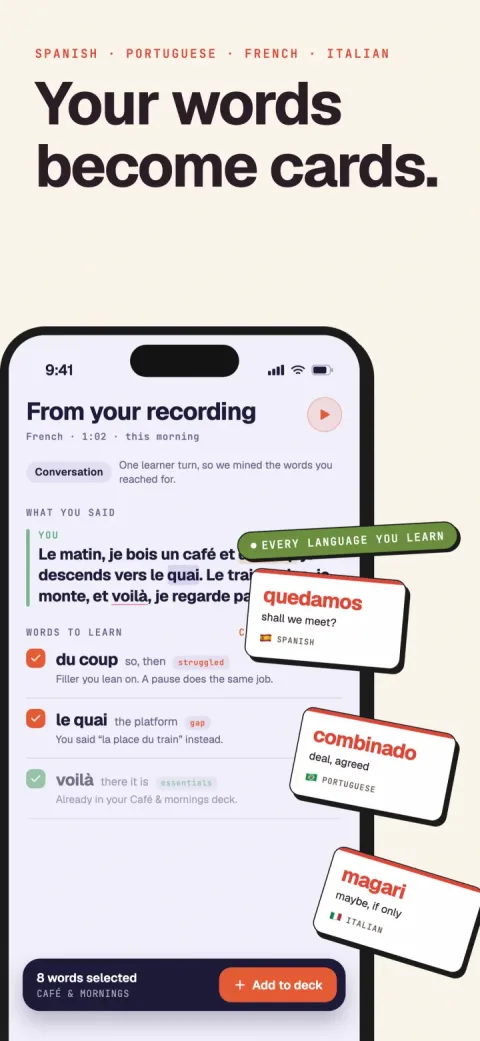
Verbamor turns the words from your own lessons and recordings into flashcards, and brings each one back before you’d forget it.

The deck Migaku sends intermediate learners to is a sample now.
A Frequency Dictionary of Spanish was the standard recommendation: 5,000 words, ranked, each with a real sentence. The version live on AnkiWeb on 21 September 2026 held 1,000 notes, and the description says so plainly.
"It's a sample. The full version (5000 notes) is currently available by email or at" a paid link. The deck it replaced, the one those guides actually link to, returns "This shared item is missing or currently unavailable."
So take the verdict first. Best Free Spanish 1k core deck is the one to install if you're starting: 1,000 cards with audio and images, updated in April 2025.
If you already speak some Spanish and want volume, take the 9000 Spanish sentences deck, with the re-upload caveat below. Both are free. The first is recent; the second is old, so read the caveat.
The rest of this is the working: what I graded them against, and the numbers the three guides I checked decline to print.
The five things I checked, before any picks
Migaku's guide does the one honest thing in this category. It publishes its criteria before its picks, and it admits the truth out loud: it reviewed "~200 free Spanish Anki decks" and "Most of them kinda suck."
That line buys more trust than either rival earns in 4,000 words. Then it asserts the picks without a single card count or date.
So here are mine, each one checkable on the deck's own page in about 8 seconds.
- Last updated. Printed on every AnkiWeb deck page. A deck abandoned in 2017 has 9 years of unfixed typos and nobody to report them to.
- Card count, actual. The number in the title is marketing. The number under "Sample (from N notes)" is the deck.
- Audio, and what kind. AnkiWeb prints the audio file count. Whether a human recorded them is in the description, if the author bothered.
- Sentences or bare words. A card reading saludo → greeting teaches you a label. A card with the word inside a sentence teaches you where it goes.
- The up and down votes. Two numbers at the top of every deck page. 31 up against 11 down is a warning that 31 alone hides.
One thing I can't give you, and neither can anyone else: download counts. AnkiWeb doesn't publish them. Sort the shared-deck list by downloads and it hands back the same unsorted results.
Any page quoting you a download figure for a free AnkiWeb deck got it somewhere I couldn't find.
A deck's last-updated date is printed on its own page, in plain text, above the description. None of the three guides I checked prints it for a single deck.
Seven free decks, and only one describes human audio with sentences
Every figure below was read off the deck's own AnkiWeb page on 21 September 2026, then read again on 13 October 2026. Not one card count, date or vote had moved in those 3 weeks, which tells you something about how often free decks get touched.
The conjugation deck deserves a note. 39 pattern groups by frequency is the right design for Spanish verbs, and it's free.
But it has sat untouched since June 2020, with an author who says outright he couldn't check every card. Use it and expect to fix a few.
Only one deck here has an author who describes human recordings paired with sentences, and it was last touched in 2019. That's the state of the free catalogue, and it's worth knowing before anybody sells you a fix for it.
Two famous recommendations are now samples
Migaku's intermediate pick is A Frequency Dictionary of Spanish, described as "a list of the 5,000 most commonly used words." Its guide was last updated 5 February 2025. Follow the recommendation today and you land on a dead page, or on the reupload that holds a fifth of the deck and points you at a paid collection.
Nobody did anything wrong here. The author reuploaded, kept the sample free, and said in the description exactly what it is.
The guide never went back to look. A page stamped 2025 while recommending a 2019 link is how a free recommendation quietly turns into a purchase.
Same story at Spanish 1500 Core Words in Context: real attention to false friends like embarazada, and a card count of 50 against a title of 1500.
There's a subtler version. The 9,263-sentence deck Migaku recommends for listening carries 137 upvotes and a 2019 date.
Search AnkiWeb and you'll also find a 2025 re-upload by a different person, same audio, description reading "Fixed order of learning. All credots goes to" the original. Somebody thought the ordering was broken enough to republish 126MB over it. The fixed copy has zero ratings, because ratings don't move with the file.
That's the actual failure mode of shared decks, and it's a different problem from card quality: nobody owns the thing you installed.
Should you pay anything at all?
Mostly no, and I'll name the exception.
Language Atlas sells a bundle of 14,000 flashcards across 73 chapters, priced at €349.99 struck through to €174.99. It comes with a 14-day money-back guarantee, and the A0/A1 deck is free.
Its page claims "over 2900 downloads and only 5-star reviews." Speakada sells its Top 100 Words deck for $1 and shows no bundle price anywhere on the page, so you learn the cost at a checkout.
Language Atlas publishes one number nobody else does: hours to each CEFR level (the European scale from A1 to C2). It's the most useful figure on any of these pages.
60 to 80 hours to A1. 160 to 200 cumulative to A2. 360 to 400 to B1, 560 to 650 to B2, 810 to 950 to C1.
Those are in the right neighbourhood. The State Department's own page puts Category I languages at 552 to 690 class hours, with Spanish at 30 weeks.
That's on a week of 23 hours in class plus 17 of self-study. A vendor telling you its product is an 810-hour road is being honest with you, and I'd rather read that than a 5-star average on 2,900 downloads.
So here's the specific buyer. Pay if you want a graded path, and if €174.99 beats the weekend you'd spend assembling the same thing. You're that buyer if you've tried a frequency deck and stalled because a rank-3,000 word arrived with nothing to do with it.
None of the free decks above is a course.
Skip it if you're a beginner. Best Free Spanish 1k core deck gives you 1,000 words with audio, images and sentences for nothing, and that's a real amount of Spanish.
You'll see "2,000 words is 90% of Spanish" quoted with no source on a page selling decks. The sourced versions are worth more.
Nation and Waring put roughly 2,000 word families (a base word plus its related forms) at about 96% coverage of informal speech. Adolphs and Schmitt, working from the CANCODE conversation corpus, found 2,000 families give "less than 95 per cent coverage" of spoken discourse, with about 5,000 words needed for 96%. Two real numbers that disagree, which is the honest state of it.
A big deck's real cost is the daily reviews
Anki is free on Windows, macOS, Linux, Android and the web. On iPhone and iPad it's US$24.99, paid once. Set against €174.99 it's not close, and the regional figures differ more than people expect.
The price that actually bites is reviews. Anki's own manual: "If you are consistently learning 20 new cards a day, you can expect your daily reviews to be roughly about 200 cards/day."
Install a 9,263-card deck at 20 new a day and you've signed up for 15 months of 200-card sessions. The manual warns about this directly, noting that more than one user "excitedly studied hundreds of new cards over their first few days" and then drowned.
One more thing the deck pages won't tell you. The manual is blunt about who wrote a premade card: "Most shared decks are created by people who are learning material outside Anki."
That means they "might not make any effort to add background information or explanations." Anki's own recommendation is that shared decks "should be used as a supplement to external material, not as a replacement for it."
Worth saying about the picture decks too. Carpenter and Olson found that for foreign vocabulary, pictures didn't beat plain translations at first. And learners felt more confident than they had earned when recalling from an image.
That gap between a frequency deck and your own Spanish is the thing I built for.
Verbamor is an iOS app that takes the words you actually fumbled, from a lesson you record or a phrase you look up. It turns them into fill-in-the-blank cards with a generated image and synthesised audio in a native accent. FSRS, an open-source algorithm that predicts when you're about to forget each card, schedules them.
Five languages. $19.99 a month, or $129.99 a year with a 7-day trial on the annual plan. Both are US prices, read off the app's own plan definitions on 21 September 2026, and the App Store sets a different number in other countries.
No free tier, which is a real reason to close this tab. Beyond its Essentials deck of roughly 650 common words, it teaches you nothing new, and it has no course to take a beginner from zero. That's exactly the job the 1k deck above does for free.
If you'll build your own cards, build your own cards. Anki plus 20 minutes a week of typing your lesson words in beats every option here, mine included, and costs $24.99 once. The people I can help are the ones who have started that habit twice and stopped both times.
Sources
The decks, each read twice on its own page
- Best Free Spanish 1k core deck. 1,000 notes, 205.56MB, 1,994 audio and 975 images, updated 2025-04-21, 14 up / 1 down. The author describes the audio as text to speech and logs a spelling-fix pass dated 4 April 2025.
- 9000 Spanish sentences, difficulty sorted with native audio. 9,263 notes and audio files, 125.49MB, updated 2019-10-22, 137 up / 7 down. Source for the Tatoeba origin, the cloze format, the Wiktionary frequency ordering and "genuine native audio by a speaker from central Spain". The 2025 re-upload is here, 126.02MB, updated 2025-08-16, no ratings, description beginning "Fixed order of learning."
- The Ultimate Spanish Conjugation Deck (No Vosotros). 5,490 notes, updated 2020-06-12, 4 up / 0 down. Source for "all 39 major conjugation pattern groups in Spanish by frequency" and "I haven't been able to check every single card for errors." The vosotros edition is 6,561 notes, same date.
- Spanish Tatoeba Sentences with Audio. 15,021 notes and audio files, 235.17MB, updated 2017-04-08, 9 up / 1 down. Source for "No translations are included" and for sentences being removed to fit the 250MB shared-deck limit.
- Top 1000 Spanish Words with Images and Audio. 938 notes, updated 2018-05-08, 31 up / 11 down. Source for the Corpus del Español lemma list and the bare word-to-word format.
- A Frequency Dictionary of Spanish v2. 1,000 notes, updated 2026-08-18, 30 up / 0 down. Source for "It's a sample. The full version (5000 notes) is currently available by email or at" a paid link, and for the Routledge dictionary it draws on. Its predecessor, deck 1350487717, returns "This shared item is missing or currently unavailable."
- Spanish 1500 Core Words in Context with Full Audio. 50 notes, updated 2026-01-25, 6 up / 0 down. Source for the 50-note sample against a 1500-card title, and for the false-friend example.
Anki itself
- Anki manual, Deck Options. Source for "If you are consistently learning 20 new cards a day, you can expect your daily reviews to be roughly about 200 cards/day" and the warning about new users who study hundreds of new cards in their first days. Also the page confirming FSRS is opt-in, with SM-2 as the shipped default.
- Anki manual, Getting Started. Source for "Most shared decks are created by people who are learning material outside Anki" and for the recommendation that shared decks be "used as a supplement to external material, not as a replacement for it."
- AnkiMobile for iOS, US$24.99 one time, on the App Store listing, re-read 13 October 2026. Desktop, AnkiDroid and AnkiWeb sync are free.
Vocabulary size and images
- Nation, P., & Waring, R. (1997). Vocabulary size, text coverage and word lists. In Schmitt & McCarthy (Eds.), Vocabulary: Description, Acquisition and Pedagogy, Cambridge University Press, 6–19. About 2,000 word families give around 96% coverage of informal spoken text.
- Adolphs, S., & Schmitt, N. (2003). Lexical coverage of spoken discourse. Applied Linguistics, 24(4), 425–438. From the CANCODE corpus: 2,000 word families give "less than 95 per cent coverage" of spoken discourse, and around 5,000 individual words are needed for about 96%. Read at abstract level only.
- Carpenter, S. K., & Olson, K. M. (2012). Are pictures good for learning new vocabulary in a foreign language? Journal of Experimental Psychology: Learning, Memory, and Cognition, 38(1), 92–101. Pictures did not initially beat translations for foreign vocabulary, and produced more overconfidence.
- U.S. Department of State, Foreign Language Training. Category I languages, 24 to 30 weeks and 552 to 690 class hours, Spanish at 30 weeks, on "23 hours per week in class and 17 hours of self-study."
The pages this one is arguing with
- Migaku, Improve your Spanish with these hand-selected Spanish Anki decks, last updated 5 February 2025. Source for "~200 free Spanish Anki decks", "Most of them kinda suck", the six Golden Rules, and the recommendations of A Frequency Dictionary of Spanish and the 2019 nine-thousand-sentence deck.
- Language Atlas, Best Spanish Anki decks. Source for €349.99 struck to €174.99, 14,000 flashcards, 73 chapters, 346 lessons, "over 2900 downloads and only 5-star reviews", the 14-day guarantee, the free A0/A1 deck, and the hours-to-level figures.
- Speakada, Best Spanish Anki decks, published 11 December 2023. Source for the $1 Top 100 Words deck, the absence of bundle prices on the page, the 500+ minimal pairs claim, and "90% of everyday Spanish comes from just 2,000 words" with no citation attached.
What I could not verify
- Download counts for any AnkiWeb deck. AnkiWeb's shared-deck listing publishes Title, Modified and Notes, and nothing else; passing a downloads sort returns an unsorted result set. No download figure appears on this page for that reason, and I'd treat one on any other page with suspicion.
- Whether each deck's audio was recorded by a human or generated. Only the authors' own descriptions say, and only some of them say it. The "native audio" claims above are the deck authors' words, not my verification.
- Error rates inside any deck. Checking 9,263 cards for accuracy is not something I did, and none of the three guides says it did. The conjugation deck's author is the only one who says so in writing.
- Language Atlas's individual per-level deck prices, which are not printed on its page, and every Speakada bundle price above $1, which are not printed on its page either.
A deck of the words you actually fumbled.
Verbamor turns the vocabulary from your own lessons into fill-in-the-blank cards, scheduled so they're still there next month.
Start 7 days freeThe 7-day free trial is on the yearly plan.