 Verbamor
The best French Anki decks, checked 13 October 2026
Install 5000 most frequently used French words: it’s free, it has 887 upvotes, and it covers the core vocabulary in frequency order, though its author last touched it in April 2022. Once you can read simple French, add French Sentences. If you’d rather build cards from your own lessons, start with French flashcards.
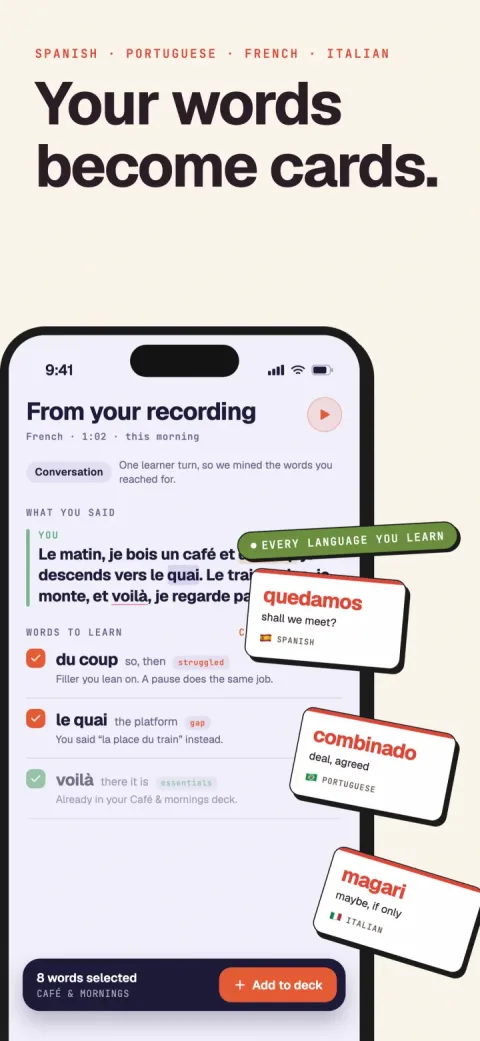
Verbamor turns the words from your own lessons and recordings into flashcards, and brings each one back before you’d forget it.

The French deck with the most votes on AnkiWeb hasn’t changed since 26 April 2022.
That’s 5000 most frequently used French words, version 6.0: 887 upvotes against 50 down when I read it on 13 October 2026. No other French deck I found came close. It’s still the one I’d install first, and I’ll tell you why after the one thing its page makes you work out for yourself.
It comes in 2 parts. The author’s note on Part 2 says it plainly: “Part 1 contains the first 500 cards, Part 2 contains the other 4500,” split so “you can get a sample before downloading the whole thing.” So the deck most guides link to is the sample. The 4,500 words after it sit on a second page.
So here’s the verdict. Starting French: take Part 1, and if you like the cards, take Part 2. Reading simple French already: add French Sentences, 3,001 sentences sorted from easy to hard. Both are free.
What I checked on each deck page
Every AnkiWeb deck page prints four things that matter, and I wrote down all four for each deck below.
- The “Updated” date. A deck last touched in 2015 still has every typo from 2015.
- The note count. It sits in small print under “Sample (from N notes)”, and it often disagrees with the title.
- The audio file count. AnkiWeb counts the files. Who recorded them is in the description, when the author says at all.
- The votes. Two numbers above the title. A deck at 101 up and 15 down has more unhappy users than the 101 suggests.
What you can’t check is downloads. AnkiWeb doesn’t publish a download count for shared decks, so a roundup that quotes one is quoting something I can’t find a source for.
Nine free French decks, read on 13 October 2026
Each line below comes off the deck’s own page. Note counts are AnkiWeb’s, and they often differ from the number in the title.
Why still pick a 2022 deck? Because a frequency deck ages slowly. The 500 most common French words in 2022 are the 500 most common French words now, and 887 people voting it up means a lot of eyes have been over the first few hundred cards.
The weak spot is sound. Of these 9 descriptions, only French 500 coloured words says anything about voices at all, and none of them says a person recorded the audio. If audio quality decides it for you, play 10 cards before you commit 5,000.
French Sentences has the opposite problem. Its sentences start easy and get harder, which is the right design, but 516 audio files across 3,001 notes means you’ll read far more of it than you hear.
One well-rated new deck is a trial, and says so
The Ultimate French Deck: LoF & French in Action was updated on 9 September 2026, the freshest date here, with 70 up and 3 down. It’s built around French in Action, which its description calls “a 52-episode romantic comedy made for learners, free to watch online”.
It holds 300 notes. The full deck has “5,000+ cards covering all 52 lessons”, and the shared one is, in its own words, “This trial deck”. The author answers a critical review the same way: it’s “a free trial version of our larger French in Action deck”, covering the first 4 episodes.
I think that’s fine, and better than average. It says what it is in the description. It also claims the full deck has “Every sentence recorded by native speakers”, which is the claim none of the free decks above makes. The AnkiWeb page doesn’t print the full deck’s price, so I can’t tell you whether that’s worth paying for.
Free shared decks are a different thing from cards you made yourself, and a trial deck is a third thing again: a sales page you can study.
Should you pay for a French deck?
Mostly not, with one kind of buyer as the exception.
Language Atlas sells a French bundle of 14,826 flashcards across 73 chapters and 346 lessons. On 13 October 2026 its page showed €349.99 struck through to €174.99, with a 14-day money-back guarantee and a free A0/A1 deck. It also says “over 2500 downloads and only 5-star reviews”, which I have no way to check.
What I like is that it prints hours. 60 to 80 to finish A1. 160 to 200 cumulative for A2, 360 to 400 for B1, 560 to 650 for B2 and 810 to 950 for C1.
Those sit in the same range as the State Department’s own page, which puts French at 30 weeks and 690 class hours, on a week of 23 hours in class and 17 of self-study. A seller who tells you B2 is about 600 hours away isn’t flattering you, and I’d trust that number over a 5-star average.
So pay if you want somebody to put the words and grammar in order for you, level by level, and €174.99 is cheaper to you than a few weekends of building it. If you’re a beginner, take Part 1 of the free deck above first. 500 words with audio is a real start and costs nothing.
A 5,000-word deck costs you 200 reviews a day
Anki is free on Windows, macOS, Linux, Android and the web. On iPhone and iPad, AnkiMobile is US$24.99, paid once; I read that on the App Store listing on 13 October 2026. That’s small next to what the reviews cost you in time.
Anki’s manual puts it in one line: “If you are consistently learning 20 new cards a day, you can expect your daily reviews to be roughly about 200 cards/day.” At 20 new words a day, 5,000 words is 250 days. That’s about 8 months of 200-card sessions, every day, before you’ve seen the last word once.
The manual is also honest about premade decks. “Creating your own deck is the most effective way to learn a complex subject,” it says, because shared decks are mostly “created by people who are learning material outside Anki”. A language counts as complex. Use the deck to get the common words in, and get the rest from French you actually read and hear.
That second part is the job I built Verbamor for. It’s an iOS app for iPhone and iPad. It turns the French words from a lesson you record, or a phrase you look up, into fill-in-the-blank cards with an image and native-accent audio, and FSRS (an open-source scheduler that predicts when you’re about to forget a card) decides when each comes back. There’s a starter deck of about 650 common words too.
$19.99 a month, or $129.99 a year with the 7-day trial, which comes with the yearly plan only. Those are US prices from the app’s own plan definitions, and the App Store can show a different figure in your country.
Here’s the concession. If you’ll type your own cards, do that. Free Anki on a laptop plus 15 minutes after each lesson beats my app on price by $129.99 a year, and the cards will be better for being yours. Verbamor is for the people who’ve tried that twice and stopped both times.
Sources
The decks, read on 13 October 2026
- 5000 most frequently used French words [v. 6.0]. 15,474 notes, 73.77MB, 6,752 audio and 3 images, updated 2022-04-26, 887 up / 50 down. Source for the frequency order, the example sentences, and the Canadian French, irregular-verb, phonology and skills extras.
- 5000 most frequently used French words [v. 6.0] Part 2. 18,000 notes, 83.08MB, 8,963 audio, updated 2022-04-25, 72 up / 4 down. Source for “Part 1 contains the first 500 cards, Part 2 contains the other 4500”, “So you can get a sample before downloading the whole thing” and the import warning.
- French Sentences. 3,001 notes, 516 audio, updated 2024-03-08, 235 up / 17 down. Source for the easy-to-hard ordering.
- Essential French. 604 notes, 614 audio and 622 images, updated 2016-10-04, 91 up / 7 down. Source for IPA, gender and “20+ hours”.
- French 500 coloured words with pictures and audio. 491 notes, 480 audio and 487 images, updated 2015-06-02, 101 up / 15 down. Source for the gender colours and the male and female voices.
- 1000 Essential French Words: Audio, Sentences & Translations. 1,029 notes, 2,055 audio, updated 2024-06-28, 19 up / 0 down.
- 501 french verbs with audio. 501 notes, 516 audio, updated 2017-08-11, 37 up / 2 down.
- Ultimate French Conjugation (Lisardo’s KOFI Method). 2,792 notes, no audio, updated 2024-01-09, 21 up / 1 down. Source for the 7 orientation cards.
- A Frequency Dictionary of French (Complete). 5,000 notes, no audio, updated 2015-12-03, 14 up / 0 down. Source for the Lonsdale and Le Bras headword list and the missing example sentences.
- The Ultimate French Deck: LoF & French in Action. 300 notes, 266 audio and 224 images, updated 2026-09-09, 70 up / 3 down. Source for the 52-episode description, “5,000+ cards covering all 52 lessons”, “Every sentence recorded by native speakers”, “This trial deck” and the author’s reply about the first 4 episodes.
Anki itself
- Anki manual, Deck Options. Source for the 20 new cards to about 200 reviews a day.
- Anki manual, Getting Started, “Shared Decks”. Source for “Creating your own deck is the most effective way to learn a complex subject” and “created by people who are learning material outside Anki”.
- AnkiMobile Flashcards on the US App Store, US$24.99, read 13 October 2026. Desktop, AnkiDroid and AnkiWeb sync are free.
Hours and the paid option
- U.S. Department of State, Foreign Language Training, read 13 October 2026. Category I, 24 to 30 weeks and 552 to 690 class hours, French at 30 weeks, and “A typical week is 23 hours per week in class and 17 hours of self-study.”
- Language Atlas, Best French Anki decks, read 13 October 2026. Source for 14,826 flashcards, 73 chapters, 346 lessons, €349.99 struck to €174.99, the 14-day guarantee, the free A0/A1 deck, “over 2500 downloads and only 5-star reviews” and the hours to each level.
What I could not verify
- Download counts. AnkiWeb doesn’t publish them for shared decks.
- Whether any deck’s audio was recorded by a person or generated. None of the free decks’ descriptions says.
- Error rates inside any deck. I didn’t check 5,000 cards by hand, and I found no review that had.
- The price of the full French in Action deck, which its AnkiWeb page doesn’t print.
Cards from the French you actually heard.
Verbamor turns the words from your own lessons and conversations into fill-in-the-blank cards, and brings each one back before you lose it.
Start 7 days freeThe 7-day free trial is on the yearly plan.