 Verbamor
Premade decks and your own cards, compared honestly
A downloaded Spanish deck gives you 5,000 cards in about nine seconds. Building the same 5,000 yourself, at a realistic 90 seconds a card, is 125 hours. Then week three arrives, you're failing the same eleven cards over and over, and the hours you saved come back as review time, spread over months, at a worse exchange rate.
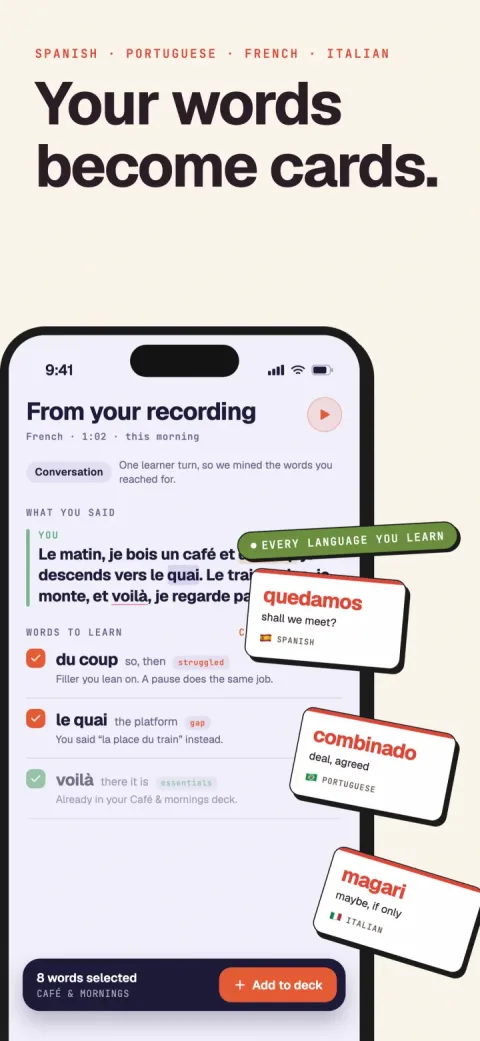
Verbamor turns the words from your own lessons and recordings into flashcards, and brings each one back before you’d forget it.

A downloaded Spanish deck gives you 5,000 cards in about nine seconds. Building the same 5,000 cards yourself, at 40 seconds each, takes 55 hours.
Take that 40 seconds as generous to the download, because it assumes the sentence is already in front of you. Ninety seconds a card is the realistic rate once you're also hunting a sentence and checking a translation. 5,000 cards at 90 seconds is 125 hours.
Then week three arrives. You have 180 reviews a day, roughly 40 of them are words you've never heard anyone say, and you're failing the same eleven cards over and over. The hours you saved come back as review time, spread over months, at a worse exchange rate.
A premade deck carries someone else's choices
A premade deck is a file someone else made and uploaded. On AnkiWeb's shared deck catalog you download it, and it lands in your collection.
Every card in it carries that person's choices: their example sentences, their translations, their idea of which 5,000 words matter. Two decks for the same language, downloaded the same afternoon, can disagree about the translation of a word.
Your own cards are the ones you write, one at a time, from something you met: a lesson, a book, a conversation, a subtitle you had to pause.
Anki's own manual says to make your own deck
The people who built the tool wrote down what they think. Their getting-started page says: "Creating your own deck is the most effective way to learn a complex subject."
Their reasoning is specific, and it's about who wrote the card. The manual's shared decks section notes that "Most shared decks are created by people who are learning material outside Anki," and that they "might not make any effort to add background information or explanations to the cards, because they already understand the material."
The card is a memory aid for a person who already has the memory. You don't have it yet.
The same section then draws the line clearly: "for complex subjects, shared decks should be used as a supplement to external material, not as a replacement for it." It carves out an exception for material that needs no understanding at all, giving capitals and flags as examples.
A country's capital is arbitrary, so all you have to do is attach it.
Download the arbitrary words and write the rest yourself
Some vocabulary is close to arbitrary. Numbers, days of the week, colors, the first few hundred concrete nouns.
There's one right answer, it doesn't shift with context, and any decent card teaches it. A premade deck handles these well, and writing 300 of them yourself is 3 hours you could spend talking to someone.
Most vocabulary isn't arbitrary. It carries a register (how formal it sounds), a set of things it goes with, and a boundary against its neighbors.
Spanish has two verbs for "to know" and two for "to be". Here are the two cards side by side.
The downloaded card: front saber, back "to know". Accurate and thin. You can pass it for a year and still not know which of the two verbs to say out loud at dinner.
The card you write after a tutor corrects you: front "Ayer ____ a la hermana de Marta en la fiesta.", back "conocí (conocer, met for the first time). Use saber for facts you learned: Ayer supe que se casó." One card, one sentence you were actually in, and the boundary against the neighbor verb sitting right there on the back.
Grammar patterns sit further along the same line. The subjunctive, the verb mood Spanish uses for wishes and doubts, is a rule about when, and the forms are the easy half.
A card you write after you got it wrong in front of a tutor holds the reason you got it wrong. A downloaded conjugation card holds a table.
- Arbitrary, single-answer, high-frequency. Download it. The first several hundred words of a language are the same for everyone. Given how word frequencies are distributed, this early block does real work.
- Anything you met in context, got wrong, or half-know. Write it yourself. The context is the part worth keeping.
- Anything you cannot yet use in a sentence. Don't make a card at all yet. A card is for holding onto something you've already understood once.
Premade decks cost you leeches, and your own cards cost you time
Premade decks have a cost that shows up on a delay. It's called a leech, and it's a card you keep failing.
Anki's leeches page defines them as "cards that you keep forgetting," and says: "When this counter reaches 8, Anki tags the note as a leech and suspends the card." Eight failures on a single card, and the card gets pulled.
The manual names the causes: too much information on one card, a lack of understanding, and interference between similar items. All three arrive more often in downloaded decks, because nobody checked whether the card matched you.
A card that has failed eight times cost you at least eight reviews, plus the ones on either side of each failure. That's where the saved hours went.
Your own cards have three costs, and they are all real.
The first is time. Forty seconds a card is optimistic if you're also finding a sentence and checking a translation.
Ninety seconds is normal, which is the 125 hours from the first paragraph. Twenty new cards a night is half an hour before you've reviewed anything.
The second is that you can only make cards from material you've met. If you're on week one and have met eleven words, you can't build a deck. A beginner with no input has nothing to mine, which is exactly the situation a premade deck exists for.
The third is that your cards can be bad. You will write ambiguous prompts, put four facts on one card, and make two cards that compete. Anki tells you when: the leech count catches your own bad cards too.
What you get in return is the writing itself. Slamecka and Graf (1978) named the generation effect: material a person generates is remembered better than the same material read. Producing the card is a first rehearsal that a download skips entirely.
One caution applies to cards from either source. If you add pictures, don't let the picture reassure you.
Carpenter and Olson (2012) found that pictures didn't initially beat native-language translations for foreign vocabulary. Learners were also more overconfident recalling from a picture than from a word. Pictures only helped once that overconfidence was corrected.
Add the image, then still grade yourself on whether you produced the word out loud.
Start a hybrid tonight: one core deck, one card a day
Most people who do this well run both, with a hard boundary between them.
- Download one deck, and only one. A frequency-ordered core deck for your language, capped at the first 1,000 words. Rename it Core 1000. Set new cards per day to 10 in the deck options, and don't raise it to 20 or 50.
- Delete everything in it above your level. Open the browser, sort by the sort field, and suspend the back half. Reviewing a card you can't use yet is how leeches are born.
- Make one card a day from real input. One. From a lesson, a podcast, a message someone sent you. Put it in a second deck called Own. Write the sentence you actually met it in, not a dictionary sentence.
- At 6 weeks, measure both decks and change the numbers. Open Browse. Right-click the column header, or Ctrl-click on a Mac, and tick Lapses (how many times each card was forgotten) and Interval. Now search
"deck:Core 1000" prop:ivl>=21 -is:suspended. That's the mature cards only. Anki defines mature as an interval of 21 days or more, and young cards haven't had time to lapse yet. Click the Lapses header to sort, add the column up, and divide by the number of cards shown. That's your mean lapses per mature card. You need the mean because the two decks will have different sizes and different ages, so raw totals compare nothing. Repeat withdeck:Own prop:ivl>=21 -is:suspended. Compare the two means. My trigger is a gap of 1.0 lapses per mature card or more. Anki suspends at 8, so a full lapse of separation is about an eighth of the way to a dead card. That's large enough to survive the noise in a 6-week sample. If Core 1000 is 1.0 or more above Own, cut the downloaded deck to 5 new cards per day and write 2 cards a day of your own instead of 1. If Own is the higher one, your cards are the problem, not the deck. Keep 10 new cards a day on Core 1000, stay at 1 card of your own, and make it shorter.
That routine takes about 20 minutes a day and needs nothing you don't already have.
Verbamor starts with about 650 common words, then makes your own cards
Verbamor is an iOS app for Spanish, French, Italian, Portuguese, Russian and German, and it does both, in a fixed order. Each language comes with an Essentials deck of about 650 common words. Past that, it only makes your own cards: you record or import a real lesson or conversation, it transcribes the audio, and it mines the words and multi-word phrases that were actually in it.
You choose which ones to keep, and it builds the card around them: an example sentence, an image, and two recordings of that sentence. One recording has the answer replaced by a tone so you have to produce it, and the other is complete.
Those go into a queue scheduled by FSRS, an open-source algorithm that predicts when you're about to forget each card. It's the newer of Anki's two schedulers, and Anki itself ships it switched off.
So on day one, before any recording, you have that starter deck and nothing of your own yet.
It also has no free tier. Explorer is US$19.99 a month, and Native is US$129.99 a year, about $10.83 a month, with a 7-day trial on the annual plan only.
Anki's desktop version is free and AnkiMobile is a US$24.99 one-time purchase. So if the 90 seconds per card isn't the part you mind, Anki plus a shared deck is cheaper and more configurable, and it always will be.
Tonight, before you make anything, write down two numbers. One is today's date, and the other is the mean lapses per mature card in whatever deck you already study, using the search above.
If you have no mature cards yet, write down zero and the date. In six weeks that line is the only thing standing between you and guessing.
Sources
Anki's own manual
- Anki manual, Getting Started, Shared Decks, read 12 October 2026. Verbatim: "Creating your own deck is the most effective way to learn a complex subject"; "Most shared decks are created by people who are learning material outside Anki"; they "might not make any effort to add background information or explanations to the cards, because they already understand the material"; "for complex subjects, shared decks should be used as a supplement to external material, not as a replacement for it." The capitals and flags exception is in the same paragraph.
- Anki manual, Leeches, read 12 October 2026. Verbatim: "Leeches are cards that you keep forgetting" and "When this counter reaches 8, Anki tags the note as a leech and suspends the card." The causes are in its Editing section ("Maybe your cards have too much information, or you're trying to memorize something without fully understanding it") and its Waiting section ("Some leeches are caused by 'interference'", with "disappoint" and "disappear" as the example).
Studies
- Slamecka, N. J., & Graf, P. (1978). The generation effect: Delineation of a phenomenon. Journal of Experimental Psychology: Human Learning and Memory, 4(6), 592-604. The citation for material you generate being remembered better than the same material read.
- Carpenter, S. K., & Olson, K. M. (2012). Are pictures good for learning new vocabulary in a foreign language? Only if you think they are not. Journal of Experimental Psychology: Learning, Memory, and Cognition, 38(1), 92-101.
One side of this argument, no download.
Verbamor only builds cards from lessons and conversations you actually recorded, so every sentence you review is one you've genuinely met, not a stranger's guess at what you need.
Start 7 days freeThe 7-day free trial is on the yearly plan.