 Verbamor
The cheapest way to learn Spanish is the one whose hours you actually spend
The cheapest way to learn Spanish is whichever method buys the hours you're short of, usually speaking, at the lowest price per hour. A realistic italki tutor hour runs $10 to $30 and corrects you. Anki costs $24.99 once on iPhone, plus about 7.5 hours to build a 200-word deck yourself.
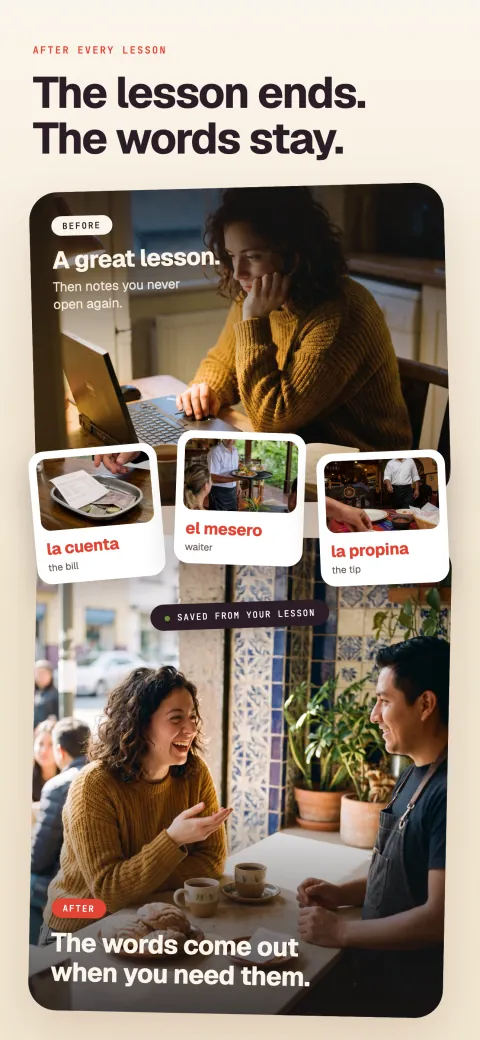
Verbamor records your lesson and turns what your tutor taught into cards that come back on schedule.

A Spanish tutor on italki costs between $4 and $60 an hour. That's italki's own published range, printed on its Spanish tutor page. A realistic full hour off its own listings runs $10 to $30.
One hour a week at that realistic rate is $40 to $120 a month. Anki costs $24.99 once on iPhone and nothing at all on desktop.
Anki is cheaper on sticker price alone by a wide margin. Almost nobody who compares the two that way ends up learning more Spanish.
A tutor hour and an Anki hour are different units. The tutor hour arrives with a teacher inside it. The Anki hour arrives empty and you fill it yourself.
Comparing prices without comparing what you supply is how people end up two years in with a large collection of subscriptions and a small collection of Spanish.
Spanish takes 552 to 690 class hours, so price the hour
The US Foreign Service Institute trains American diplomats and publishes how long its own training takes. Spanish sits in Category I, the group of languages closest to English, along with French, Italian and Portuguese.
FSI lists that category at 24 to 30 weeks, which it puts at 552 to 690 class hours. Spanish and French are at the 30-week end.
Two things get dropped whenever FSI's 552-to-690-hour figure is quoted. The first is the sentence next to it: a typical FSI week is 23 hours in class plus 17 hours of self-study.
That's 40 hours a week, and 40 across 30 weeks is 1,200 hours. So the published 690 counts class time only.
The second is the target. FSI trains people to professional working proficiency, which means running a meeting and defending a policy position in the language. That's far above ordering dinner in Seville.
Read 1,200 hours as the scale of the thing, and set your own target separately. Whatever method you pick, you're buying hours, and the monthly price matters much less than whether those hours stay bought.
A tutor hour buys correction and leaves the next six days empty
italki publishes two figures on its Spanish tutor pages: tutors "cost between $4 to $60 per hour", and "a 30-minute Spanish lesson typically costs between $4 and $10." Both are italki's own wording, checked in August 2026.
The wide band is real. italki splits tutors into community tutors, native speakers without teaching credentials, and professional teachers, who have qualifications.
You can book one lesson and never book another. There's no subscription and no minimum.
Preply prices the same thing differently, and the difference matters more than the hourly rate. Its help centre, checked in August 2026, states each subscription "is tied to one tutor and runs in 28-day cycles", and that "the minimum plan is 4 lessons per cycle".
Then comes the line that costs people money: unscheduled lessons "expire at renewal and do not carry over." Already-booked lessons are protected. The ones you meant to book aren't.
Preply publishes no hourly rate anywhere I can check, so I'm not giving you one.
Preply suits a fixed weekly habit with one teacher. italki suits an irregular schedule. If you know you will miss weeks, price the expiring-lessons rule in.
What a tutor hour gives back is the one thing no software sells: someone who notices what you got wrong and makes you say it again. What it doesn't give back is the next six days. Four hours a month against 1,200 is a slow road on its own.
So the useful figure is dollars per hour of the work you're short of. In my experience of adult learners who have been at it a while, the shortage is nearly always speaking: plenty of listening and reading, some review, almost no talking. Check it against your own week.
Merrill Swain proposed the comprehensible output hypothesis in 1985, in Gass and Madden's Input in Second Language Acquisition. She had watched Canadian French immersion students who had years of rich input and still couldn't produce accurate French.
Her claim is that producing language, out loud, is its own ingredient and not a by-product of understanding it. It remains a hypothesis and people still argue about it.
Price the plans per speaking hour and they separate. Four 30-minute italki lessons at its published $4 to $10 is $16 to $40 a month. Four half-hours is two speaking hours, so that's $8 to $20 per speaking hour.
One full hour a week runs $10 to $30, so $40 to $120 for four. Add Pimsleur at its stated $20 and the month is $60 to $140.
Add Verbamor at $19.99 instead and it's $59.99 to $139.99. Across four speaking hours, that's $15.00 to $35.00 per speaking hour, or $12.71 to $32.71 on the annual plan at $10.83 a month.
Every dollar of that spread comes from the tutor's rate.
Pimsleur costs around $20 a month, and three courses I won't price
Pimsleur is the clearest to price because it says the number itself. What its $20 buys is the part a tutor can't scale: someone already picked the words, wrote the sentences and recorded the audio.
Pimsleur's own blog, checked in August 2026, states that both Premium and All Access cost around $20 a month. That's a first-party figure and deliberately approximate, so treat it as approximate. Its exact plan prices, read on 21 September 2026 and including $19.95 a month for Premium, are in what Pimsleur costs.
The same blog post runs the division this article is about. It prices a private tutor at $50 an hour against Pimsleur at roughly $1.50 an hour, based on three lessons a week.
Duolingo Super stays out of the price comparison. Its App Store listing, checked in August 2026, shows price points from $9.99 to $119.99 with no billing term attached to any of them.
A price I can't attach to a period can't become a cost per month. Anyone printing exact Duolingo figures off that listing is guessing.
What is confirmed about Duolingo: Super carries a 14-day free trial. The free tier is usable, ad-supported and gated by an energy meter that lessons spend and correct answers earn back.
Duolingo also published a real spaced-repetition scheduler (software that times each review for just before you would forget): half-life regression, Settles and Meeder, ACL 2016, peer-reviewed and open-sourced. Whether that model still runs in production today isn't something Duolingo publishes, so nobody should assert it.
Two prices I'm not giving you. Babbel's pricing page returns an error and its support articles refuse automated checks. So any Babbel figure I printed would be copied from someone else copying someone else.
Lingopie publishes no price at all, and three other Lingopie reviews disagree with each other by a factor of 3.3. If a comparison article hands you confident numbers for either, ask where they got them.
How much does Anki really cost?
In money, almost nothing: Anki is the honest floor. Desktop Anki, AnkiDroid and AnkiWeb sync are all free.
AnkiMobile on iPhone and iPad is US$24.99 as a one-time purchase, confirmed against the App Store listing in August 2026. There's no monthly fee anywhere in it.
Then Anki's second bill arrives, in hours. Anki ships no content. Anki's own manual says "creating your own deck is the most effective way to learn a complex subject".
The free part is the scheduler. The Spanish is your job.
Somebody has timed Anki card-making. Gabriel Wyner, who wrote Fluent Forever, sat down with a Russian frequency list and reported: "I got 110 cards done in 1.5 hours."
Those covered "about 40 words", because he splits verbs across conjugations. He was practised, about 2,200 cards in. His conclusion: 25 new cards a day costs "2-3 hours a week for card creation."
Run Wyner's figure against a starter vocabulary. 90 minutes for 40 words is 2.25 minutes per word, so 200 words is 450 minutes, or 7.5 hours. Price your own time at $25 an hour and that deck costs $187.50 in time.
Set the three side by side. The tutor is $40 to $120 a month. AnkiMobile is $24.99 once.
Anki's 200-word starter deck is $24.99 plus 7.5 hours. That makes it the most expensive of the three, and the only one whose bill never appears on a card statement.
Wyner's 7.5 hours still buy something. The generation effect (Slamecka and Graf, 1978) is the finding that material a person generates is remembered better than the same material read.
Making the card teaches you something. It also takes the evening.
One Anki setting before you start. FSRS, the newer scheduler that fits a memory model to your own review history, is not on by default.
Anki still ships SM-2, the 1987 SuperMemo algorithm. The manual tells you to enable FSRS yourself, down at the foot of the deck options page.
Many blog posts claim FSRS became the default in version 23.10. They're wrong.
The scheduling gap matters. Cepeda, Pashler, Vul, Wixted and Rohrer's 2006 review in Psychological Bulletin pooled 839 assessments from 317 experiments. It found the best gap between study sessions grows as the delay before the test grows.
A scheduler that gets it wrong wastes hours you already spent.
Anki and Duolingo both beat Verbamor on price; it only wins if card-making is your bottleneck
On price alone, Anki beats Verbamor, and Duolingo's free tier beats both. Verbamor is an iOS app at US$19.99 a month, or US$129.99 a year (about $10.83 a month). Only the yearly plan comes with a 7-day trial, and there's no free tier.
Skip Verbamor if you enjoy making cards, because then the labour is the study. Skip it if you aren't on iOS.
Skip it if you have no real audio to feed it. With no lessons and no podcasts you care about, it has little to mine beyond the words you save in Translate, and a prepackaged course will serve you better.
What the money buys is the card-making hours, measured against Wyner's 7.5. You record or import a real lesson.
It transcribes the audio and mines the words and multi-word phrases you actually met, capped at 60 words and 30 phrases per recording. Those caps are ceilings, and a thin recording returns far fewer.
You tick the mined words worth keeping. Every kept item is then built without you: an example sentence, an image, and two recordings of the sentence.
One recording replaces the answer with a tone, for recall, and the other is complete. Building runs in the background, so the deck is studyable shortly after you finish choosing.
Counting hours turns the trade into arithmetic. Wyner's 200 words cost 7.5 hours by hand.
Reaching 200 kept items here costs three or four recordings you were making anyway, plus the tapping to choose them. So call the saving roughly seven hours per 200 words.
At $19.99 a month you buy those hours back at about $2.86 each. If an hour of your evening is worth less than $2.86, make the cards yourself.
Against a tutor, Verbamor is no substitute, because nothing here corrects your pronunciation or asks you a follow-up question.
Work out your own number this week. Write down what you pay each month. Then write down last week's hours split four ways: listening, reading, review, speaking.
Find the activity closest to zero and divide your monthly spend by that column alone. Do that before you add another subscription. That ratio is the thing you're actually buying.
Price the hours, not the subscription.
Verbamor turns a recorded lesson into finished cards, sentence, image and audio included, so the real cost you're weighing is the hours it saves you from building each one by hand.
Start 7 days freeThe 7-day free trial is on the yearly plan.