 Verbamor
The best apps for learning French, by what you're actually doing
Pimsleur is the best French app for a beginner (Babbel if you want rules); Lingopie for learning from shows; italki for a broken ear; Anki with native audio for intermediates; and Verbamor if you're past the beginner stage and won't build cards yourself. Most learners read French they can't follow spoken, and that gap decides what to buy.
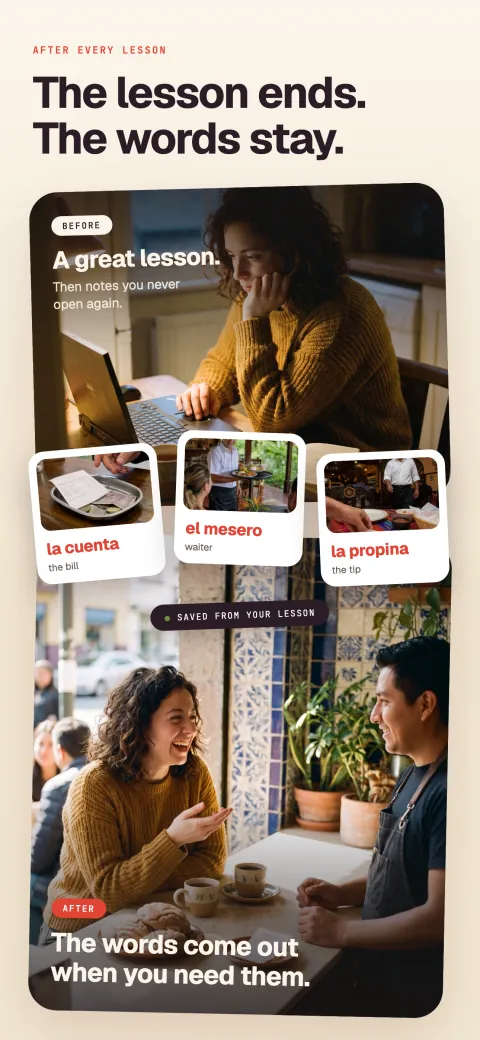
Verbamor records your lesson and turns what your tutor taught into cards that come back on schedule.

Pimsleur is the best app to learn French from zero if your problem is the ear, and Babbel if you want the rules. Duolingo is the free start, and its French course now runs to CEFR B2 content (my Duolingo French review). Add an italki tutor for speed and Anki at intermediate. Verbamor, mine, is paid with no free tier, runs on iPhone and iPad, and is for people who take lessons: it turns them into French flashcards.
French writes the word boundaries and then declines to say them
Here's a sentence a second-year learner reads without blinking: Il y a des amis qui nous attendent.
Now here's roughly what hits your ear at speed: yadezami kinouzatond.
Yadezami kinouzatond is ordinary French, spoken normally, at the speed a colleague would use. Three separate processes conspired to erase the word boundaries your eyes rely on.
Liaison revives a silent final consonant when the next word starts with a vowel. Nous avons becomes nouzavon, the Z arriving from a letter you were told not to pronounce.
Elision deletes a vowel and fuses two words: je ai was never an option, it's j'ai. Enchaînement takes a consonant that is pronounced and hands it to the next word's first syllable, so the break you expected lands in the wrong place.
And then ordinary speech compresses on top of liaison, elision and enchaînement. Il y a collapses toward ya. Je ne sais pas comes out closer to chais pas.
Both are normal. Neither is what you studied.
Spanish barely blurs its word boundaries at all. Spanish spelling maps onto Spanish sound with unusual honesty, so a Spanish learner's reading ability and listening ability climb together. In French they separate early and the gap widens for years.
French writes the word boundaries and then declines to say them. Your eyes are reading a version of the language nobody speaks out loud.
French's missing word boundaries have been measured, too. Annie Tremblay and Elsa Spinelli tracked English speakers' eye movements while they listened to French. They found the acoustic cue distinguishing a liaison consonant is genuinely there and genuinely faint.
A liaison consonant runs about 15% shorter than the same consonant at the start of a word. On an ordinary consonant, that difference is a matter of milliseconds.
The learners in their study leaned on that duration cue harder than the native speakers did. Tremblay and Spinelli put that down to English already using duration to find word edges.
So the liaison cue exists, it's tiny, and your ear reaches for it because it's the tool English gave you. No amount of vocabulary study sharpens it. Keep that in mind while reading every recommendation below.
02 / 10Nothing on this list fixes listening as fast as real native audio
Two concessions, before I recommend anything, because the rest of the page is worth less without them.
The first: if you're a beginner starting from zero, Verbamor is the wrong purchase. Apart from a starter deck of about 650 common words, it holds on to words you've already met, and it has no course to take you from zero.
You can feed it by translating phrases instead of recording a lesson, so a tutor isn't required. But a beginner needs a course first. Skip to the beginner section and buy something else.
The second concession matters more, and it applies to everyone reading. Nothing on this list fixes listening comprehension as fast as large amounts of real native audio. No flashcard app substitutes for that, mine included.
If your problem is parsing spoken French, a subscription to any of these is a smaller lever than daily listening to French media plus a tutor who corrects your ear. I'd bet an hour of French radio a day for 3 months does more for your segmentation (splitting the sound stream into words) than any deck ever built.
Cards do a different job: they hold the individual words still while your ear learns the shape of the stream. I'd rather tell you that than sell you the wrong ordering.
03 / 10Beginner, no tutor: Pimsleur for the ear, Babbel for the rules
Pimsleur is a stronger first recommendation for French than it would be for most languages. The reason is how the course is built.
Pimsleur is audio-only. You never see the spelling before you've heard the word. That sidesteps the specific trap French sets. Read beaucoup or oiseau or eaux first, and your English reading habits will build a pronunciation with almost nothing to do with the real one.
Bassetti and Atkinson found that the written form keeps bending pronunciation even in learners with years of instruction behind them. So experienced learners pay this tax too, and you avoid it by hearing things first. I've argued that at length in sound before spelling.
Pimsleur's method has real spaced-repetition ancestry too (spaced repetition means reviewing at gradually longer gaps), and it deserves conceding. Four named principles: anticipation, graduated interval recall, core vocabulary, organic learning.
Graduated interval recall means learners "are reminded of new words at gradually increasing intervals," which is what a modern scheduler automates. Pimsleur was running it on cassette long before any of these apps existed.
Pimsleur's French runs to 5 levels, with reading lessons and conversational lessons on top, and the first week is free.
On price, Pimsleur's subscriptions page shows no dollar figure, but the plan data on its own product pages does: $19.95 a month for Premium, or $149.95 a year, read on 21 September 2026. Its blog rounds both consumer tiers to "around $20 per month." Every Pimsleur price is here, including what the annual plans renew at.
The limits are real. The content is fixed, and the pace is slow by design.
Pimsleur
Audio-first is the right shape for French specifically, because it stops you inventing a pronunciation from the spelling before you've heard the word. Five levels, first week free, around $20 a month by Pimsleur's own figure. Slow and fixed, and right about the thing that matters most.
Babbel is the pick for a different learner: the adult who wants the rule stated before being asked to use it. French rewards that more than Spanish does, because liaison and elision have teachable conditions.
Liaison is obligatory between a plural determiner (a word like les) and its noun, as in les amis, and forbidden after et. Knowing that converts some of the noise into structure.
Babbel says most of its lessons take around 10 to 15 minutes. It lists voice recognition and pronunciation guidance too. Its Review feature does use spaced repetition, pulling vocabulary from lessons you've finished and scheduling sessions for you.
Babbel publishes its review ladder (the gaps it waits between reviews) on its own support page: the next day, then 4, 7, 14 and 60 days, then six months. Every word climbs the same six steps, and you can't add words of your own.
Price: 1, 3, 6 and 12-month plans plus a lifetime option. The annual works out around $9 a month. That figure comes off a Babbel coupon page, though, so treat it as a discounted rate rather than a standing one.
Babbel discounts more or less permanently. And if you found Babbel while shopping for a teacher, note that Babbel Live is no longer available to individual consumers.
Babbel
Around $9 a month annually, lessons short enough for a coffee break, and it explains liaison and elision instead of leaving you to reverse-engineer them from examples. Run it after Pimsleur, or alongside, rather than instead of the audio.
Lingopie turns shows into study, if you watch unsubtitled first
A specific and common profile: you've done a course app, and you can read. Then the first time you put on a French film without subtitles, you understood roughly one word in ten and felt the floor go.
Lingopie is built for that gap. It's French television with clickable subtitles, and every word you click gets saved into flashcards and quizzes.
It carries French among 15 languages, with playback-speed control. For French, that's the feature that matters most: dropping a scene to 80% speed re-inserts the word boundaries that full speed erased.
Now the caveat on Lingopie, and it's the reason this section has one. Subtitles let you read French while believing you're hearing it.
Your eyes are fast and they'll happily do all the work. Then you finish an episode feeling comprehension you don't have, and the next unsubtitled conversation puts you straight back on the floor.
The fix is a discipline Lingopie won't impose on you: watch each scene once with no subtitles, then again with them, then a third time with none. The first pass is the one doing the work. The middle pass is the answer key, and Karpicke and Roediger's results below are about exactly this distinction between producing something and being shown it.
Lingopie
Real French television with a click-to-save vocabulary layer, and speed control that makes fast dialogue parseable. Watch each scene subtitle-free first or the subtitles will do your listening for you. Lingopie doesn't publish a price on its homepage, so check its plans page rather than a roundup.
italki is the only option here that speaks at full speed
Every app on this page speaks to you at a speed chosen to be understood. A French person will not.
Full-speed speech is the case for a tutor, and it's sharper in French than in Spanish. You need someone who talks at unmodified speed, notices the exact moment your face goes blank, and can tell you which of the 3 processes above just ate the sentence.
Nothing automated does that. A tutor also catches the errors that are invisible from the inside: the liaison you're inserting where French forbids it, the final consonant you're pronouncing that should be silent.
italki needs no subscription and has no bulk minimum. You buy credits and book. Tutors set their own prices across two tiers, Community Tutors (native or fluent, no formal credentials, conversation-focused) and Professional Teachers (formally qualified).
Here's where the $15 to $30 hourly figure comes from. It's the one price on this page I can't take off a pricing table.
italki's own French tutor page says French tutors "cost between $4 to $60 per hour," a band wide enough to be useless. So I read the live listings on 11 August 2026 and wrote down the trial prices in front of me: $5.00, $7.00, $8.00, $12.50, $15.00, $15.00, $15.00, $20.00, $23.49, $25.00, $29.00.
Trials run cheaper than standing rates, and community tutors sit at the bottom. A full hour from a professional teacher realistically lands around $15 to $30. Check it yourself; the listings are public and they'll have moved by the time you read this.
The optional italki Plus ($5.99 a month, or $4.99 billed annually) adds AI study tools, and you don't need it to book anything.
Preply is the other big marketplace, and the difference is the billing shape rather than the quality. Per Preply's own help centre, a subscription is tied to one tutor and renews automatically in 28-day cycles, with a minimum of 4 lessons per cycle. Lessons you don't schedule before the renewal date expire without carrying over.
That commitment suits a fixed weekly habit and is genuinely harder to quietly abandon. If your weeks are irregular, or you want to hear 4 different French accents before committing to one, italki's credits are the safer shape.
I won't publish Preply hourly rates. Tutors set their own, the figures circulating come from third-party roundups rather than Preply, and an invented number is worse than an absent one.
italki
The only option here that speaks French at you at full speed and tells you what you missed. No subscription, tutors set their own rates, and a full hour from a professional teacher realistically runs $15 to $30. Buy an hour of this before you buy a year of anything else, mine included.
Reading fine, hearing badly: Anki, audio on every front
You read Le Monde with a dictionary open. You follow a slow podcast. Then a French colleague says something at speed and you catch the shape and lose the content, and more Babbel doesn't move you.
Course apps have a finite syllabus and yours is finished with you. What you need next is words chosen from the specific things you couldn't catch, which no fixed course can know about.
Anki ships no French content at all. That emptiness is exactly what an intermediate needs. It's a scheduler you fill from your own listening, and building the cards is itself doing work.
Slamecka and Graf named the generation effect in 1978: material you generate is remembered better than the same material read.
The French-specific instruction is this: put audio on the front of every card. A French card with only text on the front is testing your eyes, and your eyes are the part that already works.
Make the prompt a native recording of the whole phrase, so ils ont and ils sont stop being a spelling difference and become the sound difference they actually are.
Learn phrases rather than bare words, too. Liaison lives in the seam between words, and a word in isolation hides it entirely.
Here's the correction I'd most want an intermediate learner to have, because a hundred SEO posts get it backwards. Anki's default scheduler is SM-2, Wozniak's 1987 SuperMemo algorithm.
FSRS, an open-source algorithm that predicts when you're about to forget each card, has been built into Anki since version 23.10 in October 2023. It's very good. But the manual calls it "an alternative to Anki's legacy SuperMemo 2 (SM-2) algorithm" and leaves the switch for you to find, down at the end of deck options.
Install Anki, never open the settings, and you're running a formula from 1987.
Turn it on and you get FSRS-6: 21 parameters fitted to your own review history. You also set a desired retention target, the share of cards you want to still recall when they come due. It defaults to 90%.
The mechanics are in the FSRS post.
Cost: free on Windows, macOS, Linux and Android with free AnkiWeb sync. AnkiMobile on iOS is US$24.99 one time, and regional prices differ.
Anki
Anki is free, and empty until you fill it with the phrases that defeated you this week. Put native audio on the front of every card and learn phrases rather than words, because liaison happens between words. Enable FSRS in the deck options; the default is still SM-2.
Two things to read before you start filling an Anki deck.
French gives English speakers an enormous vocabulary head start through shared Latin and Norman ancestry. Knowing which words you already own for free changes what belongs in a deck (cognates and false friends).
And decks are half an intermediate plan at most, because at this level listening volume does work no card does. I've argued that out in input versus cards.
07 / 10Should you use Anki or Verbamor if you already take French lessons?
Try Anki first. Paid lessons are the one segment where I'd shortlist my own app, and even here it isn't automatic.
The tutored learner's problem is specific. You pay $25 for an hour, and your tutor corrects 6 things. You understand all 6 in the room while she's saying them, and by Tuesday 4 of the 6 are gone.
The hour did its job. The week undid most of it while you weren't looking.
The cleanest evidence on what stops the week-long slide comes from a vocabulary experiment. Karpicke and Roediger gave students 40 Swahili-English pairs and then changed only one thing: what happened after a pair was first answered correctly.
Pairs that kept getting tested returned at about 80% a week later. Pairs that were merely restudied returned at about 36%.
The students' own predictions are the uncomfortable detail. They had no felt sense of which method was working, which is how "I'll just listen to the recording again" survives so many weeks of not working.
Timing has numbers behind it too. Cepeda and colleagues studied more than 1,350 people. They found the best-performing gap sat at roughly 20 to 40% of a 1-week test delay, falling to about 5 to 10% at a year.
On a weekly lesson cycle, that points at reviewing a day or two after you walk out, rather than the night before you go back. A week sits at the very short end of what they measured, so read it as a direction rather than a prescription.
Anki does retrieval and spacing for free and does them well. Where it falls over is arithmetic.
A good French card with real audio on the front takes a few minutes to build. It gets built after the lesson when you're tired, and 2 skipped weeks make a backlog that ends the habit.
If you're the person who assembles 9 audio cards every week for a year, you don't need me and I'd rather say so.
Verbamor is for the other person. It records the lesson, mines every word and phrase you actually got wrong, and builds cards from those. It schedules them with FSRS, so each returns near the day it would have gone.
Every card carries native audio of its example sentence. The recall side plays the sentence with the answer replaced by a tone, so you're reconstructing a French word from the sound of the phrase around it.
For a language where the difficulty lives in the seam between words, that's the format I'd defend.
Now the disclosure, because this is where comparison pages usually start lying. Anki publishes a scheduler anyone can inspect: FSRS-6, 21 parameters, 90% default retention. Verbamor runs FSRS as well, and that's the end of what I can prove.
I have no retention figure of my own to show you. Too few people have used it for long enough to produce a number that would survive scrutiny. A percentage invented to fill a table is worth less than an empty cell.
Everything measured on this page was measured by Tremblay, Karpicke, Cepeda, Bassetti and Slamecka. It's evidence that retrieval, spacing and ear-first learning work. It proves nothing about how well my app runs them.
Having published everyone else's prices, here are mine. Explorer is $19.99 a month. Native is $129.99 a year, about $10.83 a month, and that yearly plan is the only one with a 7-day free trial.
There's no free tier and it's iOS only. Both of those are real reasons to buy something else.
Anki if you'll build the audio cards, Verbamor if you've proven you won't
Try Anki first. It's free, and one month of French lessons tells you which of those two people you are. Verbamor earns its price only once the manual version has visibly collapsed, because collapse is the single thing it repairs. And either way, keep the daily listening going, because neither app replaces it.
The longer version of the tutored-learner segment is in language apps for tutored learners. If you're weighing a free course app against lessons, that trade is in Verbamor vs Duolingo. And the equivalent page for Spanish sorts differently, because Spanish learners have a genuinely different problem: the best apps to learn Spanish.
08 / 10All 6, side by side, with what each one costs
| App | What it does for your French ear | What it costs |
|---|---|---|
| Pimsleur | Audio-only, so you hear before you read. The best defence against inventing pronunciation from French spelling. | Around $20/mo per Pimsleur's own figure. French runs 5 levels; first week free. |
| Babbel | States the liaison and elision rules instead of making you infer them. Voice recognition, and most lessons run 10 to 15 minutes. | 1, 3, 6 and 12-month plans plus lifetime. Around $9/mo annually, discounted most of the time. |
| Lingopie | Real French TV with clickable subtitles and speed control. Watch subtitle-free first or your eyes do the listening. | No price on the homepage. Check its plans page, not a roundup. |
| italki | A human at full speed who tells you which word ate the sentence. Nothing automated does this. | No subscription. Tutors set rates; a full French hour realistically $15 to $30, observed from the live listings. |
| Anki | Empty. You supply the phrases and the audio, which is why it fits an intermediate ear. | Costs nothing on Windows, macOS, Linux and Android. US$24.99 one time on iOS. Enable FSRS yourself; SM-2 is the default. |
| Verbamor | Builds audio cards from your recorded lesson, with the answer word replaced by a tone on the recall side. iOS only. | $19.99/mo, or $129.99/yr with a 7-day trial. No free tier. |
I didn't run a study, so there is no score out of 5 here
One French app roundup hands each app a single blended number: 4.8, 4.6, 4.5. No rubric breakdown, no hours logged per app, no test dates, no screenshots.
A number with no components can't be checked, which is convenient for whoever wrote it.
That roundup does have a named author with an M.Ed. and 25 years of teaching experience. That's more than most roundups can say, and it's probably why people trust it.
The credential is in teaching Spanish though, on a page about French, and the page never once mentions liaison or listening comprehension. That's the gap this page exists to fill.
I didn't run a study, so I'm not printing one. What I can do is show the work.
Every number on this page is traceable: to a first-party page the company publishes, or to a paper with a DOI (a permanent link to it) you can open. Where a number wasn't verifiable I left the hole open and said why.
The traceability rule leaves deliberate gaps on this page.
No Pimsleur price to the cent. No Lingopie price, because its homepage doesn't carry one.
Every number in a competitor's table on those points was invented somewhere. You can verify that in about 10 minutes.
When a comparison page has a number for everything, somebody filled the holes with guesses.
Duolingo does have spaced repetition, and five other answers
What is the best app to learn French?
For a beginner with no tutor, Pimsleur or Babbel, and which one depends on your ear. Pimsleur is audio-only and never shows you the spelling first, which suits French better than it suits most languages because French spelling and French sound diverge so far. Babbel is the pick if you want the rules for liaison and elision stated outright instead of inferred from examples. Verbamor is the wrong purchase at this stage: it has no course and no grammar lessons, so it will not take a beginner from zero.
Why does spoken French sound nothing like written French?
Because French deletes the boundaries between words that the writing keeps. Three processes do most of it.
Liaison pronounces a normally silent final consonant when the next word starts with a vowel, so nous avons comes out as nouzavon. Elision drops a vowel and glues two words together, turning je ai into j'ai. Enchaînement moves a pronounced final consonant onto the next word's first syllable. Add that il y a routinely collapses toward ya in ordinary speech and a written sentence and its spoken form stop resembling each other. Your eyes are reading a version of French that nobody says.
Why can I read French but not understand it when spoken?
Because reading gives you the word boundaries for free and listening does not. On the page, spaces tell you where each word ends. In speech there are no spaces, and French runs words together more aggressively than English does. Tremblay and Spinelli measured how English speakers handle this in French and found the acoustic cue marking a liaison consonant is small: liaison consonants run about 15% shorter than the same consonant at the start of a word, which on an ordinary consonant is a matter of milliseconds. The learners in their study leaned on that duration cue more than native speakers did, which the authors attribute to English already using duration to find word edges. It is a real cue, and far too faint to carry you until your ear has had a great deal of French in it.
Which app is best for French listening comprehension?
No app on this list, honestly, compared with listening volume. Nothing on this list fixes listening comprehension as quickly as large amounts of real native audio, and no flashcard app substitutes for that. If parsing spoken French is your problem, daily listening to French media plus a tutor who corrects your ear is a bigger lever than any subscription here. Among the apps, Pimsleur has the strongest claim because it is audio-only and paced, and Lingopie is useful for turning shows you would watch anyway into study material. Both work best as scaffolding around real listening rather than as a replacement for it.
Is Duolingo good for French?
Duolingo is good for vocabulary and a daily habit, and weak at the thing French learners actually struggle with. Duolingo published and open-sourced a real spaced repetition scheduler, half-life regression, in Settles and Meeder's ACL 2016 paper, so the common claim that it has no spaced repetition is wrong. What it will not do is teach you to segment fast connected speech, because most of the exercise types put the written form in front of you. Use it alongside audio rather than as your listening plan. Since 22 April 2026 its French course teaches content through CEFR B2; I covered what that does and doesn't mean in my Duolingo French review.
Is Verbamor worth it for French?
If you are past the beginner stage and keep losing what you met in lessons, conversations or reading. It is iOS-only and there is no free tier: Explorer is $19.99 a month, Native is $129.99 a year, about $10.83 a month, and only Native comes with a 7-day trial. Every card carries native audio of the example sentence, which matters more in French than in Spanish because the sound is where the difficulty lives. A tutor helps and is not required: the Translate tab saves any word or phrase you look up. If you will type your own cards, Anki does the same job for free.
Sources
How French liaison breaks an English ear
- Tremblay, A., & Spinelli, E. (2014). English listeners' use of distributional and acoustic-phonetic cues to liaison in French: Evidence from eye movements. Language and Speech, 57, 310–337.
Spelling distorts pronunciation
- Bassetti, B., & Atkinson, N. (2015). Effects of orthographic forms on pronunciation in experienced instructed second language learners. Applied Psycholinguistics, 36(1), 67–91.
Retrieval beats restudying
- Karpicke, J. D., & Roediger, H. L. (2008). The critical importance of retrieval for learning. Science, 319(5865), 966–968.
When to review
- Cepeda, N. J., Vul, E., Rohrer, D., Wixted, J. T., & Pashler, H. (2008). Spacing effects in learning: A temporal ridgeline of optimal retention. Psychological Science, 19(11), 1095–1102.
Making your own cards
- Slamecka, N. J., & Graf, P. (1978). The generation effect: Delineation of a phenomenon. Journal of Experimental Psychology: Human Learning and Memory, 4(6), 592–604.
Duolingo's published scheduler
- Settles, B., & Meeder, B. (2016). A trainable spaced repetition model for language learning. Proceedings of ACL 2016, 1848–1858.
Prices and product facts on this page were checked against first-party sources on 11 August 2026.
The words your ear missed are the ones worth keeping.
Verbamor records your French lesson, builds cards from what your tutor actually corrected, and puts native audio on the front of every one. If you don't have a tutor yet, get one first.
Start 7 days freeThe 7-day free trial is on the yearly plan.