Verbamor
The best apps for learning Spanish, by what you're actually doing
The best Spanish app depends on your week: Duolingo for a beginner with no tutor (Babbel if you want the rule stated first), an italki tutor if you've never spoken Spanish aloud, Pimsleur if your only free time is a commute, and Anki with FSRS switched on at intermediate. If you already pay a tutor, try Anki first, then Verbamor.
Duolingo is the best app to learn Spanish if you're starting from zero: the core course is free. Pick Babbel if you want grammar explained, an italki tutor to start speaking, Pimsleur for a commute, and Anki (free, FSRS switched on) once you're intermediate. Verbamor, mine, is paid with no free tier, runs on iPhone and iPad, and is for people who take lessons: it turns them into Spanish flashcards.
Every roundup I read gives you a numbered list, puts Duolingo at 1, and hands you an "average rating: 4.7/5" scraped off the App Store. It ranks apps against each other, and you don't need that comparison.
The question you're actually asking is which one you should install tonight. And I can't answer that without knowing one thing about you, so this page sorts by that instead.
Find the paragraph that describes your week. Read that one. The rest is somebody else's problem.
01 / 10A beginner with no tutor should pick Duolingo, or Babbel for the rules, and skip mine
Beginners with no tutor are most of you, and Verbamor is the wrong answer here. I'd rather say that in the first section than bury it.
If you're starting from nothing, download Duolingo. It's free in a way that isn't a trick: you get the full core Spanish course, with ads.
The free course is gated by Energy, which replaced hearts as the thing that stops you doing 40 lessons in one sitting. Duolingo doesn't publish the numbers behind Energy, so ignore any page that quotes you one.
People repeat two things about Duolingo that are now out of date. Being wrong about a competitor is a bad look, so let me correct both.
The first outdated claim is that Duolingo has no real spaced repetition (reviewing each word just before you would forget it). Duolingo published and open-sourced a scheduler: half-life regression, a model that estimates how quickly you forget each word, in Settles and Meeder's ACL 2016 paper.
That's peer-reviewed work, which is more than most apps on any of these lists can claim. Whether HLR is still what runs in production today isn't something anyone outside Duolingo can verify, so I won't tell you either way.
The second outdated claim is "Duolingo only gets you to A2." On 22 April 2026 Duolingo said its Spanish course teaches content through CEFR B2, at a Duolingo Score of 129, across 9 courses. (CEFR is the European six-level scale; B2 is upper intermediate.)
That's a statement about what's in the course. It doesn't measure what learners walk away able to do, and the distinction matters. But if a page tells you Duolingo caps at A2 in 2026, that page hasn't been updated in years.
Duolingo
Duolingo is free and complete, and the streak is the most effective habit mechanic anything here ships. For a beginner, showing up 300 days a year beats a better app you open twice. Nothing on this page is a smarter first install, and that includes mine.
The exception to Duolingo is a specific kind of adult learner. You want the rule stated before you're asked to use it, and inferring grammar from example sentences makes you want to throw the phone.
That's Babbel.
Babbel's lessons are short: "most take around 10-15 minutes," by its own description. Its Review feature does use spaced repetition. It pulls vocabulary from lessons you've finished and schedules the sessions for you.
Babbel publishes its review ladder (how long it waits between reviews): the next day, then 4, 7, 14 and 60 days, then six months. It's the same six steps for every word, and you can't add your own words to it. Babbel reviews only what its lessons taught you.
Price: Babbel sells 1, 3, 6 and 12-month plans plus a lifetime option. The annual works out around $9 a month.
That figure comes from a Babbel coupon page, so treat it as a discount price. Babbel discounts more or less permanently.
One thing to know if you found Babbel while shopping for a teacher: Babbel Live is no longer available to individual consumers. Live teaching means italki, Preply, or someone local.
Babbel
Babbel costs around $9 a month on the annual plan, and its lessons are short enough to finish on a lunch break. It tells you the rule instead of making you guess it. Buy this over Duolingo if guessing the pattern frustrates you rather than entertaining you.
Is a tutor a better buy than an app if you've never spoken Spanish aloud?
Yes, and that answer costs me something to write, since I sell an app.
If you've been studying Spanish for a while and have never said a full sentence to another human, no app on this page is your best next purchase. Book an hour on italki.
The reason is that tapping and typing quietly hide the gap. You know the word when it's one of four options on a screen. Out loud, under time pressure, with a person waiting, you find out which words you actually own.
One hour does more diagnostic work than six months of solo drilling. The list of things you couldn't say becomes the best study list you'll ever have.
A tutor is also cheaper than people assume. italki needs no subscription and has no bulk minimum: you buy credits and book.
Tutors set their own rates, and there are two tiers. Community Tutors are native or fluent speakers without formal credentials, focused on conversation. Professional Teachers are formally qualified.
On the number: italki's own Spanish tutor page says tutors "cost between $4 to $60 per hour," a band wide enough to tell you nothing.
So I read the live listings on 11 August 2026. Here are the trial prices as they appeared: $5.00, $5.00, $6.00, $7.00, $8.00, $8.50, $9.00, $9.95, $9.99, $10.00, $10.00, $10.00, $10.00, $13.00, $15.00, $15.00, $15.00, $17.00, $20.00, $22.00.
Trials undercut standing rates and Community Tutors sit at the bottom, so a full hour lands around $10 to $30. The listings are public, and they'll have shifted by the time you read this.
The optional italki Plus subscription ($5.99 a month, or $4.99 billed annually) adds AI study tools. You don't need it to book lessons, and I wouldn't start with it.
Preply bills by subscription, which is why I keep saying italki
Preply is the other big marketplace. I've been naming italki without explaining why, which isn't fair to either of them.
The difference is the billing model. It's built into how each one sells lessons, and it says nothing about quality.
Preply runs on subscriptions. Per its own help centre, a subscription is tied to one tutor and renews automatically in 28-day cycles, with a minimum of 4 lessons per cycle.
Lessons you don't schedule before the renewal date expire and don't carry over. You can adjust the plan, pause the renewal or cancel whenever you like.
italki sells credits. No subscription, no minimum, no renewal date, and switching tutors costs nothing because you were never committed to one.
So say you know you want 2 lessons a week with one person for the next 6 months. Preply's model matches that, and the commitment is a feature: it's harder to quietly stop.
Maybe your weeks are irregular, or you want to try 4 tutors before picking one. Then an auto-renewing 28-day cycle with expiring lessons is the wrong shape, and italki is the safer first move.
That's the whole reason I default to it for a beginner, who by definition doesn't yet know which tutor suits them.
I'm not publishing hourly rates for Preply. Tutors set their own, and the figures floating around come from third-party roundups, not from Preply. A made-up number is worse than none.
italki
A tutor is a better first purchase than any app on this page. No subscription, tutors set their own rates, and one hour of being unable to say what you mean will restructure your entire study plan. Do this before you pay for any software, mine included. Preply is a fine alternative if you already know your tutor and your weekly rhythm.
Speaking for the first time is frightening in a way that has its own research behind it, and pretending otherwise doesn't help anyone. I've written about why speaking feels so much harder than studying separately.
03 / 10Pimsleur is the only pick here that works with no hands and no screen
A narrow segment, and a real one. If the only reliable half-hour in your day is behind a steering wheel, most of this page is useless to you, because it all needs a screen.
Pimsleur is audio-first and hands-free. Its method also has genuine spaced-repetition ancestry, and I'll concede that plainly.
It rests on four named principles: anticipation, graduated interval recall, core vocabulary, organic learning. Graduated interval recall means learners "are reminded of new words at gradually increasing intervals." That's the idea a modern scheduler automates, and Pimsleur was doing it on cassette decades before any of these apps existed.
Pimsleur has two consumer tiers: Premium for one language, and All Access for all 50+ languages with up to 4 users. Both come with a 7-day free trial.
Pimsleur's subscriptions page shows no dollar figure, but the plan data on its own product pages lists Premium at $19.95 a month, or $149.95 a year, read on 21 September 2026. Its blog rounds both tiers to "around $20 per month." The full Pimsleur price list is here, renewals included.
The limit is that the content is fixed and slow by design. You get what the course gives you, in its order.
Pimsleur
Pimsleur is the only pick here that works with no hands and no screen, so it converts driving time that was never going to become study time. Around $20 a month by Pimsleur's own figure, with a 7-day trial. Run it alongside something else rather than as your whole plan.
Stuck at intermediate: the course is finished with you, so use Anki and turn FSRS on
You finished a course app. You can read a menu, follow a slow podcast, and hold a conversation until it goes somewhere you weren't expecting. Then you stall, and doing more Duolingo doesn't move you.
You stall because course apps have a finite syllabus and you've reached the end of what the course can guess about you. What you need next is vocabulary chosen from the specific things you can't say, which no fixed course can know.
Anki ships no language content of its own. For a beginner that's a fatal flaw. For you it's the point: an empty scheduler you fill from your reading, your shows, and the words you reached for and missed yesterday.
Building the cards yourself is doing work, too. Slamecka and Graf named the generation effect in 1978: material you generate is remembered better than the same material read.
Here's the correction I'd most want an intermediate learner to have, because it's wrong in a hundred SEO posts. Anki's default scheduler is SM-2, Wozniak's 1987 SuperMemo algorithm.
FSRS, an open-source algorithm that predicts when you're about to forget each card, has been built into Anki since version 23.10 in October 2023. It's excellent. But the manual calls it "an alternative to Anki's legacy SuperMemo 2 (SM-2) algorithm" and makes you switch it on yourself; it's the last section in deck options.
Install Anki, never touch the settings, and you're running a formula from 1987.
Turn FSRS on and you get FSRS-6: 21 parameters fitted to your own review history. You also set a desired retention target, the share of due cards you want to still remember (the default is 90%). The mechanics are in the FSRS post.
Cost: free on Windows, macOS, Linux and Android, with free AnkiWeb sync. AnkiMobile on iOS is US$24.99 one time, which funds development. Regional prices differ.
Anki
Anki is free, and the emptiness is what you want, because at intermediate the right words are the ones only you know you're missing. Enable FSRS in the deck options, since the default is still SM-2. The whole cost is whether you'll keep making cards.
Two things are worth reading before you fill Anki. Which words to add first is a real question, and word frequency answers most of it (the frequency curve).
If you'd like to hear a finished card before you build your own, 50 of Verbamor's are public as common Spanish words with audio, each with its picture, the word read aloud and a full sentence read aloud.
And cards are only half of an intermediate plan. At this level, reading and listening volume does work that no deck does, which I've argued out in input versus cards.
If you want the head-to-head on Anki specifically, that's Verbamor vs Anki.
05 / 10If you already pay a tutor, try free Anki before you try mine
Tutored learners are the one segment where I'd put my own app on the shortlist, and it still isn't the automatic answer.
The problem is specific. You pay $20 for an hour, your tutor corrects six things, you understand all six in the room, and by the following Tuesday you can produce two of them.
The lesson worked. The 6 days after it didn't.
The evidence for what fixes that forgetting is old and unusually clean. Karpicke and Roediger had students learn 40 Swahili-English pairs, then varied what happened after the first correct answer.
Items that kept being tested came back at about 80% a week later. Items that were only restudied came back at about 36%.
The students' flat predictions are the uncomfortable detail. The students couldn't feel which method was working, which is why "I'll just look over my notes" survives contact with reality for so long.
Timing has numbers behind it too. Cepeda and colleagues tested more than 1,350 people. The best-performing gap sat at roughly 20 to 40% of a 1-week test delay, falling to about 5 to 10% at a year.
On a weekly lesson cycle, that points at reviewing a day or two after you walk out, well ahead of the night before the next lesson. A week is at the very short end of what they measured, so read it as a direction.
Anki runs spaced retrieval for free, and for a tutored learner it does it well. The failure mode is arithmetic.
A good card takes a couple of minutes to write, and it gets written after the lesson when you're tired. Then 2 skipped weeks build a backlog that ends the habit.
If you're the person who types up 9 items every week for a year, you don't need me.
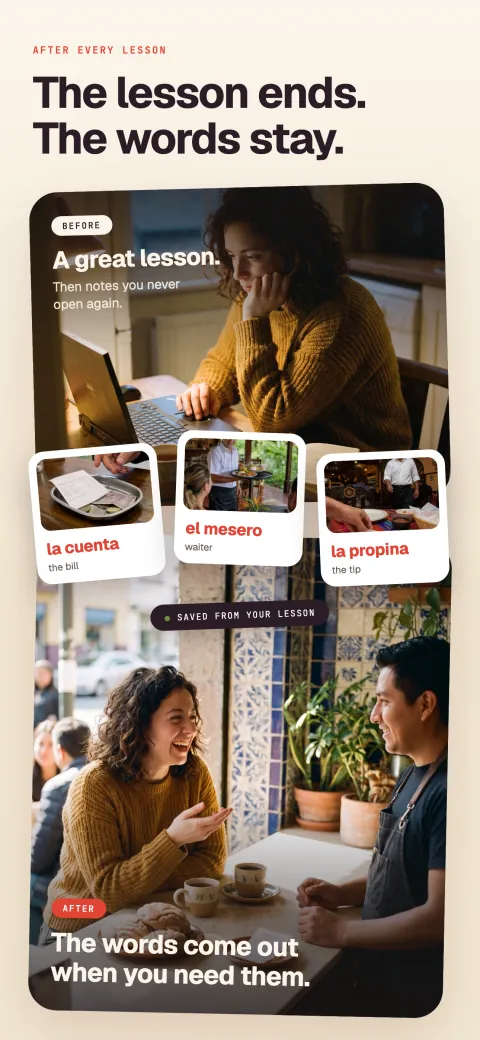
Verbamor is for the other person. It records the lesson and pulls out each word or phrase you got wrong.
It builds the cards from those and schedules them with FSRS, so each one returns near the day it would have gone. The material is your tutor's material. One of those cards, front and back, is on Spanish flashcards from your own lessons.
Now the disclosure. Anki publishes a scheduler you can inspect: FSRS-6, 21 parameters, 90% default retention. Verbamor runs FSRS too, and there my evidence stops.
I have no retention number of my own to show you. It hasn't been in enough hands for long enough to produce one that would mean anything. A percentage invented for a comparison page is worth less than nothing.
Everything measured on this page was measured by Karpicke, Cepeda and Slamecka. It's evidence that retrieval and spacing work. It doesn't prove that my app runs them well.
Since I've published everyone else's prices, here's mine. Explorer is $19.99 a month. Native is $129.99 a year, about $10.83 a month, and it alone comes with 7 free days.
There's no free tier. It's iOS only. Both of those are real reasons to pick something else.
Anki if you'll build the cards, Verbamor if you've proven you won't
Try Anki first. It's free and a month of it tells you which of these two people you are. Come to Verbamor after the manual version has already failed once, because that's the only failure it fixes. On any other segment on this page, buy something else.
The longer version of this segment, with Quizlet and the homework question, is in language apps for tutored learners. And if you're weighing the free course app against lessons, Verbamor vs Duolingo covers that trade directly.
06 / 10What's the best free app to learn Spanish? Duolingo, and mine has no free tier
Duolingo is the best free app to learn Spanish, because the whole core course costs nothing. You get ads, and Energy caps how many lessons you do in a row. Its Spanish course now teaches content through CEFR B2.
Two more are free in the way that matters. Anki is free on a computer and on Android, and only the iPhone app costs money, US$24.99 once. It has no Spanish in it, so you build or download the cards. Clozemaster is free to play, with thousands of fill-in-the-blank sentences; I compared it with mine in Clozemaster vs Verbamor.
Verbamor has no free tier. It's $19.99 a month or $129.99 a year, and the only free part is a 7-day trial on the yearly plan. If you want Spanish for $0, use Duolingo and Anki, and come back if you start lessons and keep losing what you learn in them.
07 / 10Six apps side by side: two are free to start, and the iOS-only one is mine
| App | Best for | What it costs |
|---|---|---|
| Duolingo | Beginners with no tutor. The default right answer for most people reading this. | Free tier is real. Super Duolingo has a 14-day trial; App Store prices run $9.99 to $119.99 depending on term and plan. |
| Babbel | Adult beginners who want the grammar rule stated, not inferred. | 1, 3, 6 and 12-month plans plus lifetime. Around $9/mo annually, and discounted most of the time. |
| italki | Anyone who has never spoken Spanish aloud. Buy this before any app. | No subscription. Tutors set rates; a full hour runs about $10 to $30, observed from the live listings. |
| Pimsleur | Commuters. Audio-first, no screen, no hands. | Around $20/mo per Pimsleur's own figure, 7-day trial, 2 tiers. |
| Anki | Stuck intermediates, and tutored learners who'll build cards. | $0 on a computer or an Android phone. US$24.99 one time on iOS. Enable FSRS yourself; SM-2 is the default. |
| Verbamor | Tutored learners who've already quit the manual version once. iOS only. | $19.99/mo, or $129.99/yr with a 7-day trial. No free tier. |
I didn't run a study, so there is no test score to print
The pages competing with this one tell you they tested everything. Some of them print per-app retention percentages from a 14-day trial with 50 cards, without naming a tester or a sample size.
I didn't run a study, so I'm not going to print one. What I can do is show my work.
Every factual claim here comes from a first-party page or a published paper. The prices are the ones the companies list. Where a number isn't verifiable, I've said so and left the gap open.
Leaving unverifiable numbers out is why you'll notice some deliberate holes. I don't quote Duolingo's Energy starting amount, because Duolingo doesn't publish one. I don't give you Pimsleur to the cent.
Where a company does publish the number, I use it: Babbel's review ladder is on its own support page, so it's above. Every number in a competitor's table on the other points was invented somewhere, and you can check that yourself in about 10 minutes.
When a comparison page has a number for everything, somebody filled the holes with guesses.
The short answers, and five of the six send you somewhere other than here
What is the best app to learn Spanish?
For a beginner with no tutor, Duolingo. It's free, the Spanish course is complete, and the streak is the most effective habit mechanic any of these apps ship. If you want grammar explained rather than inferred from examples, pay for Babbel instead. Nothing else on this page is a better first move, including Verbamor, which is built for people already paying for lessons and does nothing useful before that.
Is Duolingo enough to learn Spanish?
Duolingo is enough to build a vocabulary base and a daily habit, and it's no longer accurate to say it stops at A2. Since 22 April 2026 Duolingo says its Spanish course teaches content through CEFR B2. That's a claim about what the course contains, not a measurement of what learners end up able to do. It won't make you comfortable speaking, because typing and tapping aren't speaking. For that you need a person, which is what italki is for.
What's the best free app to learn Spanish?
Duolingo for a course, Anki for vocabulary you choose yourself. Duolingo's free tier is genuinely free: the full core course, ad-supported, gated by Energy, which replaced hearts as the limiter. Anki is free on Windows, macOS, Linux and Android with free AnkiWeb sync; only the iOS app costs money, at US$24.99 one time. Anki ships no Spanish content at all, so you either build the cards or download a community deck. Verbamor, which I make, has no free tier: the only free part is a 7-day trial on the yearly plan.
Should I use an app or get a Spanish tutor?
If you've never spoken Spanish aloud to another person, a tutor is the better purchase, and it's cheaper than people expect. italki needs no subscription, tutors set their own rates, and reading the live listings in August 2026 the trial prices ran from $5 to $22, which puts a full hour around $10 to $30. One hour of talking to a human exposes gaps that six months of tapping will not. Apps are better at the vocabulary drilling around that hour than at replacing it.
I'm stuck at intermediate Spanish. Which app helps?
Anki, if you'll build the cards. Course apps stop helping at intermediate because their syllabus is finished with you, and what you need next is vocabulary chosen from the things you personally can't say yet. Anki's emptiness is the feature: you fill it from your reading, your shows and your lessons. Turn FSRS on in the deck options, because Anki's default is still SM-2.
Is Verbamor worth it?
Verbamor is worth it if you're past the beginner stage and keep losing what you met in lessons, conversations or reading. It's iOS-only and there's no free tier: Explorer is $19.99 a month, Native is $129.99 a year (about $10.83 a month), and a 7-day trial comes with Native alone. A tutor helps and isn't required: the Translate tab saves any word or phrase you look up. If you're starting from zero, Duolingo or Babbel is the right answer instead. If you'll type your own cards, Anki does the same job for free.
10 / 10
Everything measured on this page was measured by somebody else
Retrieval beats restudying
- Karpicke, J. D., & Roediger, H. L. (2008). The critical importance of retrieval for learning. Science, 319(5865), 966–968.
When to review
- Cepeda, N. J., Vul, E., Rohrer, D., Wixted, J. T., & Pashler, H. (2008). Spacing effects in learning: A temporal ridgeline of optimal retention. Psychological Science, 19(11), 1095–1102.
- Cepeda, N. J., Pashler, H., Vul, E., Wixted, J. T., & Rohrer, D. (2006). Distributed practice in verbal recall tasks: A review and quantitative synthesis. Psychological Bulletin, 132(3), 354–380.
Making your own cards
- Slamecka, N. J., & Graf, P. (1978). The generation effect: Delineation of a phenomenon. Journal of Experimental Psychology: Human Learning and Memory, 4(6), 592–604.
Duolingo's published scheduler
- Settles, B., & Meeder, B. (2016). A trainable spaced repetition model for language learning. Proceedings of ACL 2016, 1848–1858.
Prices and product facts on this page were checked against first-party sources on 11 August 2026.
If you're paying for lessons, start there.
Verbamor records the lesson, builds cards from what your tutor actually corrected, and puts each one back in front of you near the day it would have gone. If you don't have a tutor yet, get one first.
Start 7 days freeThe 7-day free trial is on the yearly plan.