 Verbamor
Clozemaster vs Verbamor: a stranger's sentences or your own words
Both apps test you on a sentence with one word missing. Clozemaster draws its sentences from a public dataset in 50+ languages, schedules them on a fixed ladder, and is free to play. Verbamor builds its cards from the words in your own lessons, in 5 languages, writes an example sentence for each, schedules each card with FSRS, and is paid. Clozemaster is the better pick for a lot of you. For the card side of Spanish, see Spanish flashcards from your own lessons.
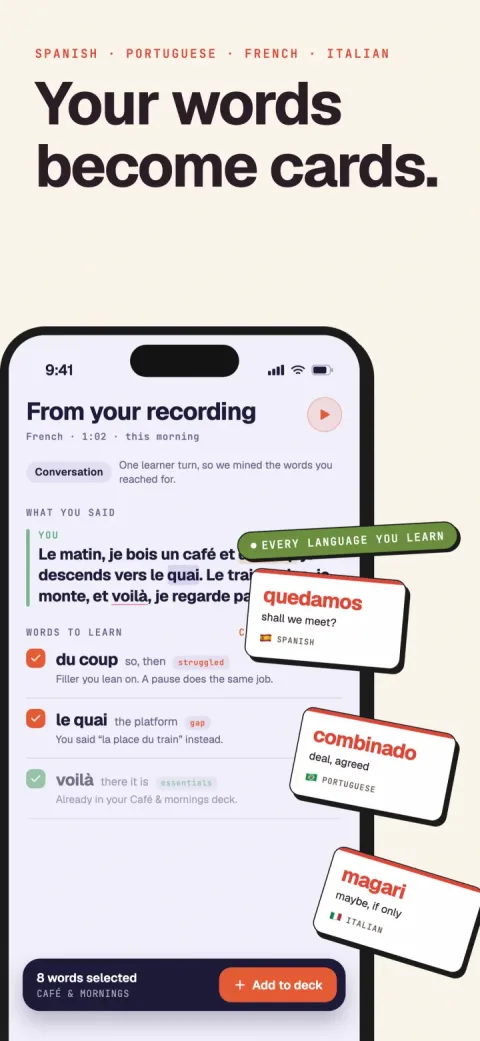
Verbamor turns the words from your own lessons and recordings into flashcards, and brings each one back before you’d forget it.

Everything about Clozemaster below comes from its own homepage, FAQ and Pro page, read on 13 October 2026. Each claim is quoted or linked, so you can check it in a minute.
I build Verbamor, so I'm not neutral. I'll say where Clozemaster is the better pick, and for a lot of readers it is.
How Clozemaster works
Clozemaster is a game of fill-in-the-blank sentences. Its homepage promises "Thousands of fill-in-the-blank sentences in 50+ languages", with "Over 170 language pairings available." It says it aims to answer one question: "What should I do after Duolingo?"
Each round shows you a real sentence with one word missing. You pick the answer from a few choices, or type it yourself for a harder round.
The sentences come from Tatoeba. Clozemaster's FAQ says "All sentences and translations are from Tatoeba's massive and awesome dataset, released under a CC-BY License." Tatoeba is a public, volunteer-built collection of sentences and translations.
Clozemaster picks the blank by rule. It checks every word in a sentence against a frequency list of the language's 10,000 most common words, from Wiktionary. It blanks the least common of those words. The FAQ calls that "the most difficult of the most common."
There's more on top. In some languages, a Fluency Fast Track orders 10,000 sentences into 10 levels, roughly by word frequency. A listening mode plays the sentence before you see it, in French, Italian, Portuguese, Russian and Spanish among others. And some sentences carry "an explanation from ChatGPT", in the FAQ's words.
How Verbamor works
Verbamor builds its cards from what you meet. You record a lesson with your tutor, and it pulls the words and phrases worth keeping out of the transcript. Or you type a phrase into the Translate tab and save it.
Each card holds an example sentence, an image, and two recordings of the sentence. The front plays it with your word swapped for a tone, so you hear the gap and say the word. The back plays the full sentence. The voices are generated with a native accent.
You grade yourself with four buttons: Again, Hard, Good or Easy. FSRS, an open-source scheduler, uses that grade and the card's history to set the day it comes back. There's also a starter deck of about 650 common words in each of the 5 languages: Spanish, French, Italian, Portuguese and Russian.
Both apps hide a word in a sentence. The difference is who wrote the sentence, and who decides when you see it again.
Where Clozemaster wins, plainly
I'd rather put this near the top than under a feature table.
Pick Clozemaster if you want it free. The homepage says "Everything you need to get fluent faster is free and always will be." Verbamor has no free tier at all.
Pick Clozemaster if you learn anything outside my 5 languages. It covers 50+ languages, across more than 170 language pairings. Verbamor does Spanish, French, Italian, Portuguese and Russian, with menus in English.
Pick Clozemaster for volume. Thousands of sentences, sorted by frequency, ready on day one. If you read at an intermediate level and want hours of practice with no setup, nothing I sell matches that.
Pick Clozemaster if you're on Android or a laptop. It runs on the web, iOS and Android. Verbamor is iPhone and iPad only.
You want sentence practice and have no lessons
If you don't have a teacher yet and you want to read a lot of sentences for free, Clozemaster is the better tool and it won't cost you anything. Verbamor earns its price only when you're taking lessons or talking with someone, and losing what they give you.
A fixed ladder against a per-card schedule
Clozemaster schedules every sentence on the same ladder. Its FAQ gives the steps: 1 day, 10 days, 30 days, then 180 days, with mastery going 25%, 50%, 75% and 100%. "If a sentence is answered incorrectly at any point, it goes back to 0% mastered."
Pro subscribers can change those intervals. Still, it's one ladder for every sentence: a hard sentence and an easy one climb the same steps.
FSRS works per card. It models how stable each card is in your memory and how hard it is, and sets the next date from your grades. A card you keep nailing drifts out to long gaps. A card you keep missing stays close.
Fixed ladders work, to be fair. A paper Leitner box is a fixed ladder and people have learned languages with one for decades. The cost shows up at scale: one miss on a 180-day sentence sends it back to 0%, however well you knew it the 4 times before. My spaced repetition guide compares the main schedulers in more detail.
Whose words you study
Clozemaster's sentences were written by strangers. That's its strength, because there are thousands, and its limit, because none of them is from your week. Its FAQ is honest about quality too: the data is "user curated", so "there will probably be a few errors here and there."
Verbamor's words come from your own lessons and the phrases you chose to translate. A word your tutor corrected on Tuesday comes with a memory of Tuesday.
The sentence around each word is a different story. Verbamor writes it with an AI model, so it makes mistakes too. The trade is fewer words, all from your own week, against thousands of sentences from everyone else's.
The comparison, side by side
| Axis | Clozemaster | Verbamor |
|---|---|---|
| Where the material comes from | Sentences from Tatoeba, a public CC-BY dataset | Words from your recorded lessons and the phrases you translate, each in an AI-written example sentence |
| The test | Fill the blank by multiple choice or typing | Hear the sentence with a tone in the gap, say the word, then grade yourself |
| Which word is blanked | The least common word within the top 10,000 | The word or phrase the card is for |
| Review schedule | Fixed: 1, 10, 30, then 180 days; a miss resets to 0%. Pro can edit the steps | FSRS, set per card from your own grades |
| Audio | Text to speech that depends on your browser and device | Two generated recordings per card, in a native accent |
| Languages | 50+, over 170 pairings | 5: Spanish, French, Italian, Portuguese, Russian |
| Platforms | Web, iOS, Android | iPhone and iPad |
| Price | Free to play; Pro is paid (price not quoted here) | US$19.99 a month or US$129.99 a year; 7-day trial on the yearly plan only |
Is Clozemaster free?
Yes, to play. The FAQ answers "How much does Clozemaster cost?" with "Nada. It's free to sign up and play, and always will be."
Clozemaster Pro is the paid tier. Its page lists "Unlimited access to thousands of sentences", listening practice on some collections, custom intervals, automatic Google translations, more stats and offline play. The word "unlimited" suggests the free tier has a cap somewhere, but I couldn't find one stated. I don't quote Clozemaster's Pro price on this site, so check it on clozemaster.com in your region.
Verbamor costs US$19.99 a month, or US$129.99 a year, which is about $10.83 a month. Only the yearly plan has the 7-day trial. Those are US prices, read off the app's own plan definitions on 21 September 2026.
Which one you should pick
Pick Clozemaster if you want free sentence practice, or you learn a language outside these 5. It's also the pick on Android or a laptop, and for thousands of intermediate sentences with no setup.
Pick Verbamor if you take lessons or talk with someone in one of its 5 languages, on an iPhone or iPad. It's for the words from those lessons that keep slipping away by the next one.
Plenty of people would do well running both. Clozemaster for reading volume, Verbamor for the words from your own week.
Clozemaster gives you more sentences; Verbamor gives you yours
Clozemaster is the better free tool for sentence volume in 50+ languages. Verbamor is a paid iPhone and iPad app for people with lessons, and it schedules each card on its own. If you don't have lessons, start with Clozemaster.
Questions people actually ask
Is Clozemaster free to use?
Yes. Clozemaster's homepage says it's free to play and "always will be". Clozemaster Pro is a paid tier that, by its own page, adds unlimited access, listening practice on some collections, custom review intervals, Google translations, more stats and offline play in the mobile app. I don't quote Clozemaster's price on this site. Check the Pro page in your own region.
How does Clozemaster pick the missing word?
Clozemaster blanks the least common word in each sentence that still sits inside the 10,000 most common words of the language, using frequency lists from Wiktionary. Its FAQ calls the result "the most difficult of the most common". The sentences and translations come from Tatoeba, a public dataset under a CC-BY license.
How do Clozemaster reviews work?
Clozemaster uses a fixed ladder. A sentence you get right comes back in 1 day, then 10 days, then 30, then every 180 days. A wrong answer at any point sends it back to 0% mastered. Pro subscribers can change the intervals, but the schedule doesn't adjust to each sentence on its own.
Is Clozemaster better than Anki?
For reading volume with no setup, Clozemaster is easier: the sentences are already there and it's free. Anki is the better tool if you want to build your own cards, control the format and run a per-card scheduler, since Anki can run FSRS once you switch it on. Many learners run Clozemaster for input and keep a separate deck for words they meet elsewhere.
Does Verbamor work like Clozemaster?
Partly. The front of a Verbamor card also plays a sentence with one word missing, replaced by a tone. The words come from your own lessons or from phrases you translate, an AI model writes the sentence around each one, and FSRS schedules each card from your own grades. Verbamor is paid and runs on iPhone and iPad only; Clozemaster is free to play on the web, iOS and Android.
Sources
Clozemaster's own pages
- Clozemaster homepage, read 13 October 2026. Source for 50+ languages, 170 pairings, multiple choice or typing, free to play, and iOS and Android.
- Clozemaster FAQ, read 13 October 2026. Source for Tatoeba, how the blank is chosen, the review ladder, the error note, text to speech, listening mode languages and ChatGPT explanations.
- Clozemaster Pro, read 13 October 2026. Source for what Pro adds. Its prices load in the browser and are not quoted here.
Verbamor
- Verbamor's prices are read off the app's own plan definitions on 21 September 2026. US prices; other App Store regions differ.
Study the words your tutor actually said.
Verbamor turns your lesson into cloze cards, each one scheduled on its own. Paid, on iPhone and iPad.
Start 7 days freeThe 7-day free trial is on the yearly plan.