 Verbamor
The flashcard that plays a tone where the word should be
A cloze audio card plays a sentence with a soft tone where one word should be, and you say that word out loud before the answer appears. The gap tests the word's form in context, and speaking forces you to commit before the reveal. If it comes out in the second after the tone, you know it.
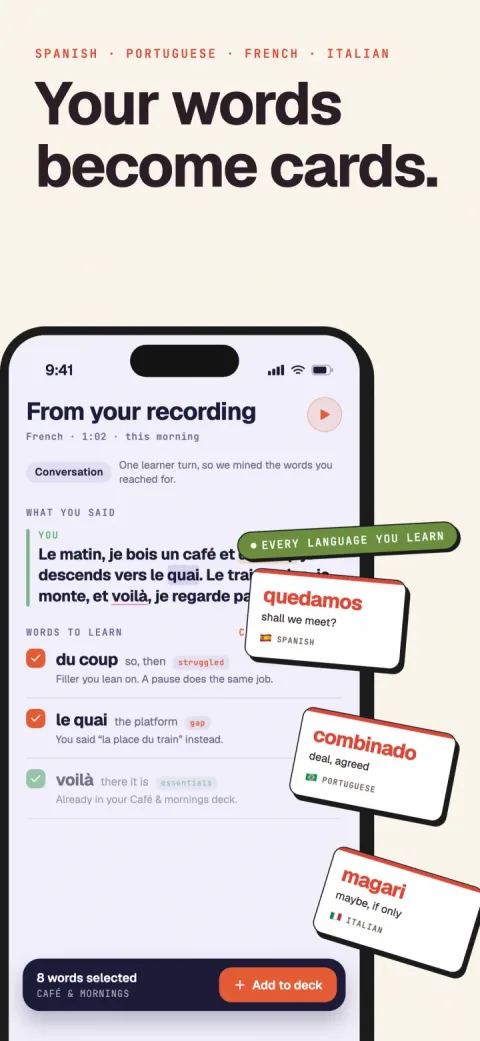
Verbamor turns the words from your own lessons and recordings into flashcards, and brings each one back before you’d forget it.

Here's a card from a Spanish deck. The screen shows a sentence with a gap in it: El trabajador ____ una caja pesada.
Then the audio plays. You hear a voice read the whole sentence, and where the missing word belongs you hear a soft tone instead. Your job is to say the word before you tap.
The word is levanta. If it came out of your mouth in the second after the tone, you own it.
If you sat there and waited for the answer, you don't, and the card has just told you so in a way a two-sided card never could.
Delete one word from a sentence and test its exact form
Cloze means a sentence with something taken out of it. The name is from Wilson Taylor, who published the cloze procedure in Journalism Quarterly in 1953 as a way to measure how readable a piece of writing was. He deleted words at intervals and counted how many readers could restore.
He took the word from closure, the idea from Gestalt psychology that a mind shown an incomplete pattern will move to complete it.
The gap is the whole mechanism. A two-sided card shows you levantar and asks for "to lift". You answer with a translation, which is a task you'll never perform in a conversation.
A cloze card shows you a sentence that's missing one piece, and the missing piece has to be the right word in the right form in the right place. Levanta, not levantar, because the sentence has a worker doing it right now.
The right form matters most for the parts of a language that only exist in context. Gender, conjugation, which preposition a verb takes, whether the adjective goes before or after.
A word list can't test any of those. A sentence with a hole in it tests all of them at once, because there's only one shape that fits.
Why does the card play a tone instead of the missing word?
The tone makes the gap arrive at the sentence's speed instead of yours. Hearing a gap is also closer to what happens when a person talks to you than reading one on a screen.
A written blank gives you time. You can look at the sentence, work out the tense from una caja pesada, reason your way to levanta, and feel good about it.
That reasoning is worth something. Conversation asks for something else: it gives you a stream of sound moving at its own speed, and the word either arrives or it doesn't.
So the recall side of the card carries a recording of the sentence with the answer replaced by a tone. You hear the rhythm, the words on both sides of the gap, the intonation of the whole line, and a beep where your word goes.
The stress pattern of the sentence is intact. So you're practicing against the real timing of the language rather than against your own reading speed.
The other face of the card plays the complete recording in the same voice, read straight through with the word spoken. The tone version is the test. The full version is the model you are copying.
Speak the answer, because your own mouth and your own voice both count
MacLeod, Gopie, Hourihan, Neary and Ozubko ran eight recognition experiments and named the result the production effect (Journal of Experimental Psychology: Learning, Memory, and Cognition, 2010, 36(3), 671-685). Producing a word aloud at study, compared with reading it silently, improved memory for it. Their explanation is distinctiveness: the spoken item gets a record with extra information attached, and at test that record is easier to pick out.
Forrin and MacLeod later split the production effect into its parts (Memory, 2018, 26(4), 574-579). They compared four conditions: reading aloud yourself, hearing a recording of your own voice, hearing someone else read aloud, and reading silently.
Memory fell in a gradient across those four, with hearing yourself sitting between speaking and hearing another person. Two things are doing the work: the motor act of speaking and the fact that the voice is yours.
One honest caveat travels with the production effect. The 2010 experiments found the effect in mixed lists, where some items were spoken and others weren't, within the same person.
It's a distinctiveness effect, so it depends on the spoken items standing out from silent ones. A review session where you speak every single answer isn't the design that was tested.
Speaking still gets you the motor and self-referential components. And it forces you to commit to an answer before the flip, which is worth doing on its own terms.
Commit out loud first, because a visible answer makes you a bad judge
Koriat and Bjork named the mechanism behind misjudging your own recall (Journal of Experimental Psychology: Learning, Memory, and Cognition, 2005, 31(2), 187-194). They call it an illusion of competence.
When you study a pair, you see the cue and the answer together. When you're tested, you see the cue alone and have to produce the answer.
Judging your own learning while the answer sits in front of you rates the wrong thing. You rate how well the pair fits together, which is easy with both halves visible.
What decides recall is whether the cue alone brings the answer back. Those two are different, and the first one feels like the second.
A spoken answer removes the room where the illusion of competence lives. You can't quietly revise "I basically had it" into a pass once the word is already out of your mouth and wrong. The card makes the commitment audible, then plays the correct version so you hear the difference immediately.
The same illusion of competence is why the image on the card is only a hint. Carpenter and Olson tested pictures against native-language translations for Swahili vocabulary (Journal of Experimental Psychology: Learning, Memory, and Cognition, 2012, 38(1), 92-101).
Pictures didn't beat translations at first, and learners were more overconfident recalling from a picture than from a translation. Pictures only helped once retrieval practice corrected that overconfidence.
An image next to a sentence you have to complete out loud is an image that has to survive a test.
Expect the load to spike on lesson day and stay small the rest of the week
Say you record one 50-minute tutor lesson a week and keep 12 words and phrases from each. That's 48 cards after four weeks.
Cards are scheduled by FSRS, an open-source algorithm that predicts when you're about to forget each card. It's the same algorithm family Anki offers, though Anki ships SM-2, an older fixed formula, by default, and FSRS is opt-in there.
FSRS-6 fits 21 parameters to your own review history rather than applying one fixed formula to everyone. It schedules to a desired retention you set (the share of cards you want to still recall when they come due), 0.90 by default in Anki.
Here's one card's ladder. Take card number one from lesson one and press Good every time.
I ran the reference FSRS-6 implementation (the fsrs Python package, version 6.3.2, at default parameters and 0.90 retention). That card comes back on day 1, again on day 3, then day 13, then day 60.
Four sightings in two months, and only two of them inside your first four weeks. Diff that against your own screen.
The catch is that the one-card ladder above assumes you never forget, and you will.
I simulated all 48 cards with a forget rate matching FSRS's own retrievability estimate (its odds that you'd recall a card right now). The load comes out spiky. Lesson day is the heavy one, around 35 to 43 reviews, because 12 new cards each get seen more than once.
The other six days of week four run a median (the middle value) of 8 reviews, with the middle 80% of days falling between 4 and 18. Across the whole 28 days the median is about 361 reviews total.
I'm not going to convert those review counts into minutes for you. The app doesn't record how long a review takes, and I won't invent the number.
Time one session with a stopwatch and you'll have a figure that's true for you, instead of one I guessed.
What changes in your speech is narrower than "you get fluent" and more useful. The cards from lesson one are the words your own tutor used with you, in sentences about the thing you were actually discussing.
So when that topic comes back, the phrase is already in your mouth. The forms come with it, because you never practiced levantar alone.
Skip this if you’re two weeks in, or never speak out loud
If you're in your first two weeks of a language, a sentence with a gap is the wrong tool. You need enough grammar to know what shape fits the hole. In practice, that means you can already conjugate a regular present tense and recognise the common gendered articles.
Elizabeth Bjork and Robert Bjork make the point directly in "Making Things Hard on Yourself, But in a Good Way", their chapter in Psychology and the Real World (Worth Publishers, 2011, pages 56-64).
Difficulties help because they trigger encoding (storing the memory) and retrieval processes that support learning. But if the learner lacks the background knowledge to respond successfully, they become undesirable difficulties. Do a beginner course first and come back.
Skip audio cloze cards too if you never speak the language out loud with anyone. Recall of a spoken sentence under time pressure is training for a specific situation. If reading is your goal, a reading-focused deck costs you less.
And if you already run Anki with a cloze template, audio on your cards, and the patience to cut clips yourself, you have most of this.
What you're buying elsewhere is the part where the sentence, the two recordings and the image get made for you. They come from a lesson you recorded, instead of from you at midnight.
Record your next lesson, keep ten words from it, and on the first review say every answer out loud before you tap. Count how many arrived before the tone ended. That number is the only one worth watching.
Say the word before you see it.
Verbamor builds every card from your own lessons with a tone standing in for the answer, so review means producing the word out loud, the same thing a real conversation actually demands.
Start 7 days freeThe 7-day free trial is on the yearly plan.