 Verbamor
Picking between the monthly and annual plan
Take Verbamor's annual plan if a person, a date or a track record already puts the language in your week, and monthly if not. The break-even is 6.5 months: pay US$19.99 a month for longer than that and you've spent more than the US$129.99 year. If you land on both lists, take monthly.
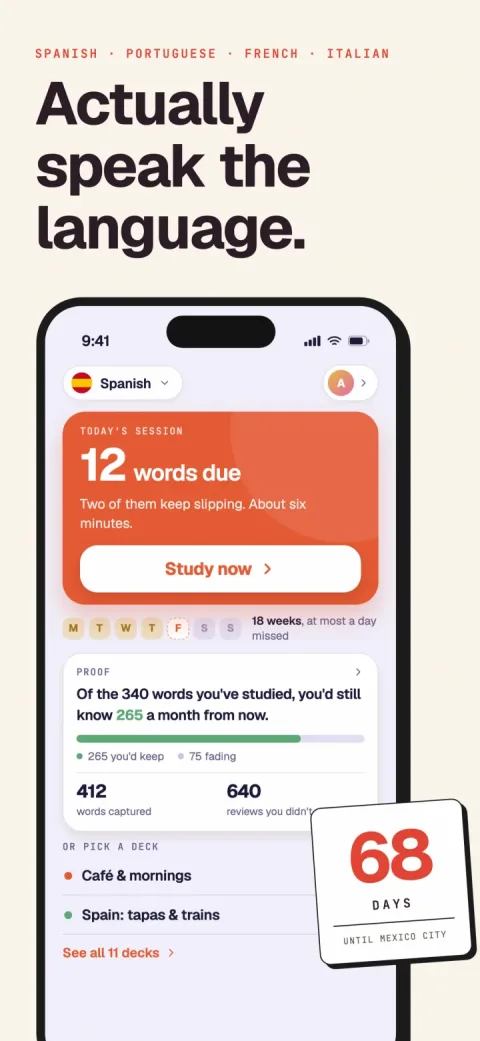
Verbamor opens on one short session a day: the words that are due, and about how long they’ll take.

The break-even is 6.5 months. Verbamor's monthly plan, Explorer, is US$19.99. The annual plan, Native, is US$129.99 for the year.
Divide 129.99 by 19.99 and you get 6.5. Pay monthly for seven months and you've spent $139.93, which is more than a full year costs. Pay monthly for six months and you've spent $119.94, which is less.
So the whole decision rests on one honest prediction: will you still be opening this app in month seven? The answer is cheap to get wrong in one direction and expensive in the other.
01 / 06Your last thirty days of study decide the plan
Explorer bills US$19.99 every month. Native bills US$129.99 once a year, which works out to about $10.83 a month. That's 46% less per month.
Native also carries a 7-day free trial, and Explorer doesn't. There's no free tier, so there's no third option where you sit at zero dollars and use the app slowly.
US$19.99 and US$129.99 are US prices. Apple sets the price in every other country and adjusts for local tax. So the number on your own App Store listing is the one that will actually be charged.
Check it there before you decide anything. A 46% gap can look different once a local currency conversion lands on it.
Two more numbers matter more than the price. The first is how many hours a language actually takes. The Foreign Service Institute, the US State Department's language school, puts Spanish in its easiest group at 552 to 690 class hours, spread over about 30 weeks of full-time study.
Full-time is the important part. At 20 minutes a day, 552 hours is 1,656 days, or about four and a half years. At the top of that range, 690 hours, it's 2,070 days, closer to five and a half.
Whichever plan you pick, you're buying a slice of something long.
The second number is your own: how many days in the last month did you do something in your target language? Count only the days you did it, and leave out the days you "meant to."
That number predicts month seven far better than how motivated you feel while reading a pricing page.
02 / 06Take annual only if a person, a date or a track record already exists
Pick annual if any of these is true.
- You already have a standing commitment that puts the language in your week. That could be a tutor, a class, a partner or family member who speaks it, a job that needs it, or a trip booked more than six months out.
- You have used a paid learning app for more than six months before, at any point, for anything.
- You studied on 12 or more days in the last 30.
Pick monthly if any of these is true.
- You have started and stopped three or more language apps in the last two years.
- Your reason for learning has no date attached to it and no other person in it.
- $129.99 leaving your account in one transaction would be a real problem this month.
- You are between languages and not sure which one you want.
The annual list is short on purpose. None of the annual conditions are about enthusiasm. Enthusiasm on day one tells you nothing, because everybody has it on day one.
The conditions are about structure already sitting in your life: a person, a date, a track record. Structure survives the week your motivation doesn't.
If you land on both lists, pick monthly. The cost of being wrong is asymmetric, and the next section is about exactly how asymmetric.
03 / 06The annual mistake is capped at about $70, and the monthly one keeps growing
Take the annual plan and quit in month three. You paid $129.99 for three months of use, so those months cost you about $43.33 each. Against Explorer's $19.99, you overpaid by roughly $70.
That's the entire downside, and it's capped. Apple doesn't bill you again until the year is up. If you cancel, you keep access until the paid year ends.
Take the monthly plan and stay two years. You pay $479.76. On the annual plan, the same two years cost $259.98.
You overpaid by $219.78, which is more than a full extra year. This mistake has no cap. It grows every month you keep being right about sticking with it.
Here is the same comparison at every length of stay, so you can find your own row:
| You stay | Monthly total | Annual total | Cheaper plan |
|---|---|---|---|
| 3 months | $59.97 | $129.99 | Monthly, by $70.02 |
| 6 months | $119.94 | $129.99 | Monthly, by $10.05 |
| 7 months | $139.93 | $129.99 | Annual, by $9.94 |
| 12 months | $239.88 | $129.99 | Annual, by $109.89 |
| 24 months | $479.76 | $259.98 | Annual, by $219.78 |
Read the 6-month and 7-month rows together. Around the break-even, the gap is about ten dollars in either direction, which is small enough to ignore.
The rows further from that pair are where the real money sits. Both reward committing early to the thing you were going to do anyway.
The larger loss belongs to the person who was right about themselves and hedged anyway. The instinct on a pricing page is always to hedge. Hedging is cheap in month three and expensive in month eighteen.
Sometimes the plan choice itself changes your behaviour. Think of the last annual thing you prepaid: a gym, a course, a domain name. Did you use it more in month two than month one, or less?
Go and check the actual record if you still have it, the same way you counted your study days.
If prepaying got you into the gym in February, annual is working with you. If the charge landed and you never went back after week three, you've run this experiment on yourself already, and it failed.
04 / 06Can you switch from monthly to annual later?
Yes, you can switch from monthly to annual later, and you're not locked in. Apple runs the billing, and its rules for switching are published and specific.
To change plans on an iPhone: open the Settings app, tap your name, tap Subscriptions, tap the subscription, then tap See All Plans and follow the prompts. That's Apple's own documented path, on How to switch to a different subscription plan.
Explorer and Native sit in the same App Store subscription group, and Native is ranked above Explorer. Moving from monthly to annual is an upgrade.
Apple's Auto-renewable Subscriptions page defines what that means: "Someone purchases a subscription that offers a higher level of service than their current subscription. They're immediately upgraded and receive a refund of the prorated amount of their original subscription."
So Apple refunds the unused portion, charges the new price, and switches you the same day.
Here's one dated case. You subscribe to Explorer on 1 March and pay $19.99, which covers you to 1 April. On 20 March you switch to Native.
You've used 19 of those 31 days, and 12 are unused. So Apple refunds about $7.74 to your original payment method and charges you $129.99 that day. Your renewal date becomes 20 March next year.
Your total outlay for that first year is $142.24 instead of $129.99. You paid about $12 for the twenty days you spent deciding.
One thing you do give up by switching later. The 7-day free trial is an introductory offer. Apple's rule on that same page is blunt: "Customers can redeem one introductory offer per subscription group."
The limit counts per group, not per product. So if you start on Explorer and move to Native later, you pay the $129.99 immediately with no trial, because the group has already spent its one offer.
The trial is only available to you on the way in, and only on the annual plan. That's the real price of deferring: about $12 in proration, plus the trial you never took.
Going the other way, annual back to monthly, is a downgrade. Apple defines it on the same page as a subscription that "continues until the next renewal date, then is renewed at the lower level and price." You keep the year you already paid for, and nothing happens until it ends.
To cancel, the path is: Settings, your name, Subscriptions, tap the subscription, tap Cancel Subscription. If you're on the 7-day trial and don't want it to renew, Apple's instruction is to cancel it at least 24 hours before the trial ends.
Set a phone alarm for day six when you start. Do it in the same minute you subscribe.
05 / 06Buy neither plan today if nothing in your week produces audio
Some people should close this page.
If you have no way to get target-language audio into the app, wait. Verbamor works by taking a real lesson, conversation or piece of audio and transcribing it. Then it mines the vocabulary you actually met, single words and whole phrases, so you can turn them into cards.
If nothing in your week produces that audio, the main loop has nothing to run on. Get the source first: book a tutor, join a conversation group, or find a podcast you'll genuinely listen to.
If you want a language outside Spanish, French, Italian, Portuguese and Russian, this isn't your tool yet.
Check the phone in your hand before you pay. Verbamor is an iPhone and iPad app, and it needs iOS 16.4 or later. On an iPhone, open Settings, tap General, tap About, and read the iOS Version line.
There's no Android version and no web version, so a Pixel, a Galaxy or a laptop browser won't run it at all.
If you're a complete beginner who has never met the language, start with something that teaches you a first few hundred words of Spanish or French. Then come back. The app is built to catch what you meet, and in week one you haven't met much.
06 / 06Count, decide, then set the alarm before you close the page
Do these four things in order.
- Count your days. Open whatever you used last month, a calendar, a tutor's booking history, a podcast app's history, and count the days you actually did something in the language. Write the number down.
- Run the rule. Twelve or more days, or a tutor, class, partner or dated trip, means annual. Three abandoned apps, or no date and no person, means monthly.
- Check your own App Store price. Open the listing on your device and read the local figure before you tap anything.
- If you chose annual, start the 7-day trial and immediately set an alarm for day six. If you chose monthly, subscribe to Explorer and set a calendar reminder for day 170, which is about a week before the break-even. When it fires, count your study days in months four, five and six. If you hit 12 or more days in each of those three months, switch to Native then, and you're still ahead of the break-even. If you didn't, stay monthly and check again at day 350.
Then record one thing. Your next tutor lesson, a five-minute voice note, a podcast episode you're half following.
The plan you picked stops mattering the moment there's audio in the app. Recording is the only decision on this page that changes what you know in a month.
Pick the plan that matches your track record.
Whichever plan you choose, Verbamor turns your own lessons and conversations into scheduled flashcards, so the subscription only pays off once there's real audio going into the app.
Start 7 days freeThe 7-day free trial is on the yearly plan.